Category: Travel

  • The Beautiful Voyage

    When you set out on your journey to Ithaca,
    pray that the road is long,
    full of adventure, full of knowledge.
    The Lestrygonians and the Cyclops,
    the angry Poseidon – do not fear them:
    You will never find such as these on your path,
    if your thoughts remain lofty, if a fine
    emotion touches your spirit and your body.
    The Lestrygonians and the Cyclops,
    the fierce Poseidon you will never encounter,
    if you do not carry them within your soul,
    if your soul does not set them up before you.

    Pray that the road is long.
    That the summer mornings are many, when,
    with such pleasure, with such joy
    you will enter ports seen for the first time;
    stop at Phoenician markets,
    and purchase fine merchandise,
    mother-of-pearl and coral, amber and ebony,
    and sensual perfumes of all kinds,
    as many sensual perfumes as you can;
    visit many Egyptian cities,
    to learn and learn from scholars.

    Always keep Ithaca in your mind.
    To arrive there is your ultimate goal.
    But do not hurry the voyage at all.
    It is better to let it last for many years;
    and to anchor at the island when you are old,
    rich with all you have gained on the way,
    not expecting that Ithaca will offer you riches.

    Ithaca has given you the beautiful voyage.
    Without her you would have never set out on the road.
    She has nothing more to give you.

    And if you find her poor, Ithaca has not deceived you.
    Wise as you have become, with so much experience,
    you must already have understood what Ithaca means.
    — Constantine P. Cavafy, Ithaca

    There’s a special place in my heart for The Odyssey. It captured my attention in early adulthood and held on tight. I might have sailed away to the Greek Isles in my own odyssey had things gone differently. And so having a heart so set on travel doesn’t surprise me very much at all. In fact, what surprises me is the amount of time I’ve spent in my home port. When you find home you know it, even when the road calls you like a Siren.

    I didn’t have the heart to break up Cavafy’s poem, and offer it here in its entirety for my fellow travelers to celebrate (as travelers do). Perhaps the flow may seem off, as if the entire voyage is top-heavy, but so be it. We must break the rules now and then in our lives if we hope to see what’s outside our box.

    And that’s the point, isn’t it? To see what’s far outside of our comfortable box, and to live to tell the tale. The box will be there when we get back. But we’ll be different, won’t we? We’ll witness things we’d only believed as myth, and things we’d never known existed but will stay with us forever for having been there. We’ll carry the sparkle of faraway places in our hearts that escapes from our eyes as we tell of places we’ve been. Similar sparks escape from the eyes of fellow voyagers who have been to the same place, and a special fire burns brightly when the sparks are shared in other ports of call. There’s a club of understanding that is earned living dreams and encountering what is carried in our souls. If that sounds ridiculous, well, check your sparks for ignition. You may need a tune-up.

    Do you understand what Ithaca means? If not, give it time and room to grow. You’ll find it far from the comfortable routine, just waiting for you to go there. You just might come across me on that journey too, chasing Ithaca and learning more about this voyage every day. So tell me, do you see it now? Isn’t it beautiful?

  • Diligent Awareness (Life as a Poem)

    “The aim of life is to live, and to live means to be aware joyously, drunkenly, serenely, divinely aware. In this state of god-like awareness one sings; in this realm the world exists as poem.”
    ― Henry Miller, The Wisdom of the Heart

    “Imagine that you’re unwell and in a foul mood, and they’re taking you through some lovely countryside. The landscape is beautiful but you’re not in the mood to see anything. A few days later you pass the same place and you say, “Good heavens, where was I that I didn’t notice all of this?” Everything becomes beautiful when you change.” — Anthony De Mello, Awareness: The Perils and Opportunities of Reality

    It’s easy to say we should live with awareness, but harder in practice. This business of living demands attention, or rather, distracts our attention from much of the things we’d be focused on if we weren’t so damned busy with that other thing. We forget, sometimes, that life is merely what we pay attention to and everything becomes beautiful when we change. Most of us won’t change or become fully aware, but isn’t it pretty to think so?

    Most don’t want to change, they want to live with what they have, while wishing for more, and do it again tomorrow. When someone does we wonder at their boldness, but don’t connect the dots to doing it ourselves. If we are what we repeatedly do (Aristotle), then doing something completely different strikes at our very identity. No wonder so many refuse to cross that line in the sand.

    “How many people do you know who are obsessed with their work, who are type A or have stress related diseases and who can’t slow down? They can’t slow down because they use their routine to distract themselves, to reduce life to only its practical considerations. And they do this to avoid recalling how uncertain they are about why they live.” ― James Redfield, The Celestine Prophecy

    The thing is, awareness isn’t about turning our lives upside down, it’s being fully present in the moment. Being open to everything that surrounds us, not just those practical considerations. We aren’t quitting our jobs and living like a hermit in a hot tent when we’re aware, we’re simply inviting more of the universe into our present moment. It seems if we want a more fulfilling life then we ought to fill more of our life with beautiful things.

    I was once a closed young man who thought of poetry as frivolous. Something was missing within me that took years to fill. When you close yourself up the world simply cannot find its way in to fill you. Over time my awareness pendulum has swung wide open. Not coincidently, I write more, listen more, seek more and linger more with the world. When we realize the world exists as a poem, we’re more inclined to dance with its verse.

    “Butterflies don’t write books, neither do lilies or violets. Which doesn’t mean they don’t know, in their own way, what they are. That they don’t know they are alive—that they don’t feel, that action upon which all consciousness sits, lightly or heavily.” — Mary Oliver, Upstream

    We expand into the world we create for ourselves through diligent awareness. Knowing what we are, and who we are, is the job of a lifetime. When we open ourselves to everything, we discover more, and we live a bigger life.

  • Looking Back and Filling Forward

    “When I look back on resolutions of improvement and amendment which have year after year been made and broken, either by negligence, forgetfulness, vicious idleness, casual interruption, or morbid infirmity; when I find that so much of my life has been stolen unprofitably away, and that I can descry by retrospection scarcely a few single days properly and vigorously employed, why do I yet try to resolve again? I try because reformation is necessary and despair is criminal.” — Samuel Johnson, via Daily Stoic

    It’s that time of year again. We hustle through the year and arrive at the end forever changed. We’ve gained insight, lost people from our lives, picked up habits, and either raised or lowered our expectations for what’s next. We aren’t just what we repeatedly do, we’re also what the world does to us and how we react to these things. We are, each of us, works in progress. We ought to take a moment to take stock of where we are, and what we might do with ourselves in this next chapter.

    What went exceedingly well this year? What fell apart despite our best intentions? What’s missing? What is overly present? What can we do to influence a better result in the New Year? These are the usual questions, worthy of our consideration, that generally lead to resolutions and writer’s cramp.

    “Decide what to be and go be it.” — Head Full of Doubt/Road Full of Promise, The Avett Brothers

    The biggest moments tend to be scheduled. We book events and trips and seek our milestone moments. Occasionally we participate in a wonderful moment of serendipity, but the big stuff in life generally happens when we put it on the calendar. Knowing this, we ought to schedule a few big moments for ourselves in 2023. Just as we must make a reservation at a great restaurant if we hope to have an epic meal there on a Saturday night, so it follows that we must book our bucket list moments when, and while, we can.

    The thing is, we don’t just live one epic moment to the next. Our lives are the things that happen in between such highlight moments. So it follows that the quality of our life is directly related to how we fill in the rest of the calendar around those milestone moments. Each day is our lifetime. So we ought to fill each with people and habits that sustain and energize us. We ought to do work that does more than pay the bills. Careers and lives are built on purpose.

    “There’s always a sunrise and always a sunset and it’s up to you to choose to be there for it,’ said my mother. ‘Put yourself in the way of beauty.” — Cheryl Strayed

    Life is more than paying bills and making it to the meeting on time. If the world is filled with beautiful moments, why aren’t we seeking them out more? One of the best habits I ever established was using a one line per day journal and make it a mission to write down something amazing each day. Not every day is amazing, of course, but when we work towards it that stack of days can be a string of magic.

    “You are the average of the five people you spend the most time with.” ― Jim Rohn

    Our best intentions can be derailed by that which surrounds us. Does our circle of friends and family lift us up or hold us down? How about our habits? For these are related, aren’t they? Our circle of influencers and our daily habits will either make us better people or they eventually pull us over the cliff. If we’re surrounded by people with bad habits and a horrible outlook on life, we tend to pick these things up ourselves. Conversely, when we’re around creative people with productive habits, we tend to lift ourselves up to meet them. So what will it be for you and me?

    No matter how old or experienced we are, we each must reconcile our time in our own way, each day. If we want a better life filled with nuggets of joy and moments of adventure we’ve got to put ourselves out there and try many things to find our thing. This all begins with looking back at what our days were filled with and deciding what was fulfilling and what we’ve had our fill of. Taking stock in such a way, we can now gaze ahead deliberately and fill that blank calendar with purpose and hope.

    We are indeed works in progress. Reformation is necessary. But we can find joy in the creative process. What better project is there to work on than our own life?

  • December Bay

    Sunsets must be earned in winter. There are no casual seaside deck conversations with a few pictures between sips of rum. No, you must seek out December sunsets by going to where it falls into the bay while bracing against biting cold winds galloping towards you in a stampede of frothy fury. Still, it makes a pretty picture and another memory.

    Micro-adventures and stolen moments of dancing with life count just the same as big trips and scheduled events. Life is our collection of all such experiences. We ought to sprinkle a bit more salt on our days to make them savory. For our best days are savored, aren’t they?

    Not as warm as it looks
  • Stepping Out on the Edge

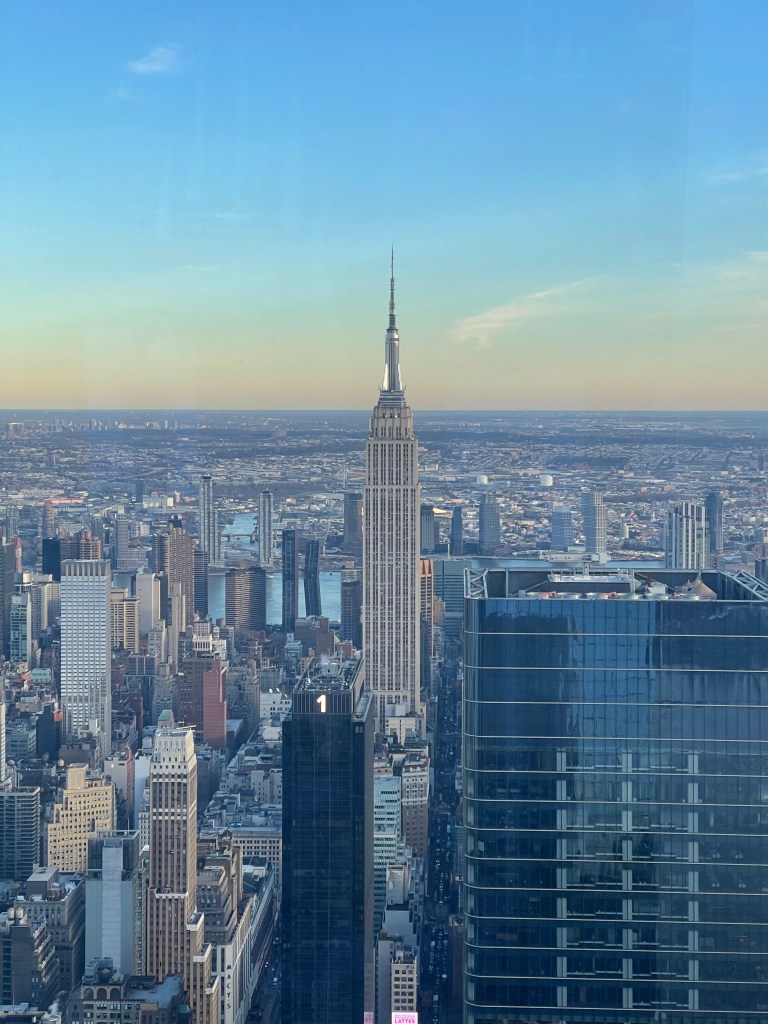
    The Edge is the highest observation deck in the Western Hemisphere, and the fifth highest in the world. It juts out of a modern and elegant 30 Hudson Yards building that glitters day and night. If you are afraid of heights, it’s unlikely you’ll ever travel up the speedy elevators that bring you 100 stories above Manhattan, but if you do, you’ll be treated to video stories displayed on the walls of the elevator cab that bring you into the clouds on the way up and on virtual flight back to earth on the return trip. As fun as the elevators are, nothing beats the actual view that greets you when you arrive.

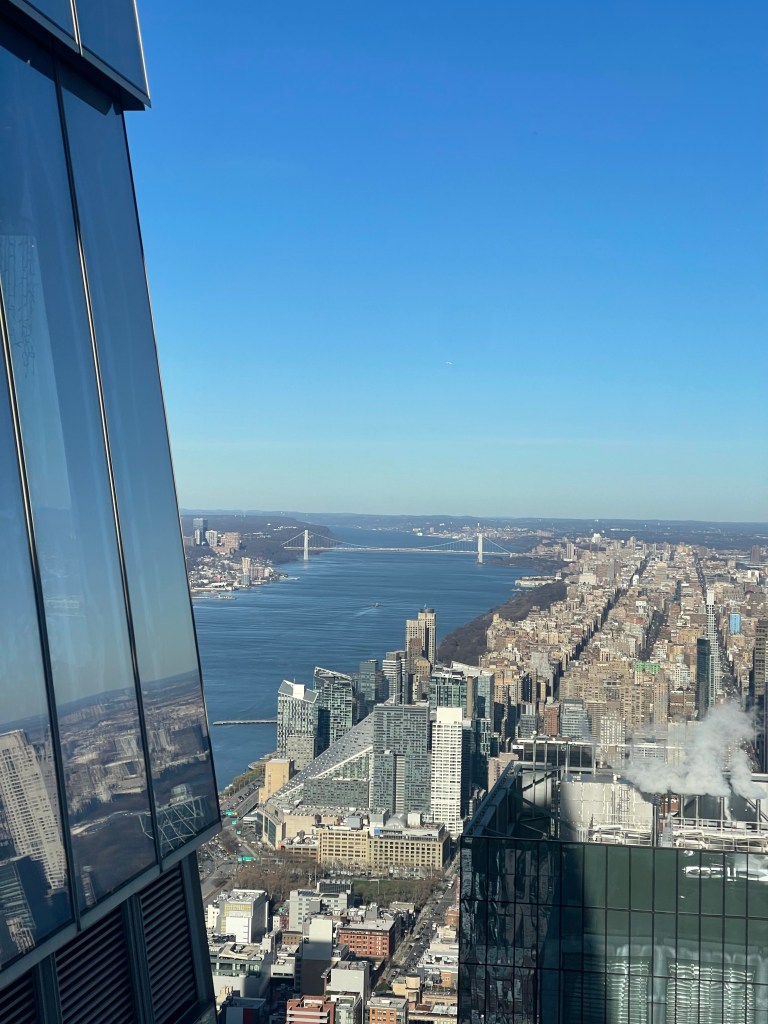
    The observation deck features epic views of the Manhattan skyline, the Hudson River and New Jersey beyond, Long Island Sound and most of the famous sites you’d think of when you think of New York: The Statue of Liberty, The Brooklyn Bridge, the Empire State Building, The George Washington Bridge, the Verrazzano-Narrows Bridge, the Freedom Tower and Chrysler Building are all visible on a clear day. If you time your visit right, you have a great view for sunset. It’s a breathtaking spot, and it’s clearly become very popular as a destination all its own.

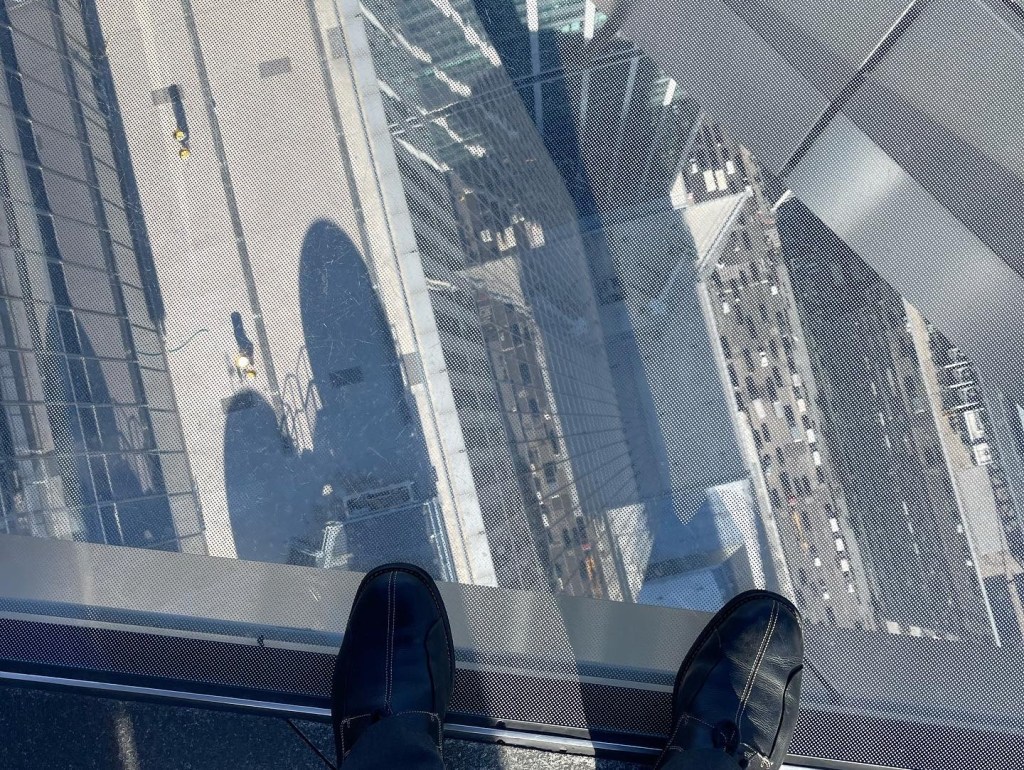
    Frankly, if you’re not afraid of heights there is still a moment that gives you pause when you visit. That would be the moment you step out onto the glass floor and look down at the traffic 1131 feet below you. I passed this particular test, but balked when someone told me to jump up and down on the floor. There are a list of things that one shouldn’t do in life, and near the top is tempting fate.

    Also available to fate tempters are the 2+ inch thick glass panels that lean outward from the deck, giving you the opportunity to literally lean out over the edge if you’re inclined to do so. For all the people visiting at the time I was there, there weren’t a lot of people leaning on the glass. Self-preservation is indeed a powerful instinct.

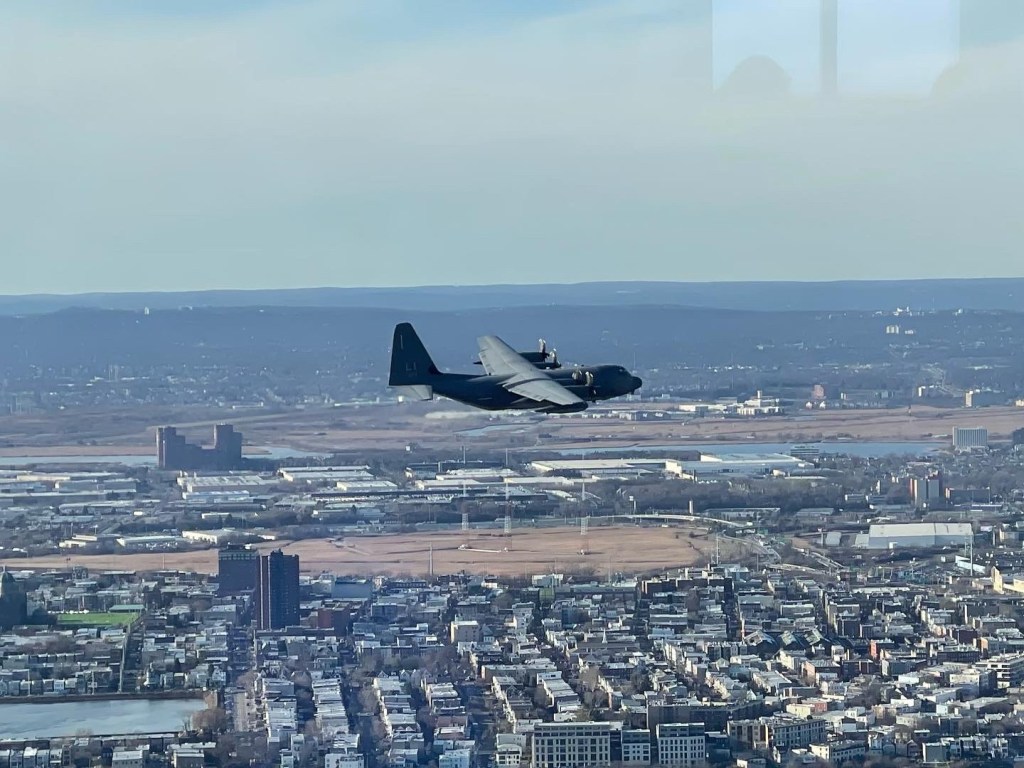
    There is a stepped seating area that climbs up even higher, if you want to sit for awhile and linger with the extraordinary views. When you’ve been to New York City many times, and have spent hours of your lifetime navigating the roads of the Metro New York area, it’s fascinating to see everything from so high up. A glance and turn of the head to look from Sandy Hook, New Jersey to the George Washington Bridge might take you a second or two, or two or three hours to drive it. You feel like you’re flying in this way, and this feeling is amplified as you realize that many of the planes flying up the Hudson River are actually lower than you.

    If you go, try to time it to be there for sunset on a calm day. Have lunch at one of the many restaurants at Hudson Yards and give yourself enough time to savor the views. It’s a trip you’ll remember. The Edge literally puts you out on the edge of a skyscraper, which isn’t as terrifying as that might sound. You almost forget where you are as you soak up the views around you. This is what you’ll remember when you return to earth.

  • Eternally Anchored

    “If we are always arriving and departing, it is also true that we are eternally anchored. One’s destination is never a place but rather a new way of looking at things.” — Henry Miller, Big Sur and the Oranges of Hieronymus Bosch

    On the second night in a roadside hotel, I’ve come to accept the traffic noise. Wedged between a highway and a distribution hub there isn’t very much soul to the place at all—the sound of traffic is the only notable anchoring point. What does one do with that but move on eventually? Noise indicates flight from this lifeless enclave and so I’m finally seeing the noise as freedom hiding in plain, uh, sound. When I return to my quieter place, perhaps I’ll celebrate that place a bit more for having been here.

    Travel opens our eyes to the beauty in the world, but sometimes it simply serves as a reminder of why we chose to anchor where we did. We ought to appreciate what we’ve got while seeking insight and understanding of the world around us. Perspective is a beautiful thing indeed, friends. Things could be worse, and things could be better, now is all we have to launch ourselves into that future state.

    Not every day can be wine and roses, or waterfalls and sunrise hikes. The trick is to grab ahold of something tangible anyway. A small, independent coffee shop or a local historical site might just be the difference between soulless and soulful. The key sometimes in business travel is knowing that this too shall pass. That highway has been calling me home since I got here.

  • Reacting to Outside Influences

    If we’re lucky, we place ourselves in environments that cater to our best life. We surround ourselves with trees and wildlife and safe places to walk with our thoughts. If we’re lucky, we gently place ourselves far from ambient noise and light. Traffic and leaf blowers and well-meaning spotlights shining bright beams into nothingness all grab our attention when we aren’t conditioned to ignore these things.

    Now and then I find myself in a hotel next to a highway, and listen to the steady escalation as the world awakens and drives from place-to-place. This should be unremarkable, and yet I just remarked on it simply because it’s different for me. Had I simply gotten a room on the other side of the hotel perhaps I wouldn’t have noticed at all. But since that isn’t the case, I make peace with the noise and celebrate the temporary nature of it. It’s not my noise forever, only for a couple of days.

    The thing is, we are as much a product of our environments as we are of our internal dialogue. What we experience builds us, teaches us love or hatred, tolerance or bias, acceptance or impatience. Living in a frictionless state sounds blissful to some, and like slow death to others. We choose how we react, and that reaction informs us about our future state. Funny, the way it is. Each reaction sets up the next interaction, when we react yet again in whatever way we do.

    Life is a series of reactions to outside influences. We chafe at some, embrace others, and build a life out of a chain of reactions and decisions along the way. Does this place us in a joyful state or a state of misery? And how will we handle the answer? We are what we repeatedly do, this is true, but we’re also what we decide not to do or accept as our fate in the moment. We each have the opportunity to choose wisely and to learn from previous mistakes. Like staying on the back side of the hotel, facing the highway, we learn lessons that might be applied in the future.

  • A Walk Around Walden Pond

    A visit to Walden Pond can be immersive, if you go at the right time. Many people go in summer to swim and enjoy the pristine water. Many fish for large mouth bass and other prizes. But the pilgrims go to visit Henry David Thoreau’s famous pond and the woods surrounding it. I’ve watched the place change over the years, but the pond and woods remain largely as Thoreau would recognize.

    You must treat a brief visit to Walden as you would a visit to a nightclub with a cover charge. There’s a flat fee of $30 USD to park. That applies for an hour or the entire day. There’s a lower fee, apparently, for Massachusetts residents. I suppose you can also opt for other ways to get to Walden Pond, but this was the simplest way to spend time at a place. The area surrounding Walden Pond is a mix of highway, commuter railroad (as it was in Thoreau’s time), capped landfill and houses increasingly further out of reach for someone choosing the lifestyle of the person who made this place famous.

    Early December is considered late autumn, but my visit felt more mid-autumn, with temperatures warmer than they should be this time of year. Henry David Thoreau would have shaken his head, I think, at some of the same behavior he observed in his day leading to the climate change we’re experiencing today but generally sitting on our hands about. But it made for a lovely day to walk around the pond.

    There is a well-defined path around the pond. It’s maintained and easy for most walkers to navigate. They make you feel like you’re in a cattle chute for much of it, with wire strung on each side of the path to keep wanderers from straying off the path. Signage explains this as erosion control measures. As a hiker of the White Mountains in New Hampshire, I’m all too familiar with the impact of popularity on trails and the surrounding landscape. I stay to the path, liberated from the freedom to wander, I instead focused on the environment around me.

    You can hear the world encroach on you at Walden. Distant highway sounds, construction, sirens, airplanes flying overhead and the commuter train all remind you that you’re in a suburb of Boston. It’s best to acknowledge this, but let it go as Thoreau let the train go as it went past in his time. The landscape is largely preserved, the water clear, awaiting those who would linger.

    When I was younger, there was no visitor center, but there was a bath house. At some point well before I came into this world some well-meaning people decided that the best way to save Walden Pond was to make it a recreation center. So a bath house was built, beach sand extended and you had a destination for family recreation. Thoreau’s cabin is on the opposite shore from the bath house, but it’s the first thing you see when you walk down the visitor parking lot. You’re either at peace with it or not, but it’s relatively benign in the off-season.

    Walden Woods extend well beyond the perimeter of the pond, and we can thank people like Don Henley for their commitment to preservation. Generations of developers find a way to squeeze as much money as they can from resources, and there are plenty of people who would turn the place inside out and up. There’s a place for development in this world, but there ought to be a place for preservation too.

    I’d brought a water bottle with me on the walk, warm day that it was, and decided in a moment of inspiration to fill it with water from Walden Pond. Thoreau drank straight from the pond in his day, I’m not inclined to do that without a filter. Instead, I brought the water with me for another pilgrimage. Just across that highway is the center of Concord, where Thoreau and Ralph Waldo Emerson lived. Just beyond the center is the Sleepy Hollow Cemetery, site of Author’s Ridge, where Thoreau, Emerson, Alcott and others are buried. I stopped for a brief visit on Author’s Ridge, told of my visit to his old cabin site, and poured Henry a sip of Walden Pond. Cheers Henry.

    Walden Pond
    A view of the pond just down the hill from Thoreau’s cabin site. This is similar to the view he would have had.
    Pile of stones next to the cabin site. I’m not loving it, but cairns are how people seem to express themselves. The site to me feels like a construction site, cleared and ready to build.
    The cabin site is surrounded by granite pillars to denote the position and size of the cabin.
    Creative cairn art rising out of Walden Pond.
  • Learn to Reawaken

    “The millions are awake enough for physical labor; but only one in a million is awake enough for effective intellectual exertion, only one in a hundred millions to a poetic or divine life. To be awake is to be alive. I have never yet met a man who was quite awake. How could I have looked him in the face? We must learn to reawaken and keep ourselves awake, not by mechanical aids, but by an infinite expectation of the dawn, which does not forsake us in our soundest sleep. I know of no more encouraging fact than the unquestionable ability of man to elevate his life by a conscious endeavor.” — Henry David Thoreau, Walden

    How rare is the poetic or divine life today? It’s hard to say. In talking to people, there is a distinct lack of engagement in the workforce. A lack of inspiration for putting yourself into things, no passion for the work, a going through of the motions that must be reconciled. If one in a hundred million souls were sparked by the poetic or divine in Thoreau’s time, I wonder what the ratio is now?

    Do we linger in a post-pandemic stupor? Is it a generational change as the kids raised with iPhones and social media and gaming become the primary fuel that powers economic and cultural life? Is it older generations, churned and manipulated, poked and prodded, finally having enough? Is it the relentlessly obvious climate change impacting everything while seemingly nothing is done about it? It makes you want to sail away sometimes, especially when you see how much fun those who did are having. But there’s inspired work to be done still, and clearly a need for more of us to lift others.

    We must learn to reawaken and keep ourselves awake. We each have purpose in this lifetime that must be fulfilled. To do otherwise is to live in quiet desperation, as Henry would point out. But how do we keep ourselves awake in such a noisy, conflicted and demanding world? He showed the way, didn’t he? Walk away from the noise, find a quiet place to contemplate your place in the world and pay attention to what happens to you. He didn’t travel very far himself (his friends would take the short walk to visit him, and he them). Mostly, solitude is turning off the electronic babysitter and the insistent chatter of the uninspired and listening to yourself. Writing it all down surely helps.

    Thoreau has always been my grounding rod. When I become disenchanted or feel that quiet desperation stirring inside or have simply had enough of the loud talkers in my world I return to Thoreau’s work, or visit his grave, or take a pilgrimage to Walden. He remains a voice of reason in an unreasonable world, speaking universal truths like so many time travelers. Their spark forever awake, forever informing, forever a beacon to light the way even as their physical selves forever rest.

    From where do we derive hope and an infinite expectation of the dawn? Answers are inclined to find us. Don’t let its whisper be drowned out in the noise.

  • A Combination of States

    “Life is a process of becoming, a combination of states we have to go through. Where people fail is that they wish to elect a state and remain in it. This is a kind of death.” — Anaïs Nin (with a nod to Marginarian)

    I might have said something about this process of becoming in this blog a few times, not having read the Nin quote before but somewhere along the way influenced by the thought. We all have similar ideas because the human condition is similar for most of us, generation-to-generation, even as we gradually, possibly, improve our lot. History rhymes, as they say.

    Maybe we’re in a state of bliss, or a state of dread, or a state of exhaustion. We might feel all these in one afternoon. Changes of state are a lifetime migration filled with big and small changes, like ripples dancing on larger ocean swells. We feel the cold splash of reality even as we’re lifted to another height, and drop down the other side. We can try to bob along in one place for awhile, thinking we can control change by treading water, but life drifts on without us if we don’t remain an active participant. Life is movement. Movement is change.

    The trick is accepting state change. Moving through it as it presents itself to us, influencing what we can and leaving the rest to fate. Amor fati. Love of fate. Where we are is where we are. Where we’ll be next is only partially our choice. Love it? Celebrate the moment. Hate it? This too shall pass.

    The distraction industry thrives because people want to remain in a state of bliss, or anger, or apathy. Distraction isn’t active participation in your own life, it’s chasing our tail around in circles thinking it’s progress. By contrast, becoming is an active word, full of hope and frustration, bliss and setbacks. That’s life in a nutshell. One crazy combination of states, experienced one after the other, to the end. We ought to view that with the adventurous spirit of an explorer, don’t you think?