Category: Travel

  • Starting Over

    “Think of yourself as dead, you have lived your life. Now take what’s left and live it properly.”
    — Marcus Aurelius

    It’s time to spread our wings and fly
    Don’t let another day go by my love
    It’ll be just like starting over
    –John Lennon, (Just Like) Starting Over

    Tim Urban posted a clever image on Twitter that illustrates the concept of today being the first day of the rest of your life. Everything that you’ve done to now is in the past, every decision you made that got you to this place, wherever that might be for you, is in the past. And all that’s left is what’s in front of you:

    Source: @waitbutwhy

    New Year’s Day represents that for a lot of people: New Year, new me! But really, it’s every heartbeat. We decide moment-to-moment what we’ll steer ourselves towards in the next. Making decisions and actions, step-by-step into the uncertain future.

    What doesn’t help is regretting the choices you didn’t make along the way. What’s done is done, what’s to be is to be, dependent on the choices you make in this moment. All the past did is place is right here, at this point on the line of human progression on this day. And while that does dictate what our options for the next step might be, it doesn’t dictate the thousands of steps that follow.

    This moment is just like starting over. How fun is that? Be bold.

  • This Will Be Our Year

    Now we’re there and we’ve only just begun
    This will be our year
    Took a long time to come
    — The Zombies, This Will Be Our Year

    Normally I take time to assess the best memories or the favorite stuff accumulated to wrap up a previous year in the final days leading into the new year. This year, other than listing a collection of books read, I am far more inclined to put 2021 to rest and get on with living. I imagine I’m not the only one in that respect.

    So how do you set the table for a great year? We’ve covered some of this already, deciding what to be and go be it is a good attitude to begin with. To realize it, you’ve got to act on it. Book the trip, block off the vacation time, commit to the athletic event, reserve the campsite or the trail hut and you’re halfway there. In some ways you’re forcing your own hand. Or you can look at it as making a commitment to your future self. It’s a high agency way of taking your life in your own hands and not just going with the flow of random events.

    Booking it naturally starts a countdown to arriving at the moment you do it. A to-do list immediately accumulates. Want to run a marathon or hike the Presidential Traverse in the White Mountains? You’d best get in shape before you set off, buddy. The world doesn’t need another unprepared fanatic hitting the starting line. Commit and begin the incremental climb to fitness so you can actually finish what you most want to start.

    Is it that simple? Of course not, but you’re far more likely to do it if you place a financial and time stake in the ground and then give yourself just enough runway to take off. You can’t commit to something so far off that you lose focus on the goal, but it can’t be so short that you aren’t ready when you arrive. Plan, then execute on that plan in a carefully measured number of workouts, vacation days, or paychecks. Use time and money to help you arrive, not as an excuse for not going at all. We become what we prioritize.

    The big moments await your commitment. Put a stake in the ground at the end of the runway and gather some momentum. It’s time to soar.

  • The Slow and Gradual Cure of Blindness

    “Great discoveries are but reflections on facts common to all. People have passed that way myriads of times and seen nothing; and one day the man of genius notices the links between what we do not know and what is every minute before our eyes. What is knowledge but the slow and gradual cure of blindness” – A.G. Sertillanges, The Intellectual Life

    The accumulation of knowledge doesn’t make one an intellectual, though it might make one better at trivia. It’s the connection of the jigsaw pieces into a complete puzzle for all to see that makes the genius. Something to aspire to, I think, and something valued. The person who can draw together disparate bits of information and turn it into insight will have no problem working in a world with an increasingly short attention span.

    Becoming that sort of person takes time and a good filter. What do you say no to? The very distractions everyone else is obsessing over. Cultural, technological, social distractions designed to pull our attention from more productive uses to linger a moment just over here. Harmlessly fun. Distractingly fun. Blindingly fun.

    The people that see the obvious we’ve all been missing tend to look at the world through a different lens. Perspective matters, and we need those who can make sense of it all more than ever. Look around the world at the noise and you’ll see some folks are too eager to drink the Koolaid and less likely to ask “why?”

    There are exciting things happening at the genius bar. Rockets bringing telescopes to deep space. Huge advancements, accelerated by mRNA sequencing, in the treatment of disease. Robotics and Artificial Intelligence that have the potential to clear mechanical and intellectual hurdles humans have been unable or unwilling to clear. What will it all mean? And who’s paying enough attention to care?

    The way to get a stool at the genius bar is to think more deeply, seek new perspectives, read material that challenges you, visit places out of your comfort zone, and then weigh these new inputs against the stuff previously stored in your personal data center. Find the connections, find the contradictions, and make sense of it all over time. Here lies the cure for blindness. And maybe the hope for humanity.

  • If We Are to Live Ourselves: Thoughts on Didion

    “I think we are well advised to keep on nodding terms with the people we used to be, whether we find them attractive company or not. Otherwise they turn up unannounced and surprise us, come hammering on the mind’s door at 4 a.m. of a bad night and demand to know who deserted them, who betrayed them, who is going to make amends.”
    ― Joan Didion, Slouching Towards Bethlehem

    I feel the truth in Didion’s observation, seeping into to me like caffeine hitting the bloodstream. For who doesn’t look back on who they used be and shake their head? That’s no longer us, and in many ways, we might wish it never was. But that person helped carry us here.

    Joan Didion passed away yesterday. There are people far more familiar with her work—far more qualified—to write her obituary than me (See Parul Sehgal’s Joan Didion Chronicled American Disorder With Her Own Unmistakable Style”). If you want to glimpse the soul of a writer of consequence, read the words that they themselves offer to the world in their most personal moments. The words that bring you into their world in common bond. Such as this quote Sehgal highlighted:

    “I’m not telling you to make the world better, because I don’t think that progress is necessarily part of the package,” she once wrote. “I’m just telling you to live in it. Not just to endure it, not just to suffer it, not just to pass through it, but to live in it. To look at it. To try to get the picture. To live recklessly. To take chances. To make your own work and take pride in it. To seize the moment. And if you ask me why you should bother to do that, I could tell you that the grave’s a fine and private place, but none I think do there embrace. Nor do they sing there, or write, or argue, or see the tidal bore on the Amazon, or touch their children. And that’s what there is to do and get it while you can and good luck at it.”

    Can’t you see it? Didion placing her hands on your shoulders, looking you square in the eye and imploring you to listen. Get to it straightaway! Live a bit more recklessly. Sing and dance and live outside your comfort zone. Take more chances. Decide who to be, and go be it.

    Didion knew urgency and pain. She lost both her husband and adult daughter within a couple of devastating years of each other. She herself suffered from Parkinson’s Disease in her final years. She might have lived a glamorous life bouncing between Malibu and Manhattan early on, but she suffered losses that would floor any of us. And she shared her journey out of the abyss with her readers:

    “I know why we try to keep the dead alive: we try to keep them alive in order to keep them with us. I also know that if we are to live ourselves there comes a point at which we must relinquish the dead, let them go, keep them dead. — from The Year of Magical Thinking

    Ultimately we either shatter into pieces and fade away ourselves or climb back out to make something of our remaining time on this earth. Didion was a fighter. And her words that remain even as she passes betray her spirit and prompt those who remain to carry on the work:

    Do not whine… Do not complain. Work harder. Spend more time alone.” — from Blue Nights

  • Reaching for Excellence in a Short Life

    Life is the daily march towards excellence or oblivion. We make of it what we will, but we all have our role to play in the dance. Isn’t it better to get out on the floor and do your bit, however awkward it might feel at times? That bit, done consistently, defines what our mark on the world might be.

    I saw a funny graph recently that sums up perfectly the act of incrementally building something meaningful, with no tangible signs of progress:

    Source: @jackbutcher

    It reminded me of a Latin phrase I’d saved as a reminder to myself to do what I can in the time I have: Ars longa, vita brevis (“art takes time and life is short”). For this is the cadence of mastery on display. We grind along in our chosen work, building consistently towards–should we be so bold as to dream it–excellence. And what external signs do we see but polite encouragement from friends and family and quiet indifference from the universe?

    “We must always seek, always endeavor. Nature makes the wilderness flower anew, the star to shine, the water to flow down slopes, round obstacles, into empty places, dreaming of the sea that waits it yonder, and which it may at last reach.” – A.G. Sertillanges, The Intellectual Life

    But what do we seek? Attention? Profit? Mastery itself? The answer is different for everyone, but I think the answer lies in perfecting the craft to the best of our ability in the short time we have in each day, and by extension, in our brief lives. This incremental ascent to better is our mission, and if we’re lucky maybe something comes of it in the end. But the magic is in the daily attempt to reach levels previously unimaginable while plodding along in the valley of “this is pointless”. Most people just move on to less frustrating pursuits. But excellence demands consistent attention.

    “Because we think well of ourselves, but nonetheless never suppose ourselves capable of producing a painting like one of Raphael’s or a dramatic scene like one of Shakespeare’s, we convince ourselves that the capacity to do so is quite extraordinarily marvelous, a wholly uncommon accident, or, if we are still religiously inclined, a mercy from on high. Thus our vanity, our self-love, promotes the cult of the genius: for only if we think of him as being very remote from us, as a miraculum, does he not aggrieve us…. But, aside from these suggestions of our vanity, the activity of the genius seems in no way fundamentally different from the activity of the inventor of machines, the scholar of astronomy or history, the master of tactics. All these activities are explicable if one pictures to oneself people whose thinking is active in one direction, who employ everything as material, who always zealously observe their own inner life and that of others, who perceive everywhere models and incentives, who never tire of combining together the means available to them. Genius too does nothing but learn first how to lay bricks then how to build, and continually seek for material and continually form itself around it. Every activity of man is amazingly complicated, not only that of the genius: but none is a ‘miracle.’” — Friedrich Nietzsche

    That’s a long quote, borrowed in its entirety from Robert Greene’s book Mastery. Maybe it’s too long to quote in a relatively short blog post, but I like to break a few rules of SEO order along the way. This blog, for all I put into it daily, is a small but important part of the life I’ve built for myself, and an indicator to those who might pay attention of the incremental progress I make towards become a better human. As another year draws to a close, I think about the progress I’ve made, see the long climb ahead of me, and hope I’m given the time to reach my own personal summit. Excellence? Mastery? No… not yet, but maybe a small step closer.

  • Crossing the Stream to Deeper

    “If you want to win the war for attention, don’t try to say ‘no’ to the trivial distractions you find on the information smorgasbord; try to say ‘yes’ to the subject that arouses a terrifying longing, and let the terrifying longing crowd out everything else….

    The way to discover a terrifying longing is to liberate yourself from the self-censoring labels you began to tell yourself over the course of your mis-education… Focus on the external objects of fascination, not on who you think you are. Find people with overlapping obsessions.

    The information universe tempts you with mildly pleasant but ultimately numbing diversions. The only way to stay fully alive is to dive down to your obsessions six fathoms deep. Down there it’s possible to make progress toward fulfilling your terrifying longing, which is the experience that produces the joy.”
    — David Brooks, “The Art of Focus”, The New York Times

    The tricky thing about discovering “primary source” material is that you’ll uncover that what you believed to be primary source references other primary sources, which infers they aren’t the primary source at all. Such is the Great Conversation, spinning through life one book, interview or article at a time. We leap from one to the other, like stones across a stream, until we reach our destination with delight (and a new stack of reading material).

    Something recently pointed me towards Cal Newport’s Deep Work, which is a how-to book on pushing the shallow work aside to get to the deep work, where we differentiate ourselves and find true meaning in our careers and lives. Newport, in turn, pointed me towards several articles and books that I hadn’t previously been aware of, and a couple that I hadn’t fully absorbed on the first go-around. I’ve pursued them all recently, all in an effort to get meaningful work done. For we all must go deeper if there’s any hope for us to contribute something meaningful. And that requires breaking the spell of distraction:

    “Efforts to deepen your focus will struggle if you don’t simultaneously wean your mind from a dependence on distraction. Much in the same way that athletes must take care of their bodies outside of their training sessions, you’ll struggle to achieve the deepest levels of concentration if you spend the rest of your time fleeing the slightest hint of boredom.” — Cal Newport, Deep Work: Rules for Focused Success in a Distracted World

    Here’s the thing: In diving into all this material around deep work, I’ve questioned whether this blog is itself deep or shallow (It aims for deep, but sometimes skims a bit shallower than I’d like). But what is the purpose of the blog but to establish a daily habit of writing and finding things out—things that gradually pull me deeper? Put another way, those stones I’m hopping across in life are documented, one at a time, for anyone that wishes to follow along. But even here, we all choose our own path across that stream of life, we just happen to land on the same spot now and then.

    That terrifying longing? It’s on the other side, and the only way to reach it is to stop watching the debris float by in the stream of distraction and focus on the next landing spot, and the one after that. Our time is short, and we have so far to go. So go deeper.

  • Memorable Moments

    Mingling at a gathering of the vaccinated recently, I got into a conversation with a person of a certain age similar to mine about the art of living. It began with the talk of regional travel and places we’d each been in the northeast—a topic I can get behind—and eventually moved on to what you do when you’re in those random places. And I brought up the one line a day journal and my habit of searching for waterfalls and other such beautiful or historically relevant places nearby. The land whispers, if we only learn to listen. Life is richer when you become a good listener.

    This act of writing one line per day has served me well, and I can stray towards evangelism on the topic when I’m not careful. Not everyone wants to be reminded to find something memorable in their daily lives. In those moments you can either revert back to being a good listener with a few neutral life questions and wait for the coffee to be served or find something interesting to mine from that conversation. Every soul has a story to tell should you listen for it.

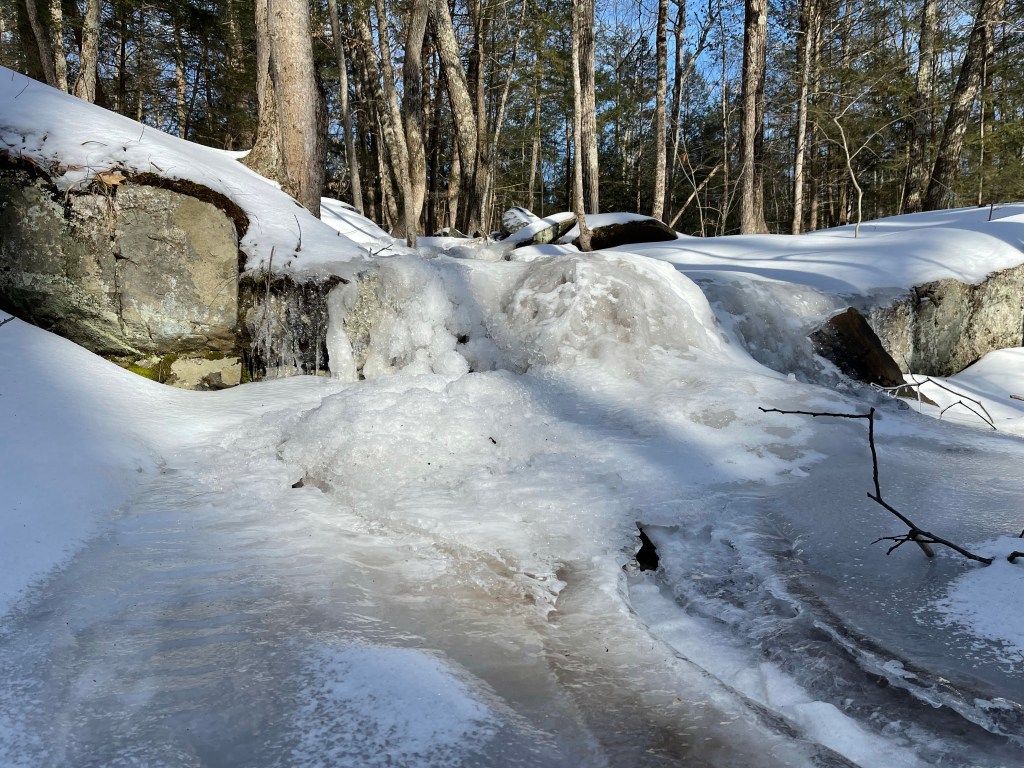
    Life is more interesting when you’re a collector of memorable moments. Finding something unique in every waking day is one way to saunter through life with the blinders off. What shall that one line be? Four meetings and chicken for dinner? Or changing into your boots and walking down a snowy gorge to find falling water using minutes brazenly stolen from the ordinary?

    Everyone has their own idea of what makes a moment memorable. It’s our responsibility to ourselves to make something of our time. Why waste it doing the same thing we did yesterday? Make it stand out from the rest in some meaningful way. Small talk at a cocktail party offers its own opportunity to expand beyond the ordinary, if done well.

    It’s entirely possible that I bored my audience to tears at that party. Then again, they might have been inspired to begin their own daily habit of writing down one memorable moment that very day… beginning with an entry about the odd character who inspired a small change before disappearing into the line for coffee, never to be seen again.

  • Visiting the Cascades of Attica

    You’ve got to know when to hold ’em
    Know when to fold ’em
    Know when to walk away
    And know when to run


    Every gambler knows
    That the secret to survivin’
    Is knowin’ what to throw away
    And knowin’ what to keep
    ‘Cause every hand’s a winner
    And every hand’s a loser
    And the best that you can hope for
    Is to die in your sleep

    —Kenny Rogers, The Gambler

    When you find a few minutes in your day, googling “waterfalls near me” can net some great micro adventures. Today’s search brought me to a pristine 60 foot waterfall just five minutes down the road from a famous prison that looks like a castle in the cornfields. The waterfall felt like you were in another universe. And it was just where I needed to be between my second and third meetings on a busy day in Upstate New York.

    There are a few web sites that describe the cascades. I found this one helpful for understanding what I was walking into. Private property, three cascades within a few hundred meters of the road, well defined path… got it. Of course, it didn’t mention the slippery layer cake hazard of fresh snow on wet leaves on gooey mud that a visitor in December might confront, but things change and we must adjust to whatever we’re presented with. I attempted to reach the 60 foot plunge from both shores, recognizing both offered potential views but also potential for an untimely end to my time on this earth. There was no one to hear me scream as I slipped down the path, over the cliff and down the ice cold river. So why tempt fate? The secret to survivin’ is knowin’ what to throw away. And knowin’ what to keep.

    But I couldn’t walk away without getting a “close enough” picture. I slipped on the micro spikes, grabbed hold of the rope someone generously left for just such foolhardy acts and made my way down to the top of the falls. Not the dangerous part, mind you, but the part some folks in my life would question my sanity for getting anywhere near. Daring, but not reckless… Hey that’s me!. Maybe someday I’ll be back and conditions will be perfect for a walk downstream and then up the river bed for that classic waterfall shot. This wasn’t that day. But it was still an adventure. If only a small one.

    Cascades from as close as I could safely get
    The other shore was even more daunting
  • Plymouth’s National Monument to the Forefathers

    Plymouth, Massachusetts might not be the oldest European settlement in the United States, but you can safely say it’s where England got its foothold in America. They might have landed in Provincetown first, hit a few places along the Cape Cod coast as they looked for a better place to settle, and maybe they would have been better off if they’d landed in what would become Boston or Providence, but they landed here. And the great floodgates of immigration began, changing this continent forever.

    That narrative of settlement and conquest is… complicated. But you can make a good case that the Mayflower Pilgrims’ pilgrimage was driven by religious freedom and a desire for peaceful coexistence with the Native American population. They happened to settle in a place where the native population had recently been decimated by disease, making for a bit more elbow room to root themselves in the place, but let’s stay on point. That first generation tried to fulfill the mission as best they could.

    To honor those noble intentions, and to put a spotlight on the best virtues that we humans aspire to, the Pilgrim Society of Plymouth conceived of a huge statue that would dominate Plymouth Harbor. The original monument was supposed to be 150 feet tall and right on the water. Reason eventually took over and they moved the monument to the top of a small hill with a commanding view of the harbor, then shortened it to 81 feet.

    The National Monument to the Forefathers is believed to be the tallest granite statue in the world. There is impressive detail in the carvings and a sense of Victorian optimism about what we aspire to be throughout. The cornerstone was laid in 1850 and the monument completed in 1889. That’s a lifetime for someone in the middle of the 19th century. Throw in the Civil War and violent conflict with Native Americans as the country was settled ever westward and those ideals were challenged even as the monument was being built.

    Today the National Monument to the Forefathers stands in dignified silence, 132 years after the dedication ceremony and a year after the 400th anniversary of the settlement of Plymouth by those Mayflower Pilgrims. That big party got cancelled last year with the pandemic, the narrative of living up to the best of virtues is more challenging than ever as we Americans sort out just who we want to be, but the monument stands. Still waiting for us to measure up.

  • Let Me Live Until I Die

    “Lord, let me live until I die.” – Will Rogers

    This is the kind of daily prayer or affirmation I can get behind. Said daily as I open my eyes to a new day. Let me live until I die is a bold stake in the ground to make the most of every moment. And shouldn’t we celebrate the possibility of the new day? What’s the alternative, to dread the commute to work, or the work itself, or what we come home to afterwards? To distract your life with media and alcohol and empty calories? No, thank you! Let me live until I die.

    It’s easy to slip into the dark melancholy of the world. It’s easier to slip than it is to climb. But slipping only leads you to new lows. Far better to climb, as tough as it might seem, to reach new heights and see new vistas. To leap out of bed to see what we might accomplish in this new day seems a far more interesting way to wake up to the world than to hit the snooze button and hide under your pillow.

    Life isn’t easy, we all know that. But the world bows to those who climb to the top, look around and light the way for the rest to see. To be a beacon requires energy and an unquenchable desire to burn brightly. You can’t burn brightly if you’re drowning in misery. Get up and get out there, where the oxygen is. Be fit and passionate and embrace life in a full bear hug.

    To live is to move, to embrace, to laugh, to love, to explore, to learn, to dance, to take a chance and to grow. Get out into the world and make the most of living while we can. I’ll see you out there.