Category: Travel

  • That Moment When Everything Changed

    “I wonder if I should have a change — a year in Europe this time — something new, something better, perhaps. A life has to move or it stagnates. Even this life, I think. It is no good telling yourself that one day you will wish you had never made that change; it is no good anticipating regrets. Every tomorrow ought not to resemble every yesterday…

    It seems remarkable to me at least that if I had not gone to Molo, I might never have seen New York, nor learned to fly a plane, nor learned to hunt elephant, nor, in fact, done anything except wait for one year to follow another… How can the course of a life be changed by a word spoken on a dusty road?”
    – Beryl Markham, West With The Night

    In this last year of the pandemic, with borders closed and wandering spirits limited to adventures of the local kind, it’s easy to throw your hands up in frustration at the “one days” that are postponed. Of one year following another with a measure of stasis unfamiliar and a bit uncomfortable. If we’re fully engaged we learn to make do, to thrive really, in those local adventures and appreciate what we have in our own back yard.

    You want a quick adventure? Click on the link above and read Markham’s book. Put aside the disgust of elephant hunting for this one (it was a different time) and immerse yourself in the perspective of an adventurous soul and a brilliant writer. Growing up in Kenya a hundred years ago, training thoroughbreds before pivoting to flying.

    Markham’s life changed when she met a man repairing his car who flew in the first World War and would soon teach her to fly. He sparked her imagination with possibility, and the rest of her life sprouted from that spark. She quickly charms you and makes you wish you’d met her in the brief time we breathed the same air. If I’d read this book at twenty I might have dropped everything and flown straight to adventure myself.

    So why not now? As with many adventurous role models, she makes you wonder; what is our own pivot? What is your moment that changes everything? It may not be a chance encounter, it might just be a small leap into the unknown. We’ve learned a lot about the world and ourselves over the last year. If there’s one clear lesson from all of it, it’s that the world was always trying to tell us something. But we were too busy distracting ourselves to pay attention.

    “The world does not act on us as much as it reveals itself to us and we respond.” – Shane Parrish, The Great Mental Models, Volume I

    How will we respond to the last twelve months that changed everything? And what shall we make of our future? Every tomorrow ought not to resemble every yesterday. Our one day can begin today. We don’t have to rely on some chance encounter with someone who teaches us to fly. That moment that changes everything can, indeed must, be this one. Flying requires summoning the courage to start down the runway and the accumulated experience to soar.

  • On Purpose

    “Find out who you are and do it on purpose” – Dolly Parton

    “Do it on purpose and you’ll find out who you are.” – Seth Godin

    Ten days seems a short time to accomplish much of anything, and the last ten days have whirled by in a flurry of moments great and small. But isn’t that all our days? This sampling, more than a week and less than a fortnight, offered a chance to focus on a few key activities to see what might happen.

    And so I exercised a bit more, rowing and hiking and snowshoeing my way across time. And wrote a bit more, offering another 5000 odd words of tribute to the Cloud. And read a bit more, finishing two books that were impatiently tapping me on the shoulder to immerse myself in.

    I’d wanted to lose a few pounds and watched five of them fall away, half of what I’d wanted but a handful less than I’d started with. I’d wanted to summit two 4000 footers but instead summited a single mountain shorter in stature than I’d envisioned but more than up to the task of changing my perspective. While there I crawled behind a waterfall and saw the otherworld there. And found myself wanting to linger behind the ice longer than I did. The whispers in that ice haven’t yet diminished in the din of work days.

    Incremental improvements such as they were, it doesn’t seem appropriate to boast about such things as losing a couple of pounds and reading a couple of books. It isn’t a boast if it’s less than you wanted, is it? But if you end in a better place than you started isn’t it a success anyway? The point, I think, is to keep raising expectations of yourself. Keep doing things on purpose and you might just find out what that purpose is.

    Purpose. What a heavy word. There are bookstores filled with thoughts on finding your purpose in life. We all contemplate what it’s all about, hopefully stumbling upon a few insights on our walk through life. Why do we do anything? Why shift in this direction over that one? Why is just purpose by another name. We generally have so much noise in our lives that we can’t hear the whispers of why anyway. I think mine might be locked away in that icy waterfall, or it could be in the next conversation I have. Or in the silence in between.

    Pulling a random ten days out of a lifetime and seeing what you can make of it with intention, you might just find that ten wasn’t quite enough to get all the way across the finish line. But you’re closer than you were without the focus and intent. If you play them well, you might just shuffle a few interesting cards into your deck of days. And find that purpose is just the direction you’ve set yourself on. For now, or for a lifetime.

  • Finding the Magic Behind the Ice

    There’s something uniquely foreign about the experience, akin to visiting an ice palace in a fantasy movie. Humans aren’t supposed to be in such places. At least that’s what we tell ourselves when we look at a waterfall from the front. And when it’s frozen in winter? Well, there’s something chillingly locked away in… there.

    Now, in case you’re wondering, this isn’t the first time I’ve been behind a waterfall. Like countless thousands, I’ve walked behind Niagara Falls and for the price of admission seen the roaring waters dropping away from the safety of a dim, well-engineered if soulless tunnel. Interesting, to be sure. But not magical.

    It’s clearly the ice. It forms a wall over the falls that announces, “sorry, closed for the season”. There’s beauty in the frozen stillness of a waterfall in winter, of course, but there’s a small part of you that feels betrayed by the ice. You hear the muted sound of water falling deep inside, and want for more.

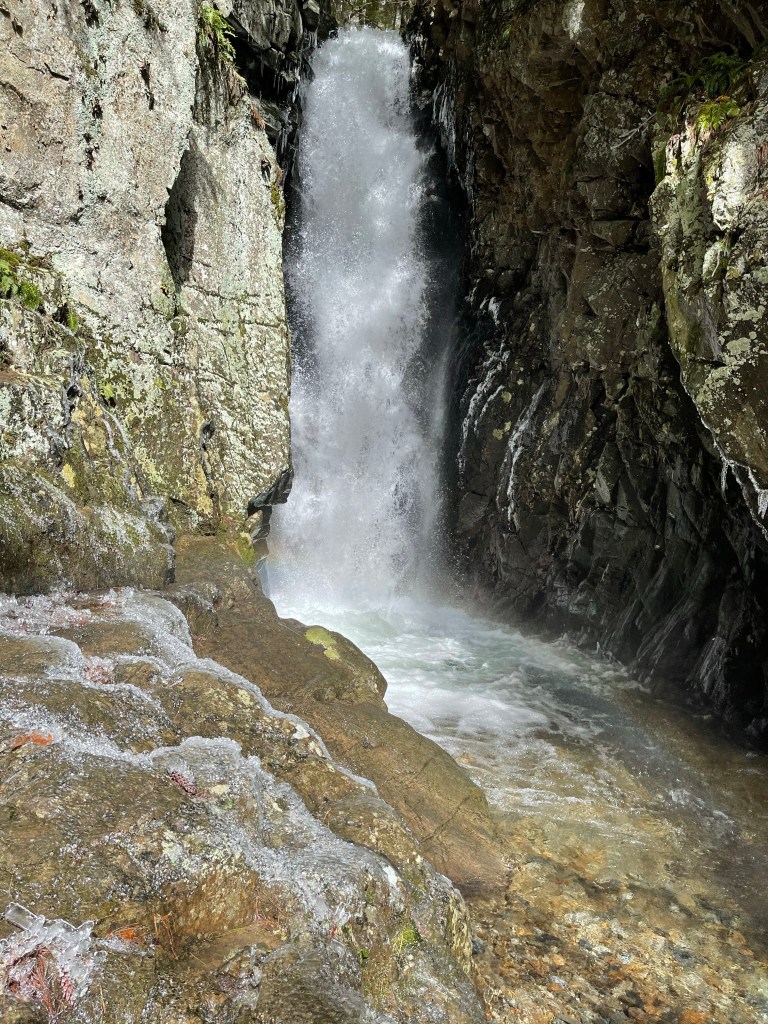
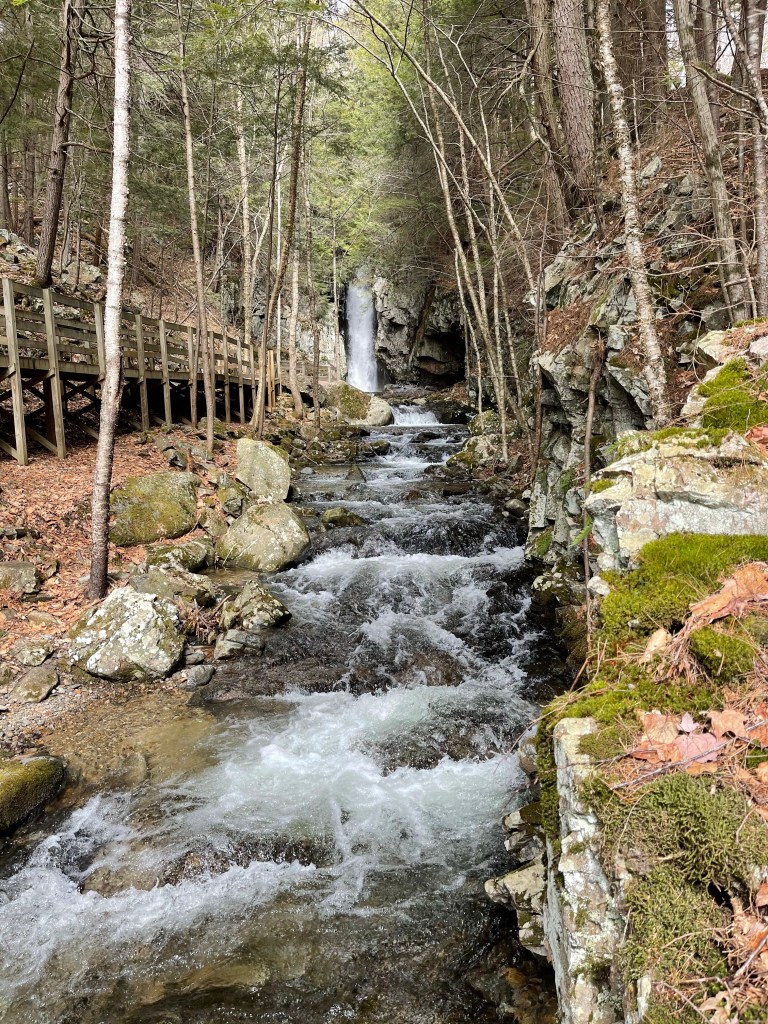
    Enter Beede Falls in Sandwich, New Hampshire. In warmer months it’s a 35 foot horsetail of falling water with a popular swimming hole. In winter it’s an ice bulge, beautiful but seemingly as inaccessible as other frozen waterfalls. But this one offers a secret for those who dare. You can duck and crawl in behind the falls on the left or right side, and even crawl all the way through if you wanted to. For some less tall than me standing up is even possible.

    I wondered at the characters over the years who have crawled behind the falls in all seasons. I wasn’t the first on this day, and other hikers waited patiently for me to finish to have their own turn in the tight tunnel between granite, water and ice. How many humans have made this crawl over the thousands of years that this cave and waterfall have danced together? A lot, I suppose. But for a few minutes, there was only me and the ice and water.

    That’s where I finally saw the magic locked away behind that frozen blue skin. Deep behind the water is indeed falling, forming icicles and frozen bubbles successively grown upon each other to form otherworldly sculptures. And through it all that shower of water penetrates the center, surrounded by its icy shield and backlit by the daylight beyond. An incredible wonderland so foreign to me, so delightful, that I felt I’d gone to another world. And indeed I had.

    Beede Falls, behind her icy shield
  • Twice the Fun: Mount Israel & Beede Falls

    Not every amazing hike is over 4000 feet. In New Hampshire there are other lists besides the 4K list, lists like 52 with a view, which offers some beautiful views with a bit less effort than the 4000 footers. For a warm Sunday with snow melting into snowball-making consistency, a couple of friends invited me to join them on a hike of Mount Israel and for a bonus, a visit to Beede Falls, one of the waterfalls on my personal checklist to see in 2021.

    A bit of history is in order. Mount Israel is named for a settler named Israel Gilman, who lived near the trailhead for this mountain. There’s still an active farm near that trailhead, and it’s easy to imagine the land in the 1760’s when Gilman was walking around this place. Mount Israel is located in Sandwich, New Hampshire, which also has a bit of history in its name. The town of Sandwich is named for the 4th Earl of Sandwich, John Montagu, supposedly the inventor of the sandwich. Given that, I made a point of packing a sandwich for the hike, in honor of the Earl (or whomever it was, lost to history, who made sandwiches for him).

    The hike began at Mead Base in Sandwich, with a straightforward two mile hike up the Wentworth Trail. For those wondering about the name of the trail, a bit more history for you: Sandwich was founded in 1767 from a grant by Governor Benning Wentworth. Another name you’ll come to know is Daniel Beede, who was chosen to lead the settlement of Sandwich and granted 100 acres. Place names usually betray the history of that place, and if you look hard enough you’ll find Easter eggs like these on maps and street signs.

    I quickly fell in love with the Wentworth Trail. It winds through old growth oak and pine trees, with some tree trunks four feet in diameter – exceedingly rare around here. The snow cover acted as a spotlight on the biggest trees in the forest. I was smitten with one oak tree that had to be a witness to the transition from Native American land to English settlement. Further up, the trail wound around granite ledge and hemlocks, offering glimpses out to Squam Lake and the surrounding ridge line.

    The summit of Mount Israel is 2620 feet with 1900 feet of elevation. Despite its modest height relative to some of the other mountains in New Hampshire, it didn’t disappoint in views or the stunning beauty of the trail itself. Steep enough for a workout, short enough to give you time for other adventures. We made short work of the trail and before we knew it we were back at the trailhead at Mead Base and Act II.

    A half mile from the trailhead is another wonder worth visiting, Beede Falls, which is named after our friend Daniel Beede. The walk itself is wonderful, with granite ledge and scattered glacial erratics lining the edge of the trail. A large cave named Cow Cave offered a quick distraction. It was so named by some cows that decided to shelter inside the cave one day deep in the past. The cave was interesting, to be sure, but the real show was Beede Falls.

    In late February the falls were largely frozen, and we walked out on the ice that must be a lovely swimming hole on a hot summer day. The amazing part of Beede Falls in looking at them from behind. The falls froze solid in front, but you can access the back from the left and right side, and crawling behind them offered a magical trip into an icy palace. Water cascaded from the granite ledge, plunging between the icy wall you see on the outside and the cave formed behind. There’s just enough room to go all the way through it if you’re adventurous and don’t mind getting a little wet.

    In all our days on this earth, how often can you say that you got to see the world from the summit of a small mountain and from the crawlspace behind a waterfall in the space of a couple of hours? If you’re blessed with good health and mobility, then surely life is to be lived fully. Adventures like this one are within reach of most of us. All you’ve got to do is get out there.

    Frozen Beede Falls
    Ice wall in cave behind the falls
    Summit of Mount Israel
  • To Roam the Roads of Lands Remote

    “To move, to breathe, to fly, to float,
    To gain all while you give,
    To roam the roads of lands remote,
    To travel is to live.”
    – Hans Christian Andersen

    Good God I’m ready to roam remote lands again. Exploring faraway places in a world that has shaken off the pandemic and opens its arms in welcome. We aren’t there just yet, we know, but every day we get a bit closer. A year into this and I’m chomping at the bit for the quirky randomness of faraway travel.

    Such thoughts are low agency conspiracies, for the world is right outside, awaiting our arrival. Crossing borders to lands remote may be just out of reach, but crossing thresholds is still very possible. And so the question isn’t the roaming, the question is the focus. I can row a million meters away (and be a different person when I arrive) right in my house, I can time travel in the chair behind me, and I can fly above the earth on snowshoes just outside the door.

    The secret all along? To push through our own borders, wherever we are, is to live. To become by working through. To move. To breathe… to gain all while you give.

  • What Are You Waiting For?

    “Dare to be wise; begin! He who postpones the hour of living rightly is like the rustic who waits for the river to run out before he crosses.” – Horace

    When you really think about it, what are we waiting for? The right time? That river keeps on flowing by and never runs out. We run out.

    Of time… opportunities lost watching it all run by. So then what of this hour? What shall it launch?

    Begin. Do you feel the urgency of time? Do what must be done.

    Start where you are, use what you have, do what you can” – Arthur Ashe

    Easy for me to say, right? Who am I to challenge you? Make no mistake, I’m dipping a toe in that water myself. For I have my own chasms to cross. The only way across is by putting action where words are and getting to it.

    I like a good challenge. Do you? What can you accomplish, see, or become in ten days? Focus on living rightly in each moment, getting across whatever your river is. From today to March 4th and written about right here on March 5th. Comment on that post if you’ve taken the challenge yourself. What are we waiting for? Hurry! For it’s already slipping away.

  • A Rock in the Woods

    History whispered from the woods, calling me to find it. A mere rock this time, set in place to forever mark the border between two agreed-upon places, as settlers tended to do. This one, they say, was set here in 1741, a year after being settled and eight years before Hampstead would be incorporated. The other town, Atkinson, would be incorporated twenty-six years later. That there is a carved A and H on the stone that is a handy indicator that you found it, but neither settlement was known by these names in 1741. Hampstead was known as Timberlane Parish then, and Atkinson at the time was a part of Plaistow, New Hampshire. No, the carving came sometime later. And so did the red paint used to highlight the letters.

    Living on a border town between New Hampshire and Massachusetts, I’m fascinated with these border markers. Some are easier to find than others, conveniently standing aside the road they’ve watched grow over their lifetime. But others are more evasive. And town border markers tend to be less fussy still. When the plowed fields return to the woods they always wanted to be the stones become hidden. And that’s where the fun begins for adventurous history geeks like me. This one wasn’t so hidden; it appears on trail maps for the conservation land it resides in. But ask the 15,000 residents of the two towns where it is and maybe 400 might not give you an odd stare back. The rock isn’t exactly a national landmark like the fictional Plymouth Rock.

    And yet, this tiny rock in the woods marking the border between two towns was set in the heart of the lands the Abenaki once used to stage raids on Haverhill, Massachusetts only four decades before. It would stand witness to the French and Indian War, the Revolutionary War, The Civil War and two World Wars, drawing the settlers from the land that surrounds it to fight for survival nearby and across the globe. And of course it would witness the birth of a nation.

    So sure, it’s just a rock in the woods, but it’s a rock that has seen a few things in its job marking a random border set in 1741 between two settlements in New Hampshire. And I wondered, brushing the snow off it for a better look, how many of those people have wondered at it in that time as I do now? And for how long will it guard this border before such things don’t matter again? I wonder.

    1741 A/H Marker
  • At That Moment

    “I felt at that moment that it was my chance to do one thing supremely well.” – Roger Bannister

    The extraordinary – mastery – starts with that feeling. That spark of excitement at the possibility that just maybe I can do this. And as they say, all it takes is a spark. True, but once the fire is lit, all it takes is fuel to make it roar. For it is just the beginning. There are more moments to come.

    The time before that moment aren’t full of sparks, they’re full of stumbles and awkwardness and frustration. The paying of dues. The long slog. The apprenticeships that turn novices into prospects and prospects into rising stars. All a precursor to that moment when you finally know that this, this is it. And once you realize it, you do whatever you must do to, well, realize it.

    “You have to expect things of yourself before you can do them.” – Michael Jordan

    All of us experience that other it. Those moments when you realize that this is definitely not it. Sometimes that it is our it masked by the long slog to get to it. But usually we know the truth of something before too long down the path. And the truth is that most its aren’t our it. So we try another it. And another. Many never find it at all. Plenty experience maybe this is it. And really, it might just be it, but the climb is long and the friends are calling to go out for a few drinks to celebrate the end whatever isn’t their it, and before pretty soon that maybe isn’t your it either.

    The relatively few who do find and fully realize their it may experience the extraordinary. For it, by definition, lies beyond the ordinary. Finding your it requires singular focus on achieving it. Which brings us back to that moment. And what you feel. And what you do with your chance.

  • On New Paths

    What good is livin’ a life you’ve been given
    If all you do is stand in one place – Lord Huron, Ends of the Earth

    If snow transforms the landscape, then a walk in that snowy terrain transforms the winter walker. Add a new path and suddenly you’re seeing the world entirely differently than you had before. Add snowshoes and you’re suddenly set free to break off trail to see new places, explore animal tracks that run off into the woods, and to see what’s on top of a rise you might have walked by at another time of year.

    There’s a popular pursuit in hiking called red-lining, in which hikers hike every bit of every trail on a map or guide. A popular red-lining pursuit in New England is hiking the AMC White Mountain Guide. The whole point of red-lining is to explore new paths – to get off the crowded hiking trails and try something new. To do it, and to belong to a small group of hardcore hikers who have also done it. And add a measure of accomplishment and camaraderie in the world of hiking. I don’t see myself hiking every trail in the AMC White Mountain Guide, but I’m fully onboard with hiking new trails and seeing the previously (for me) unseen.

    On Valentine’s Day I explored trails previously unseen in a forest I’ve spent a lot of time in. Snowshoeing with friends, we walked a trail largely by ourselves to new places. When you’re on a new trail like that, every step is a discovery, every bend in the trail is a curiosity, and every trail junction is confirmation and validation of what the map was trying to tell you all along. There’s magic in taking that image on a map for a walk and making it real.

    The day after a long walk on new trails you start thinking about the trails at those junctions that you didn’t take. You wonder at what you might have missed down that way and begin to realize the allure of red-lining. For how do you want to spend your time in this world? Sticking with the familiar or exploring new places and challenging yourself in new ways? There are other paths that warrant exploration. I’ve seen them out there, if only on a map.

  • Hiking Cannon Mountain

    A flurry of texts over the work week from two directions with questions about hiking led to a decision to join forces for a hike of Cannon Mountain. On the one hand were the Perry’s, increasingly famous in the White Mountains for years of summiting mountains and red-lining trails. I don’t recall a hike in the last couple of years where they didn’t know at least one person on the trails. And a text from my niece Kellyn offered a nice treat, with her deciding to hike with us as well.

    Cannon Mountain is an old granite mound that’s famous for a sheer rock face that once held the Old Man of the Mountain until it collapsed in 2003, and for the tram built to promote tourism and skiing on the mountain in 1938, making it the first passenger tramway in the United States. The Old Man of the Mountain gave this granite mound its first name, Profile Mountain, but eventually its resemblance to a cannon from some vantage points let to what we’re familiar with now.

    So the stage was set for four hikers to set out on a cold February 13th morning for a hike from Lafayette Campground. We chose the Lonesome Lake Trail, with three of us starting in micro spikes on the snow-packed trail. Our fourth hiker stuck with snowshoes the entire time. The conditions on the popular trail made either option fine. As with other hikes, you quickly know when it’s time to put on the snowshoes. For us that was when we took the largely unbroken Dodge Cutoff Trail over to Hi-Cannon for the hike up to the summit.

    Lonesome Lake is a beautiful lake sitting in the bowl of Cannon and the neighboring mountains of the Kinsman Range. It’s a destination of its own, and plenty of people hike up to see it, walk on the frozen lake for the beautiful views it offers, and then hike back down. But you don’t summit mountains when you turn around halfway. We powered on, snowshoeing through a wonder of marshmallow trees up the steep trail. There’s one ice-caked ladder on Hi-Cannon that I’ll always remember for the limited footing options presented to us, but we all got past it with a little help and a dose of courage.

    The thing about summits is they tend to be much colder when you’re exposed to the wind and you stop moving. Sweaty gloves quickly freeze up, making a change a requirement to keep your fingers working. We considered the observation tower for a few minutes and opted to just hike down to the ski resort’s Mountain Station, where I’m told you can buy a beer at 4080 feet. I opted for hot chili and hot chocolate, with extra hot, thank you. It’s a rare day when you can summit a mountain and have hot chili waiting for you. We quickly warmed up and reached a point where if we didn’t get going we might choose to close out the place. Onward.

    Crossing a ski trail is akin to crossing a highway. You judge the oncoming traffic, decide whether your speed can overcome the approaching traffic’s speed and go. We quickly crossed over to the trail back to the summit observation deck, crowned the summit and began our descent using the Kinsman Ridge Snow Chute, er, Trail. On the map, 4/10’s of a mile of hiking, but a lot of squiggly elevation lines stacked up in a small space. We butt-slid down large sections, my snowshoes were more telemarking skis on other sections, and we all collected snowy memories that will make great tall tales someday.

    On one of the butt-sliding sections I lost a water bottle. It wasn’t until we’d snowshoed across Lonesome Lake and I changed to micro spikes that I realized it. My disappointment at losing it turned to delight when we got to the trailhead and someone who’d found it and beaten us down the trail while we lingered at the lake had left it sitting on a post waiting for me. Good hiking karma right there. It was hard to come away with anything but positive vibes after hiking Cannon Mountain on a pristine winter day. A solar halo signaled goodwill to all. A very good day indeed.

    Cannon Mountain from Lonesome Lake
    Solar halo through the frosty trees
    Lonesome Lake with Franconia Ridge beyond