Category: Travel

  • Memento Mori

    Memento Mori

    “Do not wait for life.  Do not long for it.  Be aware, always and at every moment, that the miracle is in the here and now.”
    – Marcel Proust

    On the north side of 50 your perspective changes.  I’m more inclined to take the side trip to see something new than I was at 30 (when I was rushing from one place to the next just to get there).  When I had kids I focused on being a decent dad.  Supposedly 90% of the time you will ever spend with your children is used up by the time they graduate high school, and damn it I made sure to be there whenever I could be.

    Who knows what the day brings, let alone the next decade, but I’m working to make my 50’s a memorable and interesting time.  I figure if medical advancements, a healthy lifestyle and good luck get me to 100, then I’ve got 48 more trips around the sun.  Best to make the most of those.

    Today will be a great day.  Picking up Emily and driving her back home for the summer.  If luck and timing work in our favor perhaps a side trip along the way before the horrors of the Mass Turnpike on a Friday afternoon inflict it’s emotional toll on us.  There’s something cruel about traffic getting worse as you get closer to home from a long trip.  Sort of like the cruelty of the body and mind breaking down as you reach your “golden years”.  But as a well-seasoned 52 year old, I’ve learned to just take the road as it comes, but with an eye towards adventure.

  • Taming the Mohawk River

    Taming the Mohawk River

    The Erie Canal was first proposed when Thomas Jefferson was President.  The sheer expense and amount of labor that it would take were much more than Jefferson could imagine, and he described it as a “little short of madness”.   However, the upside for a canal that would open up the west to commerce was immense.  Investors saw a clear return on investment, and DeWitt Clinton, the Governor of New York, supported the project.  Opponents called it Clinton’s folly, but in the end he was proven right.

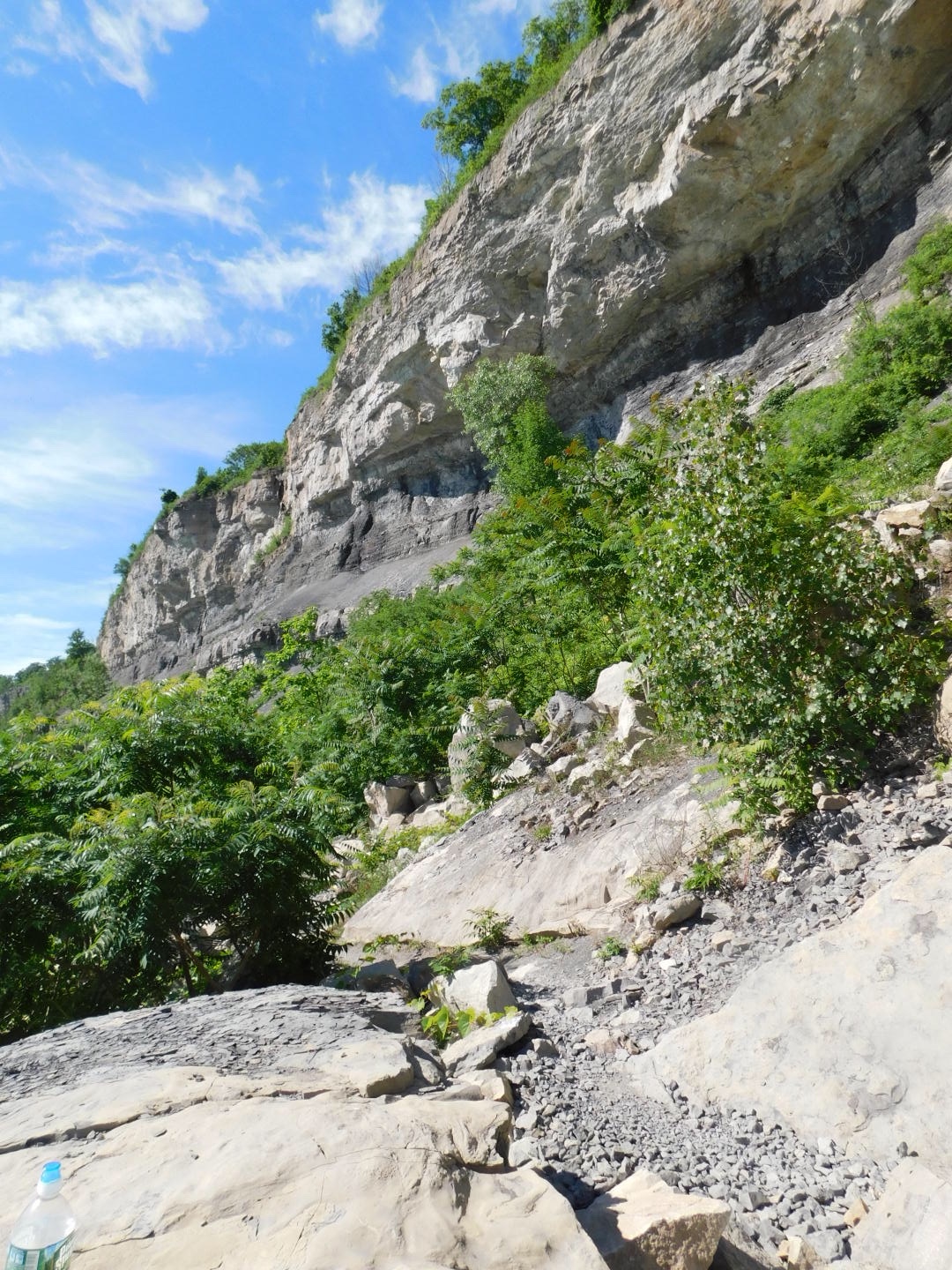
    The Mohawk River, a powerful East-West tributary to the Hudson River, was chosen as a key part of the Erie Canal, and 110 miles of the river were re-purposed as part of the it.  But rivers run wild, and the Mohawk River was no exception.  The engineers designed a series of trusses that stepped the river down while also regulating the flow.  These were effectively dams that looked like bridges.  Each had a lock for boat traffic, seen on the right in the photo below.  Today these trusses are massive steel and concrete structures that run the length of the Mohawk River.  While the barge traffic has given way to pleasure craft, the canal remains an engineering marvel.

    There’s no doubt that the Erie Canal was a massive success, and helped bring the resources and natural wealth of the western interior to the east, making cities like Buffalo, Rochester, Albany and New York much richer in the process.  Its hard not to be impressed with the scale of the Erie Canal, but there’s a part of me that would love to have seen what it looked like before 1817, when the first shovels cut into the ground in Utica.  It’s not lost on me that it was the year after Captain Clement died in my “neighborhood” in New Hampshire.  These were big years for the country, finding its place in the world after two wars with Great Britain.  The Erie Canal would fuel the industrial revolution and help the North win the Civil War.  It would be another hundred years before the world realized just how powerful the United States had become when we entered World War I.  It’s easy to see how much the canal meant for the sustained economic growth of this nation.

    The Mohawk River, like the tribe that shares its name who lived alongside it, was forever changed by the rapid expansion west.  Just like the Niagara River, the Colorado River and the Columbia River, the Mohawk River that flows into the Hudson has shrunken from a mighty river to a fraction of what it once was.  The taming of rivers is at once an impressive feat of engineering and a sad tale of man bending natural resources to our will.  I like my rivers on the wild side, but write that knowing that the taming of the Merrimack River in Lowell created that city, and as a side bar made it possible for me to row in college.  So just as I am who I am partly because of the taming of the Merrimack River, so too America is what it is because of the taming of the Mohawk River. 

  • Pabos: A Long Way From Home

    On the edge of a lawn on County Road 42 in Fishers, New York is a seven foot pyramid built in 1959 to honor a man named Pabos.  Pabos was a Basque explorer who traveled deep into the wilderness of North America only to die here 400 years ago on June 10, 1618, a little more than two years before the Pilgrims settled in Plymouth.  His grave is one of the oldest known European graves in North America.  That his final resting place was here in this Rochester suburb is fascinating.  That he is remembered at all is an accident of history.

    The Basques are people from the region in Spain that borders France.  They were focused on commerce, not settlement, and were very active fishing, whaling and trading in the Gulf of St Lawrence in the 15th and 16th centuries.  They would sail over from Spain and establish semi-permanent fishing and hunting camps in that great estuary, fishing for cod and hunting whales for a century before Jacques Cartier explored the St Lawrence River and claimed the northern lands for France.  The Basque traded with local tribes and learned to speak their languages.  Over the decades they moved further and further inland up the St Lawrence River, eventually reaching Lake Ontario and beyond.  Like his fellow Basque explorers, Pabos was likely looking for new fishing grounds, tribes to trade with and for the elusive Northwest Passage to Asia.  He likely followed the shoreline of Lake Ontario to Irondequoit Bay and then up Irondequoit Creek to see where it would take him.  Pabos may have been the first white man to walk through the old-growth forests that covered Western New York in 1618.  How he died is lost to history, but disease, illness, accident and violence claimed many explorers and the native tribes they encountered along the way.  Smallpox and other diseases brought by early visitors decimated local tribes well before the first permanent European settlers arrived.

    Almost two centuries before Victor, New York was incorporated as a town in 1812 and laborers started digging the Erie Canal something took the life of Pabos in this remote corner of Upstate New York.  What we know is he wasn’t alone.  Someone in his party buried him 300 feet from this monument and marked his grave with a limestone gravestone engraved with his name and the date of his death.  And it was there that Pabos rested in peace, lost to history until his grave was discovered in 1907 by Fred Locke, inventor of the porcelain insulator.  Locke was digging for clay when he unearthed the limestone marker of Pabos’ grave.  Had Pabos been laid to rest a few hundred feet away, his grave may never have been unearthed.  Lost forever to the accumulation of sediment, or covered over by the construction of Wangum Road or the Auburn and Rochester Railroad.

    The larger pyramid monument that sits alongside Wangum Road was built and dedicated in 1959 after a decade of extensive research on Pabos by George Sheldon.  That dedication was noted in the Rochester Democrat and Chronicle on June 10, 1959.  Sheldon and the local Boy Scouts built this pyramid and placed the plaque to honor Pados.  The actual gravesite sits 300 feet away from the pyramid on private property.  Portions of the trail he walked his final steps on still exist to this day.

    Pabos thus lives on because someone in his group carved his name and date of death on a piece of limestone, and someone stumbled upon that limestone 289 years later, and someone a generation after that dedicated ten years of his life researching the Pabos and how he came to be in this place, and with the support of the community dedicated the pyramid monument that marks this path through history.  Ironically, the person who survived and paid tribute to him with the carved gravestone is lost to history.  Yet they set in motion the series of events that bring us to this moment, 400 years later, acknowledging a Basque explorer who died alongside a creek deep in the wilderness far from home.

  • Robins

    Robins

    One sign of spring in the northeast is the reappearance of robins.  This bird migrates back in spring, feeding on worms, grubs and berries.  After a long winter they’re a welcome sight on the lawn.  On this rainy Sunday they’re very active in the yard hunting worms and gathering straw for their nests.
    Growing up this was my favorite bird.  I’ve grown to appreciate the predators and the showier cardinals and bluebirds, but there’s a lot to be said for the robin.  While others gobble up seed from the feeder, the robin hunts for its own meal.
    So welcome back robins.  It’s been a long winter and we’re glad to have you back in the neighborhood.  I’d ask that if you’re going to linger, please take as many grubs as you’d like out of the lawn.  Just watch out for the neighbors cat.  
  • A Sense of Place: Visiting the Neighbors

    A Sense of Place: Visiting the Neighbors

    The 5th of May is a big deal for distillers of tequila, brewers of Mexican beer and every Mexican restaurant in North America.  To me the 5th of May, especially on a Saturday, is a day of yard work.  After a typical New England winter and spring, meaning it was all over the place, there’s a long checklist of things that need to get done.  Loam to spread, trees to trim or cut up, potted plants to bring outside, pool chemistry to dive into, and pressure washing to get to.

    The Cinco de Mayo celebration kicks in tonight, when I’ve earned a beverage or two.  In other words, it’s just another day, but with a better tagline.  But that doesn’t mean its ordinary.  Every day is a gift after all, and there’s memories to make today too.  Yesterday, on “May the 4th be with you” day, I noted that I was only 9 minutes away from a spot I’d wanted to visit for a few years now (refer to yesterday’s post).  I had a productive, impactful work day for sure, but its the side trips that make the day.  See a historic site, meet a new and interesting person, smell the roses, seize the day.

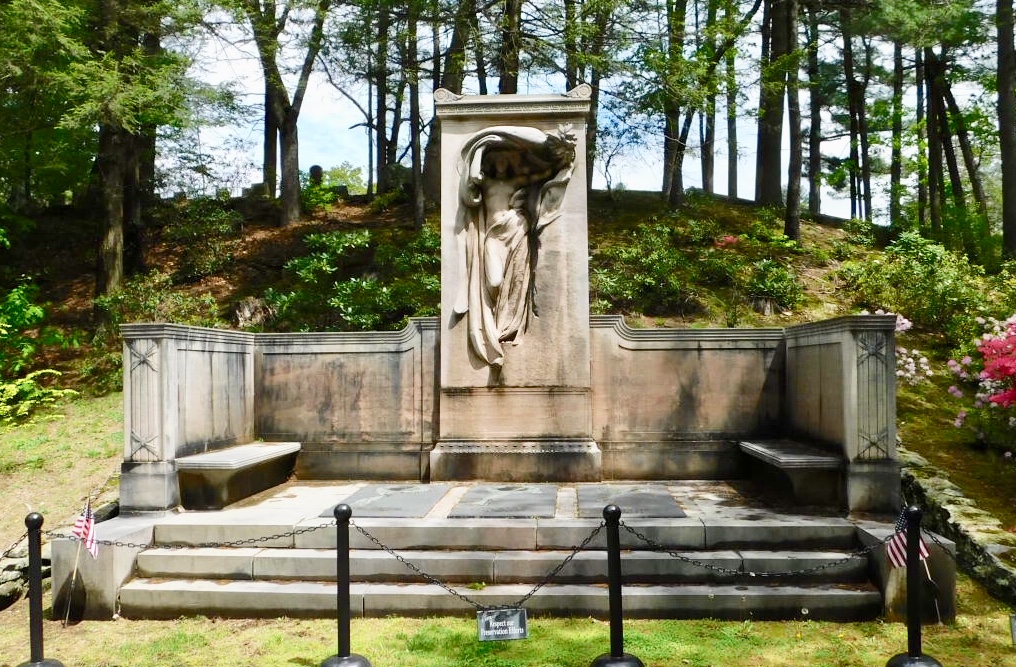
    Considering that, I’ve often thought I should visit the graveyard down the street from my house.  This morning I walked over to it and read the gravestones.  There were Hale’s, Dustin’s, Clement’s and other families buried there.  Hale’s Bridge crossed the stream right near the cemetery, but it’s long gone now, replaced by a modern road.  I’m looking up Hale’s Bridge for a post another day.  The Dustin family must be related to Hannah Dustin, we are only a few miles away from where they lived.

    Some gravestones are easy to read, others are worn down to a point where there’s no lettering at all.  Most are in between.  This is one I’ll revisit sometime with a pencil and paper.  These are the families who lived here two hundred years ago.  They likely built the stone wall that runs behind my house, and farmed the land where my house sits now.  Time reveals little of them now, save for engraved facts about the deceased, and the occasional note about what a good person they were.  Captain Clement was a “tender husband and father dear”.  He died in 1816 at the age of 37, which likely set up hardship for the family who had to endure without him.  Sure, it was a tougher time when it came to life expectancy, but 37 is pretty young.  Life is a fleeting dance with the abyss, so best to make the most of this day.

  • Moswetuset Hummock

    Moswetuset Hummock

    There are a couple of stories about how the Commonwealth of Massachusetts got its name.  One story points to the Blue Hills, which are prominent in Eastern Massachusetts.  The tribe that populated this area, “the Algonquian Indians whose name derived from mass-adchu-seuck or ‘people from the big hill’”. (answers.com)  The other story, points to Moswetuset Hummock.  Moswetusset Hummock, as www.discoverquincy.com states, “was the seat of the Massachusett Native American sachem, Chickatabot, where he negotiated with the early English settlers” supposedly including Myles Standish.  The pilgrims first settled 35 miles away in Plymouth in 1620 and started running into the natives in 1621.

    The true origin was probably a combination of both.  The “people from the big hill” spent their summers fishing and farming near Moswetuset Hummock, and that’s where they met with the Pilgrims, who would have made the trip from Plymouth Harbor in the warmer months.

    What’s notable about Moswetuset Hummock is that it looks much as it probably did then.  Sure, there are cinder paths, signs and other nods to modern times, but as you walk around the island you’re seeing roughly what Chickatabot and and those early settlers saw when they stood in the same spot 400 years ago.

    Reality is a brute, and the facts were that Myles Standish was a thug who proactively killed and intimidated Native Americans, setting the table for many more generations of brutality on the native populations of North America.  Arrowhead Hill is one of the few undeveloped tracts of land in this part of Quincy.  It would have been interesting to have seen it 400 years ago.  Perhaps a warning to the native population to be a little more skeptical of the new neighbors would have helped, but in many ways the waves of encroaching settlers, combined with diseases and weapons the native population couldn’t imagine were going to wash over this land sooner or later anyway.

  • Arnold Trail to Quebec

    In September 1775, early in the Revolutionary War, Benedict Arnold and Ethan Allen hatched a plan to attack British held Quebec.  Benedict Arnold met with George Washington in Boston and assembled an army of 1100 soldiers who marched from Cambridge to Newburyport, Massachusetts.  From Newburyport they sailed to Maine and then up the Kennebec River to Fort Western in what is now Augusta, Maine.  Some of this fort survives to this day and is labeled “America’s oldest surviving wooden fort”.

    From Fort Western, the Arnold army moved upstream 20 miles in flatboats to Fort Halifax in what is now Winslow, Maine.  Not to be outdone by Fort Western, Fort Halifax boasts the “oldest blockhouse in the United States”.  The forts and blockhouses were built with an eye towards the French and particularly towards the Abenaki.  The leaking boats compromised the gunpowder and spoiled food.  This was before the army had to hike through the wilderness of Maine to Quebec.  Today, using paved roads, the walk from Winslow, Maine to Quebec City is roughly 70 hours.  It was a little more challenging then.  The plan was for the army to paddle the flat boats up the Kennebec and Dead Rivers, but white water meant that they had to portage for many miles of the route.  In 1775, hiking through thick wilderness, mosquito infested swamps and through mountainous terrain, it took the army over a month to get to Quebec, and they lost almost half their men to desertion along the way.

    Benedict Arnold in 1775 was still a highly respected hero of Fort Ticonderoga.  His betrayal would come five years later when he commanded West Point and plotted to surrender to the British.  So Benedict Arnold is forever linked with treason, and as a result you don’t hear much about his exploits early in the war.  To my knowledge there’s no “Benedict Arnold slept here” signs, and no commemorative plaque in Newburyport noting the assembly of the Benedict Arnold army that boarded ships to sail across the Gulf of Maine to the mouth of the Kennebec River.  Perhaps if this mission had been successful Benedict Arnold would have been made Governor of Quebec, or perhaps the British would have diverted forces to take back Quebec that instead were used in battles in the colonies.

    240 years after the Arnold army’s ill-fated march on Quebec, a couple of local adventures, Jack and Astrid Santos, traced the route using kayaks, portaging and hiking the rest.  That’s one of those “wish I’d thought of it first” stories.  For all the times I’ve been to Newburyport, Maine and Quebec, I’ve never heard this story.  I stumbled on it while looking up some information on Augusta, Maine.  History is a funny thing.  It’s all around us, but until someone pays attention its just like that unread book on the shelf in the library.  I’ll be sure to hoist a pint to Benedict Arnold’s army next time I’m in Newburyport.  Regardless of what he did later in the war, in 1775 he was bold and trying to win the war for the Colonial Army.

  • Medford Rum

    Medford Rum

    For over two hundred years Medford, Massachusetts distilled molasses into rum.  For decades several distilleries operated near the Mystic River.  The rum was put into casks there and sent around the world on sailing ships, and gaining a reputation as a rum of distinction in a time when there were a lot of bad spirits in the world.  Over time the other distilleries closed until there was only one.  Medford rum was made for three generations by Daniel Lawrence & Sons, and when the sons decided in 1905 to stop making rum Medford Rum abruptly stopped distilling.

    There was an evil side to rum, and certainly Medford Rum.  It was the third leg of the slave trade, where slaves from Africa were brought to the Caribbean in exchange for sugar cane and its byproduct molasses, which was used to distill rum.  The rum was shipped around the world and became currency to fuel the slave trade.  That association with the slave trade is the tragic side to what is otherwise a classic American success story.

    Daniel Lawrence & Sons announced that they were going to stop making Medford Rum in 1905, and basically just stopped making it.  This is akin to Mount Gay Rum announcing to the world that they were done distilling rum, and what was on the shelves was all that would ever be available.  Sailors around the world would be breaking down the doors at the liquor stores to horde as many bottles as they could.  Mount Gay caused enough of a stir just getting rid of the jug handle bottles.  The uproar if they dropped Eclipse would be epic.  I’m sure it was for Medford Rum too.  The name Medford Rum was sold off to another distillery in Boston, which makes rum with the name  but not the recipe.  So we’ll never really know what real Medford Rum was like.

    While the slave trade thankfully ended, the trade of molasses for the production of alcohol in many forms continued.  In 1919 a tank containing 2 1/2 million gallons of molasses at the United States Industrial Alcohol Company burst and sent an 8 foot wave of molasses through the streets of the North End in Boston and killing 21 people.  What a way to go.

    There are a few reminders to Medford’s past as a major distiller of rum.  The Post Office has a mural on the wall that depicts Medford’s role in history, with slave carrying sugar cane in the middle panel.  Some people have chosen to be offended by that now and have demanded its removal.  I don’t view it as glorifying slavery, but acknowledging Medford’s place in the history of the slave trade.  But in this hyper-sensitive climate perhaps that’s too much for people.  As despicable as slavery was, Medford’s history of producing rum gainfully employed generations of people, just as the shipbuilding and brick making industries in Medford did.  Slavery, the treatment of the Native American population and other evils of the time should never be forgotten, but neither should the generations of industrious Americans who built things that reached across the world.

    Medford Rum for rum lovers has a mystical lore to it, fitting since it was distilled along the banks of the Mystic River.  While the name lives on through GrandTen Distillery, I view this as a nod to the past and not a continuation of the recipe the way that Mount Gay is.  I know that somewhere out there there’s an aging bottle of Medford Rum from the turn of the last century just waiting for someone to uncork it.  That elusive bottle will cause quite a bidding war.  I’m not in a position to re-morgage my house for the winning bid, but I’ll keep an eye out for it just the same.  One of my time machine carry-ons would surely be a cask of Medford Rum.

  • The Middlesex Canal

    The Middlesex Canal

    New England Yankees in the late 1700’s and early 1800’s had a transportation problem.  Water routes were the most efficient but rivers were often challenging to navigate.  Footpaths gave way to coach paths and turnpikes as the need for more efficient transportation between Boston and points north and west developed.  Three modes of transportation developed in the 1800’s that still exist in some sections: the Middlesex Turnpike, the Middlesex Canal, and eventually the railroad.

    The Middlesex Turnpike was chartered in 1805 and opened in about 1810.  It ran from Cambridge, Massachusetts to the New Hampshire border in Tyngsboro.  As a turnpike, coaches would pay to ride this route.  But other options made it unprofitable as a business and it became a free road in a little more than 30 years.  You can still drive sections of the Middlesex Turnpike today.

    One of the big competitors to the Turnpike was the Middlesex Canal, which had opened eight years before and ran roughly parallel to the Turnpike and had the advantage of tying directly into Boston Harbor on one end and the Merrimack River at Lowell on the other end, so barges could be loaded once and towed by horses to their destination at the mills.  Other goods from New Hampshire could be floated down the river and right into the canal.

    The Middlesex Canal killed off much of the trade flowing down the Merrimack River to Newburyport.  This route was problematic as boats needed to divert around the falls at Lowell and Lawrence.  Lowell’s Pawtucket Canal was built in 1796 for this purpose.  But a canal that ran directly from Lowell to Boston was attractive and surveys were done even as the Pawtucket Canal was being constructed.  As traffic on the Middlesex Canal increased, Newburyport struggled and the Pawtucket Canal was converted as a source of power for the growing textile mills in Lowell.

    Just as the Middlesex Canal expedited the demise of the Middlesex Turnpike, Pawtucket Canal and Newburyport, it suffered a similar fate with the construction of the Boston and Lowell Railroad.  The irony of this demise is that the construction materials for the railroad were transported on the canal.  Just as the canal was far more efficient at transporting goods between Boston and Lowell than the Merrimack River or the turnpike had been, so the efficiency of the railroad brought a quick end to the Middlesex Canal.

    Today you can see reminders of the canal, particularly in Billerica, Wilmington and Woburn.  The water hazard between the second and third holes at the Mount Pleasant Golf Course in Lowell was once the canal.  The Baldwin House in Woburn sits next to an overgrown section of the canal.  In North Billerica running from the Concord River towards Wilmington you can clearly see the canal path on satellite images.  And arguably the most interesting surviving structural component of the canal is the stone foundation of the Shawsheen River Aqueduct in Wilmington.

    While the Middlesex Canal is nothing more than a ditch that most people ignore today, the railroad that replaced it is still heavily used.  Sections of the Middlesex Turnpike are heavily used to this day.  The Pawtucket Canal still looks much the same as it did when it was constructed, though only used now for tours.  And Newburyport, once economically decimated by the Middlesex Canal, as rebounded nicely.

    The glory years of the Middlesex Canal lasted for one or two generations between the Revolutionary War and the Civil War.  This was a time of massive expansion, innovation and population growth in New England.  The canal featured many firsts, including the first use of hydraulic cement in America, and it inspired growth of other canals, like the Erie Canal in New York.

    There were many factors that went into the canal’s demise, but ultimately it was done in by the technology race.  It became a footnote in history, but also a stepping stone.  The lessons of the canal carried over to generations of engineers who helped build the exploding network of roads, bridges, canals and railroads that fueled the industrial revolution and America’s population growth.

  • Expiration Dates

    Expiration Dates

    I’ve gotten in the habit of checking the expiration dates on food items in the pantry and in the refrigerator at home and especially at my parent’s house on the Cape.  Expiration dates are a guideline and plenty of items last longer than the printed expiration date.  But plenty of items – I’m looking at you bagged salad – go bad before the expiration date too.

    Memento mori: “Remember we all die”.  I’m in no hurry, but I’ve seen too many reminders that it’s all just a brief stay on this earth before we’re faded snapshots in someone’s photo album.  Even those had an expiration date.  Today your photos are on a hard drive or parked in a data center somewhere.

    Memento mori.  This Stoic reminder pairs well with Carpe Diem.  Know you have an expiration date and strive to live a larger life now.  Take the leap while you can.  Don’t be an irresponsible idiot, but damn it make the day memorable for yourself.  I wrote that line and the sun just burst through the thick fog over Buzzards Bay.  Talk about validation.

    That bagged salad may still be edible when you have a few soggy, decomposing spinach leaves in the mix, but it’s not nearly as enjoyable.  Living a bold life is far easier when you’re healthy and fit than when your sick or frail.  I don’t have to look far to see what time does to all of us.  So make the most of today.  You never know what tomorrow might bring.