Category: Walking

  • Twice Beautiful

    Beauty is twice
    beautiful
    and goodness is doubly
    good
    when
    it concerns two wools
    socks
    in winter.
    — Pablo Neruda, Ode To A Pair Of Socks

    There are two kinds of people in this world. Those who complain about the weather and those who dress for the weather we’ve been blessed to experience this day. The former tend to shelter in place. The latter tend to step out into it. I don’t judge either camp, but I’m clearly in the latter.

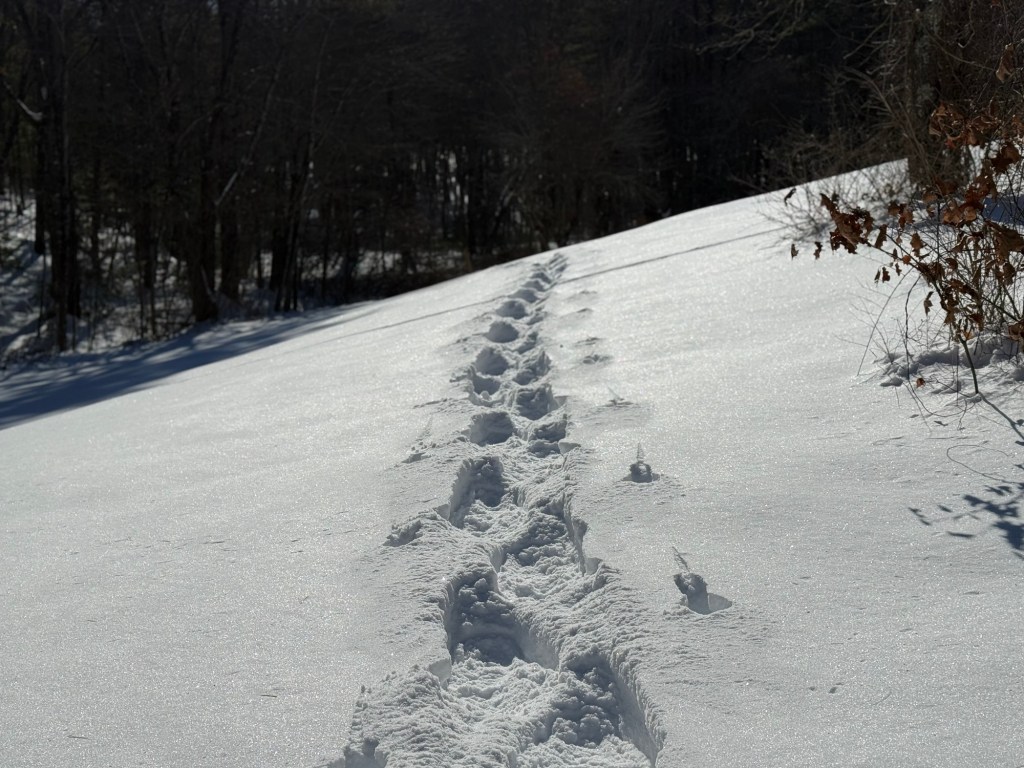
    While snowshoeing Saturday morning, I came to a split in the trail. I went to the left that morning, breaking trail and returning with the thrill of having been out in it, doing the work of being fully-alive on a bright clear morning. But all that evening I thought about the path not taken. It remained unbroken and unexplored, and with that, I felt incomplete. Those paths not taken have a way of haunting us, don’t they?

    The only thing to do was to go out again Sunday morning to see what was left for me. I silently hoped it would be unbroken still, that I might finish what I started. I saw footprints in the snowshoe tracks I’d laid and thought to myself that the opportunity was lost. But the footprints crossed the bridge and then turned back, indicating someone inclined towards common sense. Why continue on trails without the proper gear?

    The thing is, I had the proper gear. And so I kept on walking to that fork in the path and turned right onto a gloriously unbroken trail, blazing a path for any who might follow. There is sheer delight to be found in the cold stillness of a pristine snowy forest, so long as you’re prepared to be out in it and have the tools to make your way back out again no matter what.

    Having completed that walk, I doubled down with another, bringing the pup to the beach for a second winter walk. That proved far colder with wind chill cutting through our gear. Cold is one thing, cold wind is something else entirely. Even proper winter gear will let you know when it just isn’t enough. We simply have to listen to what nature is telling us.

    The pup loves the beach and could have stayed all day but for the wind. Even clad in a winter coat of her own, she knew when we were having too much of a good thing. Sometimes the best thing to do is to step out into it. And sometimes it’s best to simply turn back with stories to tell. Two stories in fact. Twice beautiful, simply for having ventured out to meet them.

    Two paths diverged. Hampstead Conservation Land.
    Snow on dunes. Hampton Beach State Park.
  • Breaking Trail and Eagle-Spotting

    “I wonder if the snow loves the trees and fields, that it kisses them so gently? And then it covers them up snug, you know, with a white quilt; and perhaps it says, “Go to sleep, darlings, till the summer comes again.” ― Lewis Carroll, Alice’s Adventures in Wonderland

    We are having a proper winter in New Hampshire this season. The cold is unrelenting and the snow consistent. It isn’t inclined to melt away when the days are frigid. Instead we have sublimation of the snowpack, and a sting on the skin. As we step into February, I write of the last day of January 2026, and a walk in the woods I’ll remember as particularly remarkable (so much so that I’m remarking on it).

    Almost a week after the region’s big snow, I finally had some time available to head to the local conservation area for a walk in the woods on my snowshoes. I went with trepidation, for I know the damage that can happen to a trail after a week of people and their pets post-holing through deep snow. But the parking lot was surprisingly empty for a Saturday morning, and the trails themselves were relatively clean. Post-holed for sure, but it’s been so cold and the snow so fluffy that it wasn’t the icy hellscape I thought it might be.

    I still chose to break trail on pristine snow whenever the opportunity presented itself. Making a bee-line across steep terrain from one broken trail towards another. Some of the drifts were pretty deep, almost 4 feet of powder, but my snowshoes were up to the task. Thankfully, so was I!

    Large portions of the conservation land’s trail network were completely unbroken. I smiled to myself at the lucky break and braced myself for the work ahead. Breaking trail on snowshoes is a great workout, and I’d gone out by myself with nobody to share the load. This is where being well-acquainted with working out comes in handy. I’m no Olympian, but I can break a trail for a few miles without passing out from the effort.

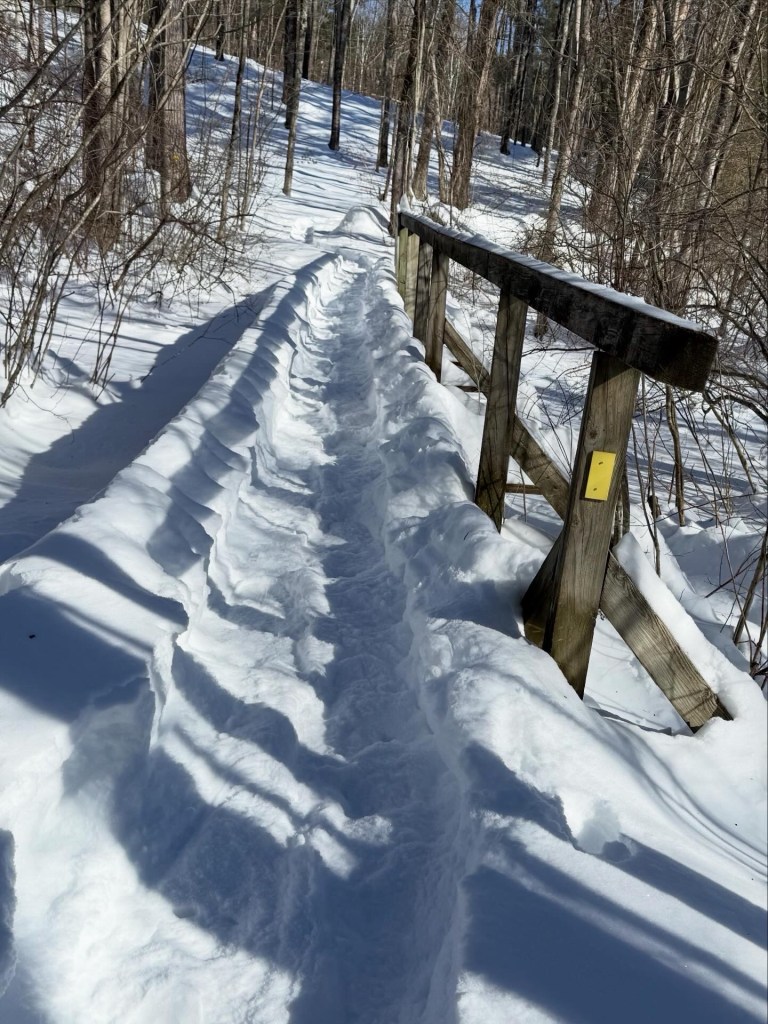
    The larger trail network required an out and back over a bridge spanning wetland. On the way to it the bridge was untouched by anything but snow. On the return, I captured a picture of the trail I’d made on the out and back. It will be interesting to see what it looks like today, with a broken trail that others may have since walked.

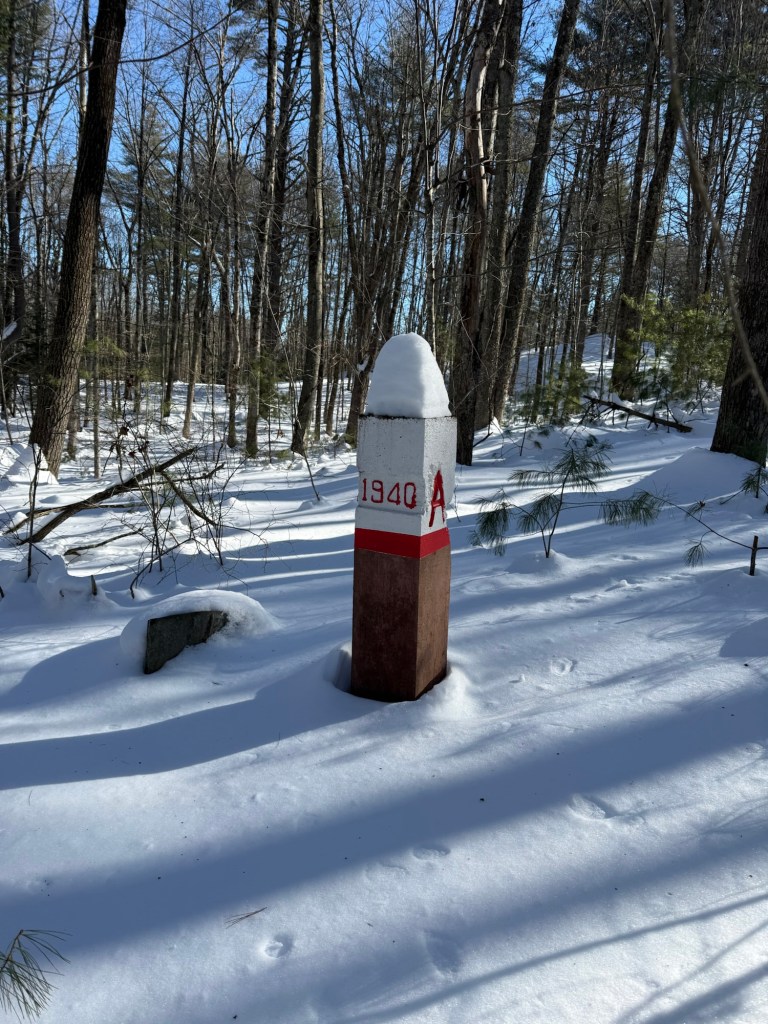
    In one section, I revisited a town border marker that someone has since painted white with red lettering to make it more obvious to visitors. A is for Atkinson. There’s an H on the other side for Hampstead. Most of the trail network covers the latter town.

    For all my time in nature on this snowshoe walk, I didn’t see much in the way of wildlife (It’s not like I’m sneaking up on anybody marching across the snow). Ironically, when I drove home afterwards, a neighbor excitedly told me he’d had three bald eagles in a tree in his yard not more than 30 minutes before. Now we’ve had a lot of wildlife moving through the neighborhood over the years, but none of us had ever seen a bald eagle, let alone three of them together. I’m sure that they’re hungry, and with the rivers frozen over they are scoping out the local valleys to expand their menu.

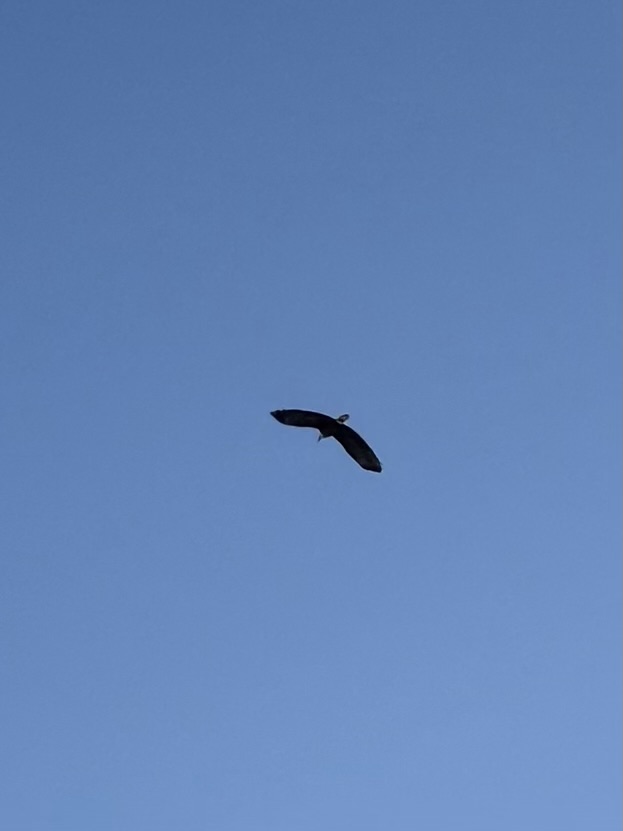
    The odds were against seeing them still in the area, but I recruited the dog for a walk of the neighborhood to see if one would return. Sure enough, I was blessed with a fly-over by one of them. There’s no mistaking an eagle soaring over the landscape, and it was a thrill to see it. By the time I had my phone out to snap a picture it was already past me gliding towards open fields beyond the woods. It was a great way to cap a Saturday morning in snowy New Hampshire.

  • Hiking Through the Boulders of Pawtuckaway

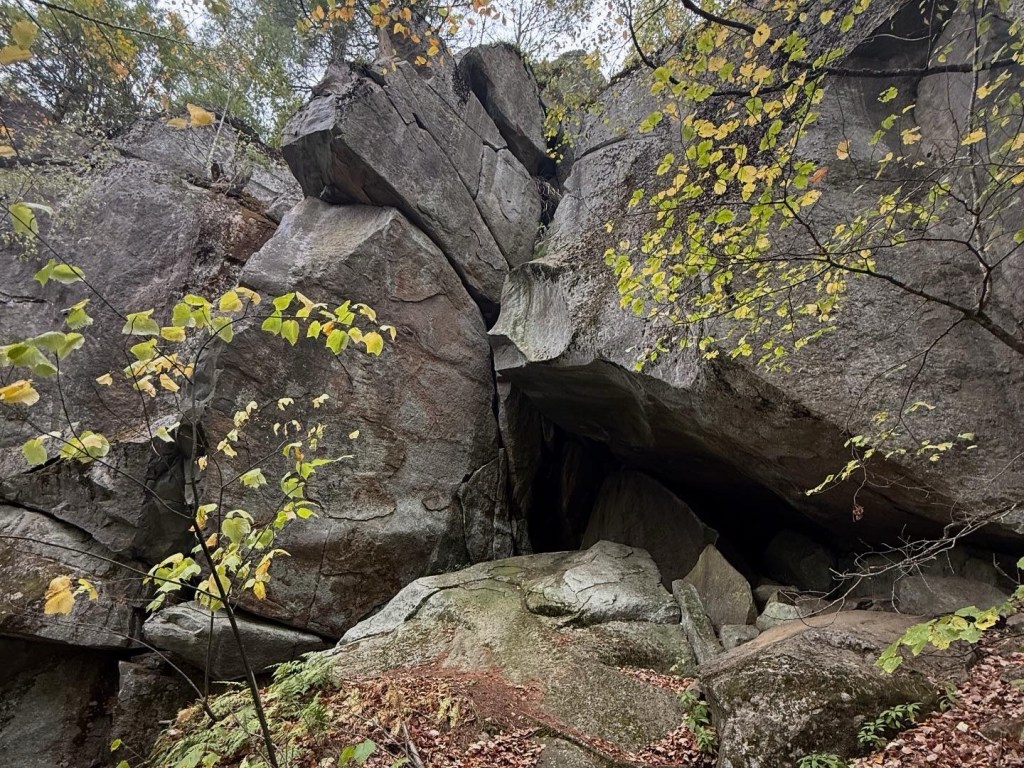
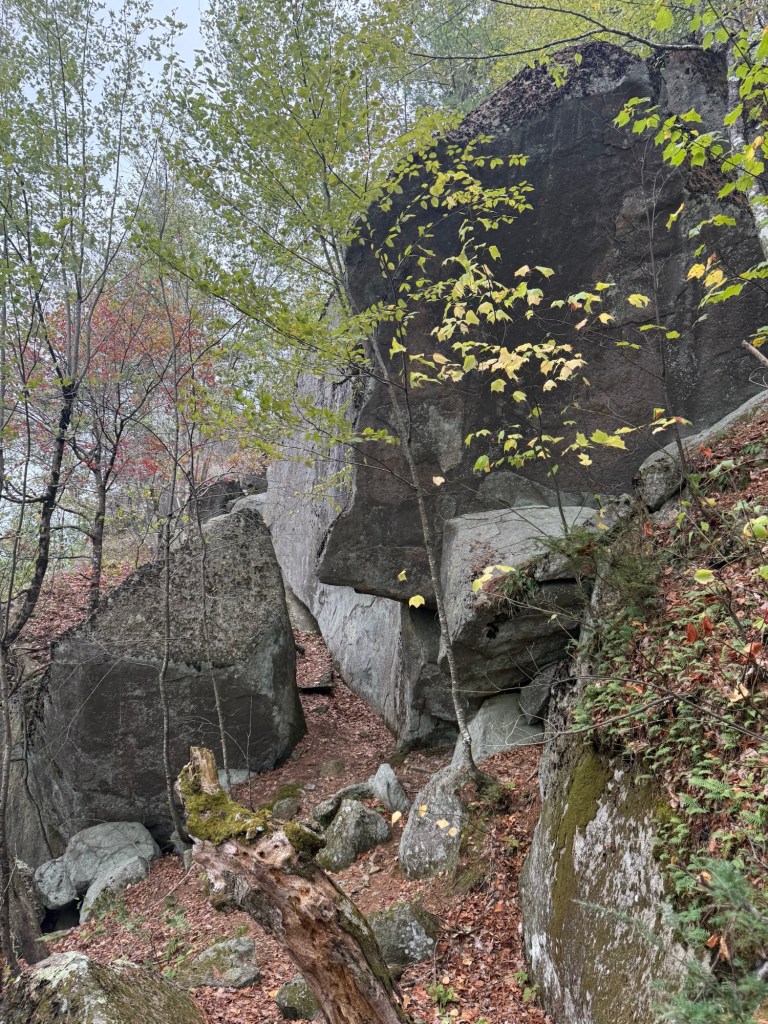
    On a cool, raw and occasionally wet Sunday an avid hiker friend and I explored the trails and summits of Pawtuckaway State Park. Situated within the towns of Nottingham and Deerfield, New Hampshire, Pawtuckaway is easy to reach compared with some other mountains in New England. And of course it’s hard to call them mountains at all, if you want to get righteous about the height thing. Doing North and South Mountains together offers a gain of only 1409 feet, I’m told, but the story isn’t the elevation gain, it’s the geological interest that draws you here.

    “High up on South Mountain a dike of black trap rock cuts the granite-like rock of the mountain, and breaking out rectangular blocks provides the treads and risers of Devil’s Staircase. The top of South Mountain and the firetower rising above it command a view overlooking the sea to the east and the mountains to the north. The Devil’s Den Trail to North Mountain first passes the huge Pawtuckaway Boulders. These tremendous blocks of rock ranging up to 60 feet in some dimensions and probably comprising the largest group of boulders anywhere, are strewn for about a quarter mile along the trail. Once a part of North Mountain, they were plucked by the glacier during the Great Ice Age and dumped in their present position when the ice melted. Devil’s Den was hollowed out by this same plucking action.”
    — Jacob Freedman, The Geology of the Mt. Pawtuckaway Quadrangle

    “Forces in the earth developed a circular fracture around the solid rock, and into this fracture more magma of a different composition rose. It consolidated to form a gray coarse-grained granite-like rock called monzonite, which now makes up the circle of the Pawtuckaway Mountains in what is called a ring-dike.” — Jacob Freedman, The Geology of the Mt. Pawtuckaway Quadrangle

    Winding through these fields of plucked glacial erratics, you’ll find plenty of rock climbers bouldering the monzonite, mountain bikers and the usual assortment of casual and serious hikers navigating the trails, and a surprising amount of horse manure indicating that some of the trails are very popular for horseback riding. There are gravel roads throughout the park as well, and we found these to be useful connectors between trails on our 12 mile hike.

    Reading about the history of the area, it seems there was a character known as the “Barefoot Farmer of Pawtuckaway” named George Goodrich who played a large role in making it a state park. The Goodrich family farmed this rocky land, and you can find the family graveyard within the state park. I can’t imagine hiking the terrain barefoot the way he farmed it, but I suppose a few decades of barefoot farming would go a long way to toughen up the toes.

    New Hampshire is in a serious drought, and you could see the impact it’s having in the streams, ponds and wetlands. Stream beds are largely dried up and the ponds are showing plenty of their muddy bottoms. The foliage is muted this year too after the stress of a dry season. But our hike coincided with the beginning of a few days of rain, and we hiked out to a misty, raw sendoff.

    I’d hiked this place before, almost twenty years ago, focused mainly on South Mountain and the fire tower you can climb up. That’s surely the most popular trail because it’s relatively easy with a nice payoff in views when you reach the summit. But for my money, North Mountain and the ledges and boulders below it are the most dramatic and fascinating place in Pawtuckaway. If you go, you can’t miss them. Shoes are optional, of course, but highly recommended.

  • Low Ground, High Places.

    Autumn is when most people flock to the high ground, searching for vantage points from which to take in the foliage. It’s a lovely thing, that foliage. What is less lovely is the flock of people. Foliage gridlock is the ugly phenomenon of fall. So those of us who live amongst the foliage tend to avoid the popular places. Beauty can be found in the quiet places too. A single orange and red leaf drifting to rest just so is all I need. But oh, those vantage points are stunning too.

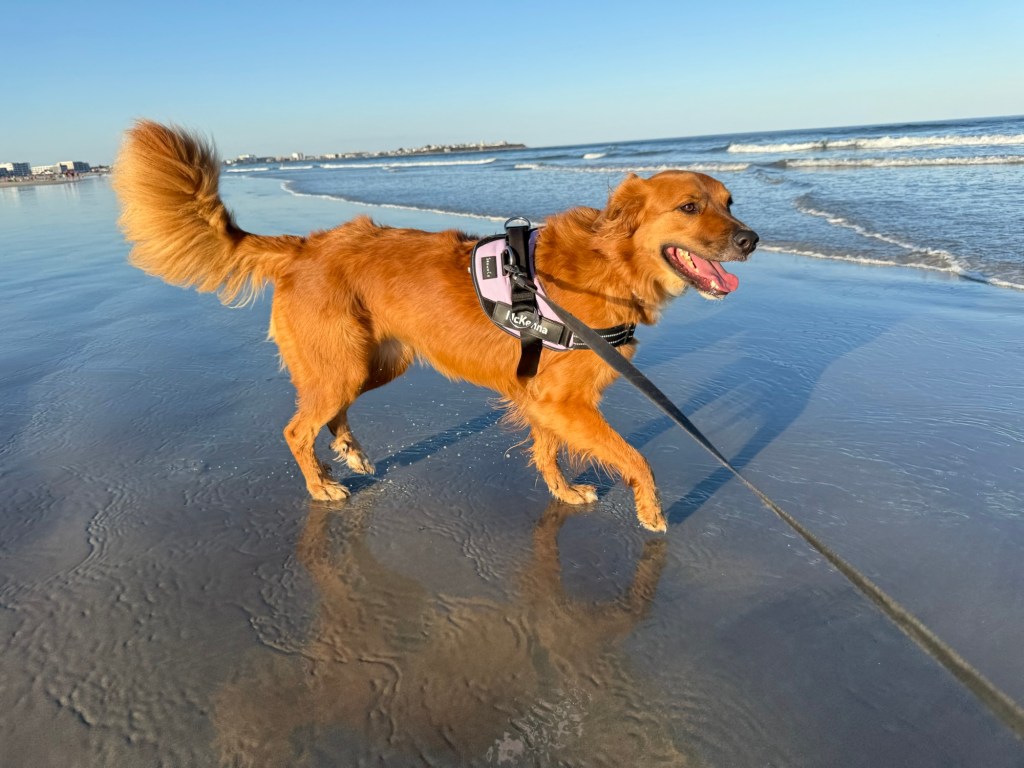
    My bride and I went to the sea to walk the pup in the low tide surf. That’s just about as low ground as you can get in New Hampshire, and we reached the highest of places watching the pup play in the foam, chase seagulls, and giving the horses a sideways glance. In the offseason the horses return to the beach, riders splashing into the waves as they trot the long stretch of firm sand out and back from the state park.

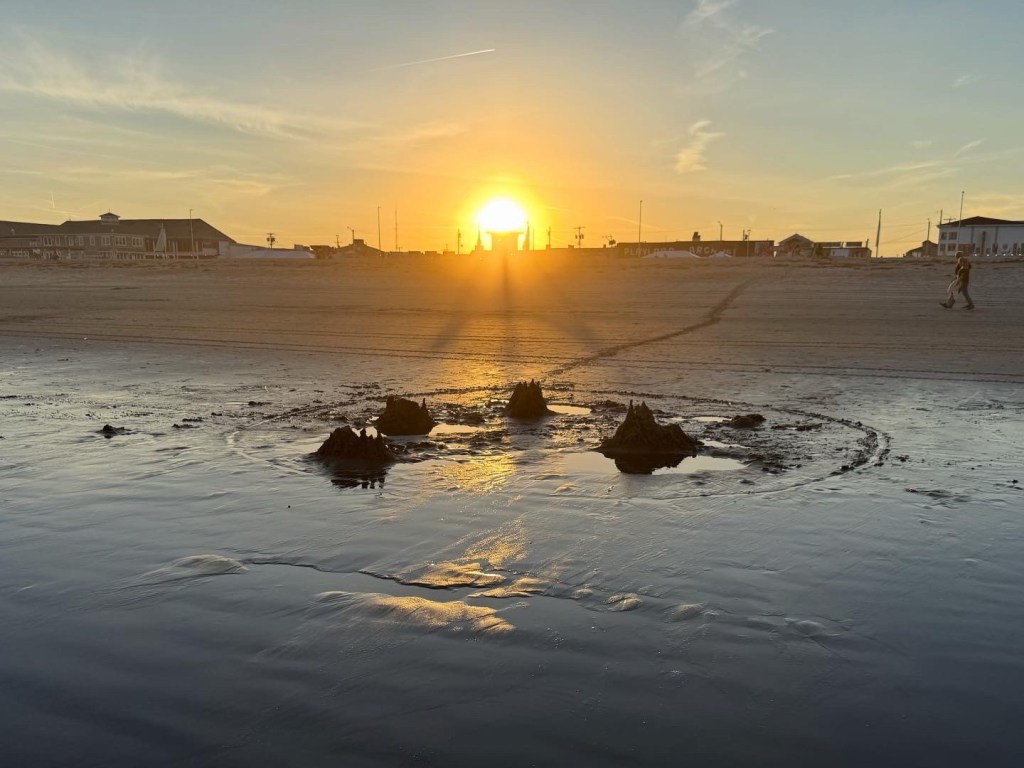
    We also return in the offseason, favoring the relative quiet it offers. Late in the afternoon on a warm October day, we found we had plenty of company but still nowhere near what it must have been earlier in the day. With the surf up and churning its relentless song, the sun casting brilliant warm light as it drops to the west, there is no foliage to wonder at. Walking along the surf line to witness what the low ground has to say, seeing the joy that a beach walk draws out of my two companions, I can tell you that there is magic just the same.

  • See What Unfolds

    The Barred Owls have returned. There is a mating pair that moves through the trees, hooting it up to check in on each other while they each hunted in different places in the woods surrounding us. I’m told that Barred Owls hunt independent of each other, eat what they eat and catch up again later. “So how was work today?” “Fine, had hoped for a baby bunny but only caught a field mouse.” Romantic stuff.

    Also developing in the neighborhood, a large beaver has moved in to the stream, wading about just after dusk above the bridge. It’s been a few years since I’d seen a beaver in the stream, and I’m wondering if the drought had dried up its previous nest. Beaver will move on when their food source is used up, not unlike the owls. We’ve all got to eat. While the owls are big talkers, the beaver works in silence most of the time.

    We’re seeing yet another bumper crop of acorns this year, which explains the abundance of animals that feed on them moving back into the neighborhood (along with the animals that feed on the feeding animals). It’s been a hot dry summer after a wet spring. I wonder what that means for the fall foliage this autumn, but I don’t wonder enough to look it up. We all have the world at our fingertips, don’t we? We ought to let a few things simply unfold before us just to keep the magic in our lives.

    I’m finally reading a paperback version of Niels Lyhne by Jens Peter Jacobsen, based entirely on the recommendation of Rainer Maria Rilke, mind you. I’m at a point in my life when I look around and find most talking heads haven’t got much to add to the conversation, so I dig deeper. Don’t just stop with the work of an author or poet or artist—seek out the works that influenced them. What challenges and transforms us, collectively?

    Today’s world is unfolding exactly as I anticipated when the elections went the way they went a year ago. We are where we are because people believe what they want to believe, and feel emboldened to behave the way they behave because others do it so it must be okay. We too may choose how to react in such times. How do we want to navigate this world that we live in?

    My advice, since you’ve read this far, is to seek out the timeless over the trend whenever possible. Things will come and go in a lifetime. We mustn’t forget that the lifetime in question is ours. We must do the best we can with what unfolds before us. There is more to this world than the madness swirling noisily on the platforms of choice. Go deeper and see what unfolds.

  • Walk it Off

    “Above all, do not lose your desire to walk. Everyday, I walk myself into a state of well-being & walk away from every illness. I have walked myself into my best thoughts, and I know of no thought so burdensome that one cannot walk away from it. But by sitting still, & the more one sits still, the closer one comes to feeling ill. Thus if one just keeps on walking, everything will be all right.”
    ― Søren Kierkegaard

    As I write this, the pup is sighing behind me, expressing some minor indignation that I’m spending these moments tapping on a keyboard instead of walking with her out in her kingdom, where she can keep track of the squirrels and rabbits who dare to encroach. We each have a purpose for our walks, but we share discovery in common. She catches up on the latest action in the neighborhood, I sometimes process the changes myself, or I dive deeply into introspection. Each step is different.

    Walking is a nonnegotiable part of my life. Every day I must walk, if not for myself than for that insistent puppy who has also deemed walking a nonnegotiable. For all my focus on cycling and rowing and kettle bell weight circuits, walking remains the one activity I do every day, and sometimes several times a day. The reason for walking hardly matters now, it’s simply a part of my identity—it’s who I am.

    Philosophy and walking are natural allies. We think best when we are moving, particularly when we don’t have distractions like music or podcasts plugged into our ears. Walking is also the best way to experience a place when traveling, and I make a point of walking extensively wherever I go to. My step count always spikes up when I’ve landed in a new place for a few days. Writing that sentence, I feel wanderlust stirring inside me. Walking is a nomadic experience. Our ancestors migrated around the world on their feet. Why not us?

    All this talk of walking reminds me that the world awaits. Shall we step to it? Be still no more than is absolutely necessary, friend. For we were born to move.

  • Grinding for the Long Term

    “Going from zero weekly exercise to just ninety minutes per week can reduce your risk of dying from all causes by 14 percent. It’s very hard to find a drug that can do that.” — Peter Attia, Outlive

    I’m sore. The kind of sore that you seek out one step or lift or twist at a time. And since I’m traveling as I write this, that means a whole lot of steps. But I’m on a climb back to a higher level of fitness—the kind that lasts a lifetime.

    We are dealt a genetic hand when we are born, and we must learn how to play that hand as best we can to mitigate the bad cards while maximizing the value of our better cards. I’m not much of a card player but I know enough to play for the long term when the cards present themselves a certain way. In poker (and in life) this is called grinding.

    There’s always an excuse for stepping off the fitness path. Yesterday’s excuse could have been deep dish pizza and a birthday toast for my daughter. Neither of those things would have changed a great day by having them. I celebrated with a salad and iced water. There’s a time for carbs and booze, and a time to stay on track. Great days happen when we focus on the joyful essential, not the superfluous extras.

    Similarly, working out every single day can suck a lot of time away from other things we could be doing. What are those things? Are they so important that we can’t carve out an hour or two out of the day to exercise? Usually not. We made a walking tour of Chicago part of our itinerary, seeing things we might not have seen otherwise while increasing our step count.

    They say that life hardens us. But life can also soften us too. We grow comfortable and complacent, and less inclined to do the work needed to be healthy, vibrant and fit. There’s a tax that comes due when we defer our fitness. Pay me now or pay me later…. Choosing to grind each day offers dividends in more energy now and a longer health span down the road. Making that road more vibrant for longer is a great investment in our time now.

  • A Hike in the Upper Las Virgenes Canyon Open Space Preserve

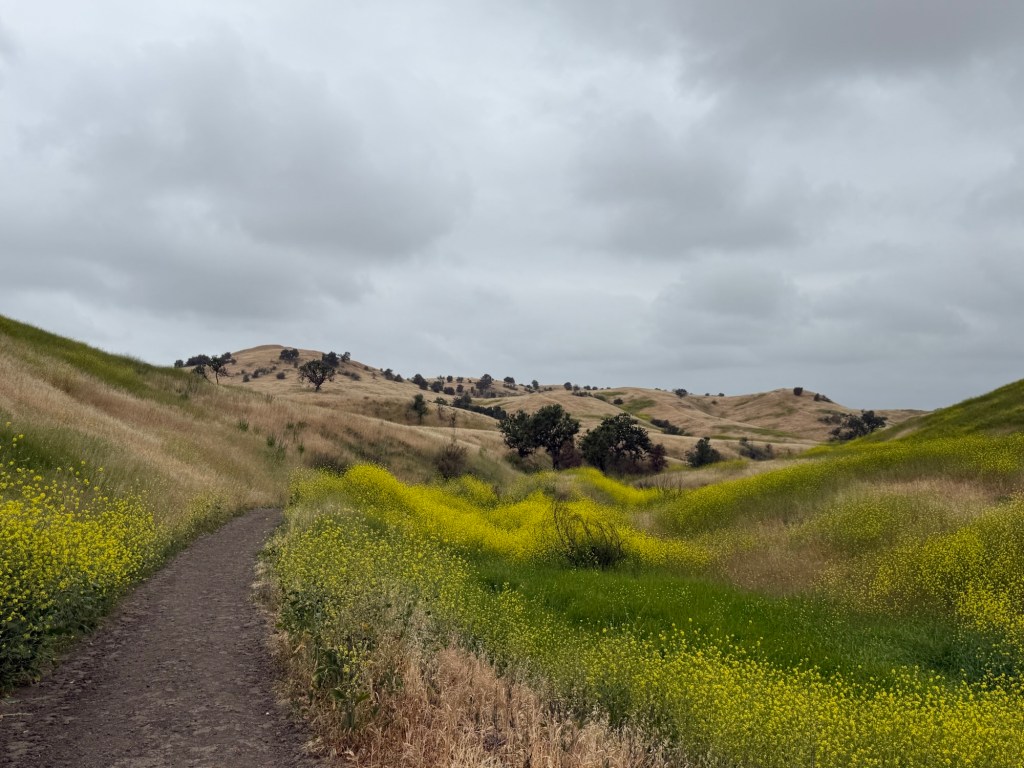
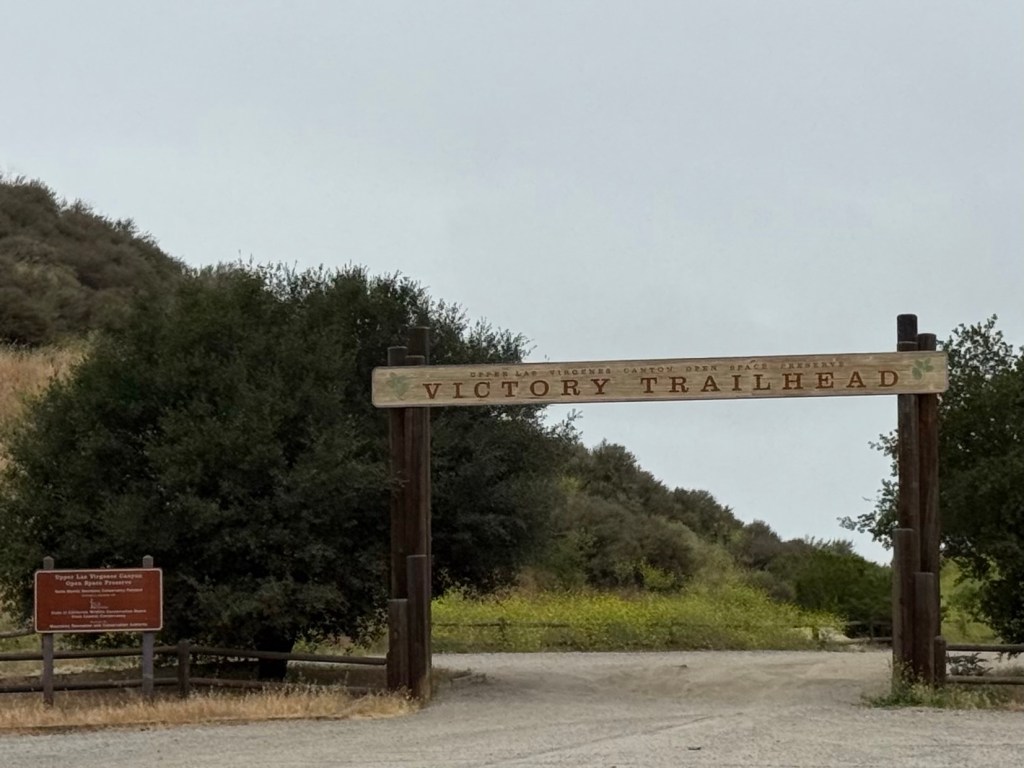
    I don’t hike enough. And I don’t see my daughter nearly enough, so a weekend in Los Angeles filled the gap between East Coast and West Coast. She found a gem of a hike in the Upper Las Virgenes Canyon Open Space Preserve for our final day together before I flew home. And as usual, we found adventure.

    “The more than 5,600-acre Upper Las Virgenes Open Space Preserve in the Simi hills at the western edge of the San Fernando Valley, is part of a critical ecological linkage and wildlife corridor between the Santa Monica Mountains and the ranges to the north. Hikers, runners, mountain bikers and equestrians enjoy miles of trails through rolling hills studded with valley oaks, sycamore-lined canyon bottoms, and vistas of unspoiled California landscapes.” — Upper Las Virgenes Open Space Preserve web site

    Our hike in May coincided with peak blooming of the wild mustard, painting the rolling hills in yellows and greens. That wild mustard is an invasive species and takes over the landscape. It also grows pretty tall, well over my head. On the main trails that’s a pleasant observation. On the single-track side trails, it becomes a gauntlet of greenery that almost fully obscures the trail. Those flower petals quickly cover you head to toe. Naturally, we chose these trails to close out 2/3rds of our 4 mile hike. Who doesn’t love an adventure?

    Neither of us would have hiked it solo, but with me parting the sea of mustard and my daughter keeping a close eye on All Trails, we found a strong pace for the trail. The only lingering concern was the distinct possibility of disturbing a rattlesnake partially obscured on the trail. So every step was a close survey of where I was about to step. And one step at a time we eventually completed the hike and savored a celebratory tap of our Garmin watches as we got back to the car.

    Our hike was admittedly unique. Anyone sticking to the main trail will have an easier time of it, and be able to fully savor the views. We also hit the trails while the wild mustard was at peak. Beautiful for sure, but also a contributor to the state of the single track trails. Know what you’re walking into and choose wisely. For us, it was another strong memory built on a bit of boldness.

  • Our Vehicle to the Future

    “Small habits don’t add up, they compound.” — James Clear

    What happens when the routine becomes, well, routine? We must change our habits in order to course correct towards something more desirable. We’ve got to disrupt what was once our normal and create a new normal. And yet we know from looking around at the world that just because a normal is new doesn’t make it desirable. Habits that once worked for us seem to conflict with the person we’d like to become. Life can feel complicated in this way.

    The leap into the unknown will happen in January for millions of people with those ambitious resolutions. We know how that will work out for most. It’s not that the goal is wrong, it’s that the desired outcome hasn’t been designed properly into our lives. Lasting change is realized through a daily reckoning with habits. James Clear would point out these habits are rather small, but compound as they become a part of our identity. Writing this blog is one of mine, and it’s survived a lot of challenging days thus far simply because not doing it on any one day would break a streak I don’t want to see broken. And here we are.

    If the pup could write she’d point out that our evening walk is another habit that must not be broken. We aim for a mile, sometimes overachieve and sometimes do half as much, but it’s our routine. And at this point in our time together, she wouldn’t have it any other way. When I travel I know I’m breaking my part of the deal and try to make it up to her with a longer walk next time.

    Habits are like contracts. Just as an athlete signs a contract and puts on the uniform of that team, we assume the identity of our collection of habits. Our interests, compounded, are who we become. But when we become interested in changing, we must turn against the current of habits that brought us to who we are now. No wonder it seems so difficult to change. Just like any of our investments, we ought to be very deliberate about where we want to be when we arrive and create a system that compounds over time. Small habits aren’t just our behavioral pattern, they’re our vehicle to the future.

  • Quiet Places

    We could all use a bit more quiet right about now. Whichever side of the cultural or political divide we fall on, it’s been a noisy, relentless year. If everything has its season, now seems a good time for some restorative quiet. Reaching quiet places is a journey with many possible routes. Which we take is less essential than the act of taking it.

    We don’t need money to find quiet, just a bit more social engineering and applied creativity. Removal from the noise is the obvious way—simply turn off the relentless media and walk away. A walk in the woods would be lovely, though orange is a must here in New Hampshire during hunting season. So maybe a walk on the beach would serve better for the next few weeks. However we find nature, it offers a whispered message that eternity doesn’t care a lick about our problems. Should we?

    I find the tactile more valuable than the electronic when seeking silence. Picking up a pen and scratching on a pad of paper can draw the noise right out of us and carry us to more enlightened places. Menial tasks like washing dishes or sweeping the floor may feel like chores when we begin, but carry us to quiet places as we work our way through the task.

    Ironically, sometimes the opposite of silence is just the answer. Lately I’ve returned to some music from my childhood that I’d pushed aside when a younger version of me thought it wasn’t cool enough. It’s probably still not cool enough, but neither am I, so who cares? I know all the words and that can be enough at this stage. Sometimes it’s not physical quiet at all, but internal quiet. Music drowns out the other noise around us and reminds us that some noise is joyful. That negative noise just gives up and floats away for a while.

    We aren’t monks or hermits, most of us anyway, and sequestering ourselves in quiet solitude isn’t a forever act, but a cyclical act of renewal. Just as the trees have shed their leaves and gone dormant, we need to give our minds the time to go dormant too. The noise level will inevitably rise again, but quiet has its place. Perhaps more than ever.