Category: Walking

  • Snowy Morning Bliss

    “In the woods too, a man casts off his years, as the snake his slough, and at what period soever of life, is always a child. In the woods, is perpetual youth…. In the woods, we return to reason and faith. There I feel that nothing can befall me in life,—no disgrace, no calamity, (leaving me my eyes,) which nature cannot repair. Standing on the bare ground,—my head bathed by the blithe air, and uplifted into infinite space,—all mean egotism vanishes. I become a transparent eye-ball; I am nothing; I see all; the currents of the Universal Being circulate through me; I am part or particle of God. – Ralph Waldo Emerson, Nature

    I admit to a bit of excitement. Adrenaline coursing through me as I anticipate the first steps outside into the freshly fallen snow. A few inches of the fluffy stuff fell from early evening and overnight and still drifts downward in lazy accumulation. Not enough to strap on the snowshoes (pity), but enough to make an adventure of the walk. What is winter for if not to be a kid again when it snows?

    My destination is the woods. The woods grow silent in the snow, and I fill with reverence. The days inside are long, for there is much to do in this forever connected march to quarterly numbers and customer engagement and cross-department collaboration. But the early mornings are mine alone. And there is magic in the air. And underfoot.

    I am the lover of uncontained and immortal beauty.” – Ralph Waldo Emerson, Nature

    The world ought to be filled with wonder, I think. But most people slide into survival mode, leaving their inner child far in the rearview mirror to face all the horrors of the world stoically. But the stoics saw the wonder of nature as Emerson saw it, and shouldn’t we too, while we still have both nature and the capacity to marvel at it?

    I always smile when I come across people from places without snow who walk outside in awe, snapping selfies in a frozen wonderland. Living in the snow globe we sometimes forget to shake it up and embrace the swirling magic. Not us, thank you. We’ll walk and swirl in the magic too.

    Morning Snow
  • Packing a Winter Day in Maine

    Some days nothing much happens. That line a day summary looks very long when you sat in your house all day. Other days you jamb ridiculous amount of activities in a relatively short number of hours. Those days you flop down on the chair, exhale and assess. And that’s where I find myself today.

    The morning started with a snow squall and limited visibility that bordered on return home and wait it out intensity. But the radar showed it tracking away from where we were heading, so we pressed on. Sure enough, the snow soon disappeared and we settled into a normal early morning drive. Destination? Mount Agamenticus in York, Maine.

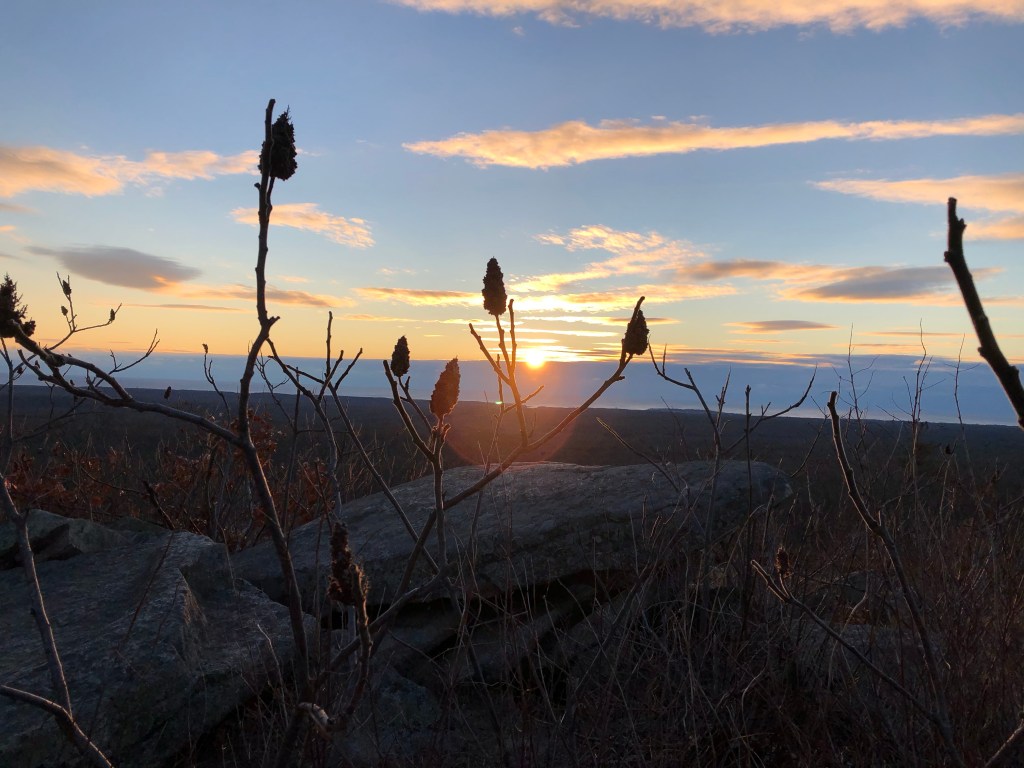
    Sunrise on this mountain top has been covered here before, I know. But we were heading to Maine anyway, so a quick hike up an old mountain for sunrise seemed like a good idea. And really, outside of the biting wind chill at the summit it wasn’t a bad way to subtract an hour of sleep from your morning.

    Next stop was breakfast at a family restaurant called Lucky Loggers in a Saco, Maine strip mall. This is the kind of place that Google searches are made for, and with 4 1/2 stars it was a no-brainer for a half dozen frozen early risers. Mission accomplished: they thawed out the group, filled our tanks full of goodness and bolstered the spirit for the next highlight in a packed morning: waterfalls.

    Hidden away amongst the touristy businesses lining the roads in Saco is a small parking lot in a stand of hemlock trees. This is the parking lot for Cascade Falls, a 20 foot wonder wedged in between granite and forest. There’s a sign that says this particular spot doubled as the Yukon in a 1930’s silent movie. It’s a lovely spot, even with large fallen trees partially obscuring the falls. On a cold January morning, ice lined the edges of the falls and the brook downstream. If you didn’t know you were in Saco you’d think you were deep in the White Mountains.

    After Cascade Falls, we drove up to Portland to see Jewell Falls in the Fore River Sanctuary. As advertised, it sits right in the middle of the city, and is a pretty little waterfall that must be really impressive when the water is running high. I’m grateful for resources like New England Waterfalls for pointing out this little gem I’d never have found on my own. For all the trips I’ve taken to Portland, I’d never known about Jewell Falls. Waterfall number two in the books, we turned westward for our third and final waterfall of the morning.

    Jewell Falls

    Waiting behind door number three this morning was Steep Falls in Standish, Maine. This was the toughest of the three to find, but featured the powerful waters of the Saco River dropping six feet into a churning pool on its way to the sea. This is where a resource like New England Waterfalls really becomes invaluable. Without it I’d never have seen this place in my lifetime. Even with the book it took a few minutes to figure out where the falls actually were. But upon arrival, we were all thrilled with the performance.

    Steep Falls, Saco River

    So there we are, three waterfalls in a small triangle in coastal Maine. We happened to do them in the order they were listed in the book, but that was coincidence. Having visited a number of waterfalls from the book before and since purchasing it, I can confirm the value of the book and recommend picking it up if you want to start your own New England waterfall adventure.

    So how do you cap a morning like that? With a beer with friends followed by a visit with a new puppy in the extended family. Driving back home we saw the sun setting over the Merrimack River and realized it was a very long day indeed. But so full of small adventures and memories. Another day in New England winter, but packed with more than the average.

  • Getting Lost With Waterfalls

    The day started with heavy, gusty rain. The kind of rain that would be a nor’easter had it been snow. The kind of rain that makes you glad you’re indoors looking out a window at it. And paradoxically, the kind of rain I wanted to be outside fully alive in. There’s an edge to any storm, and this one was abating just enough to prompt me to pursue a micro adventure or two. I packed up my rain gear and a water bottle and headed out to visit waterfalls.

    First stop was an hour from home, at Willard Brook State Park in Ashby, Massachusetts where the beautiful Trap Falls pour forever over granite ledge. This is a popular spot in the warmer months, but on a rainy Saturday in January I was the only one there. The falls were roaring from the rain, and easily heard from the small parking lot. A brief, shuffling walk on a few slippery spots and I was quickly at the falls, and thought it might be a trick. How could I have this all to myself on this day when the falls were screaming for attention? The answer lies in that moment when I looked out the window and decided I ought to go out in this weather, while the rest of the world thought that would be a crazy idea. Score one for the crazy folk.

    Trap Falls

    A few pictures and rock scrambles later, I headed back to the car and consulted the maps in Greg Parson’s excellent resource New England Waterfalls, which I’d picked up as a gift to myself while purchasing a gift for kindred spirits. Parson’s recommended a cluster of waterfalls just over the border in New Hampshire. I looked at two in particular as promising and plugged in their coordinates in my Waze app and headed off for more adventure.

    Driving towards Milford, New Hampshire, I decided to focus on Lower Purgatory Falls as my first choice, and sought out the trailhead on Wilton Road. The trailhead displayed some icy conditions and I brought my micro spikes with me for this hike. I would soon be grateful for having them.

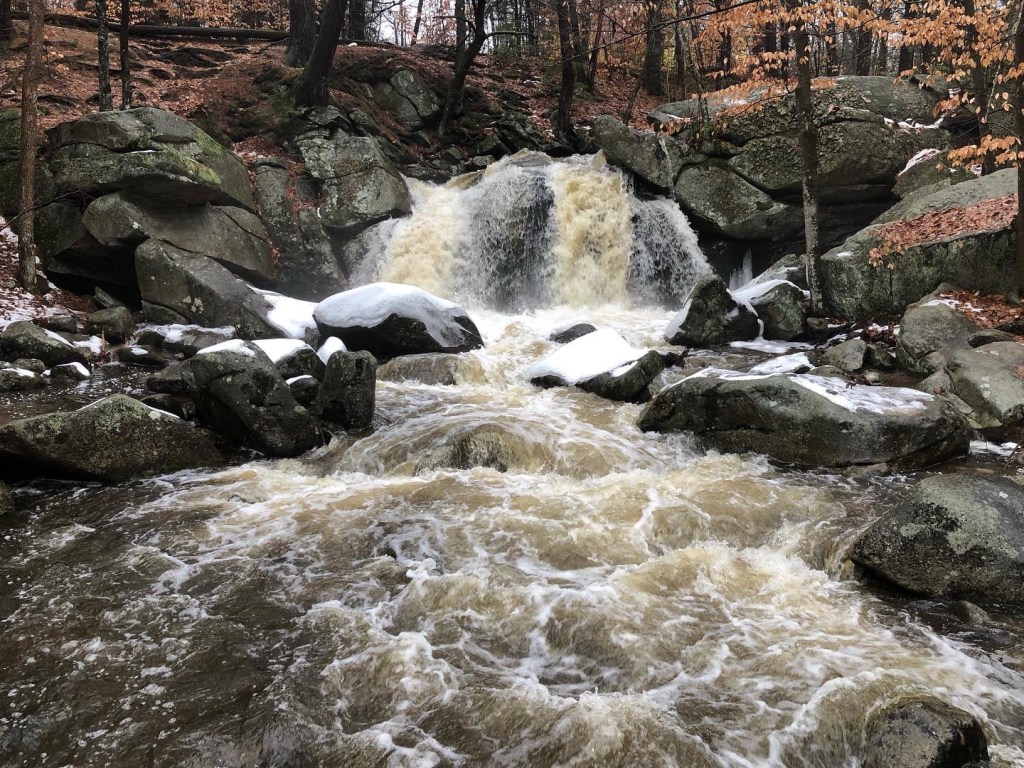
    The walk from the road to the falls is roughly half a mile. Nothing too crazy, really, just an old logging road that carries you to a yellow-blazed trail. And like Trap Falls, you could hear Lower Purgatory Falls well before you got to them. The falls are named for Purgatory Brook, a beautiful stretch of water that was white water after all the rain. Cresting a small rise, I saw the falls ahead and worked my way down to see them.

    And this is where the micro spikes were absolutely required. I was hiking solo in isolated conservation land on a day when nobody else thought it logical to be out there. A slip and fall would have been bad news. Micro spikes remain one of the best hiking investments I’ve ever made, and they offered a clear return on investment as I made my way down an ice covered hill with wet roots and rocks making up the better footing.

    Lower Purgatory Falls is a triangle-shaped wonder set deep in the woods of the aptly named Purgatory Falls Conservation Area. After the heavy rains and melt-off the falls had a lot to say, and I lingered by them for a bit to tap into their energy. Again I wondered why I was the only fool out there on this day, but I’m grateful I never came to my senses and stayed home.

    Lower Purgatory Falls

    As I was leaving the car I took a picture of the trail map supplied in Parson’s book. It indicated I could hike upstream to see Middle and Upper Purgatory Falls. The trail seemed clearly blazed in yellow and tightly followed the brook. And so I made my way upstream seeking more adventure. I found it.

    Hiking along the swollen brook, there were a couple of spots where it flooded over the trail, making for sketchy crossings. Not plummet into a frozen brook sketchy, for I’m not that crazy to attempt such things, more water deeper than your boot is tall sketchy. I made a few calculated crossings, trail blazed in a couple of spots, but always stayed safe and kept the yellow blazes in sight.

    Mossy Erratics
    Purgatory Brook, swollen with rainwater and melt-off

    Eventually the trail dead-ended at a development with a port-o-potty announcing “progress”. I silently cursed the abrupt ending to the trail, looked around to see if I’d missed it diverting elsewhere, and doubled back towards Lower Purgatory Falls, crossing anew the sketchy water crossings I’d already attempted.

    And here’s where it got interesting. I returned to the spot where I’d first seen the falls, looked left and right and saw yellow blazes going off in different directions. WTF.

    “Make sure to return on the trail you came in on as there are several official and unofficial paths in the area. Look for the yellow blazes and the junctions you passed through on the way to the falls originally.” – Greg Parsons and Kate Watson, New England Waterfalls

    Well, this is where I went wrong. I took the wrong yellow-blazed trail towards what I thought was a return to my car. After a few minutes of walking I was aware that I didn’t recognize any part of this trail. I doubled back and saw a logging road I’d ignored before and started following it until it dead-ended. Damn. And this is where you make choices deep in the woods. I could blaze my own trail through the woods with the compass on my cell phone, a picture from a book and Google maps as my guide, or I could double back once again and find the right trail. I’ve learned to trust my instincts in such situations, and not trust a phone battery. I doubled back.

    Finding a junction in the trail, I saw the yellow blazes once again splitting off in two directions. Who the hell blazed this land?? I stuck with the more worn trail and followed it to a place where (surprise!) I’d been before. It seems I’d followed the yellow blazed loop back around onto itself. And this is why bringing a compass and a reliable waterproof map is essential. Having neither, I relied on my experience in similar situations and kept my head about me. Since I was back on a trail I recognized, I simply followed it back to the Lower Purgatory Falls. Once there I saw immediately where I’d gone wrong and followed the correct yellow-blazed trail back to the logging road and eventually to the trailhead. Phew!

    This adventure started off as seeking a few waterfalls on a wet day. It became a small test in orienteering in unfamiliar woods on a wet, disorienting day without the proper equipment. And it ended with me deciding that two waterfalls were enough for one day. I thanked my wits and good fortune and headed home. The other waterfalls will have to wait… for now.

  • A Realm of Sunset and Moonlight and Silence

    “My house stands in low land, with limited outlook, and on the skirt of the village. But I go with my friend to the shore of our little river, and with one stroke of the paddle I leave the village politics and personalities, yes, and the world of villages and personalities behind, and pass into a delicate realm of sunset and moonlight, too bright almost for spotted man to enter without novitiate and probation. We penetrate bodily this incredible beauty; we dip our hands in this painted element; our eyes are bathed in these lights and forms.” – Ralph Waldo Emerson, Nature

    I’m returning Emerson once again, partly to counter the din of political tweets and headlines that dominated over the last week, and partly because I’d like to read or re-read all of his work in 2021. Which brings me back to his essay Nature, for (I believe) a third reading. And I couldn’t help but linger on the sentence above, which resonates in this time, and for this place I myself reside, in a house in low land, with limited outlook, on the skirt of the village. Emerson had the Concord River to paddle to truth. I have the New Hampshire woods and the wildlife it sustains to show me the way.

    Days like these, a quiet bit of immersion in the forest seems in order. We live in strange times, distracting times, and I’ve seen the impact on my writing lately. Thankfully, I know where to find the remedy: in nature, in tapping into the Great Conversation, and in solitude.

    “Accept what comes from silence.
    Make the best you can of it.
    Of the little words that come
    out of the silence, like prayers
    prayed back to the one who prays,
    make a poem that does not disturb
    the silence from which it came”

    – Wendell Berry, How To Be a Poet (to remind myself)

    A special thanks to Maria Popova and Brain Pickings for pointing out this particular poem in a recent tweet. This poem immediately served as a catalyst on two fronts: to search for more Wendell Berry and seek the silent contemplation I’ve stolen from myself absorbing the madness of the world. Silence, as they say, is golden.

    So outside of paddling off on my own or building a small cabin in the woods, how to bring together the natural world and the silence necessary for contemplation? The answer, for me, lies in early mornings. The conspirator against a quiet mind is the whirl of madness in the world and a desire to keep up and understand it. In these times, finding a way to paddle or walk away from it all, if only for a little while, seems imperative.

    If only to find your own voice again.

  • Quality Time

    “What is the state of things, then? It is this: I do not regard a man as poor, if the little which remains is enough for him. I advise you, however, to keep what is really yours; and you cannot begin too early. For, as our ancestors believed, it is too late to spare when you reach the dregs of the cask. Of that which remains at the bottom, the amount is slight, and the quality is vile.”
    – Lucius Annaeus Seneca, Letters from a Stoic

    Re-read that Seneca quote and measure your use of alive time against what you have left in the cask. If this year offered plenty of cause to question our use of time or the unfairness in the world, it also gave us time to think and to pivot towards better uses of time than we might have before. But the irony is that we can’t waste time dwelling on it, we can only use it as a guiding light for what we do next.

    Our current use of time is not rational. There is therefore no point in seeking marginal improvements in how we spend our time. We need to go back to the drawing board and overturn all our assumptions about time. There is no shortage of time. In fact, we are positively awash with it. We only make good use of 20 percent of our time. And for the most talented individuals, it is often tiny amounts of time that make all the difference.” – Richard Koch, The 80/20 Principle

    I got out and walked yesterday, pondering the narrow shoulders of the roads in my town and the number of cars driving on them in the busy stretches, and appreciating the quiet stretches with no cars where I could think. The takeaway was to remove the busy roads and walk in places where thinking is 80 percent of your walking time instead of simply surviving the experience. The time allocated to walking was always available to me this year, I just put it aside more often than I used it.

    I think back on the crazy year that was 2020, and wonder where the time went. Too much time on useless activities, chasing after opportunities that turned to vapor in the hard reality of the pandemic, and squandering time on social media, political debate, and watching entertainment of questionable quality. I spent more time with an iPhone in my hand than I should have, but tried to use that time reading the Kindle app, learning a bit of French and Portuguese, and taking pictures of the good moments.

    “The 80/20 Principle says that we should act less. Action drives out thought. It is because we have so much time that we squander it…. It is not shortage of time that should worry us, but the tendency for the majority of time to be spent in low-quality ways… If much greater work would benefit the most idle 20 percent of our people, much less work would benefit the hardest-working 20 percent; and such arbitrage would benefit society both ways. The quantity of work is much less important than its quality, and its quality depends on self-direction.– Richard Koch, The 80/20 Principle

    During those moments of thinking time while walking I turned over the key points of Koch’s book in my head, thinking about the the quality of the time spent and how to spend it better. We don’t really know what’s left in the cask, but we know it’s not as full as it once was. The 80/20 Principle is both obvious and widely ignored by most people. But why be most people? When applied to our use of time, the pursuit of quality becomes… imperative.

  • Visiting Waterfalls in the Rain

    Cleveland has a reputation for being all concrete and manufacturing plants on the edge of the lake. The “mistake by the lake” as some would say. But Cleveland is also ringed with an extensive park system, the “emerald necklace” that offers access to beautiful places nearby. All you’ve got to do is seek it out. I’ve made it a practice to be a seeker of beautiful places wherever I go, and this trip to Cleveland wasn’t going to be an exception.

    I stayed in a hotel in Independence, largely because it was between places I was going to for business meetings. What I learned quickly was it was also in close proximity to the Cuyahoga Valley National Park. There’s a waterfall in this park, Brandywine Falls, that is supposed to be stunning. I didn’t have the time to visit Brandywine on this trip, but will save it for the next one. Instead I looked at smaller falls within 15 minutes or the hotel and found two very close to each other in the Bedford Reservation: Great Falls at Tinker Creek and Bridal Veil Falls. I silently plotted a visit, and when Thursday morning remained open I had my opportunity to see them both.

    Waze told me I was 16 minutes from Great Falls, and I made my way there first. It was pouring out, reminding me of visiting the Isle of Skye exactly a year ago with the constant soaking raw rain. And here I was again, chasing beautiful places in soaking rain. I stopped at a store and bought a $6 umbrella that felt like it would fold in half in the first gust of wind. It turned out to be just enough for me to ignore the rain and focus on the task at hand: finding the falls.

    Waze sent me to the viaduct instead, and after walking on the paths down to the edge of a long drop to the river I realized this wasn’t the place. Getting my bearings using the park maps I figured out where Waze had steered me wrong and saw that I was actually closer to Bridal Veil Falls and went there next. The benefit of the steady rain was I was joyfully socially isolated. No COVID in the park today, thank you. The mask remained in my pocket. The drawback was nobody to offer recommendations, but heck, I’m an explorer at heart. Go explore.

    Bridal Veil Falls was more obvious, with a parking lot and good signage. There’s a boardwalk that helps you navigate the walk down to the falls easily. This makes this site good for all ages. With the stairs it would be challenging for wheelchairs to get all the way to the falls using this path, but there seemed to be an alternative on the other side of the river that might have worked. Bridal Veil Falls was roaring from all the rain, and reminded me of similar falls I’ve visited in Ithaca, New York.

    Bridal Veil Falls, roaring on this wet day
    Deerlick Creek above the falls. Wooden bridge and pathway up to the road.

    Checking my watch I knew I had time to visit the elusive Great Falls, and reviewed the map again. The problem wasn’t Waze, it was the operator who put Viaduct Park in as the destination instead of Great Falls. As is almost always the case, it was user error and I was the user. A quick drive got me where I needed to be and I took my cheap umbrella for another walk.

    If Bridal Veil Falls is deep in the park, Great Falls is on the edge of town. Cleveland Metroparks offers this description of the site: “Great Falls of Tinkers Creek shows the natural beauty and historic relevance to the development of Bedford“. Hint: “historic” and “development”. The falls are beautiful but the site isn’t pristine. There are ruins of an old grist mill on the edge of the falls and graffiti from some misguided soul that ruined a beautiful photo op. Just downstream is a large stone viaduct that used to support trains. These falls had a vibe closer to the Pawtucket Falls in Lowell, Massachusetts. Still beautiful, but more… “industrial revolution“. The rain ensured I had it all to myself, and I was careful with my footing on the wet leaves and mud. Didn’t want to be that tourist who slid into the river with his cheap umbrella and iPhone.

    And with that it was time to drive to the airport, only 30 minutes away, but seemingly much further. That’s the benefit of parks like this; you can be deep into natural beauty in minutes. And as I drove past a sea of concrete and steel and asphalt on my way to the rental car drop-off, I was grateful for the reprieve. You never know what the world offers just around the corner until you go look for it.

    Great Falls of Tinker’s Creek
    Stone Viaduct with the modern railroad bridge just downstream from Great Falls
  • The Endless Stream

    “Make a list of the activities that are non-dual in nature… Meditation, yoga, creating art, playing, reading for fun, writing, journaling, creating a business for fun. Not fooling yourself, paying attention to yourself. Not taking yourself too seriously. Examining your own thoughts for first principles. Doing activities for you and not the external world,” – Naval Ravikant, on The Tim Ferriss Show Episode #473

    I walked the endless stream again Thursday night. By endless stream I mean primarily the rail trail with its endless stream of bicycles rolling past in both directions. I had tried this for the third time since March to take a long walk on the rail trail, and found yet again that it wasn’t the charm but instead the third strike. Like going to a crowded beach you just don’t get any deep thinking done when people are moving past you in close proximity. Sprinkle in a pandemic and the maskless masses become distracting. It’s just not meant to be until the weather turns.

    I’ve used this go-to rail trail a few times in recent years to sort through various consequential life chess moves. Like Naval’s list above walking is non-dual, offering a bit of exercise and a chance to meditate while moving. Walking has always been the cork screw that opens the mind, but it sneaks up on you. I don’t generally have eureka moments but often experience slow dawns. I suppose I have a slow-twitch kind of brain that’s built for pondering, not the fast-twitch brain built for the rapid decisions that fighter pilots and gamers have to make. But I think the world needs deep thinking more than it needs gamers.

    And that’s the other endless stream we navigate: the endless thoughts that run through our head, all demanding attention. In other years I would take that thought and jot it down in the bullet journal and categorize it somewhere in the Getting Things Done way of emptying your head. In 2020 I categorize less than ever before. I don’t believe this is beneficial. But I ponder more.

    “The world is nothing but change. Our life is only perception.” – Marcus Aurelius, Meditations

    As I walked distractedly on the rail trail, not coming to any revelations, I thought that it encompassed the madness of the last seven months perfectly. An endless stream of distractions coming at you, a jumble of things to sort out in your head, and an out-and-back journey that didn’t really bring you anywhere but back where you started. And yet I was better for having done it. If that analogy holds true then there’s hope for humanity and the earth for having lived through this particular trip around the sun. We’ve all learned a collective lesson about how we treat each other and the planet. We’ve all suffered through an endless stream of setbacks to return again to the beginning and a fresh, more hopeful starting point.. One can hope anyway.

  • Return to the Rail Trail

    For the first time since early in the pandemic I decided to take a walk on the Windham Rail Trail after work. I figured at dusk most people would be wrapping up their time on the trail and heading home. I figured wrong. I nodded a greeting to those who made eye contact, ignored those who didn’t, and held my breath many times for the unmasked swarm of humanity that passed by in close proximity unmasked and unconcerned. I’m not a germaphobe, but at this point in the pandemic I’m informed enough to limit such risks whenever possible.

    You notice a lot of things when you walk a trail often: The change of seasons and how that impacts the trail, the increase in traffic, encroaching development, the casual disregard for others by the relative few who dispose of bagged pet waste on the side of the trail, and the ebb and flow of wildlife. My six mile walk was informative. Comparing it to the fall of 2019 at a similar time of day it was much busier, with many more bicyclists than you’d see a year ago. More walkers too, but not exponentially more. No, it was the swarms of bicycles that were noticeable… and notable. Headlines like “Bicycle sales skyrocket during COVID” come to mind. Here is the proof, relentlessly zipping past me one after the other. While I prefer quiet walks, I can’t complain about the benefits of a healthier society overall. Still, I make a mental note to walk the trail in the rain next time.

    Exactly two months ago I did some damage to my right ankle on the descent of the Old Bridle Path from Mount Lafayette. I’ve largely pretended it wasn’t injured and would cinch up my hiking boots tighter during hikes, but I have tried to nurse it back to health. During this walk I was generally pleased with the progress of the ankle and pushed on past Mitchell Pond in hopes of getting a photo or two of the foliage reflecting on water in the late day sun. But with the drought the water has receded far from the rail trail, with muddy pockets and rotting logs replacing the shimmer of water that used to greet me on this stretch of trail. The heavy rain earlier in the week was a welcome relief for the wildlife that relies on this water. A lot more would be welcome. Like many of us, I expect they’re longing for a return to normal.

    My walk was six miles out and back. I was running out of daylight and didn’t want to deal with bicycles speeding along on dark trails. It was nice to get reacquainted with the trail, but it felt a bit less special than at other times. Instead of an intimate conversation with the trail and the wild spaces that it dissects it was more of a shouted exchange in a busy venue:
    “Hey, good to see you again!”
    “Good to see you too!”
    “Can you believe all this?”
    “I know! What a crazy year!”
    “How have you been?”
    “What?!”
    “How have you been?!”
    “What?!”

    Anyway, stay well, we’ll catch up again when its a little less busy.”

    And so I left the trail thinking about how parched it looked and how many people were using it. But I was grateful for having it there for them and for me when we needed it most. We all need to get outside and get more exercise, and rail trails serve as an entry into a safer world away from automobile traffic. Even if I like the trails more when they’re quiet, I still value having a place to go close to home. More utilization means there will be more investment in similar trails in the future. And that’s a win for all of us.

  • Autumn Leaves

    It always happens this way. The leaves start to turn, and suddenly accelerate into a burst of color. Meanwhile, you’re busy with life, knowing the wave is washing over you but not getting out there enough to see it. The rains come, often with wind gusts, and it ends before you really noticed.

    The alternative is to notice. To walk away from the computer screen and see the foliage, feel the crisp air, smell the freshly fallen leaves mingle with the harvest. To experience the world on more than just the weekends. It seems to me a better way, noticing, and we ought to do more of it.

    Still, I have this stack of responsibilities that keep me at bay. Three big projects due for work, and home projects to finish, and other such to-do commitments. Those seem like compelling reasons to skip a walk amongst the trees today, don’t they? No?

    We remain reckless with our time, we humans, and it flies by regardless of our attention to the urgency of the matter. The autumn leaves come and go whether you linger amongst them or not. But the journey is more pleasant when you linger awhile.

    The image that stays with me most after a weekend in Acadia is not the rocky shore or the stunning sunrise on Cadillac or the lighthouse, but a single brilliant red tree along the Carriage Road. I imagine that the leaves have fallen off that tree in the stormy few days since I was there, but in my mind they remain, fluttering like Cardinals at a social event. And there’s the fleeting magic of fall foliage. The Autumn leaves are here today, gone tomorrow. Go have a look then.

  • A Cape Cod Time Warp

    We slipped back into old Cape Cod for a quiet walk on the trails of Little Bay and Monks Park in Bourne, Massachusetts yesterday.  From a perspective of scale this park is of modest size, and the loop is quick, but from the perspective of getting you out of modern Cape Cod and back into a time before the place was built up it served us well.  A time capsule of sorts, onto shady paths of sand and scrub pine needles with surprising variations in elevation from sea level to 70 feet.  Not exactly the White Mountains, but a pleasant departure from the usual flat walks.

    The variation in flora matched the elevation changes, with sassafras, scrub pine, oak, highbush blueberries and a fair amount of poison ivy dominated the landscape, with salt marsh and views of the bay sprinkled in.  In some ways this feels like its always been this way.  But there are hints to other uses in the flora as well.  A pair of large beech trees guard the entrance to the park on Valley Bars Road, planted at some point maybe a hundred years ago.  A holly on the Loop Trail looks to be out of place in the landscape as well, perhaps planted by someone before this became conservation land in 1980, perhaps by someone taking a walk in the woods who wanted a home for a shrub.  The holly keeps her secret from me.

    All of this land is preserved because of the work of the Bourne Conservation Trust, which saw the explosion of development on the Cape in 1980 and decided to do something about it.  This land was once part of the estate of George Augustus Gardner, brother of Isabella Stuart Gardner, giving it a hint of Boston Brahmin.  This area was pretty exclusive back in the day, with President Grover Cleveland summering just up the road.  He bequeathed it to his daughter Olga Eliza, who married a man named George Howard Monks, which is where the name Monks Park comes from.  The family sold the land when Olga passed away, and thankfully it was purchased by the Bourne Conservation Trust.

    The Loop Trail is roughly 1.5 miles, with a few trails that cut straight across the land providing a shortcut of sorts.  If you were to walk this trail in late fall or winter the water views would be spectacular.  In summer the oak leaves obscure much of the view, making you earn it with a walk down steep grade to the beach from the trail, or simply walk under the railroad bridge from the parking lots.  Not the longest trail, but you could walk the loop a few times and try the side trails for variation if you wanted a longer walk.  This place is a gem hidden in plain site on busy Shore Road, and worth a visit.  A quiet connection to old Cape Cod, to the wealthy who acquired the land, and to those progressive people who saved it from ever being developed. Consider a donation to their future efforts, as Little Bay and Monks Park demonstrates just how much good a few people can do.