Tag: Abenaki

  • Full Moon & Fireworks

    I once was a boat owner. Nowadays I’m a passenger on other people’s boats, and occasionally crew. I’d like to say I like it this way, not having the expense of maintaining a boat and such talk, but once it’s in your blood you never get over not having one, no matter how often you hop on someone else’s. That doesn’t make the experience any less delightful when you’re blessed with the opportunity. It’s more a call from the life that got away.

    Big Island Pond, located in Southern New Hampshire, is bordered by three towns. The namesake big island, called Governor’s Island, is mostly conservation land, making the lake feel like a time warp back to another era. There is a lot of history on this small lake, beginning with the famous Native American warrior Escumbuit, one of the leaders of the Abenaki. For the French, he was considered a hero, and knighted by Louis XIV of France in 1706. For the English settlers, he was a holy terror, responsible for several local raids during King William’s War and Queen Anne’s War. He lived on a small island now named after him; Escumbuit Island. Another famous character, Alan Shepard, the first American in space, also once lived on Escumbuit Island. Surely, there are whispers from history on quiet nights on this lake.

    Today, there’s little doubt who won the long game. The perimeter of the lake is lined with homes, and every one of those homeowners tries to be on the lake for the 4th of July fireworks. The threat of rain postponed the fireworks this night, making the lake quieter than it otherwise would have been. It turned out to be the wrong decision for the fireworks organizers, as the rains drifted away and the skies cleared enough to offer a full moon spectacle for those who ventured onto the lake anyway. That full moon rose over the dark shoreline, illuminating the calm lake with wonder.

    Cruising a populated American lake on the weekend of our national holiday is usually a recipe for boisterous fun and a bouncy ride. Boaters jockey for position to watch the fireworks, various patriotic-themed soundtracks and “homeowner special” fireworks blend together into a chaos of sound. Individual boats are also lit up in various colorful displays. I suspect most of the people on those boats are also lit up. Such is Independence Day in America. Americans don’t take nearly enough time off, but when we try to make up for lost time.

    With the fireworks postponed, it fell to some adventurous souls to make their own display. Three characters, one in nothing but a red, white and blue bathing suit, floated a swimming platform out into the middle of the lake stacked with professional-grade fireworks. They spent the next half an hour lighting off ridiculously large fireworks precariously close to their future well-being. As with boats, other people’s fireworks cost a lot less but offer the same benefit. We had a front row seat for our own fireworks display, making for a magical evening with friends. Sometimes things just seem to come together at just the right time. A timeless lake, full of history and magic, set the stage once again.

  • White Cap

    “I am in love with Ocean
    lifting her thousands of white hats
    in the chop of the storm,
    or lying smooth and blue, the
    loveliest bed in the world.”

    – Mary Oliver, Ocean

    I anticipate a white cap day on Buzzards Bay as a Nor’easter rolls through. For now the bay is restless but content to let the rain fall in abundance to its surface instead of rising up to meet it. For the march of thousands of white hats the current and wind must be more contentious than this. It will come in time, as it always does on Buzzards Bay.

    Nor’easter days are meant for hunkering down, catching up on reading and sipping hot beverages. On Cape Cod the storm will bring heavy rain and high winds. The salty water will surely rise to greet her fresh visitors. I’m a visitor myself; like a river forever moving between the mountains and the sea. I want to leave the comfort of the warm house to walk on the beach. You don’t come this far to look at it from afar. For I’m mostly water, shouldn’t I rise up to meet it too?

    Up in New Hampshire all this water will mean white hats of a different kind, with heavy snow in the mountains and clever swirls of white donning posts and mailboxes in the lower elevations. I’ll welcome the grace of snow-packed trails covering the ankle-breakers when I return to the mountains. Whenever that might be – I really don’t know. But they’ve heard my silent promise to return. We have unfinished business, those mountains and me.

    I laugh when I read polls asking where you would want to live forever. How do you choose between the mountains and the sea? Its a Sophie’s Choice question; asking one to pick between a mountain waterfall and the crashing surf. Instead I look to the Abenaki who moved for generations between the White Mountains and ocean fishing villages. They didn’t choose one over the other, they chose a life in between. And that’s where you’ll find me too.

    So today as the white caps rise, I’m reminded of the Mary Oliver poem above. I’m on the very edge of that in between for this Nor’easter, and the chop of the storm has begun. Who’s up for a walk?

  • From Asquamchumauke to Baker: What’s in a Name?

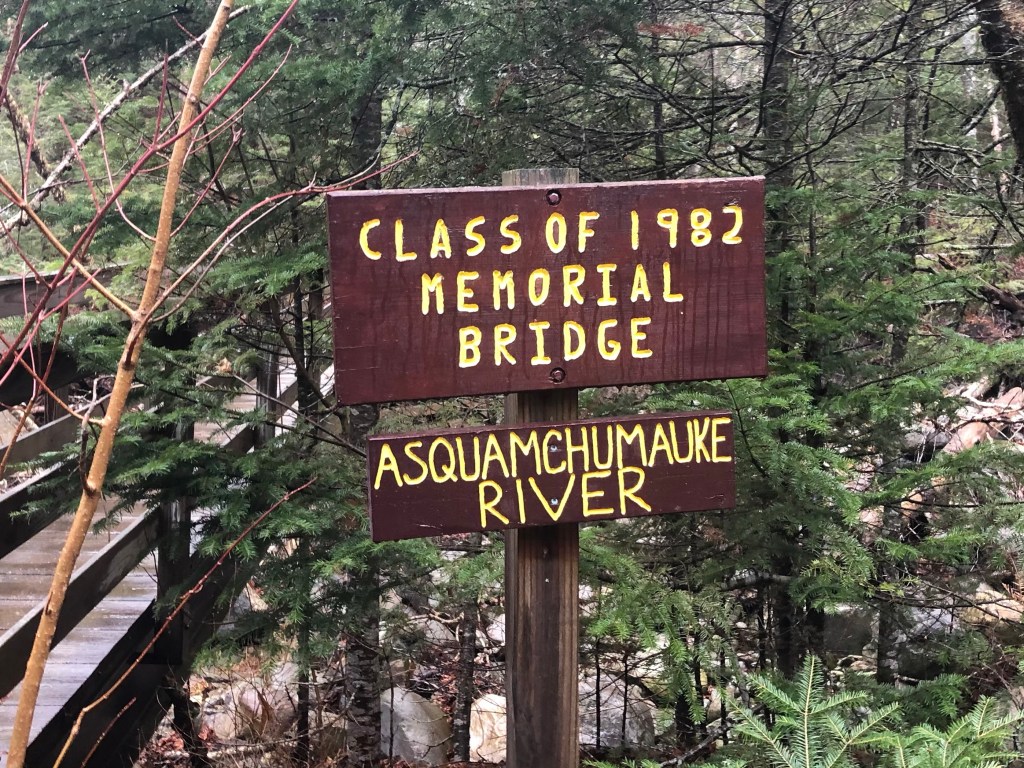
    The Baker River flows from Mount Moosilauke to the Pemigewasset River in present day Plymouth, New Hampshire. On the map the name is cut and dried: Baker. But when you cross the river at the Gorge Brook Trailhead another name emerges from the past: Asquamchumauke. History once again whispering for all who might hear.

    Dartmouth College honoring the original name

    Asquamchumauke means “crooked water from high places” in the language of the Abenaki tribes that once thrived here. It’s a lovely, descriptive name that brings romantic notions of Native Americans living in this place for generations. Yet we’ve called it Baker since well before the American Revolution. The story behind the name change is another fascinating chapter in the violent history of New Hampshire.

    Thomas Baker was a soldier in Deerfield, Massachusetts on February 29, 1704 when the Deerfield Raid occurred. Deerfield was a seminal event in Queen Anne’s War and New England history. French and Native American warriors overran the fortified settlement, 47 settlers were killed and 112 captives, including Baker, were marched up to Montreal. The Native American warriors came from around the northeast, including several tribes of the Wabenaki Confederacy. One of them was a Pennacook sachem named Wattanumman.

    Whether Baker and Wattanumman met during the fighting or forced march to Montreal is unclear, but events would bring them together again eight years later. Thomas Baker led an expedition north with around 30 men and ambushed Wattanumman, a dozen of his men and their families at the site in present-day Plymouth where the Asquamchumauke River meets the Pemigewasset River. Wattanumman and several others were killed and scalped. The men collected furs and anything of value and brought it all down to Massachusetts where Baker was rewarded for his efforts with £40.

    And this is where present-day morality meets the violent frontier morality of New England in the earliest days of our history. Both men participated in violent raids against the other in a time of war. But for fate Baker might have been killed in Deerfield, which may have extended Wattanumman’s life a few more years. Who knows? All of us are subject to the whims of fate.

    There was one other reward for Thomas. To honor what Baker and his men did in this place the name of the river was changed from Asquamchumauke to Baker, a name it still has today. With one event the life of Wattanumman was erased, and the legacy of Baker was sealed. We Americans tend to honor people with place names, while the Native Americans honored the spirit of the place itself. Asquamchumauke: crooked water from high places.

    Has a nice ring to it.

  • I Wonder About Such Things

    Who stood here, on this foot-worn knob of ledge looking out on the valley below? Not just today, but one, two or three hundred years ago? I wonder about such things.

    One hundred years ago a young couple, riding up from the mills of Lawrence or Haverhill, getting out of the city for some country air. This spot would surely be an attractive picnicking spot for quietly plotting their future together. A mixture of plowed fields and young forest creeping back in. A fine spot to debate the wisdom of the start of Prohibition or the long-overdue right to vote for women.

    Two hundred years ago, a farmer surveying the land for as far as his eyes could see all plowed fields and grazing land fenced in with large stone pulled all too frequently from the soil. Did he think about his stone walls cross-crossing the land marking his time here long after he left this earth? It was a hard life working the rocky soil. This ledge might have given him a moment’s rest in a lifetime of long, grinding days.

    Three hundred years ago, this ledge might have offered tactical advantage for the Abenaki still fighting for this wilderness of old growth forest. This high ground offered a place to ambush a hunter up from the settlements. But by this time they’d been driven further north and west, and this wilderness would soon be transformed wholly, as the entire continent would be. The Abenaki surely saw the threat of encroaching settlements. Could they imagine all the changes that would come?

    I wonder about such things now, as I stand with ghosts on this ledge, hearing their whispers. It is indeed good land, slowly returning to its original state. This ledge could tell her secrets given the chance. And now I’m just one more story, standing atop an old knob of granite, thinking I might live forever, but the ledge reminds me of the folly in that belief.

  • From Pemaquid to Andover: A Tale of Abenaki Revenge

    On February 22, 1698 a group of Abenaki warriors raided Andover, Massachusetts and killed five people and two more (Haynes and Ladd) in Haverhill.  Raids like this were somewhat common in the Merrimack River Valley at that time, as it was the frontier and friction between settlers encroaching on the lands of Native Americans who had lived there for generations was an unpleasant reality for everyone living in this area.  What was particularly interesting about this raid was who they killed, which leads to why they chose this place for a raid in the first place.

    Two years earlier at Fort William Henry in Pemaquid, Maine, Captain Pasco Chubb commanded a garrison of 60 soldiers who were stationed here, tasked with defending this relatively new stone fort from the French and Abenaki who would prefer to have them elsewhere. This site, on a point of land jutting out into Johns Bay at the mouth of the Pemaquid River, wasn’t particularly strategic, but it represented what was meant to be a permanent foothold on the coast of Maine (then part of Massachusetts) and the northernmost settlement by the English. Fort George, A wooden stockade on this spot hadn’t fared well just a few years earlier, so in reconstructing the fort the British stepped in and built it of stone and armed it with 15-20 cannon. It was completed in 1692 and held by a garrison of 60-90 men.

    There were at least three critical weaknesses with Fort William Henry. First, it was isolated and any reasonable hope for reinforcements was small. Second, the small stone and lime walls were not particularly strong, making them vulnerable to the cannon the French would bring. And third, and an unforgivable mistake given the other vulnerabilities, the supply of drinking water was outside the fort walls! So a siege of any length would prove highly effective as water in the fort was depleted.

    Ongoing tensions with the French and Native American population almost guaranteed that a siege would eventually take place.  And Fort William Henry was indeed besieged on August 14, 1696 by 100 French and 400 Abenaki. Prior to the siege, two Abenaki chiefs named Edgeremet and Abinquid went to meet with Captain Chubb under a white flag to inquire about some fellow Abenaki captured by Chubb’s predecessor and shipped to Boston. The goal was a prisoner exchange with the British.  Chubb and his men raised their guns and shot Edgeremet and two of his sons. Depending on the account you read, Chief Abinquid may have escaped. Either way this act of cowardly violence against Abenaki tribal leaders under a white flag enraged the besiegers. They wouldn’t forget Chubb and the British betrayal.

    The Abenaki wrote a letter that demonstrated their rage and feelings of betrayal.  It would set the table for later violence against settlers:

    “Lord who write at to me, listen and understand what I am about to say, аnd write, to you. Thou wilt easily recognize my words, and why wilt them not recognize them. It is thou (so to express myself) that furnishest them to me. Writing with too much haughtiness, thou obligest me to reply to thee in the same style. Now, then, listen to the truths I am about to tell thee of thyself; of thee, who dost not speak the truth when thou sayeth that I kill thee cruelly. I never exercise any cruelty in killing thee, [a*I kill thee] only with hatchet blows and musket shots. Thy heart must have been еvеr addicted to wickedness and deceit. No other proof is necessary than the acts last autumn at Saco and Pemkuit, taking аnd detaining those who were going to obtain news from thee. Never in the universal world has it been seen, never has it been related of a man being taken prisoner who bears a flag [of truce] and goes to parley on public business. This, however, is what thou hast done; in truth, thou bait spoiled the subject of discussion. Thou hast covered it with blood; as for me, I could never resolve to act in that manner, for therein I have even an extreme horror of thy unparalleled treachery. How then dost thou expect that we would talk. What thou sayest I retort on thyself. There, repent and repair the grave fault thou hast committed; seize those who killed me at Saco, and made me prisoner at Pemkuit. I will do the like by thee. I will bring thee those who killed thee when I shall be able to find them. Fail not to do what I require of thee; of this, I say, who killest me without cause; who takest me prisoner when I am off my guard. – Abenaki letter, written by French missionary brothers Vincent and James Bigot, in response to the treachery at Pemaquid

    The French weren’t as surprised, writing in an account of the events that day that “It is to be hoped that the Abenakis will not place any confidence hereafter in English promises.”  

    The English were disgusted with Chubb for quickly surrendering the fort and fleeing back to Boston.  He was thrown in jail for months when he was set free, and only freed when he wrote a petition to the Court.  In it he wrote the following:

    “And whereas ye petition is a very poore man, having a wife and children to look after with by reason of his confines & poverty are reduced to a meane and necesstous condition, having not wherewith all either to defray his prison necessary charges or to relieve his indigent family…”

    Chubb would indeed be released from jail and return to Andover to be with his wife and child.  It was there that a party of 30 Abenaki warriors led by Chief Escumbuit from Big Island Pond would become reacquainted with Pasco Chubb, killing his wife and child, and paying extra attention on Chubb, shooting him several times to ensure he was dead.  Sweet revenge, perhaps, but with the loss of innocents as well.  Chubb has largely been forgotten in the early colonial history of America, and when his name is mentioned it’s appropriately with distain.


  • Jonathan Haynes and a Trip Cut Short

    On February 22, 1698, Jonathan Haynes and Samuel Ladd were returning home from a day collecting cut hay when they were surrounded by a party of Abenaki warriors. Hopelessly outnumbered, they asked for quarter but none would be given for the older men. Both would be killed that day, and one each of their sons captured. One of Haynes’ other sons escaped on a horse. This all happened in what is now Haverhill, Massachusetts near the West Gate Market Plaza.  Today there’s very little evidence of the events of that day, save for a mention on a monument erected by descendants two hundred years later. Those descendants, happily alive at the time, are long gone now too.

    Jonathan Haynes lived a short walk from where Hannah Duston was kidnapped less than a year before.  In fact, Jonathan Haynes had been kidnapped two years before along with four of his children.  Two came back to Haverhill with their father, two lived out their lives in Canada.  This time Jonathan paid the price for living on the edge of the frontier.  The warriors who killed Haynes and Ladd had come from a raid in Andover (likely present-day North Andover) where they had killed five settlers, including Pasco Chubb, his wife and daughter.  Chubb is a story for another day, but it seems that the Abenaki were out for revenge and went to his home in winter to kill him.  Haynes and Ladd were simply unlucky to be on the path that the Abenaki warriors were taking back to what is now Concord.

    There’s a rich history in this region, full of stories like this one that are largely lost to the past. The relentless terror for people living with the threat of raids must have been unbearable at times.  Today there are only whispers.  Evidence of the once powerful Abenaki is almost impossible to find.  But sometimes you find clues to the lives of the original settlers if you simply pay attention.  The Duston Garrison still stands less than two miles away.  And thousands of people drive by the small burial ground where Haynes and his descendants are buried.  Most of the oldest gravestones are illegible as time wears away the engravings on the stone.  The burial ground, like the garrison, is one of the few places in this corner of Haverhill that hasn’t changed all that much in 320 years.  It still marks time as it has since that day so long ago when a trip home was unexpectedly and tragically cut short.

  • The Evasive Groundnut

    “I discovered the ground-nut (Apios tuberosa) on its string, the potato of the aborigines, a sort of fabulous fruit, which I had begun to doubt if I had ever dug and eaten in childhood, as I had told, and had not dreamed it.  I had often since seen its crumpled red velvety blossom supported by the stems of other plants without knowing it to be the same.  Cultivation has well-nigh exterminated it.” – Henry David Thoreau, Walden

    “Hannah Bradley later told her family that “she subsisted on bits of skin, ground-nuts, the bark of trees, wild onions and lily roots” on the trek to Canada.” – Jay Atkinson, Massacre on the Merrimack (endnotes)

    Apios americana, also known as the American groundnut, potato bean and several other names, is an indigenous plant that grows in the forests from Canada to Florida.  I’ve had a strangely compelling fascination with groundnuts since I read a description of Hannah Dustin, Hannah Bradley and other prisoners of the Abenaki who kidnapped them digging around in the woods of New Hampshire wherever they were encamped to find groundnuts to eat.  I live in New Hampshire, I wander about in the woods (though not often enough) and I found the fact that these groundnuts were so readily available to be fascinating.

    Reading about Benedict Arnold’s men starving on their march through the woods of Maine when they invaded Quebec, or Roger’s Rangers starving to death as they evaded the French and Native Americans during campaigns in the Lake George/Lake Champlain region have made me wonder about this evasive groundnut even more.  If this was a staple of the Native American population’s diet, and were known to men like Robert Rogers, why were so many of them starving?

    Henry David Thoreau alludes to one reason in Walden when he writes about discovering a “now almost exterminated ground-nut” someday resuming “its ancient importance and dignity as the diet of the hunter tribe.”  These New Hampshire woods that I like to wander in were once fields as settlers plowed fields and brought in livestock.  The stone fences that criss-cross the forest betrays the history of this land.  So for a farmer from Massachusetts living off the land may have been tougher than it is today.  As ancient forests were cut down and plowed fields took their place the groundnuts became harder to find, just as wild animals who were hunted for food became harder to find.  For the native population who lived off the land as hunter-gatherers, this must have been particularly devastating.

    Over the last few years of gardening I’ve noticed some invasive vines growing into the yard.  I sprayed some of them along with the poison ivy to knock them back, and pulled them off the fence and a spruce tree in the yard.  Imagine my surprise when I realized that the plant I was aggressively expelling from the edges of my yard was the very plant that I’ve been wondering about.

  • What’s in a Name?

    I live in Southern New Hampshire in a town that used to be part of Massachusetts.  Borders changed a lot back in the day.  The area I’m likely saw many turf wars between the Pennacook and Abenaki over the centuries.  Both tribes were part of the Webanaki Confederacy.  Webanaki means “People of the Dawn Land” because, well you know, they lived along the Eastern coast.  I think we should adopt that name again, both to honor the native population we displaced and frankly because it’s way cooler than “Yankee”.

    The name “New Hampshire” didn’t come along until 1629, when Captain John Mason, previous Governor of Newfoundland, split Northern New England with another well-connected gent named Captain Gorges and named the region between the Merrimack River and the Piscatagua River – you guessed it – New Hampshire.  Back then explorers and settlers didn’t venture too far into the wilderness, so Mason wasn’t envisioning the shape of the Granite State back then.  In fact, he never set foot in New Hampshire.  He died before he could sail over to check out his new stomping grounds.  But plenty of other folks did.  And of course, this brought violent conflict and atrocities hard to imagine today.

    There are hints to the past if you look closely enough.  Massacre Marsh in Rye, NH marks the site of a raid that killed 13 settlers.  Worlds End Pond in Salem NH once marked the end of civilization and the edge of the vast northern wilderness.  The Dustin Garrison in Haverhill MA was built to defend the region from Indian Raids.  It was a harsh, unforgiving world.  The people who settled here had to be tough, resourceful and resilient, or they simply didn’t survive.

    The name New Hampshire wasn’t an accident.  Mason had lived in Hampshire, England and it probably seemed like a logical choice to tack on New.  And the New World was looking for settlers, and naming the region after places familiar to the population back in the Old World was a nice marketing trick designed to entice settlers to drop everything they knew, risk life and limb sailing across the North Atlantic and find a piece of land to clear and farm.  And hopefully grow some food, hunt some game and fend off raids, wars and the brutal cold of winter long enough to put down roots.  New Hampshire, Nova Scotia, New Brunswick, New France, New England…  and on.  Most people never think about the names of the places they live, or the life and death struggles of the people who came before us.  The bones of the past are all around us, if we only open our eyes to see.