Tag: Annie Dillard

  • Catching Days

    “How we spend our days is, of course, how we spend our lives. What we do with this hour, and that one, is what we are doing. A schedule defends from chaos and whim. It is a net for catching days. It is a scaffolding on which a worker can stand and labor with both hands at sections of time. A schedule is a mock-up of reason and order—willed, faked, and so brought into being; it is a peace and a haven set into the wreck of time; it is a lifeboat on which you find yourself, decades later, still living.” ― Annie Dillard, The Writing Life

    The days fly by, don’t they? We fill our hours with chaos and whim or reason and order, and so goes our life. Structure thus becomes a means to a more fulfilling lifespan. That doesn’t infer rigidly-defined productivity at the expense of joyful experience, but rather using our time strategically to make the most of the what’s available to us.

    Just imagine: Imagine what we can do with our lives should we add a bit of informed structure to our driving purpose. Imagine the places we might see, the people we might influence. Imagine the ripple set across time with just a bit more focus on catching days. Imagine following through on that quiet commitment you made to yourself to do the work that speaks to you.

    We know that focusing means saying no to the parade of other options that flood our senses. No to watching that amazing episode of The Office for the nth time, no to diving into that trendy new hobby that friends are doing, no to all kinds of potential fun that we may say yes to this other thing. But that’s the rub: to do anything well we must do most everything else less well, or not at all.

    “Living life to the fullest requires settling. You must settle, in a relatively enduring way, upon something that will be the object of your striving, in order for that striving to count as striving.” — Oliver Burkeman, Four Thousand Weeks

    So are we striving for something or simply going through the motions? We choose how we react to the world as it’s presented to us, and in that reaction is our opportunity to fill our moments with something more meaningful than the other options on the table. In the heat of the moment life can feel frenzied and limited. We can’t possibly do everything.

    When we think of life in terms of time buckets or seasons, it can help bring clarity to what is essential now, versus then, and allow us to prioritize accordingly. What is most essential right now? Life would be boring with blinders on the entire time—to live fully we must open ourselves up to the world around us—but that doesn’t let us off the hook. We must carve out time for what is essential lest the time slip away forever.
  • Tossing Aside the Blindfold

    “In the eighteenth century, when educated European tourists visited the Alps, they deliberately blindfolded their eyes to shield themselves from the evidence of the earth’s horrid irregularity. It is hard to say if this was not merely affectation, for today, newborn infants, who have not yet been taught our ideas of beauty, repeatedly show in tests that they prefer complex to simple designs. At any rate, after the Romantic Revolution, and after Darwin, I might add, our conscious notions of beauty changed. Were the earth as smooth as a ball bearing, it might be beautiful seen from another planet, as the rings of Saturn are. But here we live and move; we wander up and down the banks of the creek, we ride a railway through the Alps, and the landscape shifts and changes. Were the earth smooth, our brains would be smooth as well; we would wake, blink, walk two steps to get the whole picture, and lapse into a dreamless sleep. Because we are living people, and because we are on the receiving end of beauty, another element necessarily enters the question. The texture of space is a condition of time. Time is the warp and matter the weft of the woven texture of beauty in space, and death is the hurtling shuttle. Did those eighteenth-century people think they were immortal? Or were their carriages stalled to rigidity, so that they knew they would never move again, and, panicked, they reached for their blindfolds?” — Annie Dillard, Pilgrim at Tinker Creek

    I think the point of Dillard’s quote, and the reason I chose it, was to highlight the imperfect nature of our time here, and the extraordinary capacity to receive and embrace beauty despite, or perhaps because of our awareness of the duration of the ride. We are active receivers of the ugly truth and the beautiful realization that life is a brief dance with wonder. Our version of modern blindfolds is of course a mobile phone with its infinite distractions flashing pretty images in our face. Do we truly see the rugged imperfections surrounding us when we’re a click away from something with ten million views just waiting for ours?

    A man died of exposure on a trail I’m very familiar with over the Christmas weekend. The details haven’t fully been released but it appears he was unprepared for the elements, trusted his phone to guide him and light his way when it got dark, and perished when he lost the trail and his battery faded away with his life force. Friends or relatives on the other side of the planet alerted emergency personnel, who found him too late to save him. That mobile phone might connect us to the world, but it isn’t active connection to other people, just the illusion of it. Life is a fragile dance with beauty, and (it seems) his ended when he got too comfortable with that illusion in a cold and unforgiving place.

    The thing is, that trail is one of the most beautiful and popular trails in the White Mountains. It’s easy to understand why he chose it. The tragic irony is that he received the beauty he sought in his climb, but his blindfold killed him in the end. It’s unfair to judge the hiker who perished, for at least he was out there trying to make the most of his moment (if tragically unprepared).

    There’s a lesson for every hiker in his story. But isn’t there another lesson hidden in plain sight? For shouldn’t we wonder, how many others are slowly wasting their lives staring into their own blindfolds? We must be actively engaged in our lives to see the imperfect beauty surrounding us.

  • A Swim in the Broth

    “Consider the ordinary barnacle, the rock barnacle. Inside every one of those millions of hard white cones on the rocks—the kind that bruises your heel as you bruise its head—is of course a creature as alive as you or I. Its business in life is this: when a wave washes over it, it sticks out twelve feathery feeding appendages and filters the plankton for food. As it grows, it sheds its skin like a lobster, enlarges its shell, and reproduces itself without end. The larvae “hatch into the sea in milky clouds.” The barnacles encrusting a single half mile of shore can leak into the water a million million larvae. How many is that to a human mouthful? In sea water they grow, molt, change shape wildly, and eventually, after several months, settle on the rocks, turn into adults, and build shells. Inside the shells they have to shed their skins… My point about rock barnacles is those million million larvae “in milky clouds” and those shed flecks of skin. Sea water seems suddenly to be but a broth of barnacle bits.”Annie Dillard, Pilgrim at Tinker Creek

    I confess to briefly recalling this tidbit from Dillard while reacquainting myself with Buzzards Bay, but mostly I considered the front paws of my canine swimming partner enthusiastically paddling in my direction, and equally pressing, the rumble of morning thunder close enough to keep the swim brief. We don’t think about barnacle bits when we swim in salt water any more than we think about the vapor particles we breathe in in a crowded room (at least until the pandemic). These are simply part of the deal. We embrace the universe as it snuggles in close or we curl up in terror under the covers.

    The point is, we’re meant to be out there living in the world. So dip a toe in the broth, or better yet, plunge right in. For we are very much a part of the stew of life and ought to celebrate our brief moment together. But appreciate that outdoor shower afterwards just a little more.

  • The Nerve for Excellence

    “A New Yorker essay that fall noted that mathematicians do good work while they are young because as they age they suffer “the failure of the nerve for excellence.” The phrase struck me, and I wrote it down. Nerve had never been a problem; excellence sounded novel.” — Annie Dillard, Afterword of Pilgrim at Tinker Creek

    Take that New Yorker example of mathematicians and apply it to rock stars. How many Paul McCartney or Elton John or Joni Mitchell songs written in their 40’s or later resonate as much as those written in their 20’s? They may be good or even great, but they aren’t classics. Excellence requires the nerve to go for it.

    As someone who is no longer in their twenties, I remember the audacity of youth as much as I appreciate the pursuit of safer routes as we age. After all, we’ve got bills to pay and mouths to feed and a 401(k) to nurture, right? So what does that mean for those of us who aren’t kids anymore? Should we hang it up after we hit 30? Of course not. But we have to stretch beyond our comfort zone if we want to achieve anything beyond the average.

    Sure, when we’re young we have less to lose, so it becomes comparatively easy to jump in to the deep end. But there are other ways to reach the deep end. We can methodically wade in one step at a time. Or to flip analogies, when everyone around us is slowing down to savor the view, we still have the choice to power up the hill.

    Nobody reaches mastery without tenacity and drive. Surely there’s a case for perseverance. For incrementally—relentlessly—applying accumulated knowledge towards our goal. Will that lifetime work become a masterpiece? Few ever do, but that doesn’t mean we shouldn’t have the nerve to try.

    Go deeper. Climb higher. See what we might make of our best work.

  • Become a Holy Fire

    “And I have often noticed that even a few minutes of this self-forgetfulness is tremendously invigorating. I wonder if we do not waste most of our energy just by spending every waking minute saying hello to ourselves. Martin Buber quotes an old Hasid master who said, “When you walk across the fields with your mind pure and holy, then from all the stones, and all growing things, and all animals, the sparks of their soul come out and cling to you, and then they are purified and become a holy fire in you.” — Annie Dillard, Pilgrim at Tinker Creek

    Walking about the garden upon a return from two weeks in Europe, seeing the progress of some plants and the decline of others from neglect, it’s easy to become lost in self-forgetfulness. Minor tasks become meditative when we focus on the work. So it is with hiking in solitude, where every step matters and the mind is forced to quiet itself that you may land properly to take the next one.

    If the aim is to become more open to the spirit of the world around us, surely we must quiet the chatter in our own heads. Be still, learn to listen, observe and receive the energy that might otherwise bounce off our closed mind to find a more willing recipient. What do we lose in our closed-minded self-conversation but our chance to be one with the universe?

    The thing is, most of our self-talk is useless at best and detrimental to our progress at worst. Our Lizard Brain, as Seth Godin calls it, is our worst enemy, making us feel like we aren’t measuring up, that we should have done things differently, that we don’t deserve the moment we’re in now. It’s all crap, and not what we’d expect in a close friend. But who is closer to us than ourselves?

    This Hasidic concept of receptiveness is one way to push aside the self. If we are to become a holy fire today—and in our stack of days, we must tune our receiver and accept the positive fuel that stokes our furnace. We must throw aside the wet blanket of self and accept the world as it offers itself to us.

  • Here It Comes! A Visit to Krimml Waterfall

    Live water heals memories. I look up the creek and here it comes, the future, being borne aloft as on a winding succession of laden trays. You may wake and look from the window and breathe the real air, and say, with satisfaction or with longing, “This is it.” But if you look up the creek, if you look up the creek in any weather, your spirit fills, and you are saying, with an exulting rise of the lungs, “Here it comes!” —Annie Dillard, Pilgrim at Tinker Creek

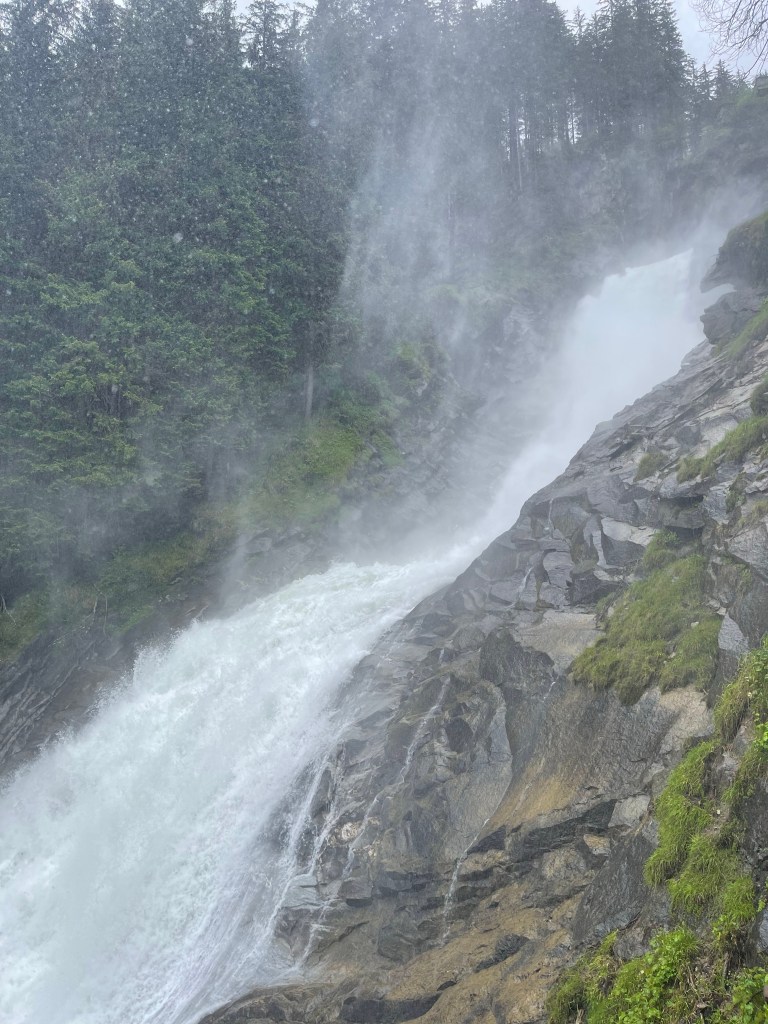
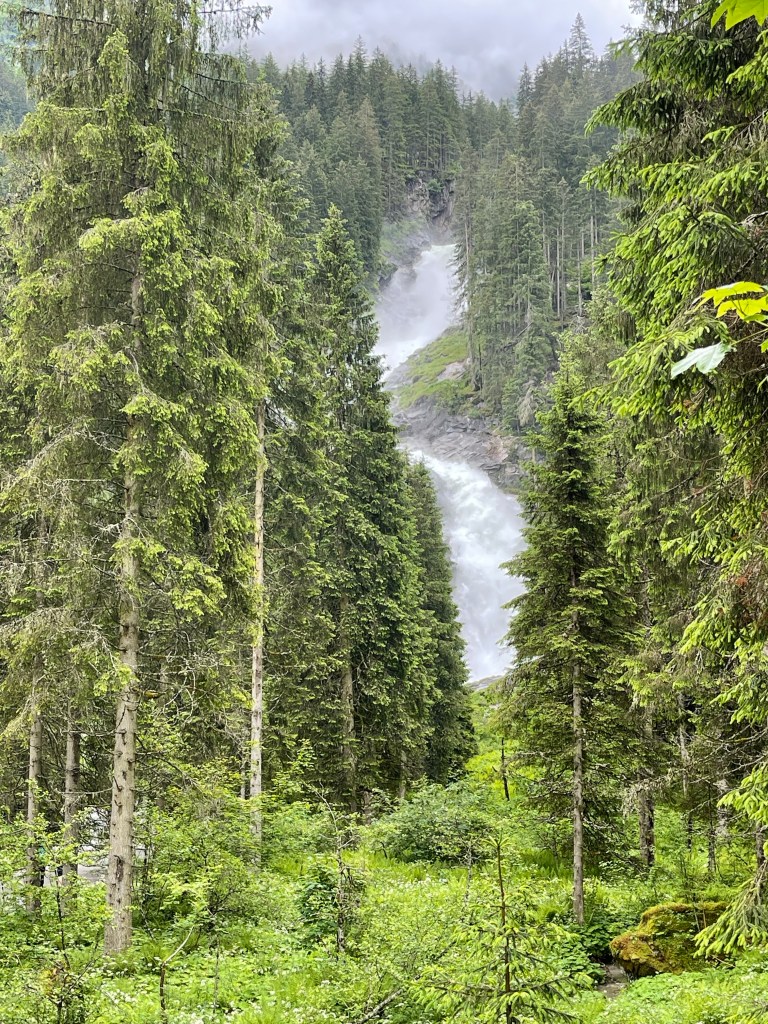
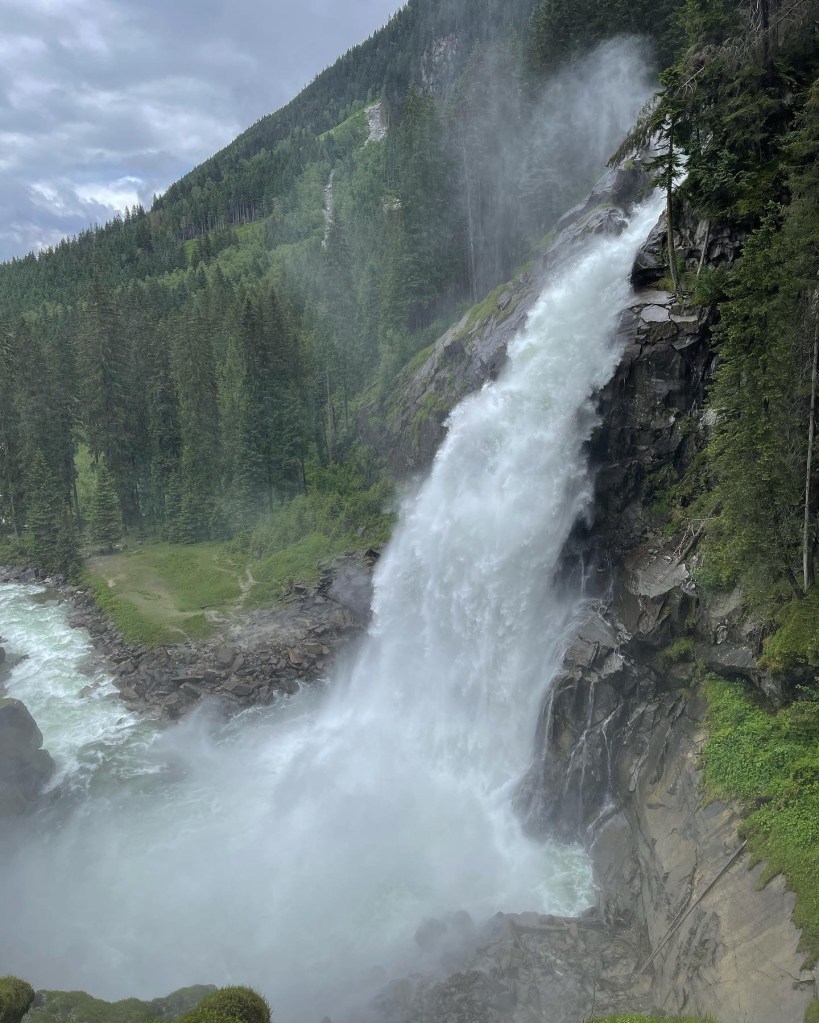
    I’m told that Krimml Wasserfall, or Krimmler Waterfall if you prefer, is the tallest waterfall in Europe. The cascades are broken up into distinct falls and the landscape makes it impossible to see the entire waterfall when you’re standing near it. Instead you hike up and discover the falls a bit at a time. With an hour to see them, this presented a slight problem—we simply couldn’t see the entire waterfall on this trip. But seeing half was quite impressive.

    It’s quite easy for your spirit to fill when you feel the spray swirl around you and hear the roar of frigid whitewater meeting stubborn rock. Maybe this is why we seek out big waterfalls, but small plunges offer their own lift. A giant like Krimml amplifies that spirit lift with awe. A visit locks in new memories.

  • What Do We Make Of This Texture?

    “What do I make of all this texture? What does it mean about the kind of world in which I have been set down? The texture of the world, its filigree and scrollwork, means that there is the possibility for beauty here, a beauty inexhaustible in its complexity, which opens to my knock, which answers in me a call I do not remember calling, and which trains me to the wild and extravagant nature of the spirit I seek… The texture of space is a condition of time. Time is the warp and matter the weft of the woven texture of beauty in space, and death is the hurtling shuttle.”
    Annie Dillard, Pilgrim at Tinker Creek

    “Every religion that does not affirm that God is hidden,” said Pascal flatly, “is not true.” What is man, that thou art mindful of him? This is where the great modern religions are so unthinkably radical: the love of God! For we can see that we are as many as the leaves of trees. But it could be that our faithlessness is a cowering cowardice born of our very smallness, a massive failure of imagination. Certainly nature seems to exult in abounding radicality, extremism, anarchy. If we were to judge nature by its common sense or likelihood, we wouldn’t believe the world existed. In nature, improbabilites are the one stock in trade. The whole creation is one lunatic fringe. If creation had been left up to me, I’m sure I wouldn’t have had the imagination or courage to do more than shape a single, reasonably sized atom, smooth as a snowball, and let it go at that. No claims of any and all revelations could be so far-fetched as a single giraffe. The question from agnosticism is, Who turned on the lights? The question from faith is, Whatever for?”Annie Dillard, Pilgrim at Tinker Creek

    At some point a month or two ago I gently put aside Pilgrim at Tinker Creek. It was right around when things got very busy, when bad news began to stack up around me like junk mail, when processing the deeper concepts behind Annie Dillard’s words became a bit more than I wanted to tackle at the moment. Everything has its time.

    Yet the questions remained.

    What do we make of all this texture? Every ridge line traversed, every waterfall’s mist tickling our skin, every deep conversation with another, every swim in a salty bay, and every sunrise glimpsed are but texture to our lives. But then again, so is every mosquito bite. It’s all so damned far-fetched, and yet here we are.

    I have a sister who is firmly in the God camp. I’m more skeptical of the Hallmark version of a loving God moving the world around like so many chess pieces. We both know life isn’t fair and throws you a curveball now and then to keep you on your toes. We just happen to disagree about “who” is winding up to throw it. And yet we peacefully coexist in both the universe and family dinners—we just don’t question each other’s beliefs.

    It’s easy to be outraged by the other side of the coin. They’re tossing around beliefs that just don’t jibe with our world views. Yet we’re the same coin. It’s fair to ask both “Who turned on the lights?” and “Whatever for?” We’re all asking our version of What’s It All About Alfie? Who said that we are ever meant to know the answers?

    Thankfully, we aren’t alone in pondering the imponderables; as with Dillard and Bacharach framing the questions in this post, we may draw on the wisdom of the ages at any time. Philosophy doesn’t answer the questions for you, but it does help you structure those questions better. We only have our short time to dance with the mysteries of the universe, and will never have all the answers.

    And yet… we get so caught up in the “who, what and why” questions that we forget to ask: How do we make the most of our present condition? For the universe only asks us to live in our time. You come to appreciate the tapestry of life a lot more when you learn to weave yourself into it and let the questions fall away.

  • The Possibility of Beauty

    “What do I make of all this texture? What does it mean about the kind of world in which I have been set down? The texture of the world, its filigree and scrollwork, means that there is the possibility for beauty here, a beauty inexhaustible in its complexity, which opens to my knock, which answers in me a call I do not remember calling, and which trains me to the wild and extravagant nature of the spirit I seek.” — Annie Dillard, Pilgrim at Tinker Creek

    Positioning this idea of beauty in the world seems quaint when wars and pandemics flood us with so much ugliness and darkness. What are we to do but find light in the darkest corners? Life is a dance along the edge between chaos and order, and we must know both. But we can’t dwell in either. Still, if we are to become what we focus on the most, why not focus on beauty?

    Writing, like photography, focuses us on what we want to find in the world. We seek out wonder while our opposites wrestle for control and influence. If the world teaches us anything it’s that life is textured and imperfect and more than a little unfair. But it’s still a blessing to be here in it. To celebrate the inexhaustible beauty in this complicated world is a mission of possibility and hope. What we make of it is up to us.

  • Stop Gulping Life Like a Power Lunch and Savor It

    What else is going on right this minute while ground water creeps under my feet? The galaxy is careening in a slow, muffled widening. If a million solar systems are born every hour, then surely hundreds burst into being as I shift my weight to the other elbow. The sun’s surface is now exploding; other stars implode and vanish, heavy and black, out of sight. Meteorites are arcing to earth invisibly all day long. On the planet the winds are blowing: the polar easterlies, the westerlies, the northeast and southeast trades. Somewhere, someone under full sail is becalmed, in the horse latitudes, in the doldrums; in the northland, a trapper is maddened, crazed, by the eerie scent of the chinook, the sweater, a wind that can melt two feet of snow in a day. The pampero blows, and the tramontane, and the Boro, sirocco, levanter, mistral. Lick a finger: feel the now.” — Annie Dillard, Pilgrim at Tinker Creek

    The universe swirls about madly all around us, and we, living in our small circle of sensory awareness, trust in it blindly. When you feel the breeze on your skin, do you wonder where it’s calling to you from? Do you ever look up at the stars and wonder at the infinity in between each? So many feel trapped in their human construct, as if any of our petty human thoughts matters to the universe. What is a construct but a story we tell ourselves? A fabrication of the moment?

    Our awareness of this moment is a celebration of being alive. If that sounds rather New Age crazy, well, I get that. That’s the frenzied mind talking, the part of us that thinks we don’t have time for such mad thoughts. We have things to do, places to be, ideas to bring to the table, transactions to make… Sure. But what else do we have but this instant with infinity lurking all around us?

    So why then do we grind away in jobs, sheltered from the elements, sipping coffee to power through another day? Why do anything disciplined and proactive at all when the universe stares back with blank ambivalence? Because our small circle reverberates. We touch others through our deliberate engagement with the world. Steve Jobs might have thought he was putting a dent in the universe, but really it was a ripple through humanity. Our ripple might not change an industry, but it can reverberate in the now. We’re here to be in the mix: a part of each other’s lives as we each sort out the implications of all that swirls around us.

    Be who you are. Become who you might be. But maybe just savor a bit more. Why do we gulp life down like a power lunch? Pause between the big gulps of living and taste the moment. Feel the now.

  • January is Waiting

    “I wonder how long it would take you to notice the regular recurrence of the seasons if you were the first man on earth. What would it be like to live in open-ended time broken only by days and nights? You could say, “it’s cold again; it was cold before,” but you couldn’t make the key connection and say, “it was cold this time last year,” because the notion of “year” is precisely the one you lack. Assuming that you hadn’t yet noticed any orderly progression of heavenly bodies, how long would you have to live on earth before you could feel with any assurance that any one particular long period of cold would, in fact, end?” — Annie Dillard, Pilgrim at Tinker Creek

    Lately I’ve been watching some Lonewolf 902 YouTube videos of winter camping with a hot tent. I’ve done a bit of winter camping in my time, with an old sleeping bag sprinkled with ember burns to prove it, but not recently. I don’t see myself hauling a titanium stove through the woods of New Hampshire and cutting up dead standing timber for firewood anytime soon. But his adventures northeast of me in Nova Scotia and Cape Breton Island are stirring the imagination once again. It’s time to get back out there.

    You might feel the cold, and might even experience the snow when you stay put in your nest. But you just don’t become a part of the season without being immersed in it. January, by all rites, offers cold, short days. I’ve noticed that I don’t notice as much when I don’t get out in it. Without a dog to walk in the cold night, I don’t watch the celestial dance across the sky. Without gathering my hiking gear and heading north, I don’t feel the sting of winter or the snow blindness of brilliant sun on frigid snow. What fun is January if you aren’t out in it?

    “Sunshine is delicious, rain is refreshing, wind braces us up, snow is exhilarating; there is really no such thing as bad weather, only different kinds of good weather. ” — John Ruskin

    January is the month when you begin to go stir crazy if you aren’t active enough. The best remedy is right in front of us—bundle up and get your ass out there. The magic of snow and ice and crisp air won’t last for long. You must go to it, prepared, if you want to experience the exhilaration of winter. Melancholy is for those who would shelter indefinitely. Nothing breaks the hold of the winter blues faster than embracing winter. So get out and experience all winter offers! How many more do you expect to have? Appreciate the gift that this season represents.

    January is waiting… but it’s slipping away.