Tag: Anthony Doerr

  • Telltales of Ownership

    “Your problem, Werner,” says Frederick, “is that you still believe you own your life.”
    ― Anthony Doerr, All the Light We Cannot See

    Sometimes we get frustrated by the forces seemingly aligned against us. I thought by now I’d have lived in a Paris studio apartment for a summer writing a novel. That seemed a far off but attainable dream once upon a time. Now? A dream unrealized and fading away into folly. I’ve chosen another path, and accept the trade-off for what I’ve gained. We don’t control everything that happens in our lifetime, we may only pick a course and set the sails as the telltales indicate.

    We are blessed with any measure of control at all. We could easily be thrown in the meat grinder of an autocratic army, or a nurse in a Gaza hospital feeling the pressure from both sides of a maddening existential war, or a slave laborer in a sweat shop hidden in plain sight from the masses complaining about the unfairness of life as they realize Starbucks stopped serving Pumpkin Spiced Latte’s for the season. Perspective is a beautiful, terrifying thing. If we’re lucky, it leads us to gratitude and empathy. There but for the grace of God go I.

    And yet we have agency. We may still set the sails and sail off towards adventure. We may be a unifying force or a divisive catalyst. We may get it right in the end or drive ourselves off the cliff. Life offers ample opportunity for the best and worst of us to express itself. We may indeed choose, and choose wisely.

    “Everything can be taken from a man but one thing: the last of the human freedoms—to choose one’s attitude in any given set of circumstances, to choose one’s own way.” ― Viktor E. Frankl, Man’s Search for Meaning

    Thankfully, or perhaps so far, most of us live our lifetime free from the darkness Frankl found himself swept up in. Do we celebrate this or feel trapped by the minutia and trivial? Are we even aware of the birth lottery we’ve won? We may not have the freedom to choose our next step, but we may choose how we react to the circumstances we find ourselves in. What are the telltales telling us anyway? In most cases, they indicate a blessed life of agency. We ought to act accordingly—not wishing for what we don’t have but making the most of what surrounds us.

  • A High Line Walk

    “Open your eyes and see what you can with them before they close forever.” — Anthony Doerr, All the Light We Cannot See

    Early morning walks are nothing new for me, but I rarely take them when I’m in Manhattan. Simply put, I don’t love walking in the city the way I love walking in other places. Blame it on the endless concrete, traffic noise and dog owners who don’t pick up their dogs crap. I can love the energy of the city while not enjoying the walking environment—I’m complicated in that way.

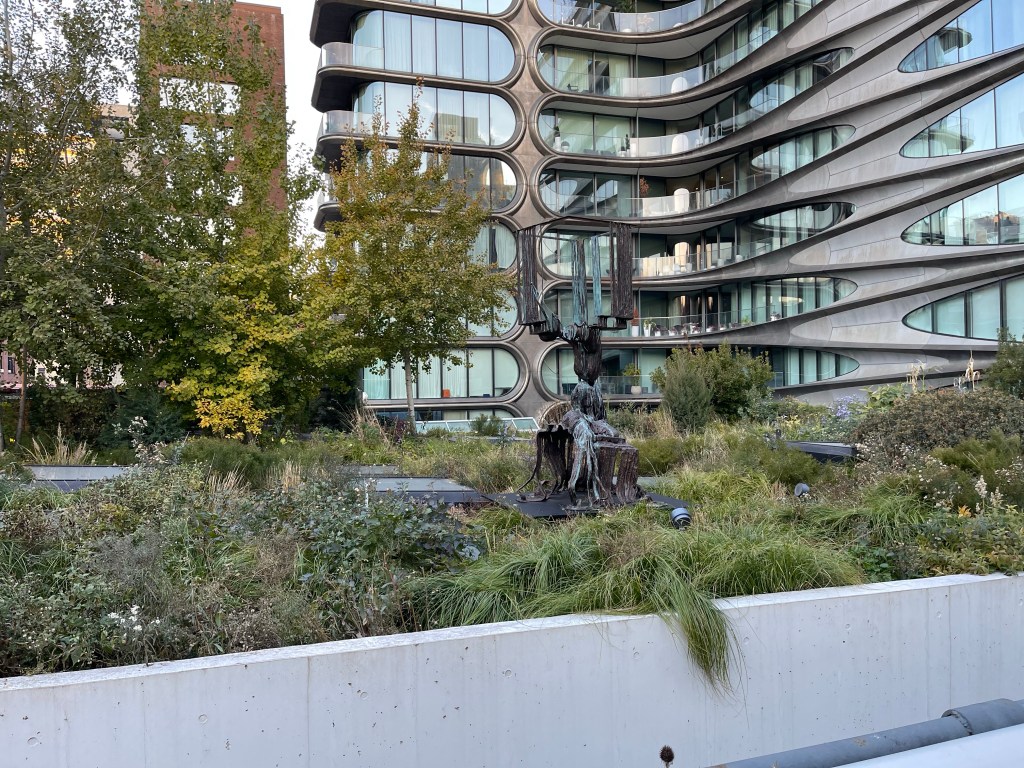
    There are exceptions to this rule. Central Park is one. The riverfront is another. And then there’s the High Line, that old elevated railway turned into a pedestrian walk. This delightful walkway doesn’t allow bicycles or skateboards or even dogs (for the record: I love dogs, it’s irresponsible owners I don’t love). This is to protect the fragile plants along the walkway, but it has the side benefit of protecting your footwear too.

    The High Line has proven to be a big hit with the public precisely because of the removal of all that I dislike about walking in the city. You feel like you’re in another world up on the High Line. A world of art and natural plantings and no cars. It’s the kind of environment that could make you love walking in Manhattan.

    Alas, my walk was abbreviated by construction. walking down the stairs back to street level reminded me that I’m a country mouse at heart. Still, a short walk on the High Line is better than nothing.

  • The Vanishing Act

    “All morning I lay down sentences, erase them, and try new ones. Soon enough when things go well, the world around me dwindles: the sky out the window, the furious calm of the big umbrella pine ten feet away, the smell of dust falling onto the hot bulb of the lamp. That’s the miracle of writing—when the room, your body, and even time itself cooperate in a vanishing act. Gone are the trucks rumbling outside, the sharp edge of the desk beneath my wrists, the unpaid electric bill back in Idaho. It might seem lonesome but it’s not: soon enough characters drift out of the walls, quiet and watchful, some more distinct than others, waiting to see what will happen to them. And writers come, too. Sometimes every fiction writer I’ve ever admired is there, from Flaubert to Melville to Wharton, all the books I’ve loved, all the novels I’ve wished I were talented enough to write.” — Anthony Doerr, Four Seasons in Rome

    Doerr wrote this while helping to raise toddler twins in a vibrant and new place completely unlike the place where he normally wrote—Rome as you may infer from the title. I can relate to this, as a restless pup bounces about behind me, chewing on seemingly everything I once held dear. Puppies are a wonder, and fill the room with joyous energy. That doesn’t make them helpful for concentration and immersion into a place where I might meet the work at hand.

    There is a time and a place for everything. A good part of Doerr’s lovely book is about the experience of being lost in an impossible, chaotic world of new parenthood and a new city. A new puppy may feel both impossible and chaotic, but really it’s simply managing our own time in lieu of the commitments made to that outside of ourselves. I simply give the pup an ice cube to work on and meet my writing somewhere closer to where I was before. Temporary relief, to be sure, but relief nonetheless.

    The thing is, the writing is flowing well, despite any distractions I bring in to my world. So well that I feel compelled to open up the spigot and let it flow more freely. The darkness of late October mornings releases this compulsion. Perhaps it’s an underlying fear of missing out when the skies lighten up, but pre-dawn seems to be magic time for the muse in my mad world.

    There are times when the work seems to flow, as every productive person has experienced in their work, and times when I know the muse has thrown up her hands and abandoned me for more dedicated writers. Until we commit to something fully, we’re just skating the line between attention and distraction. The vanishing act is elusive, wished-for but often not earned. It’s on the other side of comfort and distraction, awaiting only the fully-committed. I’ve learned to say a silent plea to myself each morning: may it be me this day.

  • Break Up the Habitual

    “We need habit to get through a day, to get to work, to feed our children. But habit is dangerous too. The act of seeing can quickly become unconscious and automatic. The eyes see something—gray-brown bark, say, fissured into broad, vertical plates—and the brain spits out tree trunk and the eye moves on. But did I really take the time to see the tree? I glimpse hazel hair, high cheekbones, a field of freckles and I think Shawna. But did I take the time to see my wife?
    ... The easier an experience, or the more entrenched, or the more familiar, the fainter our sensation of it becomes. This is true of chocolate and marriages and hometowns and narrative structures. Complexities wane, miracles become unremarkable, and if we’re not careful, pretty soon we’re gazing out at our lives as if through a burlap sack.
    … I open my journal and stare out at the trunk of the umbrella pine and do my best to fight off the atrophy that comes from seeing things too frequently. I try to shape a few sentences around this tiny corner of Rome; I try to force my eye to slow down. A good journal entry—like a good song, or sketch, or photograph—ought to break up the habitual and lift away the film that forms over the eye, the finger, the tongue, the heart. A good journal entry ought to be a love letter to the world.
    Leave home, leave the country, leave the familiar. Only then can routine experience—buying bread, eating vegetables, even saying hello—become new all over again.”

    — Anthony Doerr, Four Seasons in Rome

    A long quote, but honestly I could plug the entire chapter of this delightful book in here and call it a day. This is a song I know well. We are creatures of habit, and a good habit will save us as much as a bad habit may be our ruin, but this often puts us on autopilot with our senses. There’s a fine line between being fully aware and being overwhelmed. A bit of focus on the task at hand is just as essential as being aware of everything around us. Situation awareness can quite literally save the day for us, but awareness of every situation can make us completely useless.

    Still, so many of us miss the details for the routine. How much of a drive do we ever remember? What of the miracle of commercial flight? Most people simply resign themselves to the screen in front of them for the duration, never glancing out the window at the world of wonder just outside. What of home? Do we ever immerse ourselves in something we once gazed at lovingly, like that picture we once cherished and now barely see? How many marriages end in just such a way?

    We know the Latin phrase: “tempus fugit carpe diem” (time flies so seize the day). Seizing isn’t just an action statement to go out and do bold things, though surely that’s a big part of it. It also means being fully aware of the world around us while we’re living this day. Well before the Romans began creating such memorable phrases, that old Greek sage Seneca had his own take on this, saying “As each day arises, welcome it as the very best day of all, and make it your own possession. We must seize what flees.” Indeed we must.

    Doerr seized his day moving to Rome for a year, grabbing the opportunity of a lifetime just as he and his wife were navigating the challenge of raising newborn twins. That’s quite a one-two punch to anyone’s routine. His call to leave the familiar comes from his own experience in doing just so. But even under such extreme change in his and his wife’s lifestyle, he found routine he had to break through to find full awareness. What of us?

    “Rise free from care before the dawn, and seek adventures.” – Henry David Thoreau

    At a party of the weekend I was introduced to someone as “a blogger” and was asked what I write about. I write about everything, I explained, but didn’t go much deeper out of… habit. We rise to meet our moments or we simply go through them. Writing is a form of heightened awareness of the moment. So is photography, for that matter. I tend to be the unofficial photographer at family events and during travel because I see opportunities either to capture or create the moment. In the end, moments are all we have.

    This blog is a call to arms for myself as much as it is a collection of observations and thoughts. Tempus fugit, sir, so carpe diem. Pay attention to the moment, friend, but do note the days gone by on this journey too. We waste so much of it, don’t we? We must be aware, and be productive with our days while we have them. Make each day new all over again.