Tag: Battle of Bunker Hill

  • Remembering New Hampshire’s Soldiers Lost at Bunker Hill

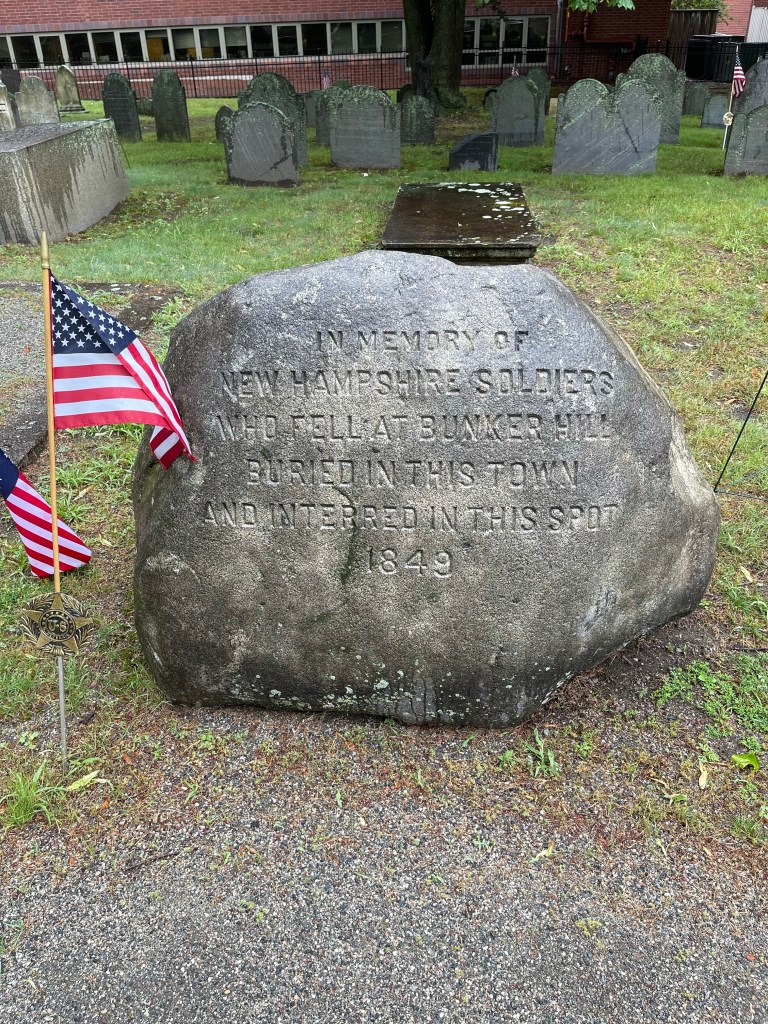
    The boulder quietly marks time amidst the everyday buzz of Medford Square, with cars circling the Burying Ground like planes preparing for a landing at nearby Logan Airport. It’s a nice touch, really, a nod to tough New Hampshire granite, honoring the men who left New Hampshire to fight in the Battle of Bunker Hill who never returned. They’re buried in Medford, and the engraved boulder placed here in 1849 honors their sacrifice.

    The Salem Street Burying Ground is a time capsule back to the earliest days of American history, surrounded on all sides by a perimeter of brick walls, roads and buildings. Medford is not what it was in 1775, but then, everything changed after Bunker Hill. Everything but the quietly stoic gravestones standing in rows around the boulder, like the soldiers themselves once lined up to battle men not much different from themselves. Enemies by fate and events bigger than themselves.

    New Hampshire sent its share of men to fight at Bunker Hill, most famously John Stark. If you look at the roster of soldiers from New Hampshire you see an extensive list from all parts of the state. By my count, 32 were killed on June 17, 1775 and two died from their wounds within a few days. No New Hampshire town paid a bigger price than Hollis, with 25% of the killed in action originating from this small community.

    Many of the British soldiers killed that day are entombed in the crypt at Old North Church in Boston. For the Americans killed that day, many are buried in small burial grounds throughout the area. This one in the heart of Medford, a little more than 4 miles from Breed’s and Bunker Hill, offers a small tribute to New Hampshire’s lost soldiers.

    I wonder about that final journey for these men. Did all of them make it to marked graves like the ones here, or were some buried in places now covered over by the relentless march of progress? For many, their final resting place, like many of their names, is lost to history.

    Honoring New Hampshire’s soldiers killed at the Battle of Bunker Hill
  • Bunker Hill

    The walk up Pleasant Street gives you a sense of what the British were up against, and why the American militia chose this spot. Beginning at The Warren Tavern, the climb is gradual at first, but very steep as you approach the crest. Waking up to a locked and loaded enemy staring down that hill would have been unacceptable, and action would be required. Just the sight of the British regulars lined up and marching towards you must have been terrifying, and the British knew that and counted on the effect it would have. But on this day terror wouldn’t budge the bold easily.

    Events of that day are well-documented. Heroic figures rose up, died or survived to fight another day. William Prescott commanded the Americans, uttering some of the most famous words of the war (in a war full of famous words) when he shouted to his nervous militia “Do not fire until you see the whites of their eyes!” to conserve ammunition. Israel Putnam and John Stark were heroes that day as well, using their experience in the French and Indian War to offer critical tactical insight. The British side features famous names as well; Thomas Gage, William Howe, Henry Clinton, James Abercrombie and John Pitcairne. For the latter two Bunker Hill would be their last battle.

    The Bunker Hill Monument stands on Breed’s Hill, which is where the bulk of the fighting took place on June 17, 1775. I’ve driven by the monument thousands of times, but only remember climbing up the stairs inside once. Not in the cards on the day I visited either, as my walk up from the tavern around the perimeter and a bit of time to re-marinate myself in my local history chewed up all of the allocated time. But I was pleased with the site, which offers appropriate reflection.

    I’d started by walk up the hill at The Warren Tavern, founded five years after the battle and named for Joseph Warren, the 2nd President of the Massachusetts Provincial Congress, who would become a martyr that day. Warren refused the safety his position offered him and choosing instead to be where the fighting would be worst. He died from a musket ball to the head, and then had his body brutalized by the British, whose heavy losses taking the hill likely inspired vengeance. Warren’s close friend Paul Revere helped exhume his body for burial elsewhere, a sign of the great respect Warren had earned in his life.

    That the bulk of the battle happened on Breed’s Hill is mostly known, but people still think the monument is on Bunker Hill. Sometimes the details get mixed up in the story telling. I love a good story and there were many on that hill on June 15, 1775. I’d say I’m better than many in knowing those who came before, but as with everything you learn as much about what you don’t know, and I appreciate a good refresher course. I’ll dance with the ghosts longer next time. There’s so much more to learn from them.

  • General John Stark

    If New Hampshire has a favorite son, it’s John Stark.  The State Motto is a truncated quote from Stark, “Live Free or Die” and of course the people of New Hampshire have a certain Stark independent streak that lives on to this day.  As a transplant from Massachusetts who lives 7 miles from where Stark was born, I’ve come to appreciate the New Hampshire way of thinking more each year.  This is my 25th year in the Granite State and it’s high time I focus on New Hampshire’s Revolutionary War hero.
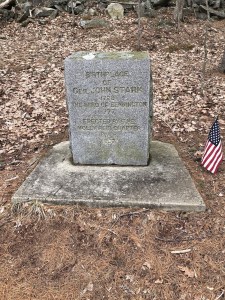
      In each phase of John Starks adult life he had extraordinary moments that would on their own be the highlight of someone else’s story.  As a 24 year-old young man he was captured by the Abenaki while hunting near the Baker River/Mount Moosilauke area.  In captivity he was forced to run the gauntlet but grabbed the stick from the first warrior in the line and attacked him instead!  This endeared him to the Abenaki and they adopted him into the tribe.  He was eventually ransomed back to freedom but this time with the Abenaki would remain a part of him.
    Five years later, with the French and Indian War making New Hampshire a war zone, Stark joined Robert Rogers as a Second Lieutenant and later Captain in Roger’s Rangers.  He participated in many of the legendary battles of the Rangers, including Battle on Snowshoes and other skirmishes around Lake George, New York.  Stark learned a lot from the tactics of Rogers, who in turn had adopted the tactics from the Native American warriors they were fighting against.  This would prove handy in the war to come.
    One event that Stark chose to sit out was the raid on St. Francis, an Abenaki village just over the present-day border of Canada.  Stark opting out was a sign of respect for those who he lived with five years before during his captivity.  It’s a great indicator of his character.
    After the war, Stark returned to his home in Nutfield (Londonderry) to work his farm.  Stark was married to Molly Page Stark, a legend in her own right, and had 11 children.  The Starks were clearly productive on the home front when they weren’t fighting wars.  Molly was a champion for smallpox vaccination, which involved deliberately infecting yourself with a small bit of smallpox, which, if it didn’t kill you, would make you immune to a worse case of it.  Smallpox was a major threat to the Continental Army during the Revolutionary War.
    During the Revolutionary War, John Stark became a legend.  He was one of the first to answer the call to arms, and fought in the Battle of Bunker Hill, where his experience in the Rangers paid dividends.  Stark’s saw immediately what the vulnerabilities were on the northern flank in the defense of Breeds Hill and built a breastwork from old stone walls to defend the Americans from a possible beach landing on the Mystic River.  This proved to be salient as that’s exactly what the British did.
    In a brilliantly orchestrated defense, the first line of New Hampshire militia fired on the attacking British and ducked down to reload.  The British kept advancing with fixed bayonets but were mowed down by a second line.  And then a third line mowed down the advancing British.  By then the first line had reloaded and mowed down the still advancing British and they finally retreated, abandoning the flanking strategy for a full frontal assault elsewhere.
    Stark would later serve George Washington at Princeton and Trenton, but unlike Benedict Arnold, he chose to tell the Continental Congress to take a hike when they passed him over for politically motivated promotions to General.  He returned to New Hampshire but left the door open for further action if needed.  And he was absolutely needed.
    In August 1777, the British Army was moving down from Canada, taking Fort Ticonderoga and working towards Albany.  The goal was to meet with the British forces coming up the Hudson River from the New York and cut off New England from the rest of the colonies.  This would effectively end the war as the British would control the flow of people and supplies.  British General John Burgoyne led an expedition to Bennington to raid supplies stored there.  That’s where he ran into the combined forces of Vermont and New Hampshire, led by 49 year-old John Stark.

    As Stark rallied his troops to attack the British, he shouted the second-most famous sentence he ever produced; “There are your enemies, the Red Coats and the Tories. They are ours, or this night Molly Stark sleeps a widow!”  The first half of that statement is contested.  What seems to have consensus is the “Molly Stark sleeps a widow” part.  Hell of a rallying cry for sure.  During the battle, Stark showed his strategic mind once again by flanking the combined forces of the  British, Loyalists, Indians and Canadians in a double envelopment, creating panic in the ranks of the enemy.  Many of them fled, leaving the British to face a full frontal assault from the majority of Stark’s New Hampshire men, which routed the British and set the stage for victory at Saratoga.

    John Stark, like General Sherman after the Civil War, chose to retire from the spotlight and move back to his farm in New Hampshire.  He lived out his life on his farm in Derryfield (now Manchester).  At the age of 82 he declined an invitation to participate in events commemorating the Battle of Bennington as his health was declining.  Instead, he sent a note with a toast to his old soldiers participating in the events.  It contains his most famous words, familiar to most everyone even if they don’t recall the source; “Live free or die: Death is not the worst of evils.”
  • The High Ground

    During the beginning stages of the French and Indian War, the British Army led by General Edward Braddock and officers that included Thomas Gage and George Washington marched to modern-day Pittsburgh to drive the French out of Fort Duquesne.  During the march, Gage’s Advance Guard failed to secure the high ground.  As they marched towards Fort Duquesne, they stumbled upon French and Indian forces, who quickly took the high ground and leveraged it to drive Gage’s Advance Guard back towards the main army.  In one became known as the Battle of the Monongahela, Braddock rushed his own army forward right into the retreating Advance Guard soldiers.  Chaos ensued, and the French and Indians routed the British forces and killed Braddock.  If lessons were learned in this battle, taking and holding the high ground seems to have been lost on some of them.

    Almost twenty years later, during the beginning stages of the American Revolution, the City of Boston was under siege immediately following the Battles of Lexington and Concord.  Both sides looked at the hills surrounding Boston and recognized the strategic importance of holding these hills as soon as possible.  The Americans were quicker to get there, and under the direction of General William Prescott, 1200 men built a redoubt on Breeds Hill to defend against the inevitable counterattack by the British.

    Old friend Thomas Gage, by now Military Governor of Massachusetts and perhaps not entirely remembering the lessons of the Battle of the Monongahela, ordered the British forces to attack Breeds Hill on June 17th, 1775.  They were repulsed twice with significant casualties, particularly with their officers.  It was during this battle that General Prescott told his American militia “Do not fire until you see the whites of their eyes” both for accuracy and because they were dangerously low on ammunition.  In fact, the lack of ammunition is what ultimately led the British to take Breeds Hill on the third attempt.    The Americans fled up and over adjacent Bunker Hill, and for some reason the event has forever been called the Battle of Bunker Hill.  Nine months later, the British evacuated Boston when they looked up at Dorchester Heights and saw the cannon from Fort Ticonderoga pointing down at them, proving they recognized the value of the high ground.

    The colonial American army seized Fort Ticonderoga by surprise and then had a year to fortify it before the British could amass an army, wait out winter, sail across the Atlantic and work their way down the St. Lawrence and Lake Champlain to meet them in battle.  When the British arrived they completely bypassed the fort and took the high ground behind it.  When the Americans holding the fort saw the cannon pointed down at them they knew the jig was up and evacuated the fort.  With barely an exchange the British took Fort Ticonderoga in one day because they saw the high ground that the Americans thought was impossible to haul cannon onto and proved them wrong.

    On July 2nd, 1863, the critical importance of holding the high ground was on display at Little Round Top in Gettysburg, Pennsylvania, where the 20th Maine Volunteer Infantry Regiment led by Colonel Joshua Lawrence Chamberlain repulsed repeated attacks by the confederate soldiers led by Lieutenant General James Longstreet.  Like the Americans at Breeds Hill in 1775, the 20th Maine soldiers were running out of ammunition.  Chamberlain, under orders to hold the line at any cost.  If the confederates were to break through they could flank the Union forces and break the back of the entire Union army.  Chamberlain ordered a bayonet charge down the hill, surprising and then routing the confederates.

    The high ground is advantageous, but it doesn’t guarantee those who hold it will win.  What it does guarantee is that there will be a high cost for trying to take it from those who currently hold it.  There’s a lot of talk about taking the moral high ground lately.  Democrats point to Republicans and evangelicals and openly question them taking the moral high ground when they defend the President’s actions and statements.  My BS detector tells me who holds the true high ground, but that could be bias.  What’s apparent though is that continuously attacking those who sit on the high ground, whomever they may be, has a deep cost.