Tag: Ben Franklin

  • A Hunger for Eternity

    “Certainly there is within each of us a self that is neither a child, nor a servant of the hours. It is a third self, occasional in some of us, tyrant in others. This self is out of love with the ordinary; it is out of love with time. It has a hunger for eternity.” — Mary Oliver, Upstream: Selected Essays

    We wrestle with the ordinary, biding our time for moments of blissful vibrancy. In a creative lifespan that is so very brief, what is it about time that has such a hold on us? This third self Oliver describes, and which many of us know to be true, must feel the urgency of the moment and scramble where it might lead us. Doesn’t our creative work lead us out of our fragile self into something more eternal? We don’t have to reach mastery to feel this, but we do need to be present with our work and giving the best of ourselves in that moment.

    “The most regretful people on earth are those who felt the call to creative work, who felt their own creative power restive and uprising, and gave to it neither power nor time.” — Mary Oliver, Upstream: Selected Essays

    We must jealously protect our time, that we may do something with it. To be productive with it, whatever that means to each of us. We only have so much life force in the well, so make it matter.

    “Dost thou love life? Then do not squander Time; for that’s the Stuff Life is made of.”— Benjamin Franklin, Poor Richard’s Almanack

    Lately I’ve been accused of giving my time to others who desperately need it. We all need it, of course, for time is all we have. We must always ask ourselves what we give up for the life we say yes to. Would this time be better served in service to our art, or to our loved ones? To our careers or ourselves? These are decisions with consequences. For what will become of us next? Giving isn’t squandering, not when we give it freely. Yet we must give time to the other stuff that calls for our attention.

    There are reasons I write early in the morning. It’s mostly because it’s the only time I can claim as my own. Let them all sleep, as lovely and essential they may be, and leave me to my work. The rest of the day will be yours. Just as soon as I click publish once again. Is this enough to satiate the muse? Let’s hope not. But it’s enough for now.
  • What Living Ben Franklin’s Five Hour Rule Really Tells You

    Google “Ben Franklin’s five hour rule” and you’ll receive page after page of business magazine articles gushing about how you too can transform your career and life using old Ben’s technique. They spin it to current times saying Bill Gates and Elon Musk follow this rule too! Just click and read on… and you get pretty much the same paragraph from every one of them:

    “The five-hour rule is a process first implemented by Benjamin Franklin for constant and deliberate learning. It involves spending one hour a day or five hours a week learning, reflecting and experimenting.”

    I could link to one of those articles, but which one? They all use the same two vanilla sentences. No deep dive into actual Ben Franklin quotes. I’m at a point in my life where this just doesn’t hold up for me anymore. Life is deeper than a Twitter-sized rule for living.

    You know who’s not breathlessly scanning those business articles for that one key rule used by Ben Franklin? Bill Gates or Elon Musk. Because they’ve long since passed that level of reading and shallow thinking in their own lives through consistent, dedicated learning, applied personal growth habits and occasionally taking audacious risks measured against that acquired knowledge.

    And that last bit is the key. Knowing when to take the leap into the unknown isn’t just instinct, it’s detecting patterns and opportunity gleaned from multiple sources of informed learning. Put down the mobile phone and pick up a book, find a quiet corner of your hectic life, and read. Learn something new that brings you to something else new. And as you acquire that wisdom do something with it. Gates and Musk, like Franklin before them, are just people like you and me who take things to a level the rest of us aren’t prepared or willing to go to… but could.

    For the last several years I’ve read every day, sought meaningful encounters wherever I am, stretched my reading to sometimes uncomfortable places, learned a bit of another language every day and firmly established the habit of writing about it right here in this blog. I’m living that Franklin rule without calling it that. I’ve learned that life is more complicated than two sentence rules for living. But the occasional spark of applied audacity has its place too.

  • The Corner of Broadway and Hudson

    One of the more significant street corners in American History is the intersection in Albany where Broadway meets Hudson Avenue.  This is the site of the old Stadt Huys where in 1754 representatives from several colonies met to discuss the Albany Plan of Union.  This group, known as the Albany Congress, consisted of a few famous men from the time, but the most famous of all was Benjamin Franklin.

    Coincidently this site, 23 years later, was also the location where the Declaration of Independence was first read in public.  Albany was a critical hub during both events.  In 1754 Albany was the edge of the wilderness.  In 1776 Albany was the center of the Northern Army’s efforts to repel the British Army, which was attempting to cut New England off from the rest of the colonies by seizing control of the Hudson River.

    Reading the Declaration of Independence in Albany had a galvanizing effect on the people who heard it.  Remember, Albany was under siege from all sides in the summer of 1776.  The British had swept over Long Island and Manhattan, and occupied New Jersey downstream.  They had just taken control of Lake Champlain to the north – a critical highway for troop movement from Canada.  And the Iroquois were allied with the British just to the west.  Albany was in a precarious position on July 19th when the Declaration was read.

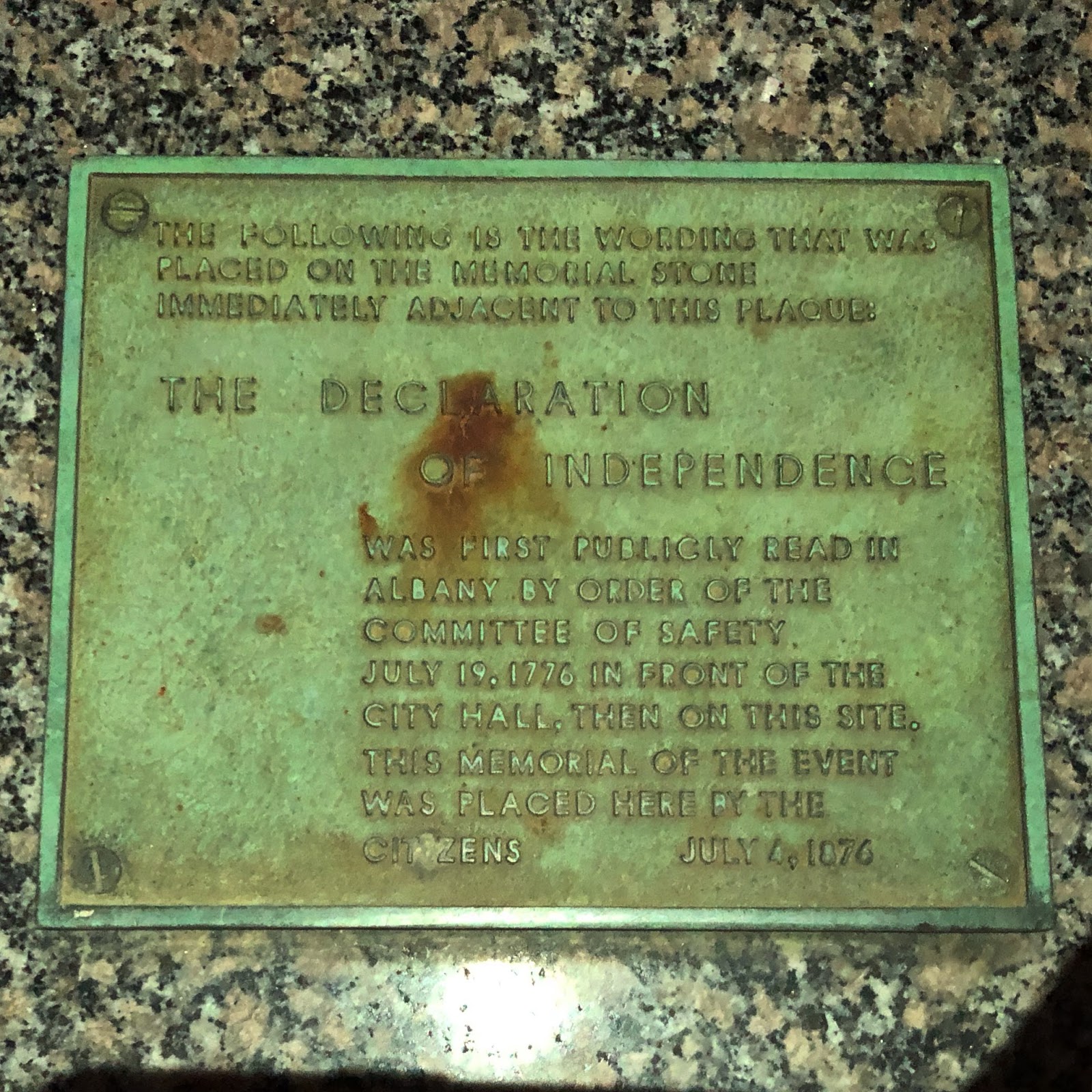
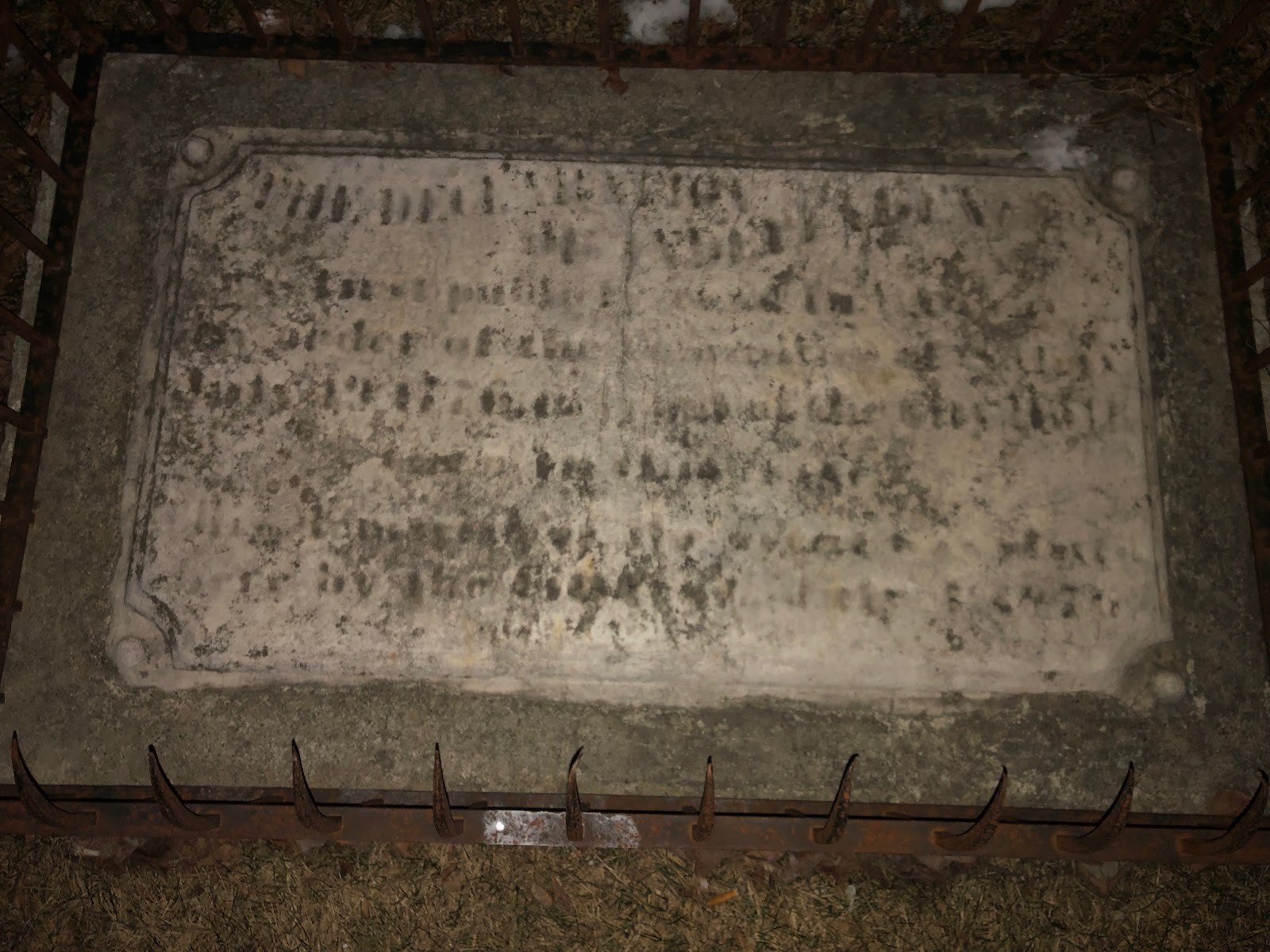
    In 1876, according to The Friends of Albany History, a ceremony commemorating the centennial of the reading happened in this spot:
     “Before a gathering of “two or three thousand” Albany residents, the tablet, which was covered by an American flag, was unveiled by Visscher Ten Eyck (Matthew Visscher’s grandson.) The tablet’s reveal was greeted by hearty cheers from the crowd, patriotic songs, chimes from the steeples of nearby churches, and a 100-gun salute.”
     
    Tonight, almost 141 years since that ceremony, 241 years since the Declaration was read in this spot, and 263 years since Ben Franklin led the Albany Congress to draft the Plan of Union, I had a couple of pints across the street from the commemorative plaque and stone that marks the site.  There are many people in history whom I’d like to have met, but Ben Franklin is high on that list.  Since I can’t have a drink with him having two pints with a nod to history will have to be close enough.
  • Hiawatha, Ben Franklin and the United States Constitution

    The Iroquois Confederacy, or the Five Nations as the British called them, were five united tribes that as a confederacy were stronger than the sum of their parts.  The Onondaga, Oneida, Mohawk, Cayuga and Seneca were united through the efforts of Hiawatha.  Hiawatha, an Onondaga adopted by the Mohawk, was born around 1525 and became a great orator.  He was Chief of the Onondaga and a follower of Deganawida, a tribal elder who recognized that the Iroquois were weakening themselves by constantly fighting amongst themselves.  Deganawida apparently wasn’t much of a speaker, while Hiawatha was considered a dynamic speaker.  They developed “the Great Law of Peace” and sold the other tribal nations on it, creating the Iroquois Confederacy.

    Ben Franklin and other powerful men in the British colonies saw the power of this confederacy and sought to model it.  Benjamin Franklin’s Albany Plan of Union was the first attempt to bring the colonies together.  It served as the foundation for the United States Constitution, whose preamble reads:

    We the People of the United States, in Order to form a more perfect Union, establish Justice, insure domestic Tranquility, provide for the common defence, promote the general Welfare, and secure the Blessings of Liberty to ourselves and our Posterity, do ordain and establish this Constitution for the United States of America.

    At its core, the concepts of a common defense and promotion of the general welfare were modeled after the powerful example in Upstate New York in the Iroquois Confederacy.  So in some ways Hiawatha influenced the very core of who we are as a nation.  And yet most people don’t think of Hiawatha of the Iroquois when they think of Hiawatha.  They think of the Hiawatha from Henry Wadsworth Longfellow’s poem ‘The Song of Hiawatha’, which was a fictional character from a different tribe (The Dakota).  Longfellow knew of the legend of Hiawatha and decided that this name would be better than the original name he was working with.  And ironically, the fictional character Hiawatha is more famous than the actual Hiawatha is today.

  • The Albany Plan of Union

    The Albany Plan of Union

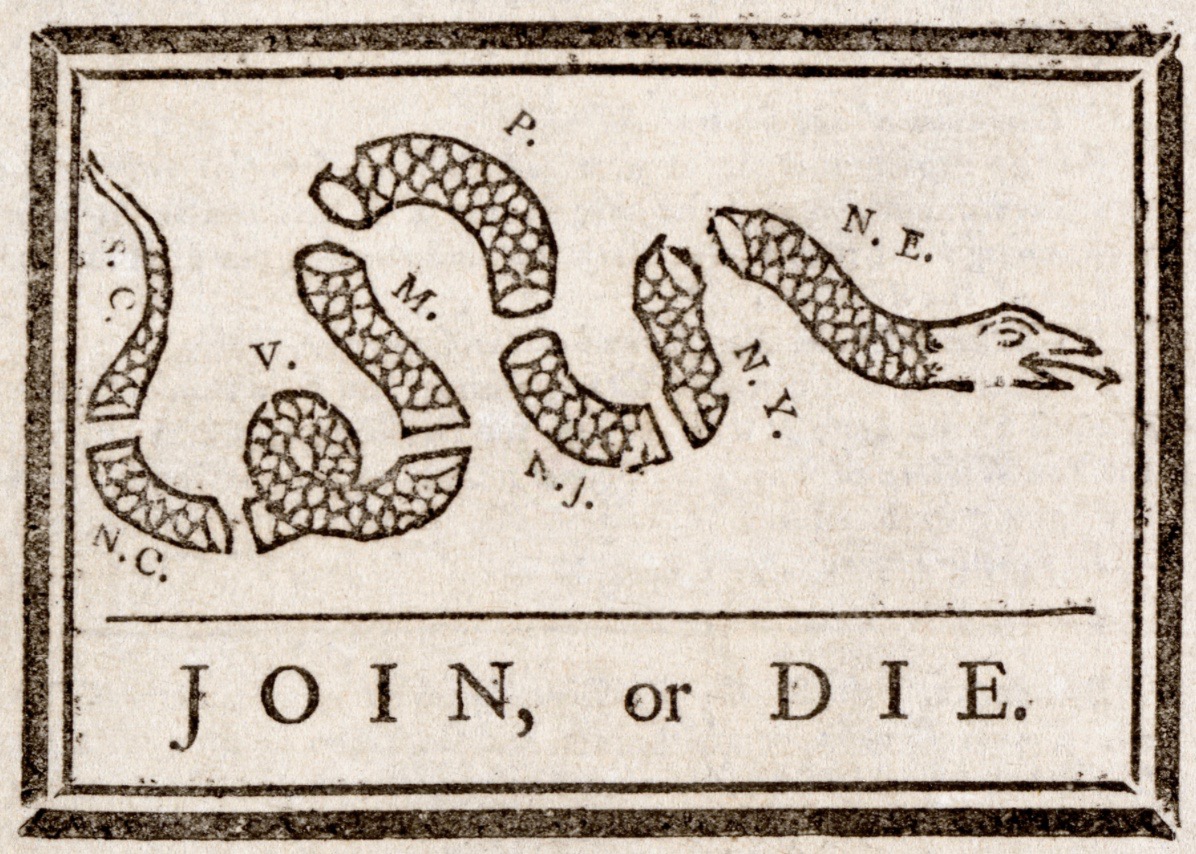
    Ben Franklin looked around the colonies and saw that they were each operating independently from each other.  With the looming threat of the French and Indian War presenting a clear and present danger to all of the colonies, it made sense to form alliances for each of the colonies to support the other should a threat arise.  Franklin’s experience in Philadelphia, where he organized a militia and defensive positions on the Delaware River to protect the city from French Privateers who taking the opportunity to pillage coastal settlements.  He saw strength in unity, and used the example of the Iroquois as inspiration for likeminded individuals to organize and discuss the prospect of united the colonies.  Franklin published articles and the cartoon above in his Philadelphia Gazette newspaper, which had the desired effect of bringing together likeminded individuals to push for the unified colonies.

    Albany was chosen as a central place, and in 1754 delegates were chosen from several of the colonies to form the Albany Congress to discuss the union.  Of the 13 colonies, New York, Connecticut, Massachusetts, New Hampshire, Rhode Island, Maryland and Pennsylvania participated in the Albany Congress.  The delegates met at the Albany “Stadt Huys”, the original state house in the region.  This plan of unification was the first formal meeting on this topic amongst the colonies.  Ultimately England and the governors of the colonies proved too much to overcome and the proposal developed in Albany was refused, but the concepts discussed during the Albany Congress was the root of the United States that would form twenty years later with the Declaration of Independence.

    At Albany the delegates proposed a “Grand Council” and a “President General” from England as leader.  Concepts that would later become the United States’ Congress and President.  Another key concept that Franklin was developing around this time was representation as a prerequisite for taxation.  The colonies were either “English” and warranted representation, or they were an “enemy state” annexed by England.  This proved a catalyst for what happened two centuries later.

    While Ben Franklin was the most famous of the delegates in the Albany Congress, there were many influential people chosen as delegates.  One of the delegates from New Hampshire was Theodore Atkinson, who had risen to be a Chief Justice in the colony and also a Colonel in the militia.  Theodore Atkinson owned a farm in Plaistow, New Hampshire.  In 1767 the land that the farm was on split from Plaistow to form a new town called, of course, Atkinson.

    As a resident of Atkinson for 24 years I’d heard stories of Theodore Atkinson, but never made the connection to Benjamin Franklin that the Albany Congress represented.  It seems that my 2H18 reading list is already paying dividends.