Tag: Carpe Diem

  • About Time

    ‘In headaches and in worry
    Vaguely life leaks away,
    And Time will have his fancy
    To-morrow or to-day.
    — W. H. Auden, As I Walked Out One Evening

    I tend to track time differently than I once did. Now I measure time by the length of my hair or fingernails (weeks versus days since my last trim). I don’t generally look at the clock before calling it a night, for what does time have to do with how tired we feel? Nor do I set an alarm to awaken, I simply wake up. In many ways, I woke up years ago to the folly of time, even if I still follow the rules and show up early (as any civilized adult ought to aspire to). In this way, you might say my relationship with time is complicated.

    When we see time for what it is, something inside us shifts. We become collectors of experiences and embracers of moments rather than maximizers of minutes on the schedule. For all my focus on productivity, at the end of the day I only care that I’ve done the essential few things that move the chains forward for me in the direction I wish to go. The rest float away like all the other past initiatives.

    Writing every day forced me to become an efficient writer. There’s no time to waste on things like writer’s block when you must ship the work and get on to other things. Similarly, other things I do every day become automatic for me, that I may check the box and move on to other things. If that sounds transactional, well, so be it, but it doesn’t mean it’s not the most important thing for me in those moments doing it. When we give something our complete attention for the time necessary to complete it, we may surprise ourselves at just how quickly we can do the work.

    One of the people who works for me was stuck on a presentation he had to deliver to the team, simply overwhelmed by how to structure a slide deck and what to talk about. After being his sounding board for all the built-up stress and despair over the unfairness of having to do this in the first place, I made the deck for him in 30 minutes and quietly sent it to him to personalize in his own way, that he might focus on more important things than a peer presentation. When we get wrapped around the pole on the details of things that aren’t all that important in the end, we waste our time. If experience has taught me anything, it’s to quickly create solutions to problems that I may go back to spending time on more important things. Spending time on my employee wasn’t a waste of my own time, it was an investment in his. I’ll take that trade-off.

    The thing is, I recognize the place that he’s in now in his life. Ten years younger than me, with family obligations that can overwhelm you when you’re just trying to get through the day—I’ve been there, done that. My doing his homework for him wasn’t meant to take him off the hook so much as to show him a clearer future. My priority is to develop an employee who can assess the nature of a commitment and allocate the appropriate amount of focus on it, that he may move on to more essential things. Looking back, I’m sure someone did the same for me once upon a time.

    Life always comes back to our operating system. When we ground ourselves in stoicism, we know that time flies (tempus fugit) and we must therefore seize the day (carpe diem). There’s no time to waste on how we feel about the matter. In the end, the quality of our life is measured in how effective we are at navigating the small things that we may accomplish the big things. What’s bigger for us than using our brief time on this earth on things that matter most?

  • Haven’t Found Right Yet

    “Being right is based upon knowledge and experience and is often provable. Knowledge comes from the past, so it’s safe. It is also out of date. It’s the opposite of originality… Experience is the opposite of being creative. If you can prove you’re right you’re set in concrete. You cannot move with the times or with other people. Being right is also boring. Your mind is closed. You are not open to new ideas. You are rooted in your own rightness, which is arrogant… it’s wrong to be right, because people who are right are rooted in the past, rigid-minded, dull and smug. There’s no talking to them.” — Paul Arden, It’s Not How Good You Are, It’s How Good You Want to Be

    It takes an advertising person to call it like it is, and Arden is certainly that. I read all sorts of books just to get a different perspective than my own. Arden sold me on his book with the subtitle: “The world’s best-selling book by Paul Arden”, which is pretty clever (for who can argue the point?) and likely sold a few extra copies to people like me who appreciate a good spin of words. It’s not a heavy lift by any means, but there are a few insights like the one above that make it worth the quick read.

    The takeaway here is that holding on to our rightness is suffocating our potential to become something more than who we are now. If we aren’t currently masters of our craft, whatever that is, then we likely haven’t found right just yet (believing we have is simply keeping us from ever reaching it). Looking at the crafts we desire to master with a clear eye, which have we come closest to reaching mastery in? Put another way, if good is the enemy of great, what have we simply settled into good enough at? We owe it to ourselves to stop posturing right all the time and make more mistakes. Good enough is a trap.

    The truth of the matter is, we never quite master anything in our lifetimes, even as we aspire to excellence (Arete). Good enough is often all most people want for themselves, me included. But arete whispers in the quiet moments, challenging the status quo. We must stop dwelling on how right we believe we are to have arrived here and dare to make mistakes more often. Otherwise, we’ll remain in a rut that feels attractive for its familiarity but is simply a destination with no end. We’ll never find excellence in a rut, we must climb up to reach it.

    Carpe diem already.

  • To Love Many Things

    “But I cannot help thinking that the best way of knowing God is to love many things. Love this friend, this person, this thing, whatever you like, and you will be on the right road to understanding Him better, that is what I keep telling myself. But you must love with a sublime, genuine, profound sympathy, with devotion, with intelligence, and you must try all the time to understand Him more, better and yet more. That will lead to God, that will lead to an unshakeable faith.” — Vincent van Gogh, Letter from Vincent van Gogh to Theo van Gogh

    There are miracles dancing just outside the door in the morning drizzle. I know this to be true because I encountered them when I walked outside to reassure the pup that it was indeed okay to go out for relief wherever she saw fit, surely burning some spot in the once-immaculate lawn. While you’re at it (I suggested), scratch a new hole somewhere, just to see what’s under the surface. She knows I’ll fill it in behind her. Miracles aren’t simply the Aurora Borealis dancing above my head just last week, miracles are in the everyday act of living. We must love it all, for our time with it is short. And we too are miracles—one day dancing with the sky like the northern lights, the next a memory. So do dance friend.

    I often shake my head at the desperate resolve to know such things as God. The answer isn’t in the ritual, the answer is felt within when we connect ourselves with the universe around us. It’s the crab apple laying a carpet of blossoms at her feet in the rain. It’s the bee’s frenzied roll in the flowers that it may carry its load back to the hive. And yes, it’s in an adolescent pup expressing her boundless energy with muddy paws. We must love many things to know the eternal.

    I’m beginning to understand eternity. It’s folly to believe we’ll ever truly know in our brief dance, but the clues are all around us, hiding in plain sight. The very word universe is derived from the Latin, universus: “combined into one”. Eternity is found in this fragile moment: as a carpet of blossoms or in the mind of a rambling writer figuring things out day-by-day. We may write a verse, as Walt Whitman once suggested. Yes, it’s been right there all along, waiting for us to make the most of the time.

  • To Go Beyond

    “Firstly you need to aim beyond what you are capable of. You must develop a complete disregard for where your abilities end. Try to do things you’re incapable of.” — Paul Arden

    “The human spirit lives on creativity and dies in conformity and routine.” ― Vilayat Inayat Khan

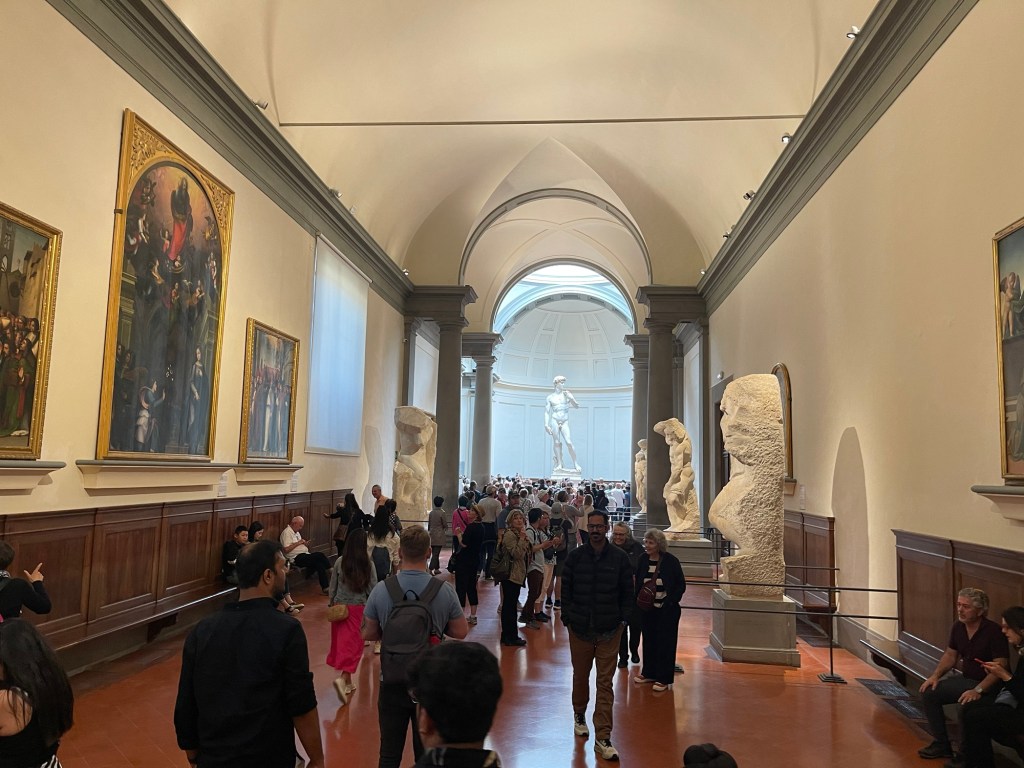
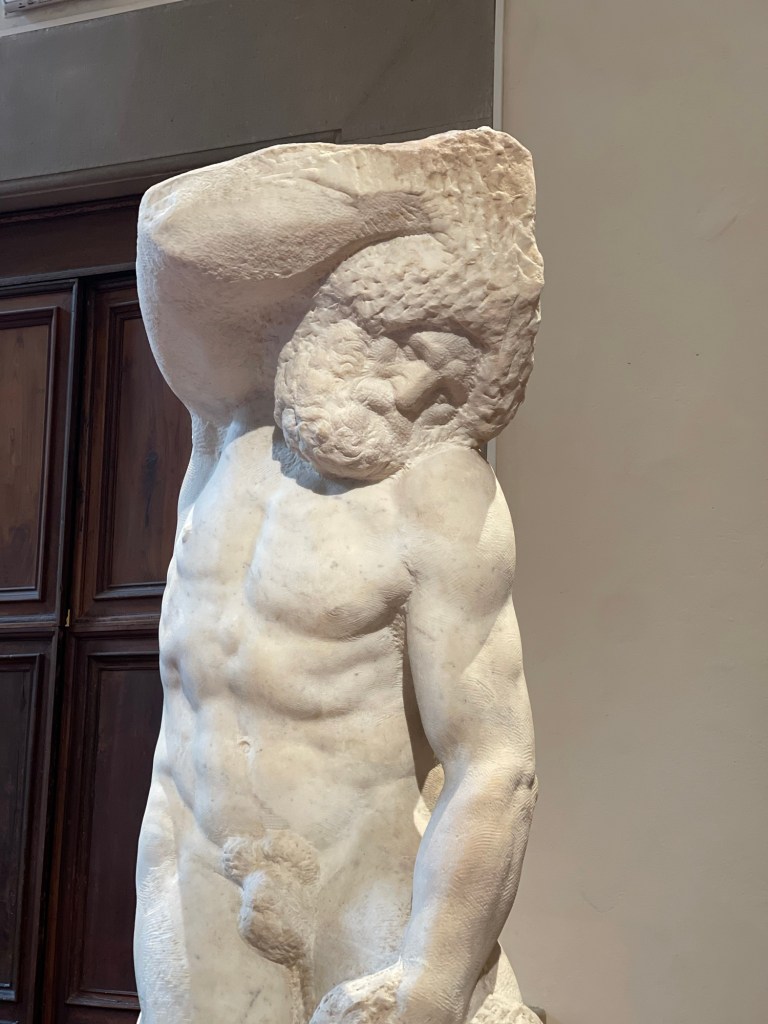
    When you walk up to Michelangelo’s David at the Accademia Gallery in Florence, some of his other sculptures in an unfinished state line the aisle on either side of you. Spending some time with each instead of just rushing past to see David is the best way to see how he released the masterpiece from the marble, as he described it. You can almost see them fighting to break free from the block, just awaiting the help of Michelangelo’s chisel. And so it is when you arrive at David, you understand where he came from—released perfection from a famously imperfect block of marble.

    The interesting thing about that block of marble was that two other artists had begun work on it, gave up on it and it sat partially chiseled and ignored by other artists who couldn’t see the masterpiece within. It wasn’t until Michelangelo saw David within that it became his project. And we are left with the brilliant result, forgetting sometimes the imperfect marble it started as.

    Lately I’ve been wrestling with the imperfect block myself, deciding whether there’s a masterpiece in there or not. To commit and begin chiseling away at something beyond what we are capable of in the moment is the only way to release something exceptional from the average. But why wait? There are no perfect blocks, only something trying to break free from what we have now. So begin with whatever it is we’ve been given and find what calls from within. In those unfinished sculptures is the pain of a masterpiece that never broke free for want of more time.

    The journey to David takes you past unfinished would-be masterpieces
    Michelangelo’s unfinished self-portrait forever trying to break free from the block
  • A Day in Athens

    “A Greek is alive to the fingertips; he oozes vitality, he’s effervescent, he’s ubiquitous in spirit. The Englishman is lymphatic, made for the armchair, the fireside, the dingy taverns, the didactic treadmill.” — Henry Miller, The Colossus of Maroussi

    Athens is named after Athena, the ancient goddess of wisdom, and the Parthenon is dedicated to Athena, so one surely must make a pilgrimage to the Acropolis and the Parthenon when one is in Athens. And so it was that I joined thousands of people climbing the stairs to visit these ancient sites. But a day in Athens ought to include more than a visit to a few touristy places.

    A bit of traffic, a healthy portion of delicious Greek food and wine, a few Olympic sites, and mostly, some time with the lovely Greeks is essential for one to know the place. Athens, and Greece as a whole, is an easy place to fall in love with. So too the people. Highly energetic and passionate, Greeks exude the spirit of carpe diem. One must follow their example and seize the day oneself.

    The history buff in me appreciates the historic sites. The stoic in me appreciates the sense of place. The artist, the beauty. It’s surely overcrowded and a bit crazy, but timelessly lovely just the same. To ooze vitality, to be fully alive, this is the Greek way. To experience it was extraordinary, to return is essential.

  • The Places We Will Be From

    Closing time, you don’t have to go home
    But you can’t stay here

    — Semisonic, Closing Time

    There’s something comfortable about staying in place. Things feel more natural and familiar, after all, and this is where all our friends are. But life is change, and we too must embrace it. Even the farmer, seemingly always in the same place, changes with the seasons. Most of us aren’t farmers, but we ought to listen to the wind and watch the level of the sun and know our place in this world will not be what it once was. We must be change agents for progress to happen.

    Closing time, time for you to go out
    To the places you will be from

    It’s easy to think back about who we were then. It’s harder to imagine who we’ll be in the future, let alone to map the path from here to there very accurately. Surely, there will be unexpected twists and turns along the way. The future is not ours, any more than the past is us today. But we do have the present, such that it is, to do with it what we will. Someday this will be who we used to be too. So we ought to make it a great story.

    Closing time, every new beginning
    Comes from some other beginning’s end

    When one door closes, another is said to open. How many doors have closed already? No matter—not really. What matters is the door opening in front of us, and our willingness to step across the threshold to what’s next. Life is about reinvention, rebirth, renewal. It’s closing time on some older version of ourselves, isn’t it? We can’t stay here forever. But as with any great adventurer, we should develop a strong sense of what’s next.

  • Between There’s

    When we travel frequently, our sense of place is slightly askew. At the moment, fresh off a trip out west, I’m trying hard to immerse myself in the glorious spring days of home while focusing more and more attention to another big trip to come soon. It’s akin to waves rolling onto the beach: each worth of consideration on their own merit, each pulling at our feet as they recede away from us on their return to the sea. If we are to be present between there and there, we must naturally be here. Easier said than done sometimes.

    No matter how busy I feel myself to be, I stop and smell the roses. Alas, it’s not the season for roses just yet in New Hampshire, so I delight in the daffodils and purple hyacinth. My daughter used that expression when we were together on Sunday smelling roses in Los Angeles, and I thought of her as I stepped outside to smell the daffodils and hyacinth on a sunny Tuesday morning back at home. The expression fit both moments; locking in a memory of each place.

    One of the gifts to ourselves in gardening is to plant perennials that come back year-after-year. I planted those daffodils and hyacinth years ago, when the kids were home and life felt very different. Each spring I spend a few moments with each, a reunion of sorts, before moving on to the obligations of the day. Nothing is more “here” than a flower in bloom. They are forever grounded, often long after we ourselves move on to other things. We could learn a few things from them, I suppose, about the essential nature of here, and we scurry between there’s.

  • Like All the Rest

    “If you say “no” to one little detail of your life, you’ve unraveled the whole thing. You have to say “yes” to the whole thing, including its extinction. That’s what’s known as “joyful participation in the sorrows of the world.” It’s my little theme song.” — Joseph Campbell, A Joseph Campbell Companion: Reflections on the Art of Living

    Memento mori, friend. This is the whole thing. We must dance with the light we receive today knowing the party must eventually come to an end. For when we are aware of the fragility of the moment and our place in it, we learn to savor it.

    It’s easy to say this, harder in practice when we feel the weight of the world on our shoulders.. Life can be hard, after all, so who are we to blissfully enjoy it all? We don’t need to enjoy the hard days, simply to accept the truth of the moment. Amor fati—love of fate. The most joyful people are the most present and aware.

    When we know our time is short in anything, or with someone, we may become fully aware of the importance of the experience. It’s here that memories are born. We are but accumulated memories molded into identity. So carpe diem—seize the day, whatever it brings. For it will soon be gone like all the rest.

  • Do Not Say, Do

    “It is a hard thing to leave any deeply routined life, even if you hate it.” — John Steinbeck

    “You are what you do, not what you say you’ll do.” — Carl Jung

    Both of these quotes appeared in my media feed recently. I’m not particularly happy with that media feed lately, but such is the state of the world and the Internet we once hoped would democratize it. That the quotes appeared to me through all the noise that is social media now is another example of that other expression about the student being ready. Spring is in the air, travel is more than just a distant whisper now, and what exactly have we been doing to prepare for all that suggests itself to us?

    The thing about writing a blog every day is that it’s very easy to say what we’re going to do, much harder to execute on that vision. It’s routines that make us or break us. Intentions are a fool’s game. Who wants to hear about the promises we make to ourselves that we break? Who wants to write about that?

    In sales there’s a term for reaching out to someone regularly just to check in and see if they’re ready to work with you. It’s called a drip campaign. When the student is ready the salesperson seemingly appears at just the right time. That can be viewed as either opportunistic or pragmatic, but the prospect will eventually leave a routine they’ve grown accustomed to whether they really want to or not. A diligent salesperson will be the one they nod to in that moment.

    Life is sales. We’re either selling ourselves on the idea of change or we’re being sold to by the rest of the universe. What the salesperson has to learn is that it’s dissatisfaction with the routine that drives change. At that moment, we flip from all talk to meaningful action. At that moment we begin to do. And doing is where the magic is.

  • On the Tail End

    I was thinking about my adult children through the lens of Tim Urban’s famous blog post, The Tail End. It reminded me that I’m on the flip side of his statement about his parents. Now I’m the parent with kids that live away from home. In many ways I’m on the tail end of my relationship with them (having already spent 90% of the time I’ll have with them in our lifetimes together). Nothing focuses the mind on the most important things in life than realizing you’re in the waning moments of any one of those important things. Sure, we may have another 40 years or more together, or we may have run our course already, we’re never really sure are we? So embrace it, and them, when you’re together.

    That got me thinking about some close friends. A couple of them will be sailing away again later this year for an extended adventure to faraway places. Sure, we’ll visit them in a few of those places, but it’s not like we’ll be seeing them every weekend then. Another couple of friends hike every weekend and invite me to tag along, which I rarely do nowadays. This has led to an absence similar to if they’d sailed away like those other friends. Life calls us where it will and perhaps we’ll see them again one day, but that tail end seems apparent.

    When you build a career in one industry, you build a network of people whom you come to rely on to always have your back, to always be present. Change industries and see how quickly those relationships disappear. It’s a lot like college or growing up in a certain neighborhood. Most relationships are built on convenience. Few survive the removal of that convenience of proximity when it’s gone. Sure, there may be a Christmas card every year, or a social media “like” as we keep track each other, but are these the same?

    The point of all this, as Urban himself suggested, is to be fully present in those moments together, for we never really know how many we’ll have. To be aware is the greatest gift we can give to those we care about, whether we’re at the start of something beautiful or in the waning moments of our time together. Put the phone down. Listen and speak with the perspective of having heard. Be here, now. For it’s all we really have together.