Tag: Concord

  • Connection

    “Ye live not for yourselves; ye cannot live for yourselves ; a thousand fibres connect you with your fellow-men, and along those fibres, as along sympathetic threads, run your actions as causes, and return to you as effects.” — Reverend Henry Melvill

    On Author’s Ridge at Sleepy Hollow Cemetery in Concord, Massachusetts the legends are interred—Emerson, Hawthorne, Alcott, Thoreau and others. I’ve visited and written about Author’s Ridge many times in this blog, because it fascinates me that so many who reached such literary fame would then choose to spend eternity in such close proximity to one another. Emerson once said that “the only way to have a friend is to be one”. The legendary families of Concord lived this so deeply that they carried it over to death.

    There are only a few people who we count as true friends, but we build connection with countless people. Our connections form a network that serves us even as we serve the network. Each individual connection may be tenuous, but woven together with many others, trust is built, reputations are formed, careers are made and communities grow into something special.

    We learn that connections are dynamic. Some people that were simply connections grow into true friends, and some true friends slip back to connections. The fabric of our connections is dynamic and ever-changing, just as we ourselves change. We receive what we nurture. Connections form over time—but they also inform over time. We learn which connections will run deep and which are merely transactional in the moment.

    Some would say that it’s a little harder to have such connections as the Concord authors had now. We don’t all live in such close proximity today. Technology may make it easier to be connected, but it’s also an active agent in pulling us apart. To be connected, we must do our part to maintain that connection. Some people are just natural connectors, but it’s nothing more than checking in on someone now and then to see how they’re doing. Do it enough and a few actually check in on us too. We don’t have to consider eternity when we reach out, simply finding connection today is enough.

  • The Visit

    Early last week, mentally tapped out and in need of consultation, I visited Author’s Hill at Sleepy Hollow Cemetery in Concord, Massachusetts. I’ve been there many times now, and the experience has grown from initial discovery and delight at finding the graves of Thoreau, Emerson, Alcott and Hawthorne in such close proximity to each other to visiting to simply say hello again. In a world full of useless noise, sometimes we find inspiration in the quietest places.

    Thinking it clever at the time, I once brought a water bottle filled with some water from Walden Pond to give Henry another sip. There are no such moments of gimmickry nowadays. Now a quiet nod is enough. They and all of their neighbors do whisper: memento mori.

    And isn’t that enough? They did their part in their time. We may choose to do ours now. One day soon enough we’ll join them in infinity. But now? Now is the time to live, friend.

    “Oh, for the years I have not lived, but only dreamed of living.”
    ― Nathaniel Hawthorne

    “If you have built castles in the air, your work need not be lost; that is where they should be. Now put the foundations under them.” ― Henry David Thoreau, Walden

    “I’ve got the key to my castle in the air, but whether I can unlock the door remains to be seen.” ― Louisa May Alcott, Little Women

    “The voyage of the best ship is a zigzag line of a hundred tacks. See the line from a sufficient distance, and it straightens itself to the average tendency. Your genuine action will explain itself, and will explain your other genuine actions. Your conformity explains nothing. Act singly, and what you have already done singly will justify you now.” ― Ralph Waldo Emerson, Self-Reliance

  • Sublimity Above Scorn

    “Scorn trifles, lift your aims: do what you are afraid to do: sublimity of character must come from sublimity of motive.” — Mary Moody Emerson

    We’ve all pondered some variation of the question, “who in history would we most love to have a conversation with?” We can easily come up with our short list of fascinating characters. One can easily derive who tops my list by the frequency with which I quote them in this blog. But not all. Consider Mary Moody Emerson, the aunt of Ralph Waldo Emerson and by all accounts a delightful, energetic and fascinating woman who could talk circles around her nephew and the thought leaders of the day residing in or around Concord, Massachusetts.

    She was born in Concord at the beginning of the American Revolution and passed away in the middle of the American Civil War. She saw a few things in her time, and was an avid reader and practitioner of commonplacing, which is essentially the format of this blog for the last several years. For all the bitterness that those two wars represented in our history, she sought enlightenment and sublimity through reading and conversation to better understand the great thinkers of the time. One can easily say she played a strong part in the rise of transcendentalism.

    The America of today is again splitting apart on ideology and scorn. It’s easy to get wrapped up in the ugliness of the moment, and I’m not advocating ignoring it (we’ve seen what happens when authoritarians are unchecked). Awareness and resolve are essential characteristics of the resilient mind. But we must be aware of the cost of participation in the war of words. Perhaps we should listen to someone who saw the worst and the best of humanity in her time and chose to lift her aims. We too may seek sublimity over scorn, knowing it will not easy, but nonetheless essential work.

  • A Walk Around Walden Pond

    A visit to Walden Pond can be immersive, if you go at the right time. Many people go in summer to swim and enjoy the pristine water. Many fish for large mouth bass and other prizes. But the pilgrims go to visit Henry David Thoreau’s famous pond and the woods surrounding it. I’ve watched the place change over the years, but the pond and woods remain largely as Thoreau would recognize.

    You must treat a brief visit to Walden as you would a visit to a nightclub with a cover charge. There’s a flat fee of $30 USD to park. That applies for an hour or the entire day. There’s a lower fee, apparently, for Massachusetts residents. I suppose you can also opt for other ways to get to Walden Pond, but this was the simplest way to spend time at a place. The area surrounding Walden Pond is a mix of highway, commuter railroad (as it was in Thoreau’s time), capped landfill and houses increasingly further out of reach for someone choosing the lifestyle of the person who made this place famous.

    Early December is considered late autumn, but my visit felt more mid-autumn, with temperatures warmer than they should be this time of year. Henry David Thoreau would have shaken his head, I think, at some of the same behavior he observed in his day leading to the climate change we’re experiencing today but generally sitting on our hands about. But it made for a lovely day to walk around the pond.

    There is a well-defined path around the pond. It’s maintained and easy for most walkers to navigate. They make you feel like you’re in a cattle chute for much of it, with wire strung on each side of the path to keep wanderers from straying off the path. Signage explains this as erosion control measures. As a hiker of the White Mountains in New Hampshire, I’m all too familiar with the impact of popularity on trails and the surrounding landscape. I stay to the path, liberated from the freedom to wander, I instead focused on the environment around me.

    You can hear the world encroach on you at Walden. Distant highway sounds, construction, sirens, airplanes flying overhead and the commuter train all remind you that you’re in a suburb of Boston. It’s best to acknowledge this, but let it go as Thoreau let the train go as it went past in his time. The landscape is largely preserved, the water clear, awaiting those who would linger.

    When I was younger, there was no visitor center, but there was a bath house. At some point well before I came into this world some well-meaning people decided that the best way to save Walden Pond was to make it a recreation center. So a bath house was built, beach sand extended and you had a destination for family recreation. Thoreau’s cabin is on the opposite shore from the bath house, but it’s the first thing you see when you walk down the visitor parking lot. You’re either at peace with it or not, but it’s relatively benign in the off-season.

    Walden Woods extend well beyond the perimeter of the pond, and we can thank people like Don Henley for their commitment to preservation. Generations of developers find a way to squeeze as much money as they can from resources, and there are plenty of people who would turn the place inside out and up. There’s a place for development in this world, but there ought to be a place for preservation too.

    I’d brought a water bottle with me on the walk, warm day that it was, and decided in a moment of inspiration to fill it with water from Walden Pond. Thoreau drank straight from the pond in his day, I’m not inclined to do that without a filter. Instead, I brought the water with me for another pilgrimage. Just across that highway is the center of Concord, where Thoreau and Ralph Waldo Emerson lived. Just beyond the center is the Sleepy Hollow Cemetery, site of Author’s Ridge, where Thoreau, Emerson, Alcott and others are buried. I stopped for a brief visit on Author’s Ridge, told of my visit to his old cabin site, and poured Henry a sip of Walden Pond. Cheers Henry.

    Walden Pond
    A view of the pond just down the hill from Thoreau’s cabin site. This is similar to the view he would have had.
    Pile of stones next to the cabin site. I’m not loving it, but cairns are how people seem to express themselves. The site to me feels like a construction site, cleared and ready to build.
    The cabin site is surrounded by granite pillars to denote the position and size of the cabin.
    Creative cairn art rising out of Walden Pond.
  • On Paul Revere’s Capture

    So through the night rode Paul Revere;
    And so through the night went his cry of alarm
    To every Middlesex village and farm,—
    A cry of defiance, and not of fear,
    A voice in the darkness, a knock at the door,
    And a word that shall echo forevermore!
    For, borne on the night-wind of the Past,
    Through all our history, to the last,
    In the hour of darkness and peril and need,
    The people will waken and listen to hear
    The hurrying hoof-beats of that steed,
    And the midnight message of Paul Revere.
    — Henry Wadsworth Longfellow, Paul Revere’s Ride

    Most every schoolchild in America learns the story of Paul Revere, who rode out to warn of the British march on Lexington and Concord on the eve of the American Revolutionary War. What you never hear about is that Revere was captured by the British on his ride between Lexington and Concord, never warning the latter town, but that one of his counterparts on that night escaped capture and completed the job.

    Paul Revere and William Dawes both set out to warn colonists about the British march to Lexington and Concord, taking different routes to Lexington. They reunited in Lexington and set off together to warn the residents of Concord of the British Regulars’ imminent march. During their ride, they came across Dr. Samuel Prescott, who’d been out courting a woman named Lydia Mulliken. That chance encounter would prove fortuitous for the colonists.

    Prescott decided to join Revere and Dawes to help warn the residents of Concord. During their ride, they were stopped by a British patrol, who attempted to take them prisoner. Revere was captured, Dawes was able to flee back towards Boston, and Prescott, who knew the area well, evaded capture and was thus able to complete the ride to Concord, where he warned his fellow colonists.

    “We set off for Concord, and were overtaken by a young gentleman named Prescot, who belonged to Concord, and was going home. When we had got about half way from Lexington to Concord, the other two stopped at a house to awake the men, I kept along. When I had got about 200 yards ahead of them, I saw two officers as before. I called to my company to come up, saying here was two of them, (for I had told them what Mr. Devens told me, and of my being stopped). In an instant I saw four of them, who rode up to me with their pistols in their bands, said ”G—d d—n you, stop. If you go an inch further, you are a dead man.” Immediately Mr. Prescot came up. We attempted to get through them, but they kept before us, and swore if we did not turn in to that pasture, they would blow our brains out, (they had placed themselves opposite to a pair of bars, and had taken the bars down). They forced us in. When we had got in, Mr. Prescot said ”Put on!” He took to the left, I to the right towards a wood at the bottom of the pasture, intending, when I gained that, to jump my horse and run afoot. Just as I reached it, out started six officers, seized my bridle, put their pistols to my breast, ordered me to dismount, which I did. One of them, who appeared to have the command there, and much of a gentleman, asked me where I came from; I told him. He asked what time I left. I told him, he seemed surprised, said ”Sir, may I crave your name?” I answered ”My name is Revere. ”What” said he, ”Paul Revere”? I answered ”Yes.” The others abused much; but he told me not to be afraid, no one should hurt me.” Letter from Paul Revere to Jeremy Belknap, circa 1798

    Longfellow’s poem made Paul Revere rightfully famous, but he did a disservice to Dawes and Prescott. Early on the morning of 19 April 1775, it would take all of them to finish the job. It’s funny that Paul Revere’s own accounting of the night receives less attention than Longfellow’s romanticized tale. But that’s history for you, we remember it as it is told, not always as it was.


    Site of Revere’s capture with the modern road beyond
    Autumn foliage along the route
  • The Compass and the Torch

    “Not like the brazen giant of Greek fame,
    With conquering limbs astride from land to land;
    Here at our sea-washed, sunset gates shall stand
    A mighty woman with a torch, whose flame
    Is the imprisoned lightning, and her name
    Mother of Exiles. From her beacon-hand
    Glows world-wide welcome; her mild eyes command
    The air-bridged harbor that twin cities frame.

    “Keep, ancient lands, your storied pomp!” cries she
    With silent lips. “Give me your tired, your poor,
    Your huddled masses yearning to breathe free,
    The wretched refuse of your teeming shore.
    Send these, the homeless, tempest-tost to me,
    I lift my lamp beside the golden door!”
    – Emma Lazarus, The New Colossus 

    There’s an interesting connection between Emma Lazarus and Henry David Thoreau.  It seems that Emma visited Ralph Waldo Emerson at his home in Concord, Massachusetts in 1876, and met the poet William Ellery Channing while visiting.  Channing was a close friend of Thoreau, and apparently never really got over the death of Thoreau 14 years prior to Lazarus’ visit to Concord.  He proved to be a tough nut to crack, but succumbed to Lazarus as he learned she was an admirer of Thoreau’s.  Channing gave her a personal tour of Thoreau’s Concord, from Walden Pond to the place he was born, and when she was leaving Concord he gave her an incredible gift; Thoreau’s compass.  I admit, that’s a breathtaking gift to me, the compass of Henry David Thoreau, the surveyor of lands and spiritual guide to generations.

    Lazarus, like Thoreau, would live a short life, succumbing to what is believed to be lymphoma at the age of 38.  But like Thoreau she lives on in words of significance created during her short tenure on earth.  Her most famous poem is The New Colossus, which was written to raise funds for the base of the Statue of Liberty, and is forever associated with Lady Liberty.  I’ve read it many times, but find new meaning in it with each reading.

    A mighty woman with a torch, whose flame
    Is the imprisoned lightning, and her name
    Mother of Exiles.

    When you absorb The New Colossus, you recognize the folly of Trump, the Tea Party and the undercurrent of white privilege that’s always been there but is recoiling under an uncomfortable spotlight.  The Founding Fathers might have been complicated in how they lived their own lives, but the ideas behind the Declaration of Independence and the Constitution were bigger than their lives.  The century after would see a nation boiling inside, putting the words to the ultimate test again and again culminating in the Civil War and Reconstruction, the settlement of the continent and the sweeping aside of Native Americans, much of the wildlife and the very land itself.  Set against this was the rise of Transcendentalism, conservation and preservation.  And all the while the immigrants kept flooding in, fleeing desperation and seeking a new hope in America.  Lazarus represents the open arms of Lady Liberty and America, with no restriction in who might be welcomed when they arrive:

    Give me your tired, your poor,
    Your huddled masses yearning to breathe free

    I know people who despair at Trump and the rise of hatred in America.  I take no pleasure in the vile and ugly amongst us.  But I also take the long view, and recognize that American is shifting once again, and the undercurrent of hatred, racism and greed is unwelcome by the vast majority in this country.  I have faith in the process and believe we’ll come out of this year like no other better for having endured.  America is a land of hope, transcendentalism is founded on the belief in the inherent goodness of people.  Emma Lazarus corresponding with Ralph Waldo Emerson and eventually visiting him shows her own interest in his thoughts and opinions.  When I read The New Colossus I think of Thoreau’s compass that was handed to Lazarus by Channing and the direct link that created between them.  I wonder if she glanced at the compass while writing The New Colossus and found the right words to say.  Words that still show us the way forward, towards our true north as a country.

  • Fences and Forests

    “At present, in this vicinity, the best part of the land is not private property; the landscape is not owned, and the walker enjoys comparative freedom. But possibly the day will come when it will be partitioned off into so-called pleasure-grounds, in which a few will take a narrow and exclusive pleasure only – when fences shall be multiplied, and man-traps and other engines invented to confine men to the PUBLIC road, and walking over the surface of God’s earth shall be construed to mean trespassing on some gentleman’s grounds. To enjoy a thing exclusively is commonly to exclude yourself from the true enjoyment of it. Let us improve our opportunities, then, before the evil days come.” – Henry David Thoreau, Walking

    When I moved into the house I’m living in twenty years ago, when this cul de sac was just being built, I watched a dozen deer run through the woods and diagonally through the backyard out to the front where the driveway is and then off to wherever they roamed from there.  A few years after that I became annoyed with one of my neighbors central vacuum system which didn’t (and still doesn’t) have any form of muffler on it.  I put up a six foot privacy fence on that side of the house to block out the noise a bit.  Fences make good neighbors, they say.

    A few years after that we got a very energetic one year old black lab and put him on a run, which was a cable strung tightly between two trees in the backyard with his chain hanging down, giving him some freedom of movement but not enough.  Eventually we fenced in the backyard entirely, and he had room to roam without running away.  Well, we thought so at the time.  Snow pack and exceptional climbing skills proved the fence wasn’t always as high as it needed to be.

    Then came the pool, and it justified the investment in the fence.  And that fence continues to serve us well, in theory keeping the young neighborhood kids out of the pool while being compliant with the town’s codes which require a fenced-in pool.  With a pool you have liability.  Lawyers love pools. Insurance companies love fences.

    The forest remains timeless.  It’s just on the other side of that fence, and it’s largely as it was twenty years ago, and twenty years before that.  It continues to invite itself back into the yard.  After all the backyard was once part of the forest and perhaps one day it will be again.  I see the deer sometimes just on the other side of the fence.  But they don’t run through the yard anymore.

    Thoreau would find his walking to be very different than it was when he wrote those words.  Aside from conservation land and State Parks like Walden the landscape is completely different than it was for him.  Roads are paved, land is subdivided, fences are put up to screen annoying neighbors or to protect pool owners from wandering toddlers.  Thoreau might say that the evil days have indeed come.  And looking at the building boom going on seemingly everywhere I can’t help but think that myself.  Houses and residential communities popping up everywhere.  Roads getting more and more congested.  Mixed-use development projects all the rage.

    I read a book recently that described the frustration that a family had at the development of Bedford, New Hampshire back in the 1960’s.  I know the stretch of road they described as it is today, but never knew it as the quiet country road portrayed in the book.  They ended up moving further north into Maine.  And maybe moving further away is the answer.  Or maybe it starts with taking care of your own backyard before it’s too late.  Conservation and preservation, zoning restrictions, political will and public demand are the formula for open space.  Developers rule most town halls nowadays.  When people are indifferent to the land around them the void gets filled by people who build 55 plus housing developments.  This isn’t developer bashing – developers do a lot of great things and I’ve directly benefited from development.  It’s more a call to all of us to demand more for the environment we’re creating for ourselves and future generations.  A little preservation goes a long way.

  • Patriots Day

    While national holidays are commonly observed by an entire country, state holidays obviously differ from place to place.  Some places, like Boston, celebrate their own holiday too, as Boston does with Evacuation Day every March 17th.  The Commonwealth of Massachusetts and the State of Maine, once part of Massachusetts, celebrate Patriots Day.

    If you aren’t from the area Patriots Day may seem strange to you.  But the name hints at its roots as a day to celebrate the first shots fired in the Revolutionary War at Lexington and Concord.  This occurred on April 19, 1775, and Patriots Day is celebrated on the third Monday in April to commemorate the events of that day.  Re-enactments take place in various places in Massachusetts, most notably in Lexington and Concord, but also Boston.

    For Massachusetts, Patriots Day also coincides with the Boston Marathon and the Boston Red Sox hosting a game at 11 AM.  These combined events make being in the City of Boston, or along the Marathon route, a special occasion.  Patriots Day is one of the great days to be in Boston.

    Participating in the Boston Marathon is a Holy Grail experience for most runners, and the race is a point of pride for anyone from the region.  That’s why it was such an affront when two brothers targeted the race with two bombs in 2013.  While they succeeded in creating initial panic and immediate attention from the world, they failed to sustain it as they completely underestimated the resolve of the people of Boston.  Like the nation as a whole, if you want to unify us against you attack us.  As in 1775 in Lexington and Concord, so again in 1941 at Pearl Harbor, on 9/11/2001 in New York and Washington and in Boston in 2013, you’ll find out that this community that is divided on so many issues unites when you bloody our nose.

    Boston is back to celebrating Patriots Day, but the city remembers 2013.  Security has significantly increased and people are more aware of what’s around them than they were then.  The race is stronger for having survived the bombing, and so is the city.  So here’s a toast to the runners, to the Red Sox, to our ancestors who faced the British that April 19th in 1775, and for those who rallied together to unite in a common effort when things got rough.  That’s what Patriots Day is about.

  • Three Works of Daniel Chester French

    Three Works of Daniel Chester French

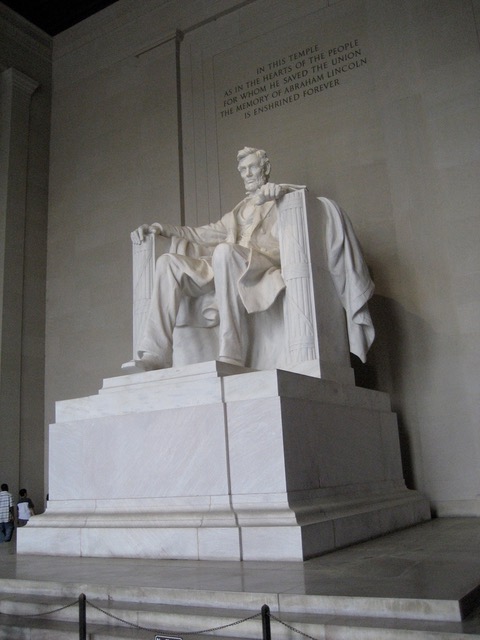
    While a lot of the attention in Concord, Massachusetts rightfully goes to the extraordinary writers who lived amongst each other in town, there were other highly-accomplished artists who lived there too.  One of the most celebrated is Daniel Chester French.  French was an American Renaissance/Beaux-arts artist most famous for his sculptures of The Minute Man at the site of the Battle of Concord and for the Lincoln Memorial.  These two works bookended his career and ensured his place amongst the giants of Concord.  In between, French had many notable works, but perhaps his most powerful, and one of his favorites, stands close to French even to this day.

    With the centennial anniversary of the battles of Lexington and Concord approaching, key people in Concord were organizing an event for April 19, 1875.  The existing obelisk marking the site had been placed on the eastern bank of the Concord River, where the British had assembled.  The western side of the bridge where the minute men had assembled to fight them was bare ground.  So a statue honoring those who fought the British was commissioned and designs were solicited for consideration.  French, who’s father was a prominent judge and the inventor of the French drain, was friendly with Concord royalty, including Ralph Waldo Emerson.  Emerson asked Daniel Chester French to submit a design, which of course was chosen.  French was 22 when he started designing the statue, and 25 when it was unveiled to the world.

    The ceremony to unveil “The Minute Man” as part of the centennial celebration of the shot heard round the world was attended by President US Grant, Vice President Henry Wilson, Poets Henry Wadsworth Longfellow and James Russell Lowell, Oliver Wendell Holmes and of course Emerson.  They were joined by an overflowing crowd of over 50,000.  Concord must have been a mad house that week in April 1875.  Ironically, the man of the hour, Daniel Chester French, was not at the centennial celebration, he was in Florence studying under another famous sculptor, Thomas Ball, who created the statue of George Washington on his horse that forever rides in the Boston Public Garden.  Much more information about French’s work on “The Minute Man” can be found in an extraordinary blog post here.

    If “The Minute Man” marked the beginning of French’s career as a renowned sculptor, “Abraham Lincoln” in the Lincoln Memorial was French at his peak.  When completed he was 70.  “Abraham Lincoln” is 170 tons of white Georgia marble.  French began the project in 1914 and did most of the work on this giant at Chesterwood, his summer home and studio in Western Massachusetts.  French spent a lot of time on the hands of Abraham Lincoln.  They’re very detailed and, it’s rumored, give a nod to Lincoln’s support for the deaf by subtly signing the initials “A” and “L”.  I’ve visited the Lincoln Memorial three times and each time I pick up something new.  I’ve never focused on Abraham Lincoln’s hands, but surely will should I have the opportunity to visit again.

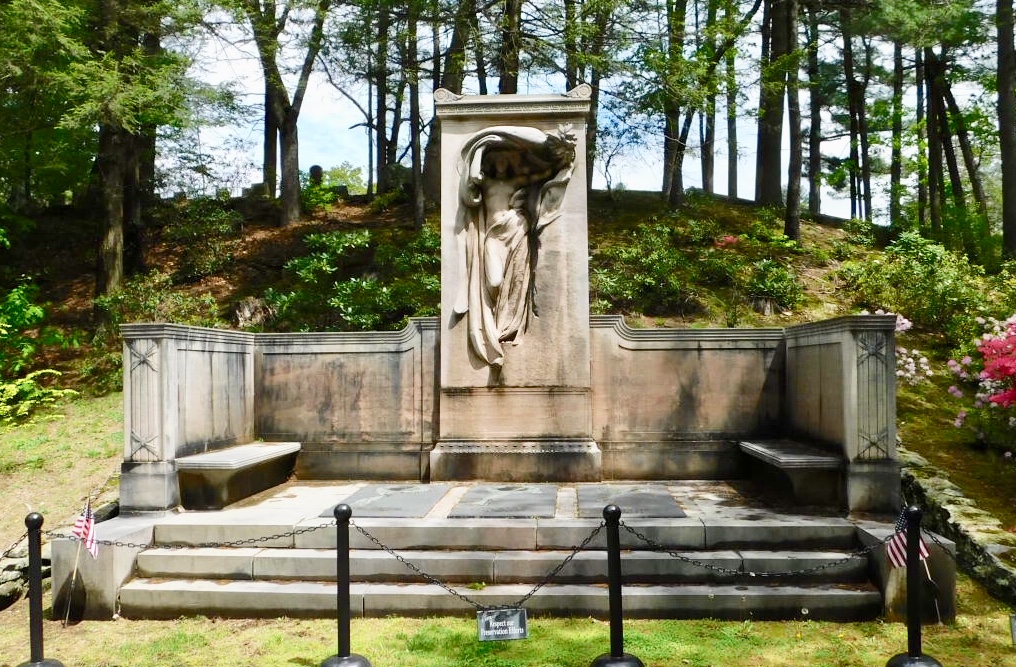
    French died in 1931 and is buried at Sleepy Hollow Cemetery not far from Author’s Ridge.  I’m sure he chose this spot carefully as his final resting place.  With old family friend Emerson at the top of the ridge in front of his grave, and one of his favorite monuments right around the corner behind him; his creation “Mourning Victory”.  The Melvin Memorial features French’s monument “Mourning Victory”.  It was commissioned by James Melvin to honor the lives of his three brothers who died in the Civil War.  “Mourning Victory” looks towards the South.  “Mourning Victory” was unveiled on June 19, 1909, 45 years to the day after John was killed.  Of the three brothers who died in the war he’s the only one buried at Sleepy Hollow Cemetery.

    As we approach Memorial Day I think more about this monument and the devastation that came with victory it created for so many families like the Melvin’s.

    “In memory of three brothers born in Concord who as private soldiers gave their lives in the war to save the country this memorial is placed here by their surviving brother, himself a private soldier in the same war.
    I with uncovered head
    Salute the sacred dead
    Who went and who return not.”

    On the day that I visited Sleepy Hollow Cemetery, there was a ceremony happening nearby.  A solitary bagpiper played, filling the cemetery with music.  I viewed it as a welcome from the  permanent residents, and I tried to honor them during my time with them.  Daniel Chester French, once a young man starting his career with “The Minute Man” statue just down the street from this spot, chose this place to be his permanent home.  His own grave is simple, not displaying any of the Beaux-art charisma that you see in his work.  Perhaps he drew inspiration from the simple dignity of his neighbor’s graves.  I would contend that that quiet dignity is present in all his great works, and inspires us to this day.

  • Now Comes Good Sailing

    Now Comes Good Sailing

    I’m not sure how I’ll go peacefully into the night, but I hope it’s a long time from now.  When my time comes I hope my last words are as interesting as those of Henry David Thoreau, who, in addition to saying “Now comes good sailing“, added “Moose” and “Indian“.  I’m no expert on Thoreau, but as I understand it he had visited Maine and seen both, and said it would be a lovely place to be buried.

    Thoreau is one of the many interesting people to have come out of Concord, Massachusetts.  Born in 1817, and dying in 1862, he lived a bold life in his 44 years.  Of the greats on Author’s Ridge at Sleepy Hollow Cemetery – Thoreau, Louisa May Alcott, Nathanial Hawthorn and Ralph Waldo Emerson, Thoreau died first.  Hawthorn followed him to the ridge two year later, Emerson twenty years later and finally Alcott in 1888.  There were other legends in Concord at this time, but these four shared a connection in life and the same ground in death.

    Environmentalist, abolitionist, surveyor, handyman, pencil maker, writer, traveler – it seems he would an interesting guy to have an speak with.  I’d love to have been canoeing with Thoreau and Hawthorne to hear some of their conversations.  I’d love to have been at the table at The Old Manse when Thoreau and Emerson got together.  When Emerson traveled Thoreau lived at Emerson’s house.  He lived on Emerson’s land at Walden Pond, where he famously wrote Walden.  He wrote about other places he’d visited – Mount Katahdin in Maine, Cape Cod, his journey up the Concord and Merrimack Rivers.  He also visited Niagara Falls, Quebec, Montreal, and other points in North America.  He never traveled overseas, and he never married.

    Walden was his great work.  The book that influenced me and so many others.  I’m overdue to read it again.  Like many books on my list it waits patiently for another day.  Thoreau might have pointed out that I’ve got to decide what to eliminate to give myself that time.  He didn’t have a television or a smart phone to distract him, but life in 1854 was not without distraction.  The nation was dividing and heading towards civil war.  People lived harder lives.  Henry’s brother died from a shaving cut.  And Henry died young too, but he squeezed immortality out of his 44 years.

    Now comes good sailing.  What an interesting thing to say on your death bed.  Thoreau was clearly interested in death and what awaited him on the other side.  I’m 6 years older than Henry was when he died and I’m in no great hurry to join him.  Will it be good sailing?  Time will tell.