Tag: Ethan Allen

  • The Yin and Yang of New Hampshire and Vermont

    “She’s one of the two best states in the Union.
    Vermont’s the other. And the two have been
    Yokefellows in the sap yoke from of old
    In many Marches. And they lie like wedges,
    Thick end to thin end and thin end to thick end,
    And are a figure of the way the strong
    Of mind and strong of arm should fit together,
    One thick where one is thin and vice versa.”

    – Robert Frost, New Hampshire

    New Hampshire and Vermont are Yin and Yang.  Almost flipped mirror images of one another, as Frost describes.  The people are similar in so many ways, and different in so many other ways.  Generally, Vermont is a “blue state” while New Hampshire is a “red state”, traditionally voting Republican (much to the chagrin of Vermont and Massachusetts).  New Hampshire has a certain active principle, Live Free or Die vibe going, while Vermont embraces a more receptive, Freedom and Unity vibe.

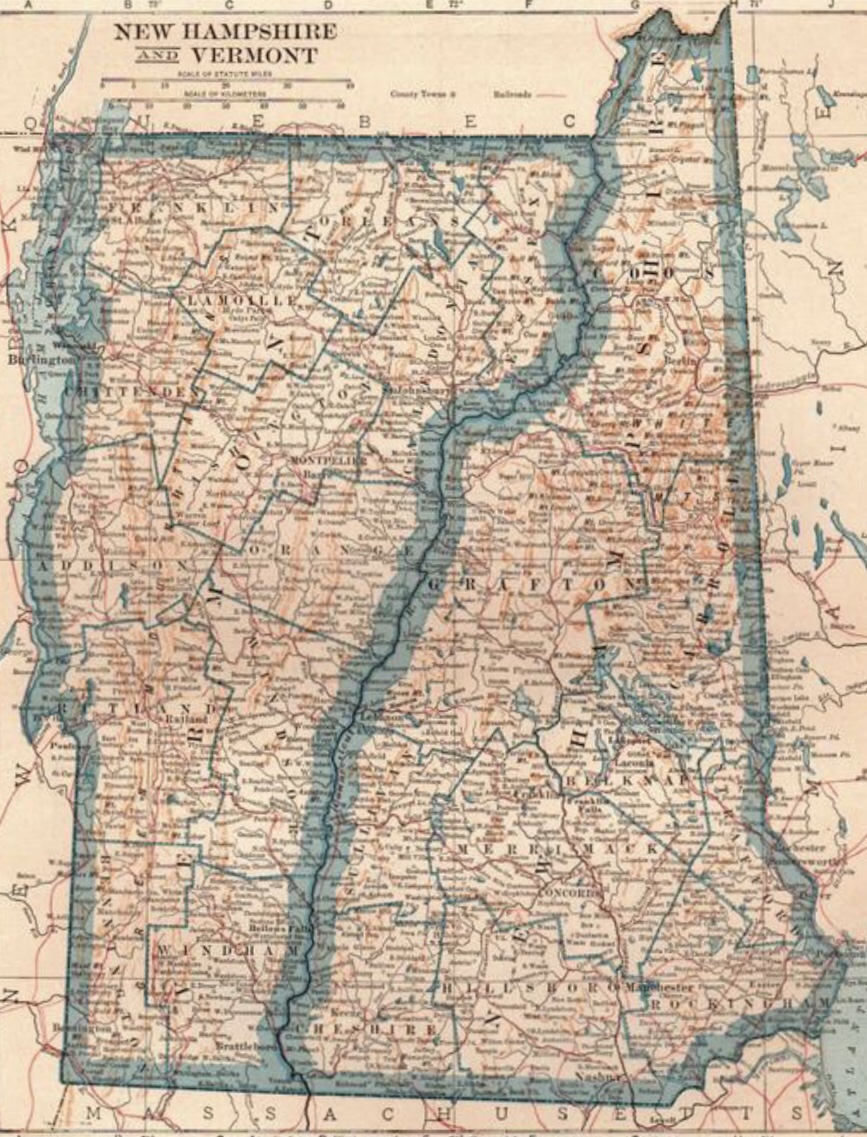
    The Connecticut River defines the border between the two, as determined by King George III in 1763. Vermont didn’t exist back then, the land was deemed New York’s. But that didn’t last very long; about the time it took for New York to try to collect taxes from the people there. Ethan Allen and the Green Mountain Boys chased the tax collectors right out and Vermont seceded as the American Revolution was ramping up. That’s a very New Hampshire thing to do! And ever since, these two states have been locked in an eternal embrace; interconnected yet independent. White Mountains and Green Mountains, conservative and liberal, two of the smallest states in size and population; wonder twins holding up the northern border and hugging each other for eternity.
  • Pass the Flowing Bowl

    When Ethan Allen and the Green Mountain Boys helped Benedict Arnold seize Fort Ticonderoga, they apparently wanted to celebrate the occasion.  In 1775 these two men, who couldn’t be more different, led the attack on the lightly defended fort, winning it without a fight.  British soldiers stations there hadn’t heard about Lexington and Concord yet, and had no idea that they might be attacked by people who were supposed to be loyal to the crown.  For the Green Mountain Boys, the best way to celebrate was to pass the flowing bowl around.  The bowl was usually filled with punch.

    The recipe for punch varied from place to place across the globe, but in the American Colonies it called for rum.  Punch rivaled ale and flip in popularity, and in some colonies exceeded it.  Punch had an added benefit over Flip or ale in that it helped introduce fruits and juices into the diet of colonists, which certainly improved their overall health (rum aside) and fending off scurvy.Wayne Curtis in And a Bottle of Rum referenced a recipe for Planters Punch that was published in The New York Times in 1908 in the form of a ditty:

    “This recipe I give to thee,
    Dear brother in the heat.
    Take two of sour (lime let it be)
    To one and a half sweet.
    Of Old Jamaica pour thee three strong,
    And add four parts of weak.
    Then mix and drink “I do no wrong – 
    I know whereof I speak.”

    Back in my college days, I thought I’d be clever and mix up a batch of punch for a party.  Not being an expert in the art of mixology, I was pretty aggressive in my pours, adding several spirits into a bowl and adding Hawaiian Punch or something like it.  After celebrating a bit too much with this concoction, the night took a turn for the worse.  It was the first and last time I’ve ever made punch.

  • New Hampshire Grant

    New Hampshire Grant

    The land that is today Vermont was once claimed by Massachusetts, New York and New Hampshire.  The Massachusetts claim originated from a fort established in the Connecticut River Valley in present-day Brattleboro.  New York based their claim on original Dutch territorial claims that all the lands west of the Connecticut River to Delaware River were theirs.  When the Dutch were ousted from North America New York followed the same general borders, which were validated by King George II.

    New Hampshire Governor Benning Wentworth chose to follow his own guidelines, choosing the western border of Massachusetts and going north to Canada and east to the Connecticut River as land he had jurisdiction over, which he then granted to middle class farmers who settled the land.  New York was granting the very same land to wealthy landowners and wasn’t particularly pleased by Wentworth’s interpretation of the borders.  These wealthy landowners then tried to tax the middle class farmers on “their” land, which led to even more tensions.

    The most famous of these middle class farmers was Ethan Allen, who was a natural self-promoter.  Allen and other farmers formed the Green Mountain Boys, who organized armed resistance to New York.  The escalating confrontations between the New Hampshire Grantees and the New York grantees continued until the beginning of the Revolutionary War forced all parties to focus on a larger problem.  Eventually New York gave up and Vermont would become a state.  There’s still an independent streak in Vermont and New Hampshire to this day.  Perhaps there’s still some lingering annoyance on the part of some wealthy New York family who’s ancestors gave up the fight for lands they were granted.