I bless the night that nourished my heart To set the ghosts of longing free Into the flow and figure of dream That went to harvest from the dark Bread for the hunger no one sees.
All that is eternal in me Welcome the wonder of this day, The field of brightness it creates Offering time for each thing To arise and illuminate.
I place on the altar of dawn: The quiet loyalty of breath, The tent of thought where I shelter, Wave of desire I am shore to And all beauty drawn to the eye.
May my mind come alive today To the invisible geography That invites me to new frontiers, To break the dead shell of yesterdays, To risk being disturbed and changed.
May I have the courage today To live the life that I would love, To postpone my dream no longer But do at last what I came here for And waste my heart on fear no more. — John O’Donohue, A Morning Offering
For Saint Patrick’s Day, a morning offering from a revered Irish writer. And what a poem it is! Go on and read it once again, I don’t mind at all. I’ve read it a few times more myself, considered what to go with and in the end quoted the poem in its entirety.
Patrick chased the snakes out of Ireland. George Washington and Henry Knox chased the British out of Boston Harbor. We note the history of this day but ought to remember to make a little history ourselves. Forget drowning in pint or dram—find your stride today instead. A wee bit of poetry, a soundtrack of favorite Irish music, a brisk walk, and some writing of our own. Perhaps a splash of green to mark the occasion. The 17th of March is a day for action, not simply commemoration.
The truth is, we get worn down by life and need to be provoked back on track. To break the dead shell of yesterdays and regain that courage to do at last what we came here for. There’s nothing to be done about all that’s happened before today, save to learn from it. Use this time to chase away our own snakes and move onward towards a brighter future. To welcome the wonder of this day by doing it justice.
“I had taken my station close on the left of Major Andre’s left hand officer; and continued in that station the whole march. The guard marched a short distance when it wheeled to the left, turning a corner of the road, and marched a short distance, when they again wheeled to the left, in order to pass through a fence. Having entered a field, they marched forward a short distance, wheeled to the right, and halted. The ground here was level; a little distance in front was a moderate ascending hill, on the top of which the gallows was erected. In the position where they halted, Major Andre was, for the first time, in view of the gallows. Major Andre here said, ‘Gentlemen, I am disappointed. I expected my request’ (which was to be shot) ‘would have been granted.’ No answer was given, and he continued with his arms locked with those of the two officers. — Dawson, Papers Concerning André
Early one morning, as commuters made their way to work and parents waited for the school bus on street corners throughout town, I made a quick stop to visit the Major John André Monument. André was swept up in the treason of Benedict Arnold and paid the ultimate price when Arnold wouldn’t turn himself in, hung and buried at this spot on 2 October 1780. George Washington himself would lament the death of André, stating that “he was more unfortunate than criminal”.
The Hudson River Valley was once the headquarters for George Washington. The river was a critical transportation hub, and if the British were to control it they would have cut off New England from the rest of the colonies. Benedict Arnold was once a highly-respected leader in the Continental army and the fight to protect the Hudson River and Lake Champlain from British control. But he was increasingly frustrated with his status, feeling like he wasn’t properly honored and rewarded for his leadership. His wife was also a Tory and desired a better position in society. This made him a prime candidate for recruitment by the British turn against the American Colonies.
Major John André, a rising star in the British Army, was chosen to meet with Benedict Arnold to formalize the details of engagement and Arnold’s rewards, both financial and status, for turning against the Americans. Arnold and André met on a warship in the Hudson River and again on shore not very far north from where André’s American journey would end. Unfortunately for André, his warship was chased off by cannon and during his overland journey back to British-controlled territory he was captured in enemy territory while disguised as an American. This made him a spy and subject to execution. That execution would happen on a small hill in what is now Tappan, New York.
“Every attention and respect was paid to Major Andre that it was possible to pay to a man in his situation … every officer and soldier in the army would have lifted both hands for the exchange of Andre for General Arnold. This exchange was offered by General Washington, but refused by General Clinton, the British Commander-in-chief. So the life of a traitor was saved; and Major Andre fell a sacrifice” — Dawson, Papers Concerning André
Major John André was later exhumed from the site and is now buried as a hero at Westminster Abbey. The site of his execution remained unmarked and, like so many historical places, eventually doomed to obscurity. In 1879, a wealthy American named Cyrus W. Field, who laid the first telegraph cable across the Atlantic Ocean, decided to put a monument up honoring Major John André. It makes sense that a man who made his fortune connecting the Old World with the New would seek to honor a dignified officer seen as more unfortunate than criminal. But it would take time for the community to see it the same way. As you might imagine, erecting a monument honoring an enemy soldier associated with the most notorious traitor in American history was unpopular at the time, and there were three attempts to destroy the monument before someone decided to add a plaque honoring George Washington and his army.
You’d never know the monument was there, in the middle of a small traffic circle on a quiet residential street, if you didn’t seek it out. Such is the nature of the Hudson River Valley today, rooted in history but built for the future. The former encampment and small hill where Major John André met his fate are today simply suburbia in Metro New York. Yet history still whispers here, and reminds us that nation-defining heroism and treachery once played out right here.
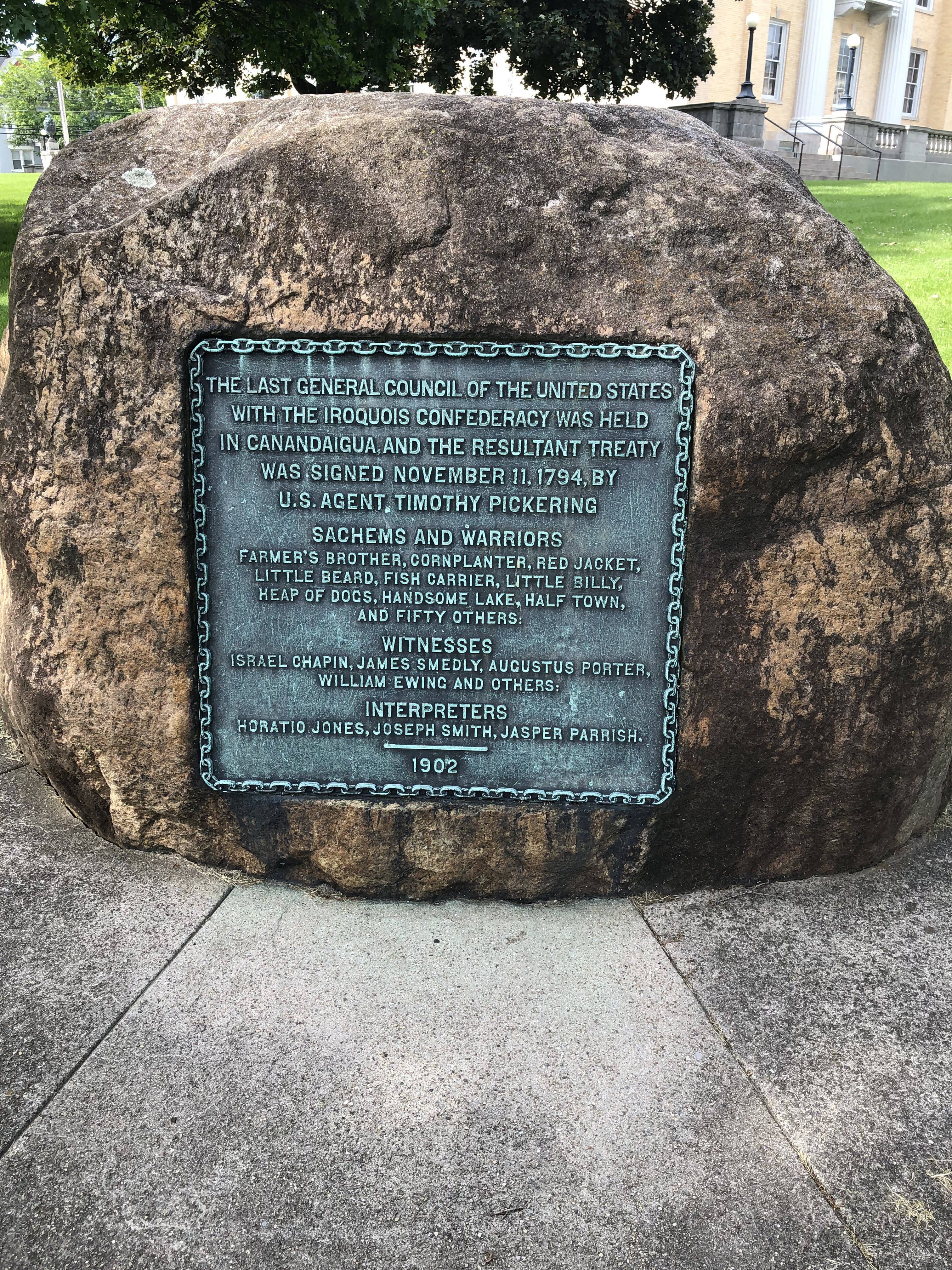
This week, on my drive from Buffalo to Seneca Falls, I made a quick detour to visit a rock. I live in the Granite State, so I know a thing or two about rocks, but the rock I was visiting is unique because of a tablet mounted to it commemorating the Treaty of Canandaigua on November 11, 1794. The location of the 1902 monument, on the lawn of the Ontario County Courthouse, is roughly where the treaty was negotiated between representatives of the United States, the Iroquois Confederacy and Quaker moderators trusted by the Iroquois.
After the Revolutionary War, American sentiment towards the Iroquois Confederacy was at a low point. The Iroquois were significantly weakened after the war, and the Americans were operating from a position of strength when they signed the Treaty of Fort Stanwix in 1784. The location is notable, as it was five miles from the site of the Orinasky ambush that wiped out many of the men from this county. Western Iroquois tribes with loyalists participated in that ambush, and seven years later a treaty was being negotiated at the fort those ambush victims were marching to relieve. The treaty ceded massive tracts of land from New York, Pennsylvania and Ohio to the Americans in an agreement known as “the Last Purchase”. The Six Nations refused to ratify the treaty but the damage was done.
Fast forward ten years and growing tensions between the United States and Native American tribes on the western border threatened to blow up into war. Suddenly the Iroquois Confederacy seemed a significant threat should they side with western tribes and declare war on the United States. President George Washington sent Colonel Timothy Pickering, a Bunker Hill veteran from Salem, Massachusetts, to negotiate a new treaty with the Iroquois. The location for the meeting to negotiate the treaty was chosen by another Massachusetts man, Israel Chapin. When Chapin died a few years after the treaty was ratified, Red Jacket, once an enemy of Chapin’s during the war, gave a eulogy at his gravesite. I wrote briefly about Red Jacket practicing his speech for Canandaigua at the spectacular She-Qua-Ga Falls previously. There’s a deeper dive that needs to take place into the lives of these three men in particular, but also the incredible list of names on the tablet. I can’t wait to learn more about Heap of Dogs.
The treaty is called both the Pickering Treaty and the Treaty of Canandaigua and is still in use today. Every year on November 11th there is a ceremony and celebration at the monument to lasting legacy of the treaty. It undid some of the damage from the Treaty of Stanwix, and reserved land for the Iroquois that is still protected. The land rush that took place after the Revolutionary War was like a tidal wave sweeping over New York westward. That they were able to set aside significant tracts of land for those who called it home before Europeans settled here remains a notable achievement.
During the beginning stages of the French and Indian War, the British Army led by General Edward Braddock and officers that included Thomas Gage and George Washington marched to modern-day Pittsburgh to drive the French out of Fort Duquesne. During the march, Gage’s Advance Guard failed to secure the high ground. As they marched towards Fort Duquesne, they stumbled upon French and Indian forces, who quickly took the high ground and leveraged it to drive Gage’s Advance Guard back towards the main army. In one became known as the Battle of the Monongahela, Braddock rushed his own army forward right into the retreating Advance Guard soldiers. Chaos ensued, and the French and Indians routed the British forces and killed Braddock. If lessons were learned in this battle, taking and holding the high ground seems to have been lost on some of them.
Almost twenty years later, during the beginning stages of the American Revolution, the City of Boston was under siege immediately following the Battles of Lexington and Concord. Both sides looked at the hills surrounding Boston and recognized the strategic importance of holding these hills as soon as possible. The Americans were quicker to get there, and under the direction of General William Prescott, 1200 men built a redoubt on Breeds Hill to defend against the inevitable counterattack by the British.
Old friend Thomas Gage, by now Military Governor of Massachusetts and perhaps not entirely remembering the lessons of the Battle of the Monongahela, ordered the British forces to attack Breeds Hill on June 17th, 1775. They were repulsed twice with significant casualties, particularly with their officers. It was during this battle that General Prescott told his American militia “Do not fire until you see the whites of their eyes” both for accuracy and because they were dangerously low on ammunition. In fact, the lack of ammunition is what ultimately led the British to take Breeds Hill on the third attempt. The Americans fled up and over adjacent Bunker Hill, and for some reason the event has forever been called the Battle of Bunker Hill. Nine months later, the British evacuated Boston when they looked up at Dorchester Heights and saw the cannon from Fort Ticonderoga pointing down at them, proving they recognized the value of the high ground.
The colonial American army seized Fort Ticonderoga by surprise and then had a year to fortify it before the British could amass an army, wait out winter, sail across the Atlantic and work their way down the St. Lawrence and Lake Champlain to meet them in battle. When the British arrived they completely bypassed the fort and took the high ground behind it. When the Americans holding the fort saw the cannon pointed down at them they knew the jig was up and evacuated the fort. With barely an exchange the British took Fort Ticonderoga in one day because they saw the high ground that the Americans thought was impossible to haul cannon onto and proved them wrong.
On July 2nd, 1863, the critical importance of holding the high ground was on display at Little Round Top in Gettysburg, Pennsylvania, where the 20th Maine Volunteer Infantry Regiment led by Colonel Joshua Lawrence Chamberlain repulsed repeated attacks by the confederate soldiers led by Lieutenant General James Longstreet. Like the Americans at Breeds Hill in 1775, the 20th Maine soldiers were running out of ammunition. Chamberlain, under orders to hold the line at any cost. If the confederates were to break through they could flank the Union forces and break the back of the entire Union army. Chamberlain ordered a bayonet charge down the hill, surprising and then routing the confederates.
The high ground is advantageous, but it doesn’t guarantee those who hold it will win. What it does guarantee is that there will be a high cost for trying to take it from those who currently hold it. There’s a lot of talk about taking the moral high ground lately. Democrats point to Republicans and evangelicals and openly question them taking the moral high ground when they defend the President’s actions and statements. My BS detector tells me who holds the true high ground, but that could be bias. What’s apparent though is that continuously attacking those who sit on the high ground, whomever they may be, has a deep cost.
One of the biggest heroes for the American Colonists in the Revolutionary War in 1776 was a fisherman from Marblehead, Massachusetts. Actually, he was more than a fisherman, he was also a cordwainer (shoemaker), rum trader, merchant and notably, the first Captain (of the Hannah) in the Continental Navy a later in the war he commanded forces at Saratoga and served with distinction there as well. But it was and as the Commander of a brigade known as the “Amphibious Regiment” that John Glover became a legend in the history of the American Revolution.
Glover’s group of fishermen and merchants saved the Continental Army twice in New York with strategic evacuations from Brooklyn and later from Manhattan. These two evacuations saved the Continental Army from certain defeat against far superior numbers. These weren’t the battle hardened troops of later in the war, these were undisciplined troops led by Generals, including George Washington, who were being outmaneuvered by the British Generals. Glover’s fleet of small boats shuttled the entire army across the Hudson River to Manhattan and then to New Jersey in the cover of darkness.
In December of 1776, Glover’s Marblehead men once again became heroes in shuttling the Continental Army across the frigid Delaware River to Trenton, and then back again with 900 Hessian POW’s. Glover’s fleet pulled off some of the most impressive amphibious maneuvers of the war, equalling the British invasion of Long Island in seamanship, and perhaps surpassing the British with their sheer audacity.
At some point I’ll update this post with pictures of John Glover’s statue in Boston and his home in Marblehead, Massachusetts. For now, I’m taking a moment to appreciate this war hero, rum trader, merchant, fisherman and yes, cordwainer. Glover is one of the legends of the American Revolution and should be more widely known today.
In the Southeastern corner of Brooklyn, New York is an oddly-named village named Gravesend. The definitive origin of the name is lost to history, but it’s generally agreed that it comes from the Dutch phrase “Count’s Beach”. This was part of New Amsterdam in the 17th century, and it remains one of the only place names in Metro New York that still holds a Dutch-origin name. Go up the Hudson River and you’ll find plenty more.
Gravesend is [sort of] famous for two things. First, it’s the location of Coney Island Amusement Park, home of the gag-reflex hot dog eating contest every 4th of July. Given the date this event happens there’s some irony in the second reason for Gravesend’s fame. It was the site of the British landing in the summer of 1776 when the British and Hessian forces swept across Long Island and Manhattan and gained control of the critical New York Harbor and the lower Hudson River.
On the morning of August 23rd, 1776 the British invaded America at Gravesend Bay. By noon of that morning more than 15,000 British troops made an amphibious landing on the beaches there, and brought with them 40 artillery pieces. They quickly moved into the interior of Brooklyn and taught General George Washington and the colonial army a lesson in strategic military moves. Washington looked around days later and realized that there was no hope and evacuated his troops from Long Island. That evacuation is a story for another day, but needless to say, the defense of the American colonies hadn’t gone as planned. So on the 4th of July, when strange people consume massive quantities of hot dogs dipped in milk, think about American hopes for a brighter future being dashed in Gravesend in the summer of 1776. It’s okay to look away when they show it.
Long before present-day Syracuse dominated the lake that bears their name, the Onondaga lived in this area. Onondaga means “hill people”, and there are certainly plenty of those in the region. If you look at a map of the area, you see that there’s another dominant feature in this region: water. Lake Ontario is just to the north and west of Lake Onondaga. The finger lakes are southwest. And the Mohawk River cuts an East-West corridor from Albany to roughly Lake Oneida, which connects to Lake Onondaga via the Oneida and Seneca Rivers. This network of waterways was a superhighway for native populations, and later for Basque and French traders, and eventually British colonists and the waves of settlers who followed them. Salt production was a major industry for early settlers to the Syracuse area as they tapped into the massive natural deposits around the southern part of Lake Onondaga.
In my fourth year of crew, I rowed on Lake Onondaga in the summer of 1988 in the Intercollegiate Rowing Association Regatta. This regatta was memorable for me for a few reasons. That year Northeastern University had an accident on the way to the regatta and their rigger was killed. The Heavyweight Men went on to win the IRA’s that year, and I witnessed the race. To say Northeastern was a sentimental favorite after that event is an understatement.
When you drive down I-90 you cross the lake outlet between the Seneca River and Lake Onondaga where Syracuse has their boathouse. This is where we launched during the IRA’s and I still have vivid memories of my time there that bubble to the surface whenever I cross this outlet in the daylight.
The Onondaga were one of the five original tribes in the Iroquois Nation. The Oneida and Mohawk were to their East, and the Seneca and Cayuga were to their West. So the Onondaga as the middle tribe were the logical “keepers of the fire” for the five nations.
During the Revolutionary War, the Onondaga fought on the British side and paid for this in 1779 Sullivan Campaign led by Major General John Sullivan. George Washington brought the fight to them in a series of coordinated raids in when the United States won. Thousands of Iroquois fled to Canada and many starved in the winter of 1779-1780. Their homeland was settled by New York veterans of the Revolutionary War as part of the Military Tract of Central New York. Today there are roughly 500 people living in the Onondaga Nation Reservation just south of Syracuse.
Lake Onondaga has suffered its own affront, as a company called Allied-Signal, which later became Honeywell, and other companies used the lake as a dumping ground for Mercury and other toxic chemicals. Years of dredging and capping the bottom of the lake were completed in 2017. The Onondaga consider the lake sacred. Corporations considered it a convenient dumping ground. It seems to me that the way the Onondaga lived on the land and the waterways that cut across it is preferable to the way that those who came after them have treated each. I know that in 1988 I wasn’t thinking about how much mercury I was rowing over as we competed in the IRA’s.
Growing up in the United States of America, you heard a version of history that made our Founding Fathers and the generals who fought the American Revolution out to be heroes. And in many ways they were. The winners write the history, no doubt, but they did create a democracy that was the envy of the world while fighting off the greatest military power of the day.
I’ve read that if Benedict Arnold had been killed at Saratoga instead of badly wounded he would be remembered as one of our greatest heroes. There’s no doubt that he was a complicated man; aggressively ambitious to a point where he drove those he commanded, was loathed by many of his peers, but loved as a true leader by anyone who saw him in action.
Had Benedict Arnold not turned against the colonies, he would have been celebrated as one of our greatest military leaders for his raid on Quebec, the raid on Ticonderoga, the Battle of Valcour Island on Lake Champlain against overwhelming odds, the Battles of Ridgefield, Connecticut and Saratoga. In all of these, Arnold exhibited courage, persistence, strategic vision and competitive spirit critical in war. He sacrificed an enormous amount of his personal wealth and political power for the Revolution, and was a key reason the British were ultimately defeated. And yet he’s best known for his betrayal.
You can’t take omit that betrayal when considering the man. There’s no doubt that he deserved the condemnation and infamy he received and receives to this day for not just betraying the colonies, but also betraying George Washington and the troops he served with. But it’s… complicated. If Arnold weren’t such a hero in 1775-1778, his betrayal in 1780. He remains the most famous traitor in history, and the most forgotten hero.
I’ll try to visit a few of the places that Benedict Arnold made history in. Not because I admire the man, but because without him I’m not sure that the Continental Army would have won in the end. And what would our history have been then? Unlike Washington, there aren’t a lot of “Benedict Arnold slept here” placards on the sides of colonial era homes. But there are monuments to what he accomplished, and I’d like to explore a few of those in 2019.
During the Revolutionary War more than 130,000 people living in North America died from Smallpox. Of those fighting in the war, about 7000 died in the war, while more than 17,000 died from disease. And smallpox was the biggest killer on the continent.
Variola virus, or smallpox is spread through physical contact, airborne through breathing droplets from an infected person, or through bodily fluids. About 30% of the people who got smallpox died from it. The disease was declared eradicated in 1980.
During the Revolutionary War soldiers would deliberately infect themselves with a small amount of the virus on their skin as a crude form of self-inoculation. They would become sick but nowhere near as sick as others who got the disease through normal transmission. It’s a terrifying gamble to infect yourself with a disease that kills 1/3 of the people who contracted it. There was also significant debate within the colonial army about the wisdom of inoculation. Major General John Thomas threatened his troops in the Northern Army with the death penalty they were found to have inoculated themselves. There’s some tragic irony in Thomas succumbing to smallpox himself within weeks of his order.
Once you had smallpox (and of course, survived) you were immune to it. There was speculation that the British army, who were largely immune to it from dealing with outbreaks at home, deliberately introduced smallpox to the colonies as a form of chemical warfare. As horrific as this sounds, it’s not entirely farfetched. After all, Jeffrey Amherst had done just that to the Native American population approving smallpox-infected blankets being given as gifts to Chief Pontiac and his Ottawa Indians during the French and Indian War just a decade earlier.
George Washington was well aware of the threat posed by smallpox, and increasingly looked to inoculation as a way to save his army from being decimated by the disease:
“In February 1777, while encamped at Morristown, Washington became convinced that only inoculation would prevent the destruction of his Army. Emphasizing the need for secrecy and speed, Washington ordered the inoculation of all troops. Because Virginia forbade inoculation, Washington asked Governor Patrick Henry to support the program, writing that smallpox “is more destructive to an Army in the Natural way, than the Enemy’s Sword.” In the end, the gamble paid off. Fewer than 1% of the Soldiers died from being inoculated, and the program was so successful in controlling smallpox that he repeated it in the Valley Forge winter of 1778.”– Army Heritage Center
For people who complain about living in the times we live in, I’d point them straight at smallpox as an example of how much better off we are today than we were years ago. Advancements in healthcare have completely transformed our lives for the better. Longer lifespans for sure, but also a better overall quality of life without the threat of smallpox, polio and other horrific diseases.
It’s bitterly cold outside. Snow boots, winter parka, bomber hat flaps tight to the face when you’re letting the dog out cold. In general I don’t complain about the weather. Hell I live in New England and while some call it our birthright, I view it as whining about something you can control. Don’t like it? Move to Florida.
When it gets like this I think about the people who were out in these elements fighting the Revolutionary War or the French & Indian War. No creature comforts for Colonel Henry Knox and the soldiers in his command as they hauled artillery 300 miles through the wilderness from Fort Ticonderoga to Boston to help free the city from the British siege in the winter of 1775 – 1776. Nor for Rogers Rangers and slowly starved to death as they evaded the French and Native Americans who were actively hunting for them on lands they knew better. No reprieve for George Washington and the soldiers hunkered down at Valley Forge in the winter of 1777 – 1778. I could write another hundred examples but I think you get the point.
History offers great perspective on what real hardship is. It isn’t living in the suburbs with a gas furnace and six supermarkets within ten minutes drive and pizza delivery a call away. No, this isn’t hardship, and I tune out those who complain about it.