Tag: Giovanni da Verrazzano

  • Encounters with the Unfamiliar

    Coming up on a year of taking French lessons using Duolingo, and I recognize I’ve got a long, long way to go. Nothing impresses that on a person like listening to someone sing softly and rapidly in French, as Lous and the Yakuza did in a remarkable Tiny Desk Concert on NPR. It really wasn’t until Marie-Pierra Kakoma started speaking in French that I picked up on some of what she was saying. The rest of the time I was hopelessly grasping for familiar words while enjoying the cool vibe of the music. Sometimes you just need to concede defeat and make the most of the situation.

    To be fair, a second or third language is much easier to understand in a conversation than it is in rapid-fire lyrics in a pop song. Walking around in Montreal most people are just happy that you’re trying to meet them halfway with their own language and help bridge the conversation. Body language and intonation not only help bridge the language barrier, they often serve as the primary way of communicating. People are people anywhere you go. Most want to help others.

    For all my talk of learning French, I know it would take immersion to really make it sink in. At the moment I’m at the dog paddle level of swimming in the French Olympic pool. And that’s okay for now (after all I’m locked away in a pandemic), but at some point I’ll face another test and it ought to push me to get better.

    Take that hopelessly lost feeling of listening to Marie-Pierra Kakoma singing and flip it around. At one point she spoke English, struggled with it, and returned to her native French. That was the moment when two people speaking different languages would have bridged those gaps for each other. But it was just her and a microphone with her band silent behind her. That struggle is one we all feel with a foreign (to us) language. The encounter with the unfamiliar. The unknown.

    Think of the great explorers of history, Giovanni da Verrazzano, Jacques Cartier, Henry Hudson, Samuel de Champlain. The best of them encountered the unfamiliar all the time. Unknown lands, hidden shoals, native people encountering strangers for perhaps the first time, and always, language barriers. Being able to get that encounter with the unfamiliar right the first time was often the difference between life and death for them. Who are we to struggle with a few words and throw our hands up in frustration?

    Encountering the unknown informs. We learn what we don’t know and, if we let it, teaches us to be better. Do you throw your hands up and walk away or press on and figure it out? That teaching moment is casually informative for me, but might be urgent for an immigrant lost in a new city with a sick child. Encounters with the unknown offer a lesson in empathy for those paying attention. Figuring out where the restroom is might just be the most urgent thing we ever struggle with. For some it means a whole lot more to figure things out. Read the bio for Marie-Pierra Kakoma and you see that she was a refugee herself. She gets a pass with her struggles speaking English to an unseen audience.

    I may never master French, but I’m very slowly picking it up. Should the pandemic end and travel restrictions lift, perhaps a trip to Montreal or Paris is in order to celebrate. We’ll all be ready to encounter something unfamiliar by then. In the meantime, should I encounter someone struggling to be understood in my own language, maybe a bit of empathy and generosity would help in the moment.
  • The Cold Water Initiation

    “Though it be the hottest day in July on land, and the voyage is to last but four hours, take your thickest clothes with you, for you are about to float over melted icebergs.” – Henry David Thoreau, Cape Cod

    The stretch of water between Cape Sable Island in Nova Scotia and Cape Cod in Massachusetts is known as the Gulf of Maine. A lot of history has floated between these two points, from Native Americans and later the Basque fishing and whaling these rich and vibrant waters to explorers like Giovanni da Verrazzano and Samuel de Champlain mapping the coast and looking for places for settlements. The Gulf of Maine remains the one constant that each would recognize, though they might wonder where all the fish went until they glance back at the developed shoreline.

    In 1604 Champlain ventured south from Port Royal to explore the coast of Maine. It was on this trip that he discovered Acadia, and further south, the “baye longue” between two capes and a long stretch of sand beaches on the present coast of New Hampshire.” (David Hackett Fischer, Champlain’s Dream. It’s on these beaches that generations of New Englanders and vacationing Canadians have discovered the truth in Thoreau’s words: this water is as cold as melted icebergs!

    Cold water gets in your blood, and you don’t celebrate it so much as accept it for what it is: a shocking reminder of how insignificant we really are. The Atlantic Ocean is divided into the Northern Atlantic and the Southern Atlantic, but really, there are divisions within divisions. A swim in Miami is not the same as a swim in Virginia, and a swim in the Hamptons on Long Island is definitely not the same as a swim at Hampton Beach in New Hampshire.

    You aren’t really a New Englander until you’ve taken the plunge into the Gulf of Maine on a hot day. It’s an initiation of sorts into the extremes. There isn’t a person who swam in early July at Hampton Beach who couldn’t relate to the bobbing passengers at the end of Titanic. The cold water hardens you, tests your mettle, and reminds you of your mortality. And that’s why I’ve grown to love a bracingly cold swim now and then. That stinging skin is a shocking reminder that you’re still very much alive… if a bit numb.

  • The Devil’s Belt

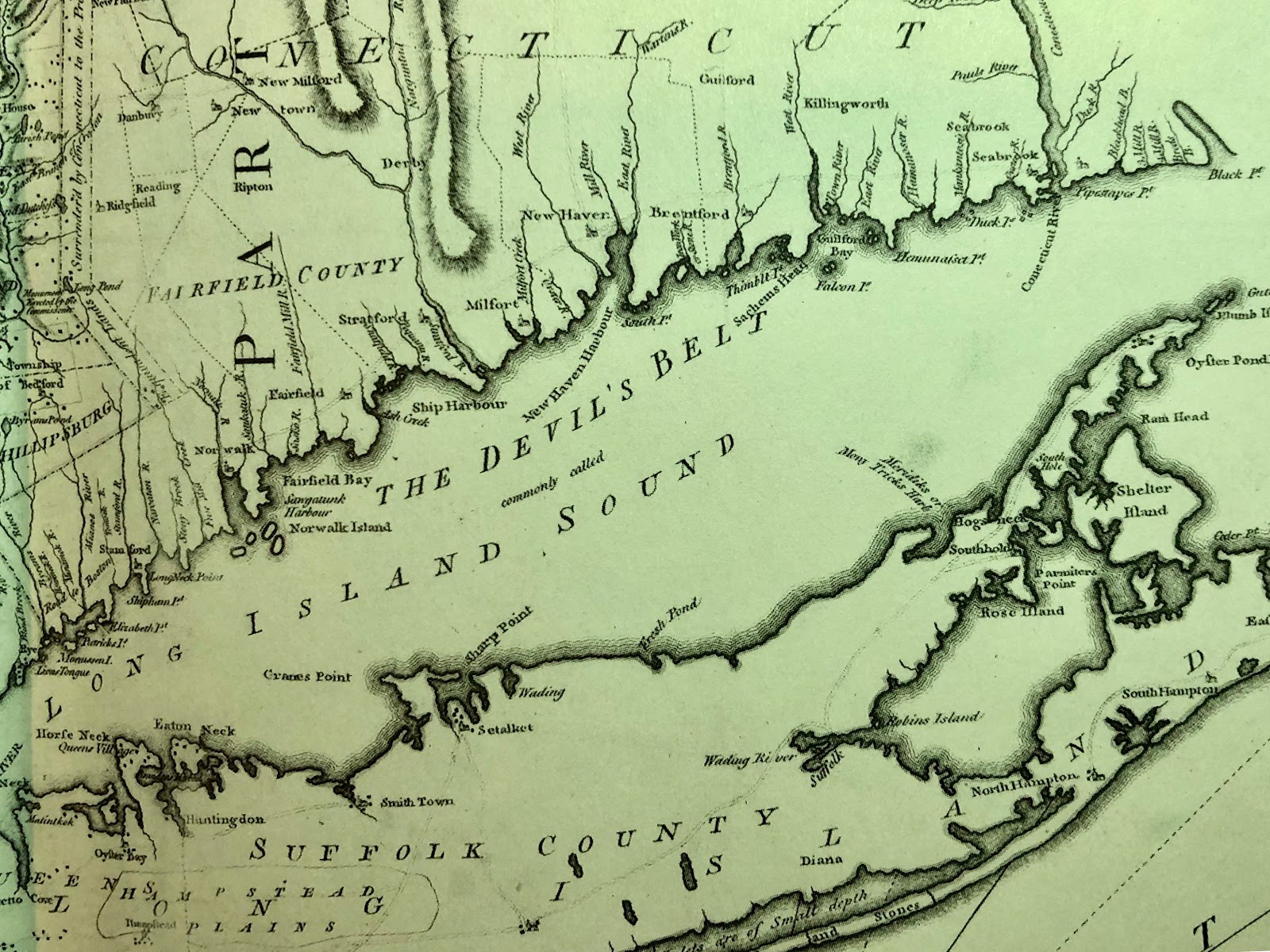
    Long Island Sound is an estuary between Connecticut and mainland New York on one side and Long Island on the other.  This body of water is renowned for its fast currents and shoals, which earned it the nickname The Devil’s Belt.  The most famously difficult portion to navigate was the narrow inlet between the East River and Long Island Sound, known appropriately as Hell Gate.

    Three early explorers mapped out this region between 1527 and the early 1600’s.  Giovanni da Verrazzano was searching for the Northwest Passage after Magellan’s circumnavigation of the globe a few years before.  He made one of the earliest maps of the North American coast from Florida to Newfoundland.  Verrazzano noted the mouth of the Hudson River and the coast of Long Island.  He may have sailed into Long Island Sound.  More than 80 years later in 1609 Henry Hudson famously sailed up the Hudson River but also explored north to Cape Cod.  And a couple of years after that Adriaen Block sailed from the East River into Long Island Sound and up the Connecticut River.  Like Verrazzano, he also explored what is now Rhode Island.  Block Island is named after him.  Block is thought to have named Hell Gate upon sailing through the narrows.  He called it “Hellegat”, which in Dutch means “hole from hell”.

    Long Island is 118 miles long.  Long Island Sound is not quite that long, but pretty close.  It’s 21 miles wide at it’s widest point.  The mouth of Long Island Sound wasn’t much easier on mariners than Hell Gate was, with The Race, the 3 1/2 miles between Fishers Island and Little Gull Island, being the site of rapid currents as the tides changed and water entered or exited Long Island Sound.  The sound is popular with fisherman and sailors alike.

    In the summer of 1951 an adventurous young man named George Post sailed out of Shinnecock Yacht Club in a 16 1/2 foot SS 114 to do something audacious.  George decided to sail around Long Island, but in typical George Post style, he planned stops along the way at Long Island parties.  George was something of a Great Gatsby with his adventurous and fun-loving spirit.  He had friends meet him with a tuxedo to change into for the party, and then the next morning it was back to sailing.

    George sailed northeast out of Shinnecock Bay, rounded Montauk, past Orient Point and down Long Island Sound towards New York City.  He had friends drop beer and food in floating packs from a plane.  George sailed past Rikers Island, and into the East River and Hell Gate, dodging floating debris and barge traffic in the East River until he finally got past Manhattan.  I can imagine what he thought when he sailed past the Statue of Liberty, rounded Brooklyn and sailed out into the Atlantic Ocean.  And I can imagine what everyone else was thinking when this 20 year old kid sailing a small boat floated past them.

    George made it back to Shinnecock, called his mother to pick him up, and got back to being a young adult on Long Island.  He was the older brother of my step-father John, and I’d had the opportunity to meet him on a few occasions over the years.  I wish I’d been more familiar with this story then, and I wish I’d asked him a few questions about it before he passed away.  He was every bit the adventurous spirit that Verrazzano, Hudson and Block were, and his younger brother is, and it would have been fun to learn more about that side of him.