Tag: Governor Benning Wentworth

  • Twice the Fun: Mount Israel & Beede Falls

    Not every amazing hike is over 4000 feet. In New Hampshire there are other lists besides the 4K list, lists like 52 with a view, which offers some beautiful views with a bit less effort than the 4000 footers. For a warm Sunday with snow melting into snowball-making consistency, a couple of friends invited me to join them on a hike of Mount Israel and for a bonus, a visit to Beede Falls, one of the waterfalls on my personal checklist to see in 2021.

    A bit of history is in order. Mount Israel is named for a settler named Israel Gilman, who lived near the trailhead for this mountain. There’s still an active farm near that trailhead, and it’s easy to imagine the land in the 1760’s when Gilman was walking around this place. Mount Israel is located in Sandwich, New Hampshire, which also has a bit of history in its name. The town of Sandwich is named for the 4th Earl of Sandwich, John Montagu, supposedly the inventor of the sandwich. Given that, I made a point of packing a sandwich for the hike, in honor of the Earl (or whomever it was, lost to history, who made sandwiches for him).

    The hike began at Mead Base in Sandwich, with a straightforward two mile hike up the Wentworth Trail. For those wondering about the name of the trail, a bit more history for you: Sandwich was founded in 1767 from a grant by Governor Benning Wentworth. Another name you’ll come to know is Daniel Beede, who was chosen to lead the settlement of Sandwich and granted 100 acres. Place names usually betray the history of that place, and if you look hard enough you’ll find Easter eggs like these on maps and street signs.

    I quickly fell in love with the Wentworth Trail. It winds through old growth oak and pine trees, with some tree trunks four feet in diameter – exceedingly rare around here. The snow cover acted as a spotlight on the biggest trees in the forest. I was smitten with one oak tree that had to be a witness to the transition from Native American land to English settlement. Further up, the trail wound around granite ledge and hemlocks, offering glimpses out to Squam Lake and the surrounding ridge line.

    The summit of Mount Israel is 2620 feet with 1900 feet of elevation. Despite its modest height relative to some of the other mountains in New Hampshire, it didn’t disappoint in views or the stunning beauty of the trail itself. Steep enough for a workout, short enough to give you time for other adventures. We made short work of the trail and before we knew it we were back at the trailhead at Mead Base and Act II.

    A half mile from the trailhead is another wonder worth visiting, Beede Falls, which is named after our friend Daniel Beede. The walk itself is wonderful, with granite ledge and scattered glacial erratics lining the edge of the trail. A large cave named Cow Cave offered a quick distraction. It was so named by some cows that decided to shelter inside the cave one day deep in the past. The cave was interesting, to be sure, but the real show was Beede Falls.

    In late February the falls were largely frozen, and we walked out on the ice that must be a lovely swimming hole on a hot summer day. The amazing part of Beede Falls in looking at them from behind. The falls froze solid in front, but you can access the back from the left and right side, and crawling behind them offered a magical trip into an icy palace. Water cascaded from the granite ledge, plunging between the icy wall you see on the outside and the cave formed behind. There’s just enough room to go all the way through it if you’re adventurous and don’t mind getting a little wet.

    In all our days on this earth, how often can you say that you got to see the world from the summit of a small mountain and from the crawlspace behind a waterfall in the space of a couple of hours? If you’re blessed with good health and mobility, then surely life is to be lived fully. Adventures like this one are within reach of most of us. All you’ve got to do is get out there.

    Frozen Beede Falls
    Ice wall in cave behind the falls
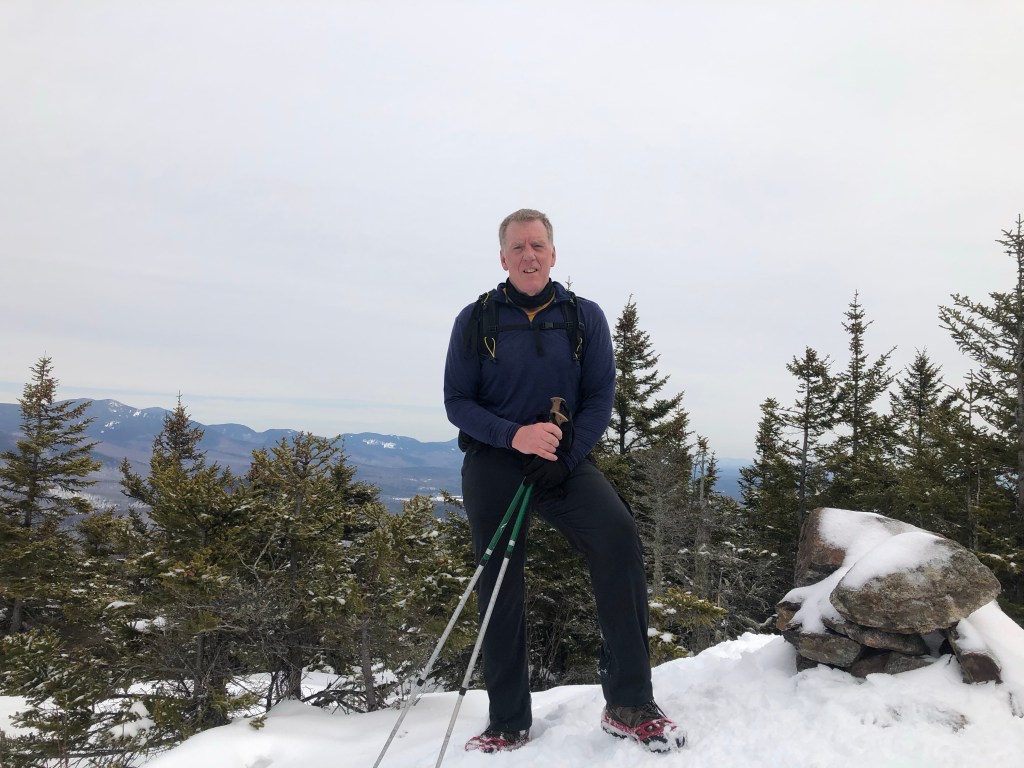
    Summit of Mount Israel
  • New Hampshire Grant

    New Hampshire Grant

    The land that is today Vermont was once claimed by Massachusetts, New York and New Hampshire.  The Massachusetts claim originated from a fort established in the Connecticut River Valley in present-day Brattleboro.  New York based their claim on original Dutch territorial claims that all the lands west of the Connecticut River to Delaware River were theirs.  When the Dutch were ousted from North America New York followed the same general borders, which were validated by King George II.

    New Hampshire Governor Benning Wentworth chose to follow his own guidelines, choosing the western border of Massachusetts and going north to Canada and east to the Connecticut River as land he had jurisdiction over, which he then granted to middle class farmers who settled the land.  New York was granting the very same land to wealthy landowners and wasn’t particularly pleased by Wentworth’s interpretation of the borders.  These wealthy landowners then tried to tax the middle class farmers on “their” land, which led to even more tensions.

    The most famous of these middle class farmers was Ethan Allen, who was a natural self-promoter.  Allen and other farmers formed the Green Mountain Boys, who organized armed resistance to New York.  The escalating confrontations between the New Hampshire Grantees and the New York grantees continued until the beginning of the Revolutionary War forced all parties to focus on a larger problem.  Eventually New York gave up and Vermont would become a state.  There’s still an independent streak in Vermont and New Hampshire to this day.  Perhaps there’s still some lingering annoyance on the part of some wealthy New York family who’s ancestors gave up the fight for lands they were granted.

  • Wentworth-Coolidge Mansion

    The first Governor of New Hampshire was a real character.  Benning Wentworth Colonial Governor from 1741 to 1766, granted the governorship by Great Britain to settle a business deal with Spain that went south when the two countries got into one of their many disputes.

    As Governor, Wentworth had a damn the torpedoes approach that fits well with the Live Free or Die state motto that was adopted later.  One of the most controversial things Wentworth did was grant land in what is now Vermont to settlers, even though New York claimed the land as theirs.  Naturally this eventually led to hostilities between the two, most famously with Ethan Allen.  That’s a story for another day.

    Wentworth requested that a capital building be built in Portsmouth, but the New Hampshire General Council denied his request.  So Wentworth built a council chamber at his 100 acre farm instead.  It was here that he did most of the governing of the state.  It’s also where he sprung another controversy on his guest one night when, as a widowed 64 year-old, he married his 23 year-old servant.  It seems Wentworth was a player.

    The farmhouse is actually four or five buildings tacked together.  According to the Wentworth-Coolidge mansion web site, “The property became the center of political and social life in the colony. The Mansion is historically significant as the only original surviving residence of a Royal Governor in the United States”.  Interestingly, the first lilacs planted in the United States were planted here and the oldest in the country.  So New Hampshire has potatoes in Londonderry and lilacs in Portsmouth as two firsts.

    The house was eventually sold off a couple of times, remaining a farm for some time but gradually falling into disrepair until it became the summer house of John Templeman Coolidge III in 1886.  The Coolidge family, wealthy Bostonians, restored the property and likely saved it from oblivion.  The family hosted wealthy friends and artists from Boston each summer, and the area thrived.  His widow donated the mansion to the state in 1954.

    Today the property is a state park, surrounded by some pricy real estate.  I did a first day hike here to mark the New Year, 2018.  It’s a property I’d love to explore sometime, and dig into the history a bit more.