Tag: Hannah Duston

  • Jonathan Haynes and a Trip Cut Short

    On February 22, 1698, Jonathan Haynes and Samuel Ladd were returning home from a day collecting cut hay when they were surrounded by a party of Abenaki warriors. Hopelessly outnumbered, they asked for quarter but none would be given for the older men. Both would be killed that day, and one each of their sons captured. One of Haynes’ other sons escaped on a horse. This all happened in what is now Haverhill, Massachusetts near the West Gate Market Plaza.  Today there’s very little evidence of the events of that day, save for a mention on a monument erected by descendants two hundred years later. Those descendants, happily alive at the time, are long gone now too.

    Jonathan Haynes lived a short walk from where Hannah Duston was kidnapped less than a year before.  In fact, Jonathan Haynes had been kidnapped two years before along with four of his children.  Two came back to Haverhill with their father, two lived out their lives in Canada.  This time Jonathan paid the price for living on the edge of the frontier.  The warriors who killed Haynes and Ladd had come from a raid in Andover (likely present-day North Andover) where they had killed five settlers, including Pasco Chubb, his wife and daughter.  Chubb is a story for another day, but it seems that the Abenaki were out for revenge and went to his home in winter to kill him.  Haynes and Ladd were simply unlucky to be on the path that the Abenaki warriors were taking back to what is now Concord.

    There’s a rich history in this region, full of stories like this one that are largely lost to the past. The relentless terror for people living with the threat of raids must have been unbearable at times.  Today there are only whispers.  Evidence of the once powerful Abenaki is almost impossible to find.  But sometimes you find clues to the lives of the original settlers if you simply pay attention.  The Duston Garrison still stands less than two miles away.  And thousands of people drive by the small burial ground where Haynes and his descendants are buried.  Most of the oldest gravestones are illegible as time wears away the engravings on the stone.  The burial ground, like the garrison, is one of the few places in this corner of Haverhill that hasn’t changed all that much in 320 years.  It still marks time as it has since that day so long ago when a trip home was unexpectedly and tragically cut short.

  • The Merrimack River Frontier

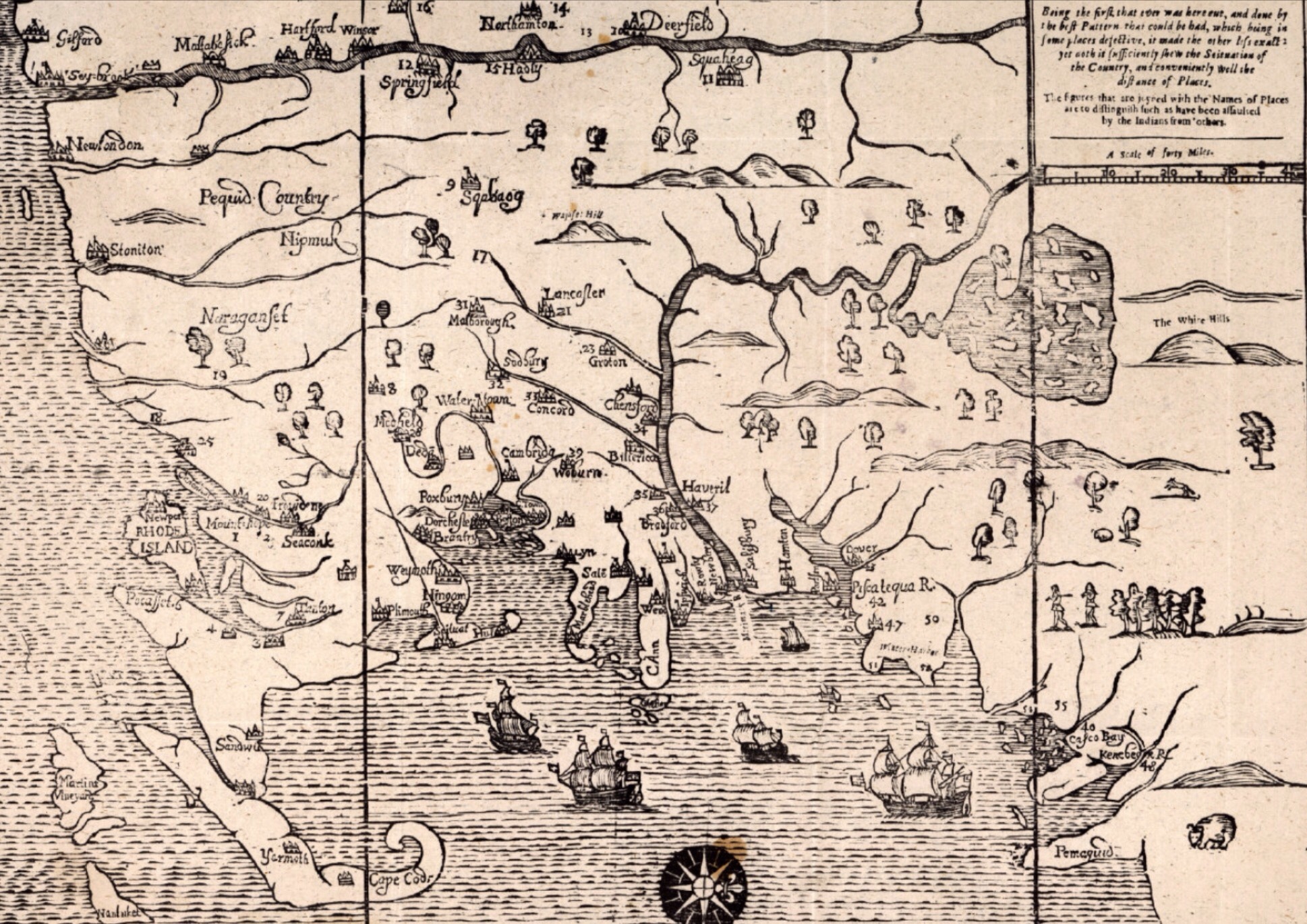
    Yesterday I dove deep into the Cape Cod section of John Seller’s Mapp of New England.  Today I’m looking at another fascinating section – the border between “civilization” and the “wilderness’.  I’ve written before about place names like World’s End Pond in Salem, New Hampshire.  Nothing hammers that home like seeing a map from 1675 showing the Merrimack River towns of Haverhill (“Haveril“), Billerica and Chelmsford (“Chensford“) Massachusetts as the frontier towns they were at the time.  North of the Merrimack River is wilderness in this map, South are the growing settlements of Massachusetts.  The river serves a critical role for settlers and Native Americans alike as both transportation and a border.  Settlements at this time were largely along the rivers and their tributaries, the Concord and Nashua Rivers.

    That bend in the Merrimack River northward was a critical point in the understanding of this land.  Isolated outposts like Billerica, Groton and Lancaster represented the outer reaches of people like us.  The map shows Lake Winnipesaukee and its many islands, so there was clearly knowledge in 1675 of what lay beyond, but it remained for all intents and purposes a vast, dangerous wilderness for another century until the fortunes of war, attrition in the Native American population and the shear mass of settlers from Europe turned the tide.

    It’s no surprise that the most notable Indian raids of the day were happening along the frontier.  York, Haverhill, Andover, Billerica, Chelmsford, and Groton all suffered Indian raids during the series of wars between the French and British.  Further west Brookfield and Deerfield had similar raids.  These frontier towns were dangerous places, and the settlers there would rarely venture out to tend their fields unarmed.  Towns like Haverhill were building fortifications and the brick 1697 Dustin Garrison for a measure of protection in the years spanning King Williams War and Queen Anne’s War.

    There were a series of conflicts between the English settlers and the Native American population that impacted northern New England.  In all cases the underlying conflict between the expansion of English settlements and the encroachment on the Native American population was a key factor.  French influence on the Native American tribes also contributed significantly in many of the raids in Merrimack River Valley from 1689 to 1713 as raiders were offered rewards for scalps and prisoners.  Living in this area for most of my life I see many reminders of that time in our history, and I always glance over at World’s End Pond and the Duston Garrison whenever I pass either.  Duston’s wife Hannah was famously kidnapped during King William’s War, her baby and many neighbors killed, marched through the town I live in by Abenaki warriors, and later escaped back down the Merrimack River on one of those raids.

    Wars Impacting Northern New England in the Early Colonial Period:

    • King Philip’s War 1675-1678 (Northeast Coast Campaign vs. Wabanaki Confederacy)
    • King William’s War 1689 – 1697 (French and Wabanaki Confederacy)
    • Queen Anne’s War 1702–1713 (French and Wabanaki Confederacy)
    • Dummer’s War 1722-1726 (Wabanaki Confederacy)
    • French and Indian War 1754 – 1763 (French and Mohican, Abenaki, Iroquois and other tribal alliances)

    So Seller’s Mapp of New England was a living, breathing document that was strategically important to the British and by extension the English settlers living in New England.  If matters were largely settled with the Native American population in the Southern New England areas by 1675, they were anything but settled in Northern New England.  Northern Massachusetts, including what is now coastal Maine and New Hampshire were the literally on edge, looking north and west for raiders.  That they would ultimately overpower the Native American population and New France settlements was not a foregone conclusion at the time.  Another reason it completely fascinates me.

  • Jeffrey Amherst

    The winners get to write the history.  That maxim has dictated what we’ve learned in history books, at church or in the stories told time and again through generations.  Whether its historical perspective, political correctness gone awry or a long overdue reset, there’s no doubt that some of the historical figures of the past are getting re-evaluated over the last decade or so.

    General Robert E Lee, Columbus, Hannah Duston, and Tom Yawkey are some of the historical figures honored in the past who are being re-examined in the present.  Outrage addiction is real, and there are plenty of people who look for anything they can find to be indignant about.  Some people ignore the realities of the situation people were in at the time, like Hannah Duston’s immediate peril should she be discovered escaping that island on the Merrimack River.

    Jeffrey Amherst is a good example of one-time hero being re-examined with the lens of history.  There’s no doubt that Amherst was a man of action trying to win the French and Indian War.  There’s no doubt that the settlers in the region were enduring atrocities at the hands of the Native Americans allied with the French.  But history points out that Amherst is the man that approved giving smallpox-infected blankets to Chief Pontiac’s Ottawa who were wreaking havoc on Fort Pitt and the settlements in Western Pennsylvania.

    In a letter to Colonel Henry Bouquet in 1763 Jeffrey Amherst approved of a plan to “to try Every other method that can serve to Extirpate this Execrable Race.” in response to Bouquet’s letter asking for permission to “inocculate the Indians”.  Biological warfare utilized to eliminate a problem during war.  It’s hard to justify the action, but it’s easy to understand if you look at the North American settlers killed and kidnapped over the past 70 years in wars between the French and British.  There were horrors on both sides.

  • Paradise in the Starbucks Drive-Thru

    I was waiting in a Starbucks drive-thru this morning and looking at the house behind it.  Before there was a Starbucks in this spot there was a Mobile station.  Before that?  Probably the yard of the house I was looking at.  Before that?  Probably farmland for a family that owned a larger plot of land in this corner of Haverhill.  Before that?  Probably a few generations of farmers.  And before that?  Perhaps the Duston family, who lived across the Little River, or another family that settled this land.  Before that?  Deep woodland that the Eastern Abanaki inhabited for centuries.

    I wonder now and then what the generations of people who lived on this land would think of it now.  Plunked down in the Starbucks parking lot, they’d be stunned to see the semicircle of cars lined up around the building as coffee addicts and Frappuccino posers each pulled up and completed their transactions.

    They call this part of Methuen Paradise Valley.  The valley today doesn’t measure up to the name.  Don’t get me wrong, there’s some lovely parts of Haverhill and Methuen.  But the spirit of the place, that intangible that prompted some folks a few generations back to name this place Paradise Valley is gone now.

    “Don’t it always seem to go
     That you don’t know what you’ve got til its gone
     They paved paradise
     And put up a parking lot.” – Big Yellow Taxi, Joni Mitchell

    Conservation and preservation are really the only way forward.  I hope people look up from their phones and lattes long enough to realize that.  Or maybe its just progress and I don’t see it.

  • Handshake with History

    Handshake with History

    Whenever I visit a place, I try to understand a little bit about the place.  Who came before me?  What happened here and how has that changed this place and the world we live in?  You stumble on ghosts walking through quiet woods when you come upon a stone wall running straight as an arrow left to right.  Or an old logging road cutting through the forest.  Dimpled rocks betray the hundreds of micro spikes that gripped this granite before you came along.  Statues and monuments tell one story, but so too do the buildings and canals and cobblestone streets.

    I’ve visited Mark Twain’s house in Hartford, Robert Frost’s farmhouse in Derry, New Hampshire and Ernest Hemingway’s house in Key West, Florida.  I ran my hand up the stair railing in each and stood in the doorways they would have been standing in as they looked out on a different world than the one I live in.  Dancing with ghosts.

    I once helped a friend tear down an old shed that had seen better days.  Hammer and pry bar in hand, I stripped layers of plywood and siding off the walls until we were down to the studs of the shed.  This was no Home Depot special.  The studs were old growth wood, hand sawn and straight.  They’d been quietly doing their job for a hundred years or so.  I gave a nod to the craftsman who built it.

    I visited the Duston Garrison in Haverhill, Massachusetts last year, the day after visiting the island that Hannah Duston escaped from between Concord and Franklin, New Hampshire.  In walking around the garrison, built by Hannah’s husband Thomas, a brick layer and farmer, I came across a pair of thumb prints in the brick.  Were they his thumb prints or those of someone who worked with him or re-pointed the brick wall somewhere else in history?  I don’t know, but I do know that whoever it was came before me and I put my thumbs in those compressions in a moment of solidarity across the centuries.

    Thomas and others built this garrison in 1697 for protection from the indians who attacked Haverhill, killing members of his family and his neighbors.  This was the frontier, and I often think about that time in history, so close to where I’m living my own history, and yet so different.  321 years later, this is our time.  That’s not some bullshit motivational slogan.  We’re alive today while the vast majority of people who have lived aren’t.  So many others came before us, and so may more will come after us.  I quietly make my handshake with history when I feel it.  And I feel it a lot in the places that I go.