Tag: Henry David Thoreau

  • Break Up the Habitual

    “We need habit to get through a day, to get to work, to feed our children. But habit is dangerous too. The act of seeing can quickly become unconscious and automatic. The eyes see something—gray-brown bark, say, fissured into broad, vertical plates—and the brain spits out tree trunk and the eye moves on. But did I really take the time to see the tree? I glimpse hazel hair, high cheekbones, a field of freckles and I think Shawna. But did I take the time to see my wife?
    ... The easier an experience, or the more entrenched, or the more familiar, the fainter our sensation of it becomes. This is true of chocolate and marriages and hometowns and narrative structures. Complexities wane, miracles become unremarkable, and if we’re not careful, pretty soon we’re gazing out at our lives as if through a burlap sack.
    … I open my journal and stare out at the trunk of the umbrella pine and do my best to fight off the atrophy that comes from seeing things too frequently. I try to shape a few sentences around this tiny corner of Rome; I try to force my eye to slow down. A good journal entry—like a good song, or sketch, or photograph—ought to break up the habitual and lift away the film that forms over the eye, the finger, the tongue, the heart. A good journal entry ought to be a love letter to the world.
    Leave home, leave the country, leave the familiar. Only then can routine experience—buying bread, eating vegetables, even saying hello—become new all over again.”

    — Anthony Doerr, Four Seasons in Rome

    A long quote, but honestly I could plug the entire chapter of this delightful book in here and call it a day. This is a song I know well. We are creatures of habit, and a good habit will save us as much as a bad habit may be our ruin, but this often puts us on autopilot with our senses. There’s a fine line between being fully aware and being overwhelmed. A bit of focus on the task at hand is just as essential as being aware of everything around us. Situation awareness can quite literally save the day for us, but awareness of every situation can make us completely useless.

    Still, so many of us miss the details for the routine. How much of a drive do we ever remember? What of the miracle of commercial flight? Most people simply resign themselves to the screen in front of them for the duration, never glancing out the window at the world of wonder just outside. What of home? Do we ever immerse ourselves in something we once gazed at lovingly, like that picture we once cherished and now barely see? How many marriages end in just such a way?

    We know the Latin phrase: “tempus fugit carpe diem” (time flies so seize the day). Seizing isn’t just an action statement to go out and do bold things, though surely that’s a big part of it. It also means being fully aware of the world around us while we’re living this day. Well before the Romans began creating such memorable phrases, that old Greek sage Seneca had his own take on this, saying “As each day arises, welcome it as the very best day of all, and make it your own possession. We must seize what flees.” Indeed we must.

    Doerr seized his day moving to Rome for a year, grabbing the opportunity of a lifetime just as he and his wife were navigating the challenge of raising newborn twins. That’s quite a one-two punch to anyone’s routine. His call to leave the familiar comes from his own experience in doing just so. But even under such extreme change in his and his wife’s lifestyle, he found routine he had to break through to find full awareness. What of us?

    “Rise free from care before the dawn, and seek adventures.” – Henry David Thoreau

    At a party of the weekend I was introduced to someone as “a blogger” and was asked what I write about. I write about everything, I explained, but didn’t go much deeper out of… habit. We rise to meet our moments or we simply go through them. Writing is a form of heightened awareness of the moment. So is photography, for that matter. I tend to be the unofficial photographer at family events and during travel because I see opportunities either to capture or create the moment. In the end, moments are all we have.

    This blog is a call to arms for myself as much as it is a collection of observations and thoughts. Tempus fugit, sir, so carpe diem. Pay attention to the moment, friend, but do note the days gone by on this journey too. We waste so much of it, don’t we? We must be aware, and be productive with our days while we have them. Make each day new all over again.

  • Unhurried and Wise

    “Shams and delusions are esteemed for soundest truths, while reality is fabulous. If men would steadily observe realities only, and not allow themselves to be deluded, life, to compare it with such things as we know, would be like a fairy tale and the Arabian Nights’ Entertainments. If we respected only what is inevitable and has a right to be, music and poetry would resound along the streets. When we are unhurried and wise, we perceive that only great and worthy things have any permanent and absolute existence, that petty fears and petty pleasures are but the shadow of the reality. This is always exhilarating and sublime. By closing the eyes and slumbering, and consenting to be deceived by shows, men establish and confirm their daily life of routine and habit everywhere, which still is built on purely illusory foundations.” — Henry David Thoreau, Walden

    I logged on to a Software-as-a-Service account I use for work thinking I’d quickly check a box that was nagging me. Upon login I was prompted for a mandatory password change, adding another box to check instead of eliminating one. So it is that even the quickest tasks lead to more tasks, and the whirl spins our heads just when we think we have it all figured out.

    Some of us aspire to be unhurried and wise. Certainly, during the pandemic we all examined our priorities. Many pivoted to more meaning, while others leaped back into the familiar trap of distraction. I was somewhere in between, with an inclination to seek waterfalls and summits balanced by a series of compelling shows streaming on too many services to count that I simply had to catch up on so I could keep up with the conversation. I never quite met my objective on either count, but don’t feel compelled to finish any of them at the moment. Checking boxes is a game, and there are times in our life when we grow tired of games.

    When we make time for nature and poetry in our lives, we aren’t being frivolous, we’re seeking the essential. To do this properly is to eliminate distraction and focus on where we are now. Some of us become masterful in adding one more thing to the list, thinking it will be the one thing that will fulfill us or at least make the day complete. This is a form of frenzy, which is never an attractive state. Better to shorten the list than shorten our state of awareness and calm. The goal of life should never be to rush through it.

    If I aspire to anything in this stage of life, it’s to move closer to unhurried and wise. By all accounts I’ve got a long way to go in both respects, but there’s no rushing to unhurried, and there’s no shortcut to wise. It begins with shorter lists and lingering longer on the quietly beautiful magic around us. Some tasks are inevitable, but they should never be at the expense of what has a right to be in this moment.

  • Isle au Haut: A Billion Stars and Pristine Trails

    “This whole earth which we inhabit is but a point in space. How far apart, think you, dwell the two most distant inhabitants of yonder star, the breadth of whose disk cannot be appreciated by our instruments? Why should I feel lonely? Is not our planet in the Milky Way?” — Henry David Thoreau, Walden

    Anchored in a quiet cove, boat rolling steadily (and indicating why we were alone in this place), we stepped out into a brilliant sky to bear witness to a billion stars. The Milky Way so bright it reflected off the water. This was what we’d hoped for, yet almost missed fleeing mosquitoes earlier in the evening. We were not so alone after all.

    The thing about sailing that is so attractive is your ability to place yourself in places like this, nudged up against a corner of Acadia National Park that few ever venture to. There are no buses or fifth wheel camp trailers on Isle au Haut. Those are fine people too, just more than I seek out when getting away from it all. Here you find the quiet bliss inferred in the very concept of a nature preserve.

    Spending a bit of time on the main stretch (where the road is actually paved), we found the locals friendly and the ice cream sandwiches tasty, but I couldn’t buy a stamp for my postcard after 11 AM. Isle au Haut has what must be one of the nation’s smallest Post Offices. If you want counter service get there early. So it goes. The stamp will have to wait.

    The hiking trails are mostly well-defined here, and in some boggy corners nature’s winning the battle to reclaim them. They say build it and they will come, and surely we do, but not so many that you ever feel you can’t get some solitude. We saw precious few fellow hikers, despite the delightful trail network. This naturally continued out at the anchorage. Precious few fellow sailboats. There is plenty of elbow room on Isle au Haut. May it always be this way.

    Isle au Haut Lighthouse (1907)
  • The Greatest Ghost

    “In the end, we are haunted by the examples of the past, the denied permission to live a free journey. We are haunted by the partial examples of those in our purview, taking their pusillanimity or oppression as predictive of our own. We are haunted by the social constructs that tell us what a woman is and what she can or cannot do, and what a man is and how he will be shamed by living beyond these calculated constrictions. We are haunted by bad theology, bad psychology, and bad social models into thinking we are defined by our history, by our race, or by cultural heritage. We are haunted by the unexamined lives of our ancestors and caregivers. We are haunted by the widespread impression that history is the future. We are haunted by the limited imagination of our complexes. And even more, we are haunted by the small lives we live in the face of our immense possibilities. Haunting is individual, generic, cultural, and extremely hard to challenge because it so often seems bound by generations of practice, ancestral fears, and archaic defenses of privilege.
    The biggest haunting of all, the biggest shadow that occludes our sense of sovereignty in the outer world, is the specter of our unlived life. Something within each of us suffers, longs, despairs, persists, and even goes underground to reemerge as fantasy, as projections onto surrogate objects of desire, or as anesthetizing self-soothing. When the soul is not honored, when our possibility is denied by an outer oppressor, a social proscription, or worse, our own pusillanimity, our pathology intensifies. We are bombarded with pharmaceutical anodynes, cultural distractions, and rationalizations and evasions that facilitate these deflections from the summons to personhood. In the context of such hauntings, the greatest ghost for us is the apparition of what was possible but that we shunned. Such moments are not very pretty and may have to haunt us even more to get our actionable accountability. If we live in haunted houses, we are called to turn the lights on and clean house.”
    — James Hollis, Living an Examined Life: Wisdom for the Second Half of the Journey

    I suppose Hollis’ words might be broken down to this: We mustn’t live our lives encumbered by the embedded beliefs that have held us back thus far. We must break away from that prison and go live boldly. To do otherwise is to succumb to our limitations. The mass of men lead lives of quiet desperation, as Thoreau put it.

    These are lessons that come to us in time. We see the ghosts for what they are and work to open our minds that they might drift away. Are we the best of what we might have been? Probably not, but we can point to the highlights proudly and remind the ghosts that we’ve lived a good life nonetheless. We each know where we might have done more. That doesn’t make what we’ve done worthless, but it ought to be a foundation more than a prison cell. Who we become next is largely based on what we do with the days left for us.

    The trick to chasing the ghosts away is boldness. Our ghosts don’t want to follow us into scary places. Just as a bully often caves in when confronted, so too do our self-limiting beliefs. We are capable of so much more than we give ourselves credit for. A bit of audacity is good for the soul, and sets it free to go be. Audacity is the antithesis of pusillanimity (I don’t even like writing pusillanimity, let alone being it). Like the character George in Seinfeld, doing the opposite opens up all kinds of possibilities for us.

    We are what we repeatedly do, this we know to be true. So it’s fair to ask ourselves, what voice directs what we’re repeatedly doing? Is it a ghost or the song of freedom from who we used to be? Is it time for a new dance track? Stop shunning possibility. Dance with audacity, it may just turn the ghosts on their heads.

  • Stillness Instead

    Have I lived enough?
    Have I loved enough?
    Have I considered Right Action enough, have I come to any conclusion?
    Have I experienced happiness with sufficient gratitude?
    Have I endured loneliness with grace?

    I say this, or perhaps I’m just thinking it.
    Actually, I probably think too much.

    Then I step out into the garden,
    where the gardener, who is said to be a simple man,
    is tending his children, the roses.
    — Mary Oliver, The Gardener

    Just this morning, I opted for the garden instead of a hike. I’ve done that a lot recently, choosing just about anything instead of a hike. Last week it was finishing a book I’d wanted to dive into, and I celebrated my time not doing something else I love. For it isn’t that I don’t love hiking, I surely do, it’s more a case of wanting something else instead. When you have free will you get to choose, within reason, such things as where to be and what to do.

    When it comes to such things as checklists of books read and summits climbed, we sometimes opt for none of the above. Life is a series of days where anything is possible if we just persist, or nothing gets done if we resist. What leads to resistance in a world that rewards action? Are we the lesser for having opted out? Or do we find something else in stillness?

    Lately I’ve wanted nothing more than time in the garden. It’s June, after all, and even a raw and wet June is still a month of growth and possibility. Slowing down enough to find the beauty in my own backyard seems the best use of this time.

    “It is the beauty within us that makes it possible for us to recognize the beauty around us. The question is not what you look at but what you see.” ― Henry David Thoreau

    That old expression, “when the student is ready, the teacher will appear”, applies equally well with the geraniums as with the mountains. When this student is ready I’ll attend to that checklist of summits once again, or perhaps I won’t. For today there are other lessons to learn.

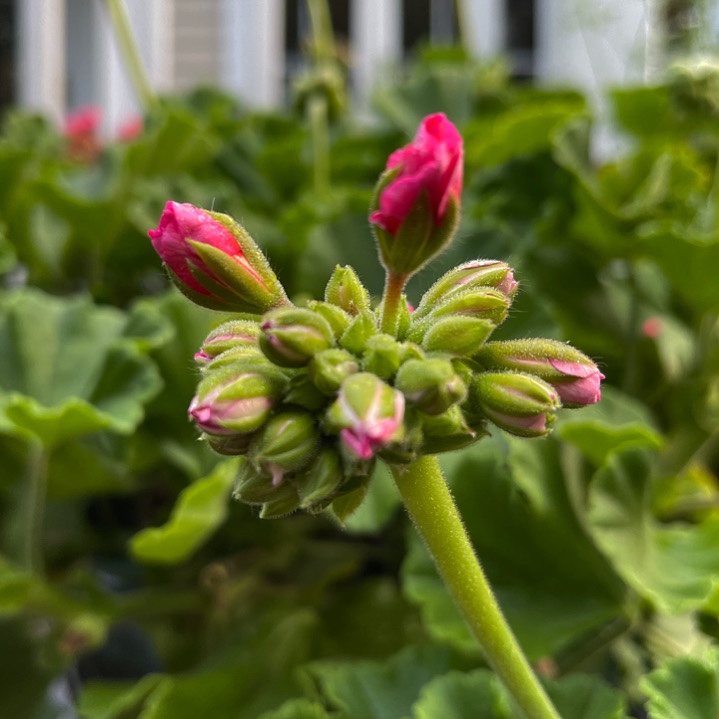
    Geranium
  • What Can We Live Without?

    Our life is frittered away by detail. An honest man has hardly need to count more than his ten fingers, or in extreme cases he may add his ten toes, and lump the rest. Simplicity, simplicity, simplicity! I say, let your affairs be as two or three, and not a hundred or a thousand; instead of a million count half a dozen, and keep your accounts on your thumb-nail. In the midst of this chopping sea of civilized life, such are the clouds and storms and quicksands and thousand-and-one items to be allowed for, that a man has to live, if he would not founder and go to the bottom and not make his port at all, by dead reckoning, and he must be a great calculator indeed who succeeds. Simplify, simplify. Instead of three meals a day, if it be necessary eat but one; instead of a hundred dishes, five; and reduce other things in proportion.Henry David Thoreau, Walden

    Now and then I dabble in intermittent fasting. I can’t always control where I am and whether I can exercise, but I can control what I eat and drink. Fasts range from 13 hours up to 24 in general, but mostly I seem to do two or three per week of either 16 or 18 hours. My longest fast ever was about 48 hours. I’ve heard of some people doing seven days. You won’t find me pushing that kind of limit. Simply put, I like to eat, and skipping a meal or two is a good way to remind myself to ease off on the eating thing a bit. There are health benefits to intermittent fasting, ranging from healthy weight loss to long term resistance to degenerative diseases (I’m told). But mostly, I do it to control the conversation in my own head about when and what to eat.

    The question to ask of ourselves is, what can we live without? We soften ourselves with abundance: food, entertainment, friends of convenience, information… the list goes on. Removing most of this noise offers an opportunity to find that which is most essential to us in our lives. Food becomes fuel and not filler. Entertainment elevates to a highlight moment instead of background noise. True friends are true sounding boards and not frivolous back-slapping small-talkers. Information leads to a deeper understanding, not a sound bite with no substance. You get the idea.

    If there’s an irony to Thoreau, it’s his tendency to jamb a hundred words into a sentence just to get everything out of his head and on paper. For a man that preaches simplicity, we sometimes have to wade through a lot of word soup to get to the key message. But Thoreau lived a short life, and there was so very much to put out there in the world before he left us. We all ought to feel that urgency.

    A bit of temperance is good for us. A bit of solitude with our thoughts brings the truth to the surface. Life in the din isn’t all its cracked up to be, for we rapidly run out of time to find out who we really are. With a little less input, what might we put out there in the world? The more we say no to some things, the more we amplify our yes to other things. Choose wisely.

  • Listen Carefully, Spend Wisely

    Colm Doherty: I just have this tremendous sense of time slipping away from me, Pádraic. And I think I need to spend the time I have left thinking and composing. Just trying not to listen to any more of the dull things that you have to say for yourself.
    Pádraic Súlleabhain: Are you dying?
    Colm Doherty: No, I’m not dying.
    Pádraic Súlleabhain: But then you’ve loads of time.

    Colm Doherty: For chatting?
    Pádraic Súlleabhain: Aye.

    Colm Doherty: For aimless chatting?
    Pádraic Súlleabhain: Not for aimless chatting. For good, normal chatting.

    Colm Doherty: So, we’ll keep aimlessly chatting, and me life’ll keep dwindling. And in twelve years, I’ll die with nothing to show for it, bar the chats I’ve had with a limited man, is that it?
    — Martin McDonagh, The Banshees of Inisherin

    There’s a darkness in this film that is borne of desperation. The characters react to the bleak reality of their lives in different ways. Colm and Pádraic’s sister, Siobhan Súilleabháin, desperately seek something beyond their relentlessly trivial existence. Pádraic sees nothing at all wrong with living out his days one exactly the same as the one before. And this raises the central question of the film, one we all faced at the height of the pandemic: what are we actually doing with our time? Is this all there is for us, or might we create something meaningful that lives beyond us before we pass? These are questions many of us wrestle with, while others contentedly choose more of the same. We each reconcile our brief dance with the world in our own way.

    These questions are timeless, even if we aren’t. Indeed, this temporary shelf life drives us to find answers. Our old friend Thoreau famously observed in the beginning pages of Walden that “the mass of men live lives of quiet desperation”. We bear the weight of these questions still, amplified by that realization that time is slipping away. Memento mori, friends. Carpe diem.

    The thing is, we shouldn’t despair at the thought. There ought to be freedom in that realization. We have an opportunity to amplify our living, and make it resonate in our time. We have the opportunity to create something that lives beyond ourselves, something that ripples. Alternatively, we might simply live. Neither choice is wrong, unless we’re quietly telling ourselves it is. The answer for each of us is to listen carefully, and spend wisely.

  • A Walk Around Walden Pond

    A visit to Walden Pond can be immersive, if you go at the right time. Many people go in summer to swim and enjoy the pristine water. Many fish for large mouth bass and other prizes. But the pilgrims go to visit Henry David Thoreau’s famous pond and the woods surrounding it. I’ve watched the place change over the years, but the pond and woods remain largely as Thoreau would recognize.

    You must treat a brief visit to Walden as you would a visit to a nightclub with a cover charge. There’s a flat fee of $30 USD to park. That applies for an hour or the entire day. There’s a lower fee, apparently, for Massachusetts residents. I suppose you can also opt for other ways to get to Walden Pond, but this was the simplest way to spend time at a place. The area surrounding Walden Pond is a mix of highway, commuter railroad (as it was in Thoreau’s time), capped landfill and houses increasingly further out of reach for someone choosing the lifestyle of the person who made this place famous.

    Early December is considered late autumn, but my visit felt more mid-autumn, with temperatures warmer than they should be this time of year. Henry David Thoreau would have shaken his head, I think, at some of the same behavior he observed in his day leading to the climate change we’re experiencing today but generally sitting on our hands about. But it made for a lovely day to walk around the pond.

    There is a well-defined path around the pond. It’s maintained and easy for most walkers to navigate. They make you feel like you’re in a cattle chute for much of it, with wire strung on each side of the path to keep wanderers from straying off the path. Signage explains this as erosion control measures. As a hiker of the White Mountains in New Hampshire, I’m all too familiar with the impact of popularity on trails and the surrounding landscape. I stay to the path, liberated from the freedom to wander, I instead focused on the environment around me.

    You can hear the world encroach on you at Walden. Distant highway sounds, construction, sirens, airplanes flying overhead and the commuter train all remind you that you’re in a suburb of Boston. It’s best to acknowledge this, but let it go as Thoreau let the train go as it went past in his time. The landscape is largely preserved, the water clear, awaiting those who would linger.

    When I was younger, there was no visitor center, but there was a bath house. At some point well before I came into this world some well-meaning people decided that the best way to save Walden Pond was to make it a recreation center. So a bath house was built, beach sand extended and you had a destination for family recreation. Thoreau’s cabin is on the opposite shore from the bath house, but it’s the first thing you see when you walk down the visitor parking lot. You’re either at peace with it or not, but it’s relatively benign in the off-season.

    Walden Woods extend well beyond the perimeter of the pond, and we can thank people like Don Henley for their commitment to preservation. Generations of developers find a way to squeeze as much money as they can from resources, and there are plenty of people who would turn the place inside out and up. There’s a place for development in this world, but there ought to be a place for preservation too.

    I’d brought a water bottle with me on the walk, warm day that it was, and decided in a moment of inspiration to fill it with water from Walden Pond. Thoreau drank straight from the pond in his day, I’m not inclined to do that without a filter. Instead, I brought the water with me for another pilgrimage. Just across that highway is the center of Concord, where Thoreau and Ralph Waldo Emerson lived. Just beyond the center is the Sleepy Hollow Cemetery, site of Author’s Ridge, where Thoreau, Emerson, Alcott and others are buried. I stopped for a brief visit on Author’s Ridge, told of my visit to his old cabin site, and poured Henry a sip of Walden Pond. Cheers Henry.

    Walden Pond
    A view of the pond just down the hill from Thoreau’s cabin site. This is similar to the view he would have had.
    Pile of stones next to the cabin site. I’m not loving it, but cairns are how people seem to express themselves. The site to me feels like a construction site, cleared and ready to build.
    The cabin site is surrounded by granite pillars to denote the position and size of the cabin.
    Creative cairn art rising out of Walden Pond.
  • Learn to Reawaken

    “The millions are awake enough for physical labor; but only one in a million is awake enough for effective intellectual exertion, only one in a hundred millions to a poetic or divine life. To be awake is to be alive. I have never yet met a man who was quite awake. How could I have looked him in the face? We must learn to reawaken and keep ourselves awake, not by mechanical aids, but by an infinite expectation of the dawn, which does not forsake us in our soundest sleep. I know of no more encouraging fact than the unquestionable ability of man to elevate his life by a conscious endeavor.” — Henry David Thoreau, Walden

    How rare is the poetic or divine life today? It’s hard to say. In talking to people, there is a distinct lack of engagement in the workforce. A lack of inspiration for putting yourself into things, no passion for the work, a going through of the motions that must be reconciled. If one in a hundred million souls were sparked by the poetic or divine in Thoreau’s time, I wonder what the ratio is now?

    Do we linger in a post-pandemic stupor? Is it a generational change as the kids raised with iPhones and social media and gaming become the primary fuel that powers economic and cultural life? Is it older generations, churned and manipulated, poked and prodded, finally having enough? Is it the relentlessly obvious climate change impacting everything while seemingly nothing is done about it? It makes you want to sail away sometimes, especially when you see how much fun those who did are having. But there’s inspired work to be done still, and clearly a need for more of us to lift others.

    We must learn to reawaken and keep ourselves awake. We each have purpose in this lifetime that must be fulfilled. To do otherwise is to live in quiet desperation, as Henry would point out. But how do we keep ourselves awake in such a noisy, conflicted and demanding world? He showed the way, didn’t he? Walk away from the noise, find a quiet place to contemplate your place in the world and pay attention to what happens to you. He didn’t travel very far himself (his friends would take the short walk to visit him, and he them). Mostly, solitude is turning off the electronic babysitter and the insistent chatter of the uninspired and listening to yourself. Writing it all down surely helps.

    Thoreau has always been my grounding rod. When I become disenchanted or feel that quiet desperation stirring inside or have simply had enough of the loud talkers in my world I return to Thoreau’s work, or visit his grave, or take a pilgrimage to Walden. He remains a voice of reason in an unreasonable world, speaking universal truths like so many time travelers. Their spark forever awake, forever informing, forever a beacon to light the way even as their physical selves forever rest.

    From where do we derive hope and an infinite expectation of the dawn? Answers are inclined to find us. Don’t let its whisper be drowned out in the noise.

  • Building Upon the Dream

    “Qué lindo es soñar despierto, he says. How lovely it is to dream while you are awake. Dream while you’re awake Andre. Anybody can dream while they’re asleep, but you need to dream all the time, and say your dreams out loud, and believe in them.” — Andre Agassi, quoting Gil Reyes, Open: An Autobiography

    I detected movement in the pool, a light ripple that telegraphed swimming. Walking over to see what was generating the ripple, I saw a mouse treading water while desperately trying to find a way out of the pool. Isn’t it funny that the very thing I might attempt to kill if it were in my home is something I immediately set about rescuing when I found it floundering in deep water? We can’t possibly kill something that so desperately wants to be alive, and go to great lengths to save it.

    But what of our dreams?

    Qué lindo es soñar despierto… How nice it is to daydream. For in dreams we find ourselves. And begin to believe you might just reach them. Which is exactly what Thoreau pointed out to us:

    “If you have built castles in the air, your work need not be lost; that is where they should be. Now put the foundations under them.” ― Henry David Thoreau, Walden

    Dreaming is the necessary first step, but too many forget to build upon the dream. The foundation is the required next step in the process of getting there. We’ve all neglected this next step a few times in our own lives—for the dreaming is easy, while the building is hard. But build we must to get where we dream of going.

    Have you seen The Secret Life of Walter Mitty? It’s a frustrating, tedious movie when Walter is daydreaming all the time. It becomes compelling when he finally acts. The message is clear: We must wake up from our daydream and act upon it to reach excellence.

    We can’t let our dreams flounder and drown. Act! While there’s still time! For we can’t tread forever.