“The tops of mountains are among the unfinished parts of the globe, whither it is a slight insult to the gods to climb and pry into their secrets, and try their effect on our humanity. Only daring and insolent men, perchance, go there.”― Henry David Thoreau, The Maine Woods
The White Mountains of New Hampshire are my destination of choice when I seek “unfinished parts of the globe” close to home. Lately I haven’t summited many mountains, what with life and all. But I still seek them out and hope for more time to pry into their secrets.
I took the easy route for the sunrise picture below, standing beside a large window at the Mount Washington Hotel and immersed in Victorian elegance while looking out at the Presidential Range. Opting for the quick picture instead of hiking up to greet them in person might seem like cheating. Not very daring or insolent at all, really. But then again, the picture wasn’t going to wait for me to exit the building, let alone climb a trail. And so here it is, reflections and all, to remind me that there are mountains still to climb. Should we dare to go there.
“On every side, the eye ranged over successive circles of towns, rising one above another, like the terraces of a vineyard, till they were lost in the horizon. Wachusett is, in fact, the observatory of the State. There lay Massachusetts, spread out before us in its length and breadth, like a map. There was the level horizon, which told of the sea on the east and south, the well-known hills of New Hampshire on the north, and the misty summits of the Hoosac and Green Mountains, first made visible to us the evening before, blue and unsubstantial, like some bank of clouds which the morning wind would dissipate, on the northwest and west. These last distant ranges, on which the eye rests unwearied, commence with an abrupt boulder in the north, beyond the Connecticut, and travel southward, with three or four peaks dimly seen. But Monadnock, rearing its masculine front in the northwest, is the grandest feature.
As we beheld it, we knew that it was the height of land between the two rivers, on this side the valley of the Merrimack, or that of the Connecticut, fluctuating with their blue seas of air,—these rival vales, already teeming with Yankee men along their respective streams, born to what destiny who shall tell? Watatic, and the neighboring hills in this State and in New Hampshire, are a continuation of the same elevated range on which we were standing. But that New Hampshire bluff,–that promontory of a State,—lowering day and night on this our State of Massachusetts, will longest haunt our dreams.” — Henry David Thoreau, A Walk to Wachusett
Mount Wachusett is a glaciated monadnock, standing 2006 feet tall. Like her neighbor to the northwest, Mount Monadnock in New Hampshire, Mount Wachusett stands watch over the landscape that bows before her. You can’t talk about one mountain without mentioning the other, for they are forever kindred spirits in the landscape. Both mountains are uniquely positioned so that their waters flow to the Merrimack River from one side and to the Connecticut River from the other. The waters from each river run in my blood, which made a hike to the summit a sort of homecoming for me. And yet, for all the hikes I’ve done on Monadnock, I’d never hiked Wachusett.
This was a month where the weather continued to disappoint those who dream of deep snow drifts, while thrilling those who pine for a mild winter. Count me in the camp of the former: I wanted nothing more than to fly across snow plains this winter. A heavy snowfall the day before offered one last chance for the month. But it was quickly apparent that this was a micro spike hike, and the snow shoes were left behind yet again.
From the Visitor’s Center, you can easily summit Mount Wachusett in under 30 minutes. But that wasn’t our goal. Instead we took the Bicentennial Trail around the eastern slope to High Meadow Trail, up through a stand of Hemlocks to the Pine Hill Trail. Fluffy snow over ice creates uncertain footing, and we slowed our pace to mitigate the risk of injury. For a time, the only break in the trail ahead was from a porcupine, who’s distinct tail marked the trail in footprints and swirly plows. It seems most people cut to the chase and scramble up the mountain. We were more inclined to linger with it, to get to know it better. To feel what Thoreau felt when he and Richard Fuller hiked here from Concord, set up their tent atop the lonely summit, and had the place to themselves for a night.
Wachusett’s summit has changed since Thoreau’s time. There’s a ski slope on one side, there’s a mountain road you can drive up in the warmer months to see the view without earning it, and there’s ample parking for those cars. A few towers, including an observation tower, complete the scene. I wonder, reading Thoreau’s account, where did they pitch their tent and read Virgil by the light of a summer full moon?
Winter snow obscures much of the impact of man, but you’re still clearly in a manmade world when you’re on the summit of Mount Wachusett. To return to nature you must seek the trails that criss-cross around the reservation. But the views are largely the same as they were for Thoreau’s 180 years ago. Just as it was for him, Monadnock stands prominently as the grandest feature of the 360 degree view.
Inevitably we left with more to see, trails and old growth forest to explore another day. For this day I found what I was looking for. Time with an old friend hiking trails I’d always meant to get to one day. And a glimpse into a world Thoreau would find both foreign yet comfortably familiar. Wachusett is timelessly accessible, but somehow always felt apart from the mountains I sought out. We finally got acquainted with one another.
Summit tower, Mount Wachusett Distinctive porcupine tracks mark the trailPlenty of exposed granite despite the snowWhich way do we go? Plenty of choices.
There’s a tricky thing in writing—deep introspection is conveyed through outward expression. When you read a lot you stumble on some deeply damaged characters who had the courage to put it all out there on paper for others to see. I’ve mined myself similarly, but I don’t have the deep scars that others seem to have. Blame it on a good family growing up, but the fuel for the writing isn’t to draw out the pain of the past but rather to tap into the experience and intense gratitude of being alive at this time. That doesn’t mean there aren’t scars, how does anyone live an unsheltered life without scars? That which you once were is a memory that haunts you or spurs you towards becoming a better person. I’ve long ago buried the character I hated in myself, though he keeps trying to crawl out of his grave.
Decide what to be and go be it.
There’s a feeling that comes over you when you decide what to be. It’s like a magnet that pulls you in the direction you want to go in. My sailor and hiker friends know this, for it relentlessly pulls them towards their True North. I smile when someone questions why someone would put all their eggs in one basket. If you haven’t found your basket you can’t possibly know why others do what they do.
“I don’t want to swim in a roped off sea.” — Jimmy Buffett, Cowboy in the Jungle
We all have our calling. Do we listen to it or to the helpful guidance of others? When you find that direction, killing time on other things feels like you’re strangling yourself. Urgency and purpose demand your attention. The only way forward is deliberate action. Growing outward requires we stretch ourselves beyond what we once were, and then to keep doing it over and over again. To reach out towards where we want to be often means pulling away from what we once were.
Mellow is the man who knows what he’s been missing Many, many men can’t see the open road — Led Zeppelin, Over the Hills and Far Away
Huddled in a group at an Irish pub, four men scheming for the future: one free of obligations and ready to roam, one surfing the peak of his career and working to cash in before it crashes, one just riding the swell and hoping this time—this time— he’d caught the right wave, and me, a would-be writer and wanderer observing the human condition. I’m surfing my own wave, of course, but don’t we all dream of coming about, hoisting the main and sailing away instead?
“We labour at our daily work more ardently and thoughtlessly than is necessary to sustain our life because it is even more necessary not to have leisure to stop and think. Haste is universal because everyone is in flight from himself.” ― Friedrich Nietzsche, Untimely Meditations
Nowadays we can all see what we’ve been missing in YouTube videos, Instagram and Facebook posts, or wherever you choose to live vicariously through the lens of others. My own favorite footage often involves drones flying above stunning landscapes, as if I were flying myself. And don’t we all wish to fly?
But the question is, do we wish to fly away from something or towards something? For life is short and we can’t waste our precious time running away from ourselves. Yet so many do, in distraction and debauchery and debate. It’s easy to run away, but impossible to really get away from that nagging discontent.
Old friend Henry David Thoreau pointed out that “the mass of men lead lives of quiet desperation.” He would also say that, “So thoroughly and sincerely are we compelled to live, reverencing our life, and denying the possibility of change. This is the only way, we say; but there are as many ways as there can be drawn radii from one centre. All change is a miracle to contemplate; but it is a miracle which is taking place every instant.”
In other words, life is change, everything is changing around us even as we debate what we ought to do with ourselves. Which brings me back to a constant refrain: We must decide what to be and go be it. And be content with that which we leave behind.
“The average human lifespan is absurdly, terrifyingly, insultingly short. But that isn’t a reason for unremitting despair, or for living in an anxiety-fueled panic about making the most of your limited time. It’s a cause for relief. You get to give up on something that was always impossible—the quest to become the optimized, infinitely capable, emotionally invincible, fully independent person you’re officially supposed to be. Then you get to roll up your sleeves and start work on what’s gloriously possible instead.” — Oliver Burkeman, Four Thousand Weeks: Time Management for Mortals
Every now and then you read a book that becomes an instant frame of reference for how you see the world and your place in it for the rest of your days. Walden, Awareness, Meditations, and Atomic Habits are some of the books that changed me profoundly. I can comfortably place Four Thousand Weeks on that short list. This is a mesmerizingly insightful look at the fragile dance we’re all in the middle of, and how we think and react to our realization that life is impossibly short. It reinforces many of the things I’ve written about in this blog, and turned a few working theories upside down and dumped them on the scrapheap. It’s a book I’ll be processing for awhile.
“Your experience of being alive consists of nothing other than the sum of everything to which you pay attention. At the end of your life, looking back, whatever compelled your attention from moment to moment is simply what your life will have been. So when you pay attention to something you don’t especially value, it’s not an exaggeration to say that you’re paying with your life... what we think of as “distractions” aren’t the ultimate cause of our being distracted. They’re just the places we go to seek relief from the discomfort of confronting limitation.“
Confronting our limitation, and how we process that by either living in the moment or distracting ourselves with ritual, busyness, by deferring to the future (all the way to “afterlife”) or skimming along in the shallow pond of the unimportant are all very human reactions to figuring out what the hell to do with this short time before we rejoin infinity. Heady stuff, stuff that demands contemplation. But it can be overwhelming to think about such things. Who wants to be the Debbie Downer in their own life party?
Burkeman points to the possibility of accepting life for the brief dance it is so you can focus on what you can and cannot achieve. Decide what you’ll focus on, and importantly, what you’ll let fall away. We can’t excel in everything, so why burden ourselves with those things on our to-do list? We know what’s most important already. Be honest with yourself about what is going to fall off and celebrate the unburdening of releasing it for our essential contribution.
All those books listed above, in one way or another all come down to the idea of making the most of our short time. Since we all know the ship is sinking from the moment we reach awareness, shouldn’t we be conscious about how we react to it? Isn’t it liberating, in a way, to release the burden of the shortness of time and seize this moment? Think about the Titanic in her last moments —would you rather be in the band playing tunes to the end or the fool who jumps into the icy water screaming in denial to the last? Even the people who made it to the life boats gained but a short time more. I’d like to think they used it well.
And so should we! Since we all meet our fate in the end, shouldn’t we make the most of our brief lives? What will you do with this focused time?
Dove that ventured outside, flying far from the dovecote: housed and protected again, one with the day, the night, knows what serenity is, for she has felt her wings pass through all distance and fear in the course of her wanderings.
The doves that remained at home, never exposed to loss, innocent and secure, cannot know tenderness; only the won-back heart can ever be satisfied: free, through all it has given up, to rejoice in its mastery.
Being arches itself over the vast abyss. Ah the ball that we dared, that we hurled into infinite space, doesn’t it fill our hands differently with its return: heavier by the weight of where it has been. —Rainder Maria Rilke, Dove that ventured outside
We wanderers are all chafing to break free. To arc across the abyss once again, and land in places foreign and mysterious, and return again changed by where we have been. We feel the firmness of the ground beneath our feet and celebrate the stability of place. But our blessing and our curse is our longing to fly once again.
Life changes us all, whether in love or travel or rolling the dice on a career path. Our lives are the arches we build between where we launch from and where we land. But landing someplace doesn’t mean you can’t launch yourself somewhere else, again and again, to see what kind of cathedral you can build for yourself. Who said we are only allowed to fly once?
“If you have built castles in the air, your work need not be lost; that is where they should be. Now put the foundations under them.” ― Henry David Thoreau, Walden
Arches don’t just float in mid-air. You’ve got to build that foundation to properly launch yourself into the abyss if you want to land on solid ground on the other side (let alone return again). It goes without saying that proper financial and logistical planning are necessary if your arch is to cross a big chasm. But small arches are beautiful too, and don’t require more than a bit of courage to fly.
Assuming we live to be 80, we’ve all burned 2 1/2% of our lives with COVID. How have we spent that time? Hopefully not locked in fear in our homes, but instead getting vaccinated and finding adventure where we may, while we can. If not then, why not now? How far will your next arch span? Where will you land? If you dare?
Have you ever wandered lonely through the woods? And everything there feels just as it should You’re part of the life there You’re part of something good If you’ve ever wandered lonely through the woods – Brandi Carlile, Phillip and John Hanseroth, Have You Ever
It’s hunting season in New England, and bright orange is the color of choice for those who dare wander into the woods. Admittedly I haven’t been wandering in the local woods all that much lately, for reasons both valid and delusional, but mostly because I got out of the habit of placing myself there. You know when you’ve been gone too long, you feel it in your bones. I’d been gone too long and finally did something about it.
Walking through the bare trees of New England in late Autumn, smelling the fallen leaves in the cool, damp air, delivers a unique sense of place not achieved in a world of concrete and steel. Inevitably you think of those who wandered these woods before you, whether yesterday or a thousand years ago, the woods hold their hopes and dreams and secrets just as firmly as they’ll hold your own.
There are whispers in the forest, easily heard in solitude. They’re reflections of our greatest hopes and fears. Yes, some fear the woods, hearing ghosts, fairies or dark spirits. I think we mostly hear our own inner voice, caught in the wind and reflected back to us as naked truth, as cold and bare as the tree trunks and branches.
In his enduring gift Walden, Thoreau described the “indescribable innocence and beneficence of Nature”. Nature surely gives back far more than it receives from humanity. Shouldn’t we offer something good in return for the gift of nature?
Readers of this blog know that I chafe at loud talkers, people who play music while hiking, motorized vehicles, and other such encroachments in the woods. It feels blasphemous, disrespectful, and the antithesis of all I go there for. But the trees themselves don’t care, they’ve seen it all before and will again. The intrusion is mine to bear, the trees will still be here, hopefully, long after the rest of us clear out.
This too shall pass, the wind whispers through the bared forest. The leaves returning to earth underfoot voice their agreement. Here, you’re part of something good. One day we’ll all be ghosts, mere whispers in the wind. But not today. Today we were alive, and the woods felt just as they should.
“We do not associate the idea of antiquity with the ocean, nor wonder how it looked a thousand years ago, as we do of the land, for it was equally wild and unfathomable always.” – Henry David Thoreau
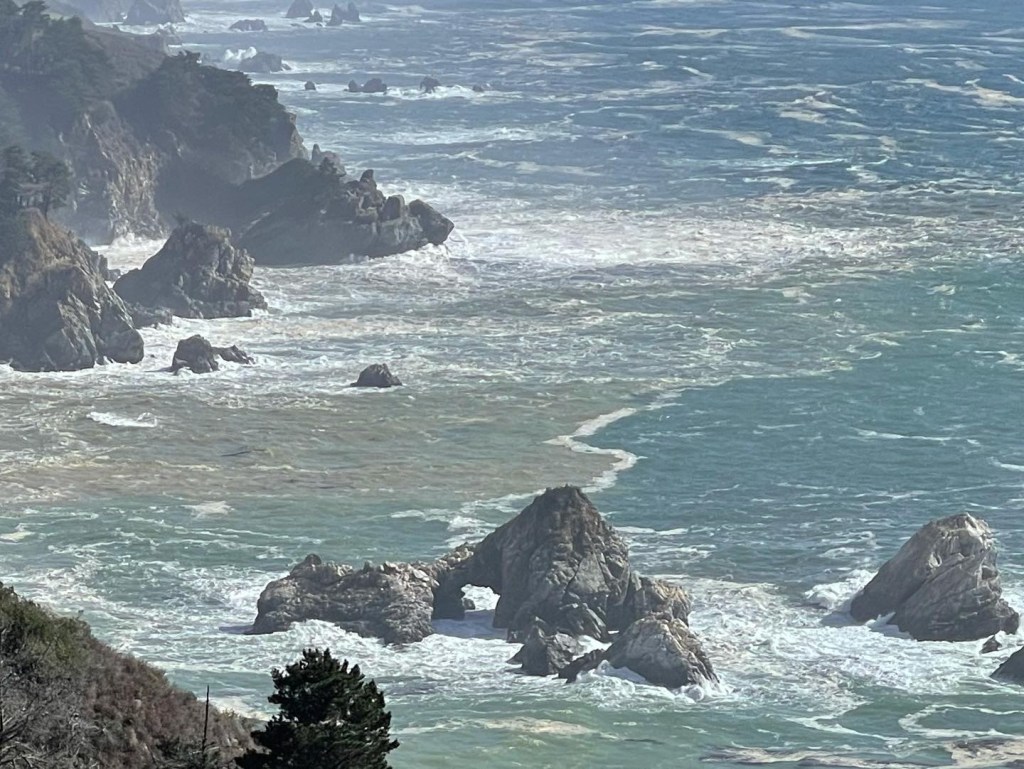
I’m an East Coast guy. California is another world when you live with ice and snow and sunrises as your standards. You imagine what a place might be like when you’ve never been to it but hear of it often. It becomes the stuff of legend. Driving the Pacific Coast Highway and visiting Monterey and Big Sur became such a legend for me. And the experience lived up to its billing.
When you look out at the Pacific Ocean for a few hours, and the rugged, mountainous terrain this highway snakes through, you feel the truth in Thoreau’s words. But for the highway itself and a few scattered houses and ranches this view hasn’t changed much in millennia. And unless it all tumbles into the sea it ought to look the same for another millennium. We’re just rolling footnotes passing through the eternal. The Pacific Coast Highway sets you straight about such things.
Starting our drive from the dunes of Marin, we drove Ocean View Boulevard to Sunset Drive, making our way to pay the $10.75 entry fee for access to 17 Mile Drive. It was worth the price of admission, particularly with the big waves rolling in as remnants of a stormy ocean. Officially, 17 Mile Drive has 17 landmarks to view (all mapped for you when you pay to enter). Unofficially, the glimpses of the homes of the ultra-wealthy and a drive by Pebble Beach Golf Links are a big part of the draw.
A quick visit (checking of the box) in Carmel and we were off to Big Sur. This is where cellular coverage all but disappeared and you put your trust in fate. There are hundreds of turn-offs you can pull over into and several larger scenic vista parking areas. The toughest places to find elbow room were Bixby Bridge and McWay Falls. Each offer that postcard or Instagram worthy image. The trick is to find an image that’s unique without putting yourself in peril. Sometimes the perfect picture is the one everyone else took too.
The rest was simply breathtaking views and an appropriate focus on keeping the car on the road. Every turn brought another stunning view, and at some point you stop taking pictures of waves crashing onto massive boulders and cliffs and simply enjoy the drive. The Pacific Coast Highway is an embarrassment of riches in its beauty and a national treasure. Make sure you have a full tank and the time to enjoy this experience.
“A man’s ignorance sometimes is not only useful, but beautiful—while his knowledge, so called, is oftentimes worse than useless, besides being ugly. Which is the best man to deal with—he who knows nothing about a subject, and, what is extremely rare, knows that he knows nothing, or he who really knows something about it, but thinks that he knows all? My desire for knowledge is intermittent, but my desire to bathe my head in atmospheres unknown to my feet is perennial and constant. The highest that we can attain to is not Knowledge, but Sympathy with Intelligence.” – Henry David Thoreau, Walking
We arrive at a deeper understanding and empathy with the world by getting out into it. If there’s been a curse to the pandemic, it’s the distinct lack of getting out there to encounter a different perspective on things than you might have sheltered in place with your favorite sound bites and tweets.
If the last 6-7 years were defined by anything, it’s this growing assurance that your side is right and any other is wrong. The world seemingly spiraled down into an antagonistic cesspool of us versus them. What’s missing is empathy: the putting ourselves in their shoes part. Seek first to understand and then to be understood, as Stephen Covey would have put it. He’d be shaking his head at the world we find ourselves in today.
Getting out to meet the world is the solution to this problem. Seeing things the way they look from the other side offers perspective unavailable to those who don’t venture past the mailbox. The idea of getting out to see the world seems to be the most logical thing in the world to many of us, but fills others with dread. Would you live your life forever in a shell or break out of your limited view of the universe and see what’s really out there?
This week I’m getting back out in the world, not for work, but for pleasure. To see things from a different vantage point, to seek the truth about how things are in a place other than here. To bathe my head in atmospheres unknown to my feet and return with a new perspective on this world. And then, boldly, to do it again.
Time drops in decay, Like a candle burnt out, And the mountains and woods Have their day, have their day; What one in the rout Of the fire-born moods Has fallen away? – WB Yeats, The Moods
The Moods, as I understand it, are the messengers from God (God, in turn, is fire). Whatever your beliefs, there’s truth in the core message: time slips away drop by drop, and we all must pass. Whether a poet or philosopher or the woods or even the mountains themselves, all must “have their day”.
Let us turn to old friend Henry and consider the phrase differently:
“The universe constantly and obediently answers to our conceptions; whether we travel fast or slow, the track is laid for us. Let us spend our lives in conceiving then. The poet or the artist never yet had so fair and noble a design but some of his posterity at least could accomplish it. Let us spend one day as deliberately as Nature, and not be thrown off the track by every nutshell and mosquito’s wing that falls on the rails. Let us rise early and fast, or break fast, gently and without perturbation; let company come and let company go, let the bells ring and the children cry—determined to make a day of it. Why should we knock under and go with the stream?” – Henry David Thoreau, Walden
We get so caught up in life’s minor distractions that we lose track of the days slipping by. Shouldn’t we channel that inner fire and spend our lives in conceiving while we have this time? But wait! If even the mountains themselves eventually erode to sand, how can we be so bold as to expect a measure of immortality?
This is why the concept of God and eternity hold so much meaning in our brief lives, we seek to understand the meaning of it all. Poets and philosophers and amateur bloggers each confront the brutal fact that we all must pass, and we don’t really have an answer for what lies beyond.
So be it. But knowing that the track is indeed laid before us, shouldn’t we reach for our own measure of immortality, as fragile as it might be, and make a day of it? That, friends, seems to be the point all along. Have your day.