“When the first light dawned on the earth, and the birds awoke, and the brave river was heard rippling confidently seaward, and the nimble early rising wind rustled the oak leaves about our tent, all men, having reinforced their bodies and their souls with sleep, and cast aside doubt and fear, were invited to unattempted adventures.” – Henry David Thoreau, A Week on the Concord and Merrimack Rivers
There’s finally, blessedly, a plan. Places to be, filled with uncertainty and doubt, in the very near future. With one eye on the variants and another on the weather, reservations and bookings complete. There’s new hope for a return to attempting the previously dreamed of. New adventure awaits.
The moment Thoreau wrote of above took place when he was a young man, before his brother passed away from tetanus, before he wrote Walden or Civil Disobedience. Just a couple of young adventurers waking up along the Merrimack River in Tyngsborough, Massachusetts ready to take on their previously unattempted. It captures that moment of waking up excited and recharged and bursting to get out there and do what you’ve been scheming to do. It’s a more comma-intensive version of my favorite Thoreau quote of all:
“Rise free from care before the dawn and seek adventures.”
It should be no surprise to readers of this blog that I’m scheming again. Ready and willing to burst from this big empty nest of a tent and get out in the world again. Big adventures planned for September and October. Micro adventures to fill the gaps, beginning immediately. Room for a pivot here and there, to be sure, but if you don’t plan it and take the leap you’ll just put it off for another day that may never come.
When you woke up this morning and took stock of the world around you, did it give you a bit of a thrill? If you aren’t buzzing with anticipation, what are you waiting for? Cast aside your doubt and fear and get to it already. Tackle those unattempted adventures.
“When we walk like (we are rushing), we print anxiety and sorrow on the earth. We have to walk in a way that we only print peace and serenity on the earth… Be aware of the contact between your feet and the earth. Walk as if you are kissing the earth with your feet.” – Thich Nhat Hanh
“When we walk, we naturally go to the fields and woods: what would become of us, if we walked only in a garden or a mall?” – Henry David Thoreau, Walking
I’ve been walking on pavement too often recently. The mileage is good but the spirit is muted. Your feet have a hard time connecting you to the earth when there’s three inches of asphalt separating you from it. Still, walking on asphalt is better than being indoors all day, and to be honest, I’ve experienced too much of that lately.
One recent walk took me along the Cape Cod Canal for six miles. Visually it was striking with a parade of yachts and commercial vessels streaming past on a particularly busy day. And the company was certainly good. But that connection to the earth was missing on those paved bike paths.
Maybe walks on pavement are better than nothing, but like Henry I wonder what becomes of us when we aren’t off in the fields and woods. The more we connect our feet to the earth and cover ground the more we hear our own voice. Walking flushes the toxins out of your body and soul. Sitting all the time, as we do these days with our desk jobs and a return to commuting robs us of that flushing and the ick pools up inside of us until we once again get up and out.
“What is a course of history or philosophy, or poetry, no matter how well selected, or the best society, or the most admirable routine of life, compared with the discipline of looking always at what is to be seen? Will you be a reader, a student merely, or a seer? Read your fate, see what is before you, and walk on into futurity.” – Henry David Thoreau, Walden
Well, which are you – a reader or a seer? Are you going to live vicariously through the adventures of others or seek your own way? There’s no time to ponder indefinitely, you must choose to live, and to walk boldly towards that future you. The world shrugs indifferently at the masses who live in quiet desperation, and opens up for those who dare to break free of the routine.
Deferring life is a fool’s game, but most of us willingly play it. What meaningful leap will you take today towards that future you so desperately cling to? For if not now, when?
“Focus your attention on the link between you and your death, without remorse or sadness or worrying. Focus your attention on the fact you don’t have time and let your acts flow accordingly. Let each of your acts be your last battle on earth. Only under those conditions will your acts have their rightful power. Otherwise they will be, for as long as you live, the acts of a timid man…. Being timid prevents us from examining and exploiting our lot as men.” – Carlos Castaneda, Journey to Ixtlan
I did the math, mentally adding 25 years to my current age and toyed with the idea of being that later age. There are no guarantees that I’ll ever reach that point in my life, of course. No guarantees for any of us marching through time on our annual trip around the sun. But I toyed with the idea of being an old man and wondered at the state of my mind and body. I wondered at the experiences I’d had in the interim, these years between now and then.
This long sleep we have in store for ourselves is our future, whether a quarter century away or this afternoon, and we ought to live boldly instead of merely timidly existing. I won’t say I’ve mastered this, but I live a better life knowing that the whole dance could end on the next drum beat. But we can do so much more. Simply by living with urgency.
This theme, the constant reminder of our imminent death, runs through Stoic philosophy. And it runs through this blog. I try, not always successfully, to use it as a cattle prod to my backside. A jolt of awareness that this could all end at any moment, so break free of that routine, break away from the timid existence and live a life of adventure and boldness. It’s the underlying theme of this blog, beginning on the home page with Thoreau’s call to action:
“Rise free from care before the dawn and seek adventures.” – Henry David Thoreau
If we accept that we must die, and as improbable as it might seem, at any moment, what might we do to live now? If this is our final act, what will it be? And, if blessed with another, what of the act to follow?
The answer clearly must be to live the moment with urgency. Say what must be said. Do what must be done. Get out there and live boldly! Pursue the magic in the moment with vigor and a profound lust for life.
“On the 26th of March, 1602, old style. Captain Bartholomew Gosnold set sail from Falmouth, England, for the North part of Virginia, in a small bark called the Concord… ‘The 15th day,’ writes Gabriel Archer, ‘we had again sight of the land, which made ahead, being as we thought an island, by reason of a large sound that appeared westward between it and the main, for coming to the west end thereof, we did perceive a large opening, we called it Shoal Hope. Near this cape we came to anchor in fifteen fathoms, where we took great store of cod-fish, for which we altered the name and called it Cape Cod.’” – Henry David Thoreau, Cape Cod
A bit of trivia lost in history is where Cape Cod originally got its name. A lot of people, including Thoreau, point to Gabriel Archer. Archer wrote the entry Thoreau quotes above in 1602. He’d then go on to supposedly name Martha’s Vineyard after his daughter when an abundance of grapes were found there.
Of course, without the Cod, it might have been named something else. Four hundred years of fishing decimated the Cod population, leading to sharp restrictions on fishing. Pressure from commercial fishing lobbies to raise limits on Cod run counter to the goal of full restoration of the biomass. And then you’ve got those seal population increases. The slow restoration of the Cod population is ongoing, but like so many endangered species it hangs by a thread.
Archer traded with the local Wampanoag Tribe at what is now Cuttyhunk. He returned to England that same year but would return again in 1607. Archer would butt heads with John Smith in Jamestown and would ultimately die there within a few years. His journal was published after his death and the names Cape Cod and Martha’s Vineyard were sticky enough to live on well after him. More than his own name, it seems. Life is funny that way.
“The sea-shore is a sort of neutral ground, a most advantageous point from which to contemplate this world. It is even a trivial place. The waves forever rolling to the land are too far-travelled and untamable to be familiar. Creeping along the endless beach amid the sun-squall and the foam, it occurs to us that we, too, are the product of sea-slime.” – Henry David Thoreau, Cape Cod
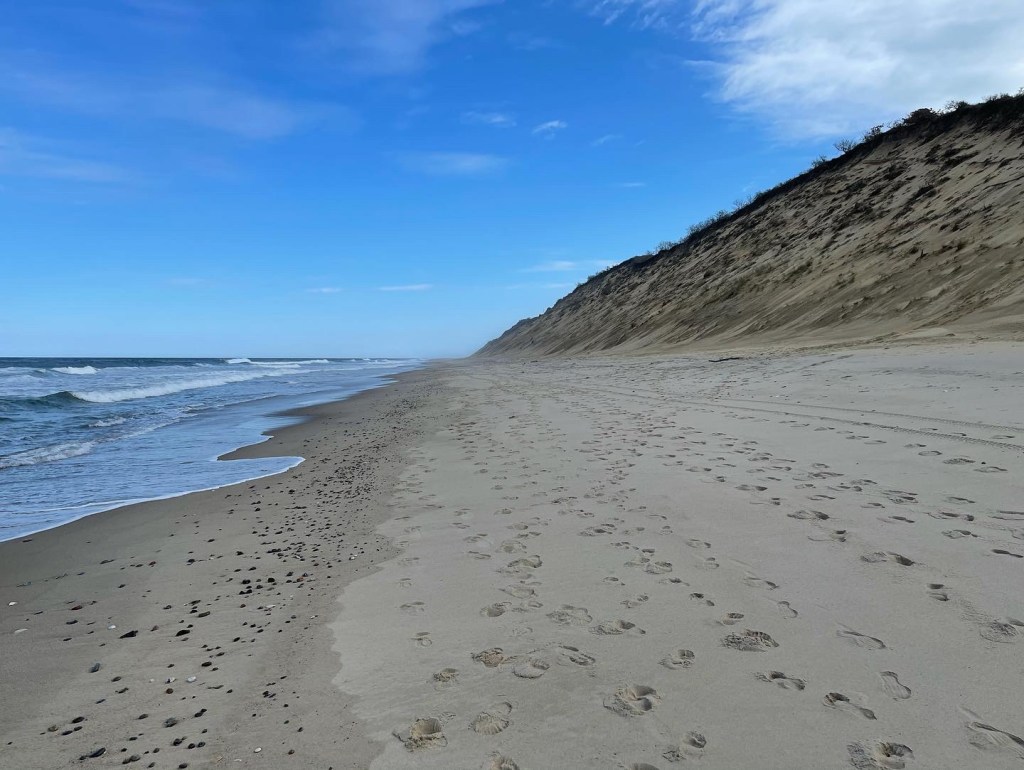
Between the massive dunes and the crashing Atlantic Ocean in Wellfleet is a strip of sandy beach bearing the brunt of the relentless assault from wind and sea. The surf in warmer months is a feeding ground for Great White Sharks, who have modified their hunting style to chase grey seals right into the churning shallows that swimming humans like to frolic in during the warmer months. Great Whites don’t hunt humans, but sometimes they mistake humans for seals.
In April you don’t see many seals bobbing in the surf on Cape Cod. So the sharks move on to other hunting grounds and leave this stretch of wild ocean to the occasional surfer and the beach walkers. A walk on the Cape Cod National Seashore can happen just about anywhere with an access path down the 100-foot dunes. Sand is dangerous stuff that can bury a reckless trespasser in no time at all. Sticking to the access paths preserves the dunes and just might preserve you too. The access paths themselves inform in their soft give. This is not a place for the meek. If you can’t handle the access path don’t walk this beach.
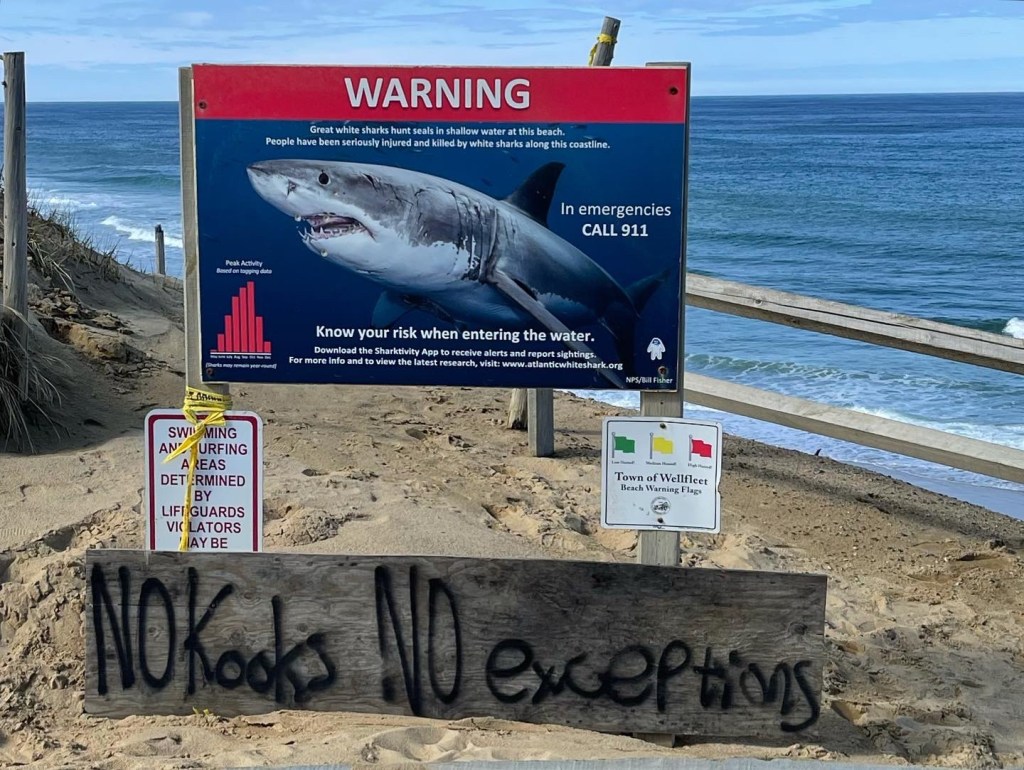
For an off-season walk, we chose to park at the Beachcomber in Wellfleet and walk a stretch of soft sand known as Cahoon Hollow Beach. The Beachcomber is a trendy cool place at the height of summer. In mid-April it’s a convenient parking spot for easy access to the beach. A sign of the times is a shark warning with a handmade sign added to the bottom sharply suggesting “No kooks, no exceptions”. Wellfleet has had just about enough of the worst representatives of shark tourism.
The National Seashore has a 40 mile stretch of beach that would test the strongest of walkers. When you say you’ll walk just to the bend you soon realize that bend keeps disappearing ahead of you. We walked about a mile, following the curve of the dunes around the forearm of Cape Cod. Walkers tend to gravitate towards the surf line where shells and smooth rocks offer themselves up for consideration. Soon your pockets are full and you recognize the folly of treasure hunting when every receding wave reveals another treasure.
Thoreau walked the entire length from Chatham to Provincetown in the mid-1850’s and wrote about it for lectures that would end too soon in his abbreviated life. It would be published after his death in 1865 – the same year the Civil War ended. I think often about Thoreau, dying at 45 with so much left to do and see and write about. And here I was following him again, walking the beach between dune and sea, thinking it might just go on forever. Knowing it won’t.
“The world always seems brighter when you’ve just made something that wasn’t there before.” Neil Gaiman
This rather cheery quote by Gaiman prompts a challenge of sorts from me. For making something isn’t what makes the world brighter, making something you care about making is what brightens the world. For in the making of something in such a way you honor the world with your contribution.
As Gaiman rightly points out, we’re lovingly placing something that wasn’t there before out in the world for it to embrace. Will it fly or get lost in the noise? It’s not up to us to decide. It’s up to us to create it and set it free. And then to get back to the business of building another beacon.
The best of our work becomes accretive rather than reductive. Look around, there’s plenty of people creating hateful, mean-spirited work that divides and diminishes the world. But not us, no: we offer something more. Something that resonates across the table and across time. For the very best work becomes timeless.
So what makes something timeless? I believe it’s the deep connection between two people that your work represents. Paint placed just so on canvas. Architecture that stirs the heart generations after the last stones were laid. Words that transcend the author or poet and connect one soul to another. This is what brightens the world. This is the shining soul beacon of the artist that keeps hope alive, like a Fresnel lens lights the distance in a turbulent dark sea:
“If you have built castles in the air, your work need not be lost; that is where they should be. Now put the foundations under them.” – Henry David Thoreau, Walden
“Dwell on the beauty of life. Watch the stars, and see yourself running with them.” – Marcus Aurelius, Meditations
“Tell me, what is it you plan to do with your one wild and precious life?” – Mary Oliver, The Summer Day
“If you dare nothing, then when the day is over, nothing is all you will have gained.” – Neil Gaiman, The Graveyard Book
“This above all: to thine own self be true, And it must follow, as the night the day, Thou canst not then be false to any man.” – William Shakespeare, Hamlet
All words across time, offering a path through the darkness in the world. Offering hope and direction and illumination. This is something more. And this is our opportunity too. Great artists are ambassadors to the world, bridge builders to the future, and infinite soul connectors. That’s something to aspire to.
“That’s what makes death so hard – unsatisfied curiosity.” – Beryl Markham, West with the Night
Where does restlessness come from? I believe it comes from that unsatisfied curiosity that Markham references above. What will you regret on your deathbed? The restlessness of the unexplored: unsatisfied curiosity. This phrase from such an accomplished woman, such an adventurous spirit, knocked me back two steps. Because I understand myself more in that pile of words. Don’t you?
Unsatisfied curiosity. I see is in friends buying a bigger sailboat to go farther, to go longer, on their next adventure. In friends collecting mountain summits and filling social media with their seasons of wonder. In family and friends building meaningful businesses and careers out of schemes and dreams. And I see it in myself, writing and searching for more, exploring our history and the world around us. Stretching in new directions and pushing at my own limits.
Unsatisfied curiosity drives progress and growth. Restlessness is a form of being uncomfortable with the limitations we find ourselves living with. The world is out there, should we be bold. Should we leap. And why shouldn’t we? Why be timid and afraid of life? There’s work to be done. Places to go and visions to be realized. Enter Henry:
“Rise free from care before the dawn, and seek adventures.” – Henry David Thoreau
It seems impossible, really, when you think about the leap from the Wright Brother’s first flight in 1903 (itself extraordinary) to Markham becoming the first person to fly solo across the Atlantic Ocean 33 years later, to humans landing on the moon 33 years after that. In our brief time together on this planet, aren’t you curious about what you can accomplish? Bold action satisfies curiosity. What you can see? What can be realized?
If you watch a commercial on television, or a reporter out on a city street, or even the cast intro on Saturday Night Live in February 2021, everyone is wearing masks. A year ago you’d have wondered at it, even as the pandemic rapidly descended on the world. Today it’s commonplace, and I’m more often surprised at the outliers walking into a store without one. I stood in a line for snowblower parts and a mechanic walked briskly through the store unmasked. In a crowded grocery store I saw an elderly woman(!) without a mask on. In both cases I had the same reaction I might have had two years ago to someone wearing a mask. Isn’t it funny how the world has changed our perceptions in such a brief turn of the calendar?
I chafe at restrictions, favoring wandering, crossing borders, friendly conversations with strangers and simply getting out there. But we all sense a light at the end of the tunnel, and we’ll reach a tipping point with vaccinations as we did with mask wearing. With more and more people I know joining the ranks of the vaccinated, a sense of optimism grows. Travel will soon be a reality again, even if a bit different from the travel of a few years ago. There’s plenty of travel available today, without worrying about the complexity of borders, just outside.
“My vicinity affords many good walks; and though for so many years I have walked almost every day, and sometimes for several days together, I have not yet exhausted them. An absolutely new prospect is a great happiness, and I can still get this any afternoon. Two or three hours’ walking will carry me to as strange a country as I expect ever to see. A single farmhouse which I had not seen before is sometimes as good as the dominions of the King of Dahomey. There is in fact a sort of harmony discoverable between the capabilities of the landscape within a circle of ten miles’ radius, or the limits of an afternoon walk, and the threescore years and ten of human life. It will never become quite familiar to you.” – Henry David Thoreau, Walking
Many times during the past year I’ve thought of Thoreau walking the landscape I know today. There’s plenty that’s changed since his time, but there’s also plenty that remains just as it was then. Much of it remains undisturbed, as if in a time warp, awaiting a visitor. I doubt he ever got up to the corner of New Hampshire where I walk, but I’ve walked in his woods near Walden and note the similarities.
“Walk until your day becomes interesting — even if this means wandering out of town and strolling the countryside. Eventually you’ll see a scene or meet a person that makes your walk worthwhile.” – Rolf Potts, Vagabonding
With a hint of the coming snow in the air, I took my snowshoes out to find new prospects. I quickly moved off the packed trail into virgin snow, crunching along on the snowdrifts through woods and fields. Cold hands soon warmed as I worked up a good pace past old stone walls and silent trees. Snowshoeing offers a slow burn, steady state workout similar to cross-country skiing. There’s a small thrill in hovering over the frozen land while blazing a new trail on snowshoes, and I felt a bit like I was flying as I crunched along.
Reconnecting with the blazed trail at a frozen stream crossing, I noted the collection of prints of those who had come before me. Snowshoes and fat tire mountain bikes, micro spikes and dog prints spiraling in circles from the trail in patterns of joyful exuberance and the freedom of the winter woods. It occurred to me that my own tracks were more similar to the dog prints than those of the trail walkers. Wandering spirits are rarely contains for very long on defined paths.
A simple walk in the woods, off trail, can change a person. In winter what was familiar ground becomes a voyage of discovery. Perception is how we frame the world around us, and I find it best to turn my perceptions upside down now and then. Every walk suggests something profoundly new, and winter transforms both the landscape and the visitor alike. Pausing a moment, I listened to the sound of silence. My snowshoes and I had walked our way to interesting, embracing the cold indifference of the woods to pandemics and masks and turns of the calendar.
Walking along on familiar trails transformed into strange country, I stopped worrying about the neglected collection of stamps in my passport. Feeling a million miles from anywhere I’d every been before, I came across a border marker deep in the woods indicating I’d crossed over from the town forest of my neighboring town into the undeveloped forest of my own town. I smiled and noted that not all borders are closed. And the unfamiliar isn’t very far at all from home.
Into the snowy woodsSnow blanket on an old stone fence
“So long as I am hanging on I want to be young and noble. I want to be bold.” – Mary Oliver, Desire
There’s that word again. Bold. I chase it down, let it challenge me. Take a deep breath and get after it yet again. To rise free from care before the dawn and seek adventures, as Thoreau put it so well.
Latin words for bold translate to audax, confidens, fortis, and they all fit. To be a bit audacious, confident and fortified are generally celebrated in this harsh world. We all aspire to a bit of boldness in our actions, don’t we?
It’s the last day of the year that most everyone would love to see go away. And yet great things happened despite it all. I started to take stock of the exceptions to the general malaise that was this year and generally the ones I had any control over started with a bit of boldness. Deciding what to be and then going out and being it. I save the selfies for others. Ego is my enemy. Instead of celebrating those mountains climbed and the waterfalls sought out I’m quietly putting them in my memory bank with a smile. That’s what archives and search are for.
What have we done with our time this year? What will we do today? Next year is upon us, what shall we make of it? Begin in earnest, today.
I have places to be and I’m excited about the future. That begins with celebrating the last day of the year and finding the next micro adventure to fill the days with wonder until the world opens up again someday. It begins with a measure of boldness.