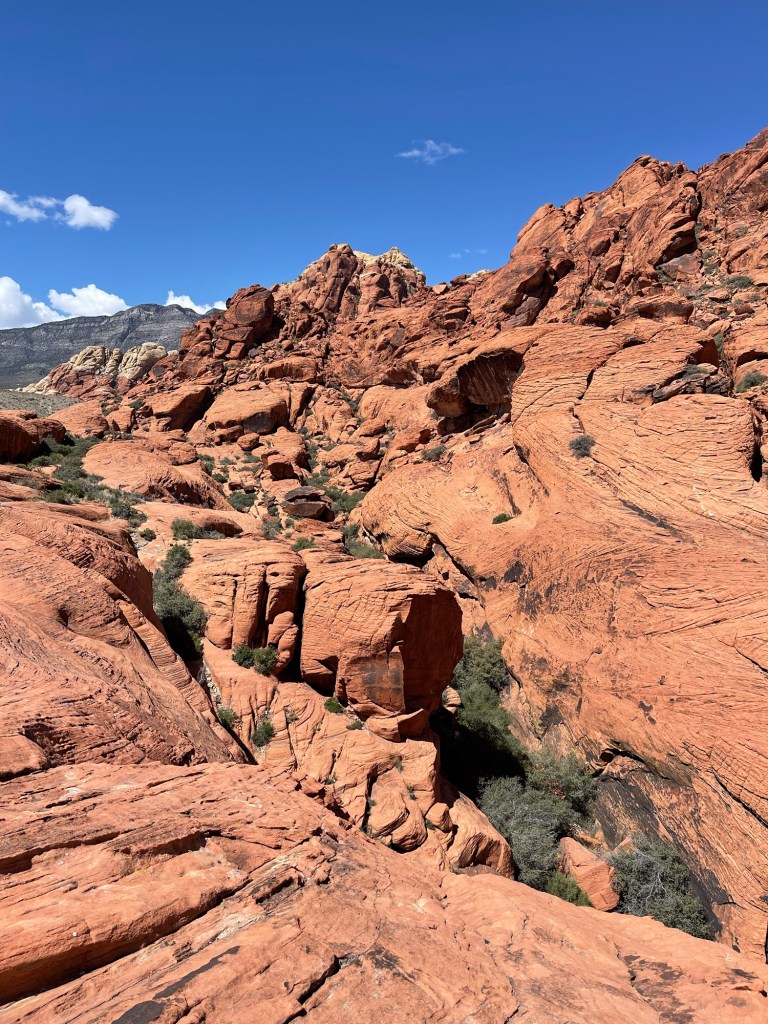
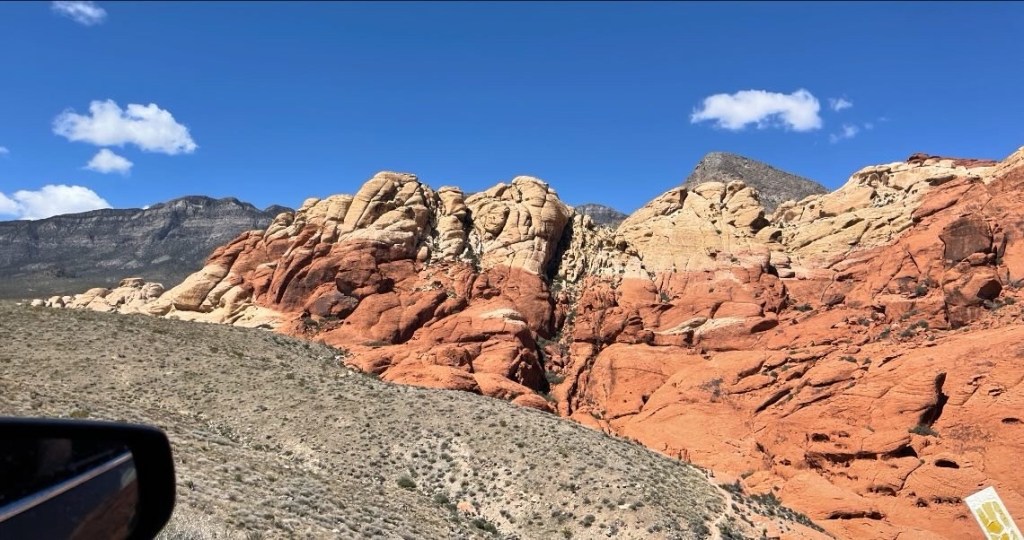
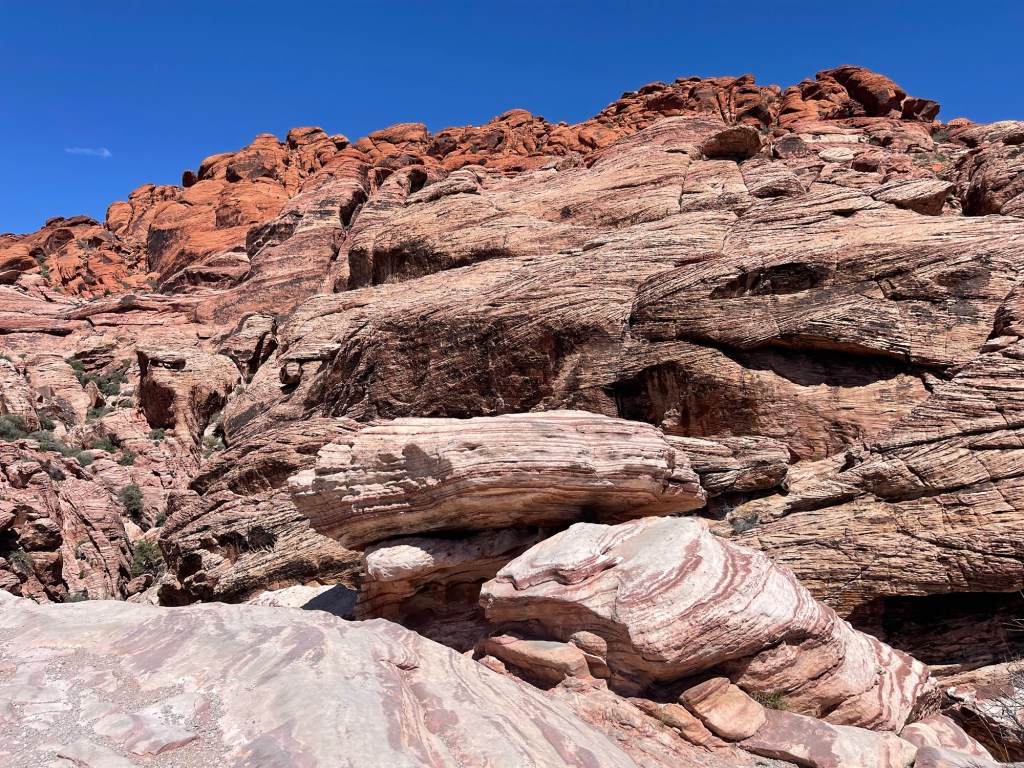
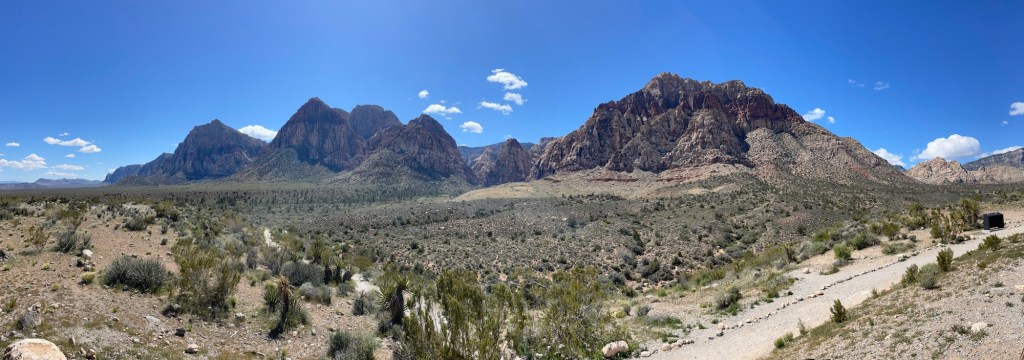
The region I live in was experiencing a total eclipse on April 8th. I was in Las Vegas, Nevada with an opportunity to see a partial eclipse. I might have been chagrined by this at another time in my life, but now? Amor fati friends. I watched the eclipse I had before me and made the most of the place and time I had available and visited Red Rock Canyon.
Red Rock Canyon more than lives up to its name, but red is just one of the many colors in this desert environment. Calico might have been a better choice, and one section of the scenic drive does have that name. It’s a stunning departure from the ugliest parts of humanity you might find elsewhere in the city.
The scenic drive is a one-way, 13 mile loop winding through the canyon. The one-way nature of it is a blessing as drivers are distracted enough already by the scenery without having to worry about cars coming at them head-on. But it does mean you should take the time to stop at every point of interest for there’s no going back.
A drive is nice, but I was here to hike. There is a nice network of trails throughout the area, but we spent the bulk of our time at Calico Hills scrambling and hiking amongst the massive sandstone formations. It was similar to Joshua Tree National Park in many ways, without the scale of that place, but more than making up for it with convenient proximity to Las Vegas.
The region is very popular with rock climbers and we watched dozens of them climbing the cliffs on our hike. Like gambling, rock climbing is not my game, but I can appreciate the skills of those who pursue it. Hiking and scrambling are enough for me, and in a place this beautiful this close to the Vegas Strip, I found the experience both exhilarating and immensely enjoyable.
There haven’t been a lot of hiking blog posts this year as there simply haven’t been a lot of hikes. Similarly, there haven’t been a lot of waterfall visits or posts either. Life sometimes has other plans for us. So imagine my delight when I could combine two 4000 footers with one of the highest rated waterfalls in New England. You might day we hit the trifecta, but we didn’t stop at three amazing experiences. On a spectacular October day after a day of heavy rains, we were set up for quite a day in the White Mountains.
That heavy rain factored in to where we parked and which trail head we started from. The easy button on this day was to pay the fee for parking at the Cog Railway parking lot and hiking up the Ammonoosuc Ravine Trail. This is a relatively easy trail to warm up on, until you hit the gem pool and begin a steep incline. This was a workout for this author, recently celebrating long streaks of 10,000 steps on flat land and thinking that translated into better fitness, but it was a small price to pay for the spectacular views of falling water and, once above tree line, the vistas from Mount Monroe and Mount Washington. Ironically, my Apple Watch died halfway through the hike and my streak of 10K steps “ended” on a day I did far more. Go figure.
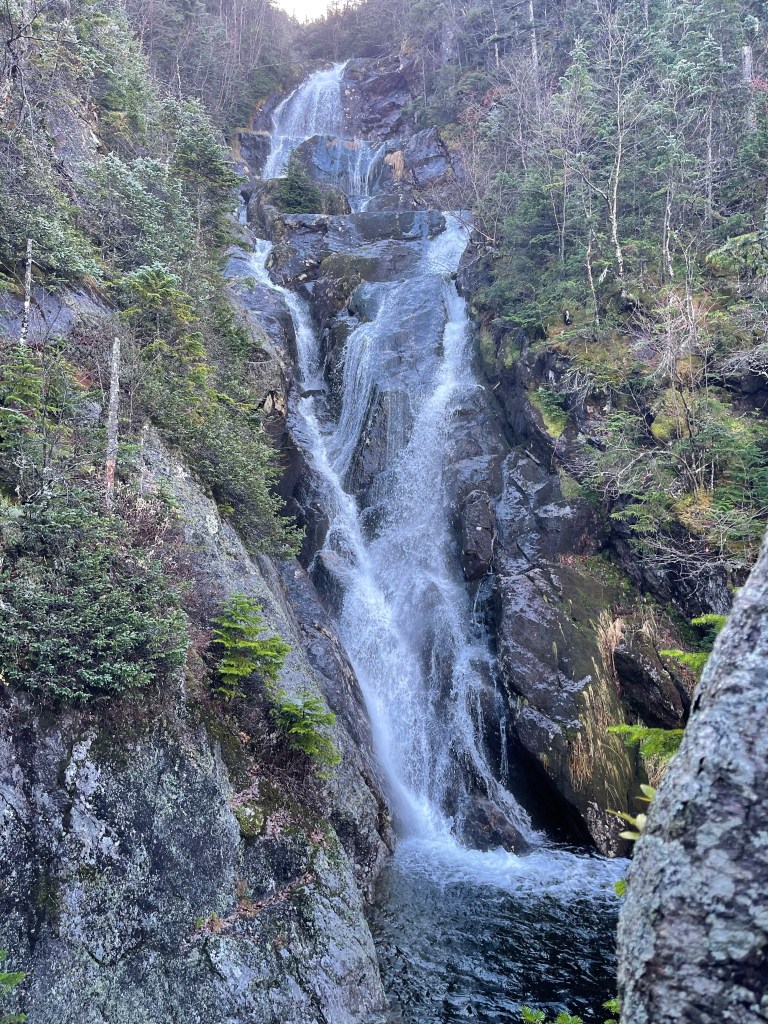
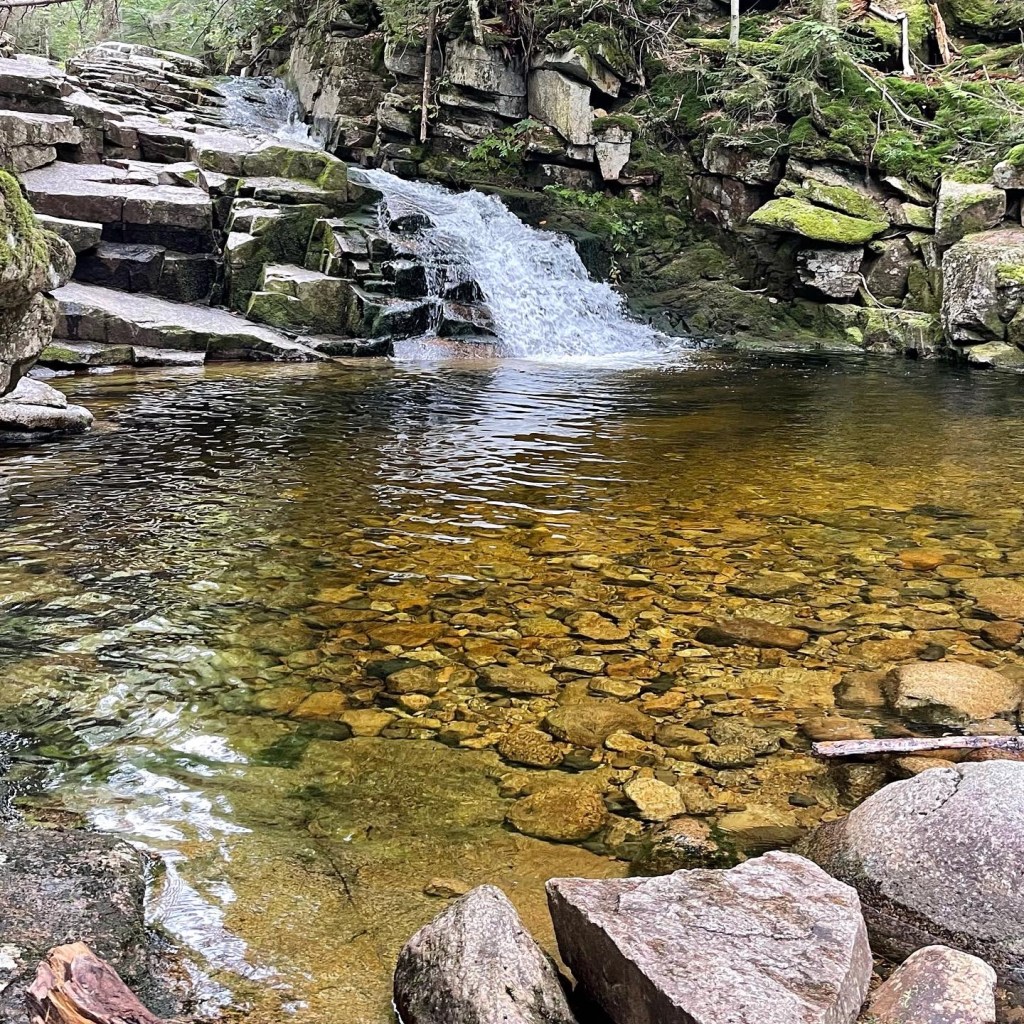
The Ammonoosuc Ravine Trail offers plenty of opportunity to see falling water. The Gem Pool is a lovely spot with a 35 foot waterfall right on the trail and impossible to miss. Further along, there’s a side spur that features a more stunning view of a 600-700 foot cascade that was roaring on this particular day. Some blown-down trees partially blocked the spur trail but it was a small investment in time for an incredible view. Talking to one hiker as we came back to the main trail, I mentioned that it was totally worth the side trip. He politely ignored me and continued his hike up to Mount Monroe. I wondered, how many incredible moments do we miss out on when we’re so singularly focused on a goal? To use Pico Iyer’s phrase, we abdicate possibility in such moments.
The trail eventually brings you to the AMC Lakes of the Clouds Hut, closed for the season when we arrived, but offering a warm sunny spot to take a break before continuing to summit Mount Monroe. This is where serendipity stepped in, and we bumped into the two sons of a close friend as they descended from Monroe just after we’d done the same. A few minutes for either party and the encounter would never have happened. Life is full of such chance encounters when we put ourselves in a position to experience them.
The hike to Mount Washington from Mount Monroe looks relatively simple, but that’s the White Mountains for you. The reality is a hike up a boulder field one deliberate step at a time. Some trail runners make quick work of this, for me it was an opportunity to pace myself. The two sons were soon summiting Mount Washington while I took my sweet time. My hiking buddy Tom was kind enough to wait for me now and then. Getting back in hiking shape after months away from it takes a few hikes. Resuming my quest to complete the 48 4000 footers on the highest peak wasn’t reckless (Washington is relatively easy compared to some lower peaks), but it was bold.
On this particular day, the Mount Washington Observatory was celebrating its 90th birthday with tours of the weather station. This was a wonderful opportunity to see what happens behind that door, and literally top the experience off with a climb to the weather observatory itself, the highest point you can stand on in New England, and have a look around. Opportunities like that don’t come along often, and it was another moment of serendipity on this day of days.
If this all sounds like it was too good to be true, well, I still had to pay penance for the audacity of hiking two of the highest peaks in one day. That price was paid in the form of a pair of boots that weren’t up to the task, making the descent rather painful, and with some cramping in the thighs as the finish was just in sight. There were lessons learned on this day: Don’t ever go on a hike unprepared for the things you’ll put yourself through, and always have the best boots available to help finish the job. If there’s a positive lesson, and you’ve no doubt picked up on it already, it’s that putting yourself out there pays dividends in experience both challenging and inspiring. We may live a grander and more full life simply by moving towards it.
Upper Ammonoosuc Ravine FallsGem Pool, Ammonoosuc RavineMount Washington from Mount Monroe. Looks close, doesn’t it?Mount MonroeLake of the Clouds with Mount Washington rising above it all
This hike was meant to be a compromise to myself. No salt water weekend, no longer hikes to knock off another 4000 footer or three. But still spectacular, still a light workout on a beautiful trail, and the real payoff; seven waterfalls in a relatively short span.
I had my doubts. You walk to the trailhead at Waterville Valley Resort and see right away that this hike is going to start between the road and some of the village condos. But you cross a road and leave most of that behind you. From then on you are hiking a pleasant trail to the first waterfall and not really seeing many people (for me, a Saturday afternoon).
The Cascade Trail is a 3 mile round trip to the Waterville Cascades. The silence of the forest is notable and welcome. You quickly forget that you’re in close proximity to a ski resort, and instead immerse yourself in hiking relatively pristine second growth forest that wraps itself around you and shuts out the outside world. Before you know it the hike brings you to the first cascade on Cascade Brook, a series of seven plunges that feel bigger and more remote than they really are.
But there are reminders of the alternative paths to the falls. We met a group we’d seen in the parking lot that opted to ride the chairlift up instead of hiking. We spoke to another couple of guys on mountain bikes who had ridden up to the falls to soak in the swimming holes. Both conversations reminded us that there were other faster ways to reach the cascades than hiking. We saw sad proof of this when we passed a pyramid of empty Bud Lite cans that some fools had stacked alongside the brook. Without a backpack for this short hike I had to leave this mess for someone else to deal with. Not everyone who ventures into the woods leaves them as they found them. This is the price of proximity.
But the falls themselves were each wonders, and we celebrated the unique beauty of each as we climbed higher and higher up the trail. When you reach the last big cascade there’s a bridge for a mountain bike trail that you can cross to descend the other side and return you to the Cascade Trail and your hike back down.
I’m interested in how people meet the falls. Some are reverent and respectful, some more nonchalant about the experience. I think it’s relative to how much work you put in towards reaching them, and the path you chose for yourself. But that may seem dismissive and smug when a hiker says it. More specifically, it’s not the work you put into reaching it, it’s how your attitude when you reach it that matters most.
The work-to-reward ratio of the Waterville Cascades makes it an easy choice. The proximity of that resort comes in handy for lunch or dinner and a restroom afterwards. The entire experience reminds you that finding beautiful in this world isn’t all that hard if you just put yourself out there to meet it.
Not every amazing hike is over 4000 feet. In New Hampshire there are other lists besides the 4K list, lists like 52 with a view, which offers some beautiful views with a bit less effort than the 4000 footers. For a warm Sunday with snow melting into snowball-making consistency, a couple of friends invited me to join them on a hike of Mount Israel and for a bonus, a visit to Beede Falls, one of the waterfalls on my personal checklist to see in 2021.
A bit of history is in order. Mount Israel is named for a settler named Israel Gilman, who lived near the trailhead for this mountain. There’s still an active farm near that trailhead, and it’s easy to imagine the land in the 1760’s when Gilman was walking around this place. Mount Israel is located in Sandwich, New Hampshire, which also has a bit of history in its name. The town of Sandwich is named for the 4th Earl of Sandwich, John Montagu, supposedly the inventor of the sandwich. Given that, I made a point of packing a sandwich for the hike, in honor of the Earl (or whomever it was, lost to history, who made sandwiches for him).
The hike began at Mead Base in Sandwich, with a straightforward two mile hike up the Wentworth Trail. For those wondering about the name of the trail, a bit more history for you: Sandwich was founded in 1767 from a grant by Governor Benning Wentworth. Another name you’ll come to know is Daniel Beede, who was chosen to lead the settlement of Sandwich and granted 100 acres. Place names usually betray the history of that place, and if you look hard enough you’ll find Easter eggs like these on maps and street signs.
I quickly fell in love with the Wentworth Trail. It winds through old growth oak and pine trees, with some tree trunks four feet in diameter – exceedingly rare around here. The snow cover acted as a spotlight on the biggest trees in the forest. I was smitten with one oak tree that had to be a witness to the transition from Native American land to English settlement. Further up, the trail wound around granite ledge and hemlocks, offering glimpses out to Squam Lake and the surrounding ridge line.
The summit of Mount Israel is 2620 feet with 1900 feet of elevation. Despite its modest height relative to some of the other mountains in New Hampshire, it didn’t disappoint in views or the stunning beauty of the trail itself. Steep enough for a workout, short enough to give you time for other adventures. We made short work of the trail and before we knew it we were back at the trailhead at Mead Base and Act II.
A half mile from the trailhead is another wonder worth visiting, Beede Falls, which is named after our friend Daniel Beede. The walk itself is wonderful, with granite ledge and scattered glacial erratics lining the edge of the trail. A large cave named Cow Cave offered a quick distraction. It was so named by some cows that decided to shelter inside the cave one day deep in the past. The cave was interesting, to be sure, but the real show was Beede Falls.
In late February the falls were largely frozen, and we walked out on the ice that must be a lovely swimming hole on a hot summer day. The amazing part of Beede Falls in looking at them from behind. The falls froze solid in front, but you can access the back from the left and right side, and crawling behind them offered a magical trip into an icy palace. Water cascaded from the granite ledge, plunging between the icy wall you see on the outside and the cave formed behind. There’s just enough room to go all the way through it if you’re adventurous and don’t mind getting a little wet.
In all our days on this earth, how often can you say that you got to see the world from the summit of a small mountain and from the crawlspace behind a waterfall in the space of a couple of hours? If you’re blessed with good health and mobility, then surely life is to be lived fully. Adventures like this one are within reach of most of us. All you’ve got to do is get out there.
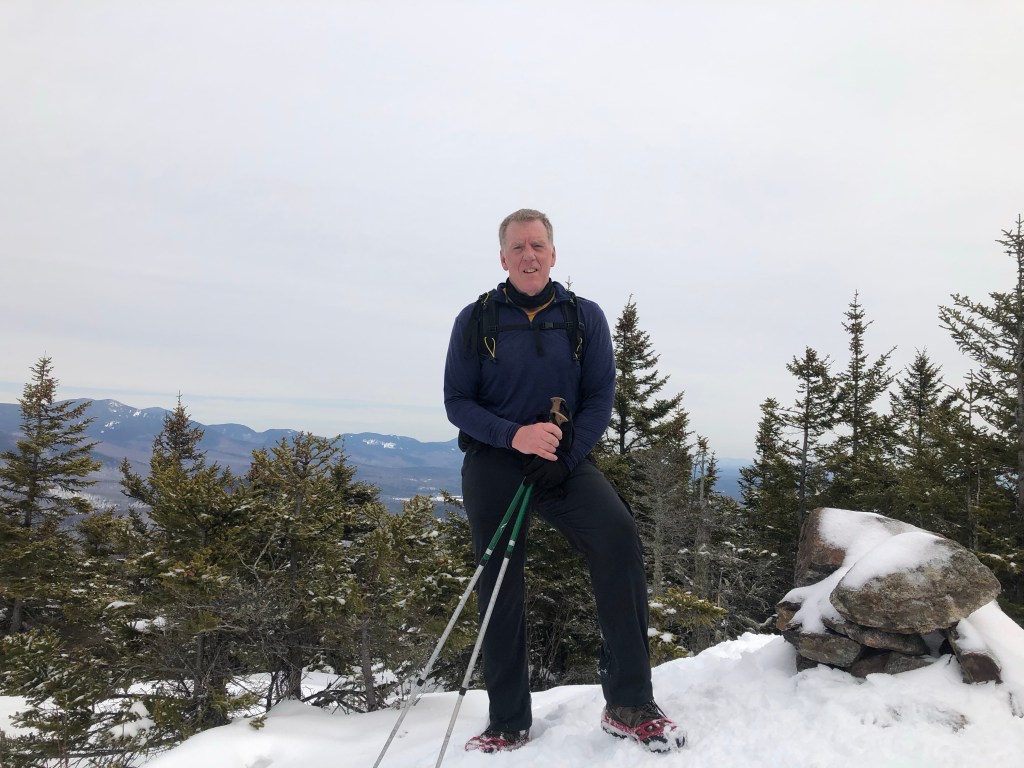
Frozen Beede FallsIce wall in cave behind the fallsSummit of Mount Israel
The last day of January felt like it should throw up challenging hiking in New Hampshire. In fact the temperature read a solid -4 degrees at the start. But the truth is that if you aren’t breaking the trail it’s comparatively easy. The snow pack on popular trails covers up a lot of the erosion and exposed granite ankle biters that are a normal part of hiking in the White Mountains. You simply trade the pounding on your lower extremities for a different pair of challenges: traction and hours of walking with your toes pointing up.
Think about a groomed ski slope, all corduroy and pristine. Perfect for skiing down, but imagine walking to the summit straight up that slope. How do your feet grip? How does that angle feel on your ankles and calves after about an hour? That’s the dilemma of the hiker on a snow packed trail. Snowshoes and descending butt sliders press the snow down into a version of that groomed slope, albeit it two feet wide. Step six inches off trail and your foot plunges down two feet into the abyss.
Overcoming such challenges requires mechanical assistance. On the one hand you have micro spikes; one of the best inventions ever for handling winter traction issues. I’ve gushed about micro spikes before and generally they’re perfect for frozen packed snow. They become more challenging when the snow softens and begins to ball up under your feet. Walking on snowballs is just as enjoyable as it sounds. Another consideration is ice. I feel comfortable walking on ice with micro spikes on, but not walking up a slide with them. Trusting rubber bands with your general well being has limits. And this is where an upgrade is in order.
A step above micro spikes are crampons, which offer more traction with a deeper spike designed to linger in your nightmares. I see crampons and think about those times I accidentally kicked myself in the back of the leg hiking in tight terrain and shudder. But then I recall a story I read about a guy who stepped out of his tent to take a leak hiking Everest or some such place. He made the unfortunate decision to not put on his crampons and promptly slid down the mountain screaming to his death. Crampons are made for comfortable late night relief in such conditions. Truthfully, I tend to avoid most “icy slide nightmare” hiking, but sometimes you run into spots where it would be the better choice. On Mount Liberty a couple of days ago I wished I’d had them a few times as I kicked my micro spikes into frozen snow hoping for footing.
And then there are snowshoes, used by generations of people trying to get from point A to point B without post-holing every step along the way. Snowshoes have come a long way, and the best of them have crampon-like steel spikes protruding from them and a wonder for the sloped uphill hiking conditions: the heel lift. A heel lift is a metal hinge that flips up to offer welcome support for your heel. It effectively levels your foot on a slope, creating a more comfortable hiking angle. Snowshoes come in different sizes based on your weight and the type of snow you’re hiking it. I have a great set of Tubbs snowshoes that are perfect for fluffy powder walks in open terrain. Being a tall clydesdale my shoes are 36″ long, which makes them a challenge on tight trail hiking. And with the trail compacted it’s simply easier to stick with the micro spikes or crampons. Using shorter snowshoes for compacted snow would offer the best of both worlds.
There are times when you might put all three on in the same hike. I didn’t bring crampons on my last hike but wore the snowshoes for an hour during a steep ascent in packed powder. My hiking partner that day chose to stick with micro spikes on the ascent and flew up the hill with me gasping to keep up with the extra burn of snowshoes. When I conceded and switched back to micro spikes our hiking speed equalized again. He wore his crampons on the descent while I wore micro spikes. In softening snow broken down by many hikers at that time of the day it was a toss-up. Had it been frozen and compacted as it had been in the morning the crampons would have been better.
Ultimately accessories are successful when you start with a great pair of boots, pick the right accessory for the terrain, and are willing to switch on the fly when things change. Another truth is that if you don’t get out there in it, none of this matters. Winter is meant to be lived in fully. Being shut up in the warm house might be comforting, but don’t we spend way too much time in our houses now? Step out there. Just wear the appropriate gear.
Contingencies. I pack for contingencies. Most of it stays in the bag, bulging against the sides, weighing the pack down directly onto the hip belt, as designed, and a bit on the shoulders, as is the way. First aid kit, extra warm clothing, extra food, and, it turns out, just enough water for this eleven mile trip. Snow demands micro spikes, but also snowshoes. Mine spent most of the day strapped to my backpack, but I gave them a try for about an hour of hiking before strapping them back on the pack. The compressed snow and narrow trail made wearing them more hassle than salvation. Sometimes you try out your contingencies and realize that you were better off with the original plan. But I do love those heal lifts on steep inclines.
It was -4 degrees Fahrenheit at the start of my hike this morning. Most layers packed as contingencies went right on the body for the start of the hike. Snow has a way of being crispy and slippery when you dip below zero. And the trail we started hiking wasn’t the same trail we descended when the sun rose and warmed temperatures into the twenties. Having the right footwear and accessories is essential when you see swings in temperatures like that.
Still, for all the contingencies planned for, most everything stayed in the pack. Sleeping pad, extra layers, way too much food, all of it mocking me on the steepest parts of the incline and for most of the descent. But as soon as you don’t pack it you know what’s going to happen. Yeah, contingencies, especially in winter, must be a part of your kit. You’ve got to have a winter pack that can handle all the extra stuff, provide tie downs for the snowshoes, and remain an afterthought for the duration of the hike. For day hikes I’ve settled on an ULA Photon pack, which offers everything I need and the space for those extras.
Winter hiking in New Hampshire offers plenty of beautiful moments. Moments that serve as exclamation points on the trip and in your life. But winter can offer up stunning beauty and calamity quite rapidly in the White Mountains. Mother Nature doesn’t care about your feelings. You must be prepared for whatever she throws at you. And that’s what contingency packing is for. Sure it mocks you when it never gets used, but it also assures you that it will be there for you if you need it.
The next blog post will cover the actual hike. Memorable, incredibly clear, and two more 4000 footers checked off. Stay tuned, there’s a lot to cover.