Tag: Irondequoit Creek

  • A Long Walk on the Erie Canal

    Leaving on a Sunday night for a business trip is never fun, but this week I tried to keep it in perspective.  Time away from home sucks, but time seeing new things usually tempers that a bit.  I got to the hotel in time to watch game 6 of the Stanley Cup finals, celebrated a Bruins win and prepped for the week ahead.  Monday would be a long day of customer-facing meetings, and by the end of the day I was ready to get outside and move.  My hotel was in Bushnell’s Basin, an especially lovely part of Perinton, New York.  A large part of the charm is the Erie Canal running through.  The tow paths have been reclaimed as walking paths, akin to a rail trail but with the benefit of a waterway on one side of you for the entire journey.

    A quick five minute walk from the hotel is Richardson’s Tavern, built in 1818 and now the oldest original canal house left on the Erie Canal.  I’ve written about it previously.  Just across the single lane Marsh Road Bridge is the Erie Canal Heritage Trail.  The bridge was built in 1912 but was just completely renovated.  It was the first time I was able to cross it to walk the trail so I made the most of it.

    The great thing about the Erie Canal is that it’s still a functioning transportation corridor.  Where once it was barges full of commerce coming from the Great Lakes to the Hudson River, today it’s largely pleasure boats making their way from point-to-point.  I thought it would have been a great place to row, with long straightaways and a convenient bike path for coaches barking instructions.  Funny how I always come back to rowing when I see the right body of water…  but today I was walking, and my goal was a quick five miles before dinner.  From the bridge I walked 2 1/2 miles towards Pittsford, turned around and walked back.

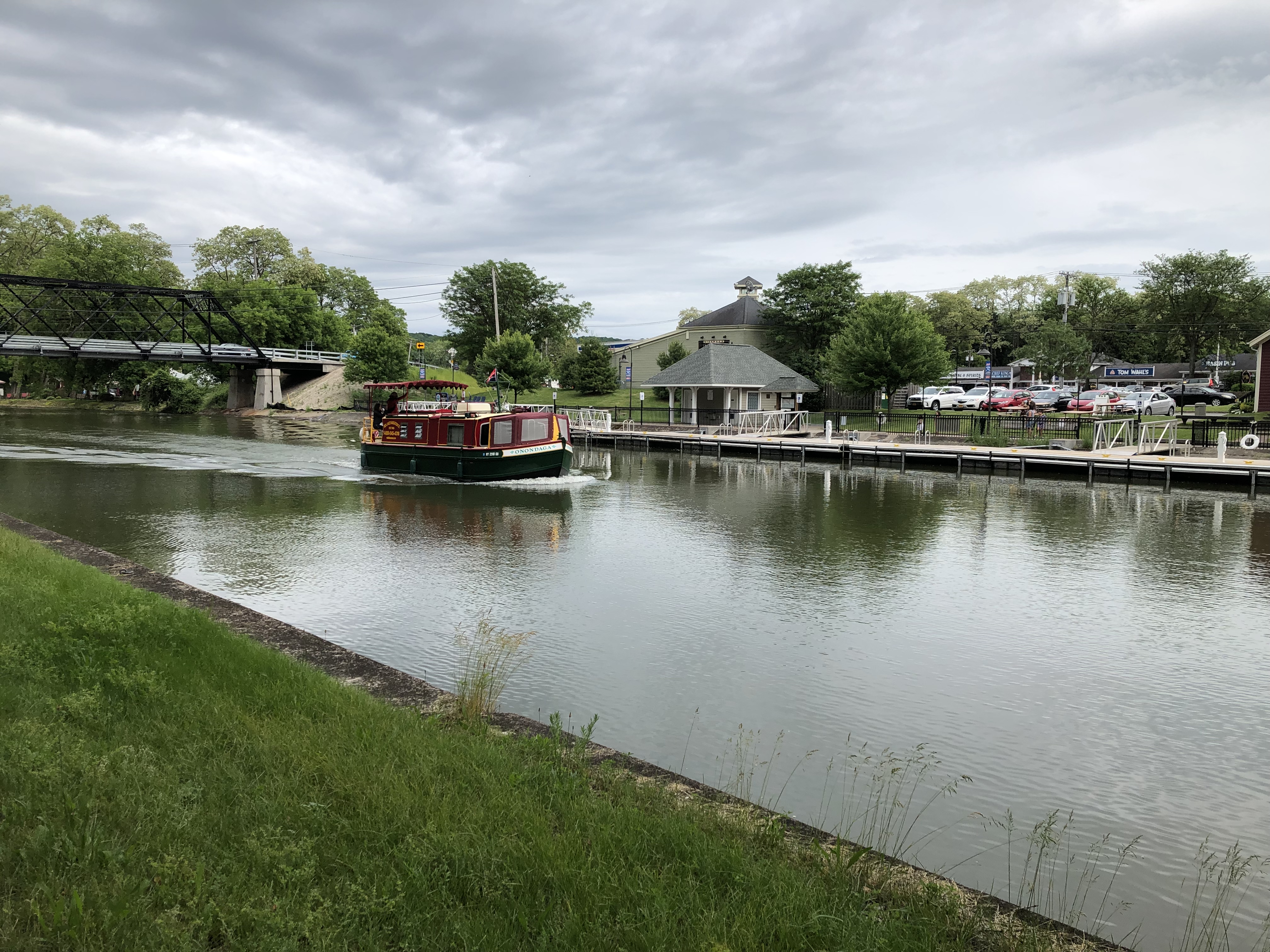
    Walking the trail, I passed walkers, joggers and bicyclers.  A highlight was watching two boats cruising the canal.  People wave to boats, and boaters wave back.  The world would be a better place if everyone else would follow their example.  This stretch of the Erie Canal is best known for a particularly challenging engineering project that had to happen to support the canal traveling through.  The Irondodequoit Creek ran perpendicularly 70 feet below the path of the proposed canal.  So James Geddes, the assistant engineer for the Erie Canal, designed the Great Embankment, a mile long, 7-story pile of rock and fill from the canal, with a 245 foot culvert to channel the creek they were building over.  This was the early 1800’s mind you, so digging and dumping required a significant labor force.  The embankment was completed in 1822.
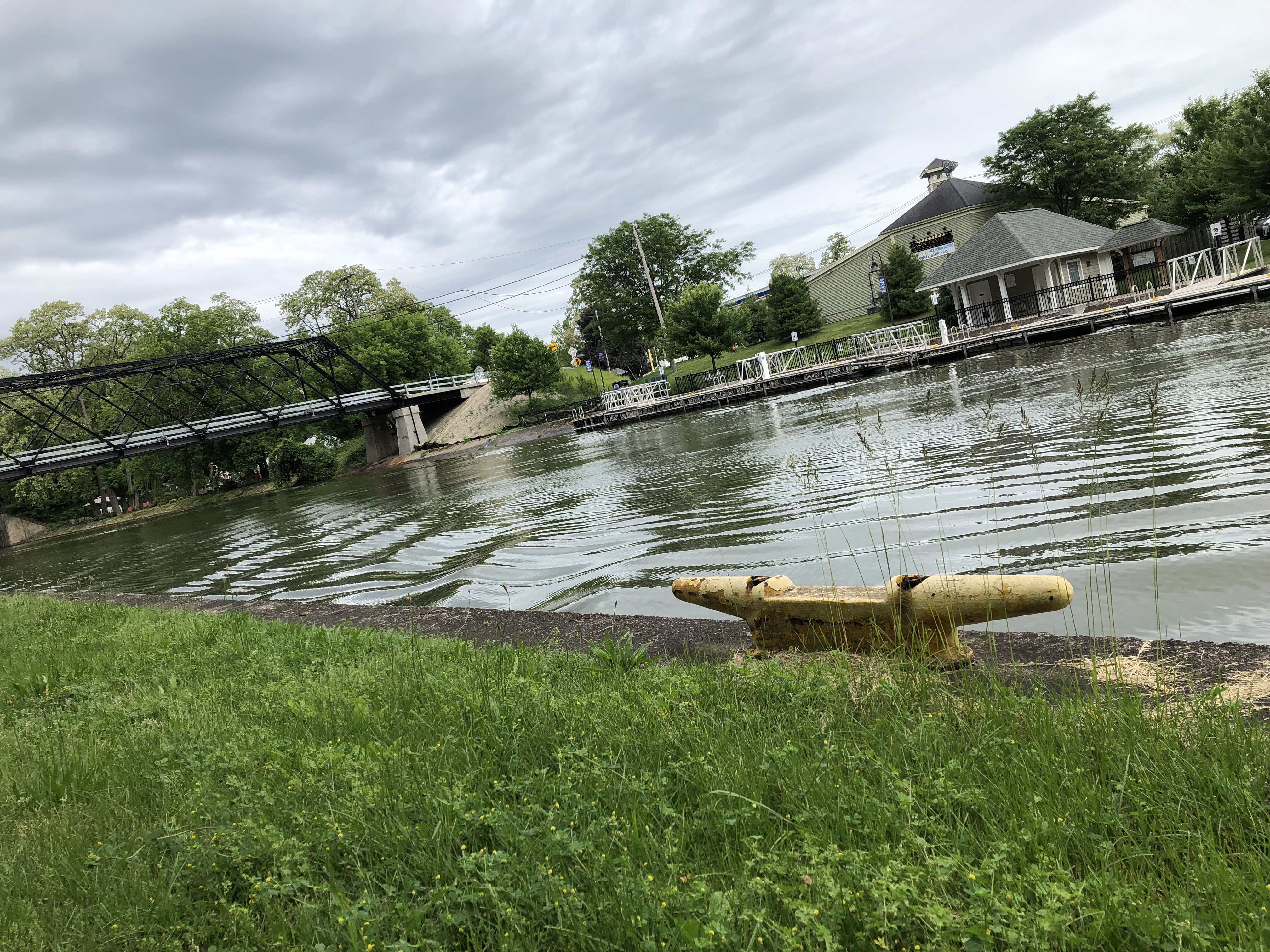
    Back in Bushnell’s Basin after my walk, I took a right turn and headed for a new brewery that opened last year.  Named Seven Stories after the height of the Great Embankment and for the seven forms of storytelling, this brewery had great beer and better names for it.  They’re right along the canal, and I replaced my burned calories with a pint and a couple of 5 ounce tasters.  Seven Stories will be on my regular rotation on trips to the Rochester area.

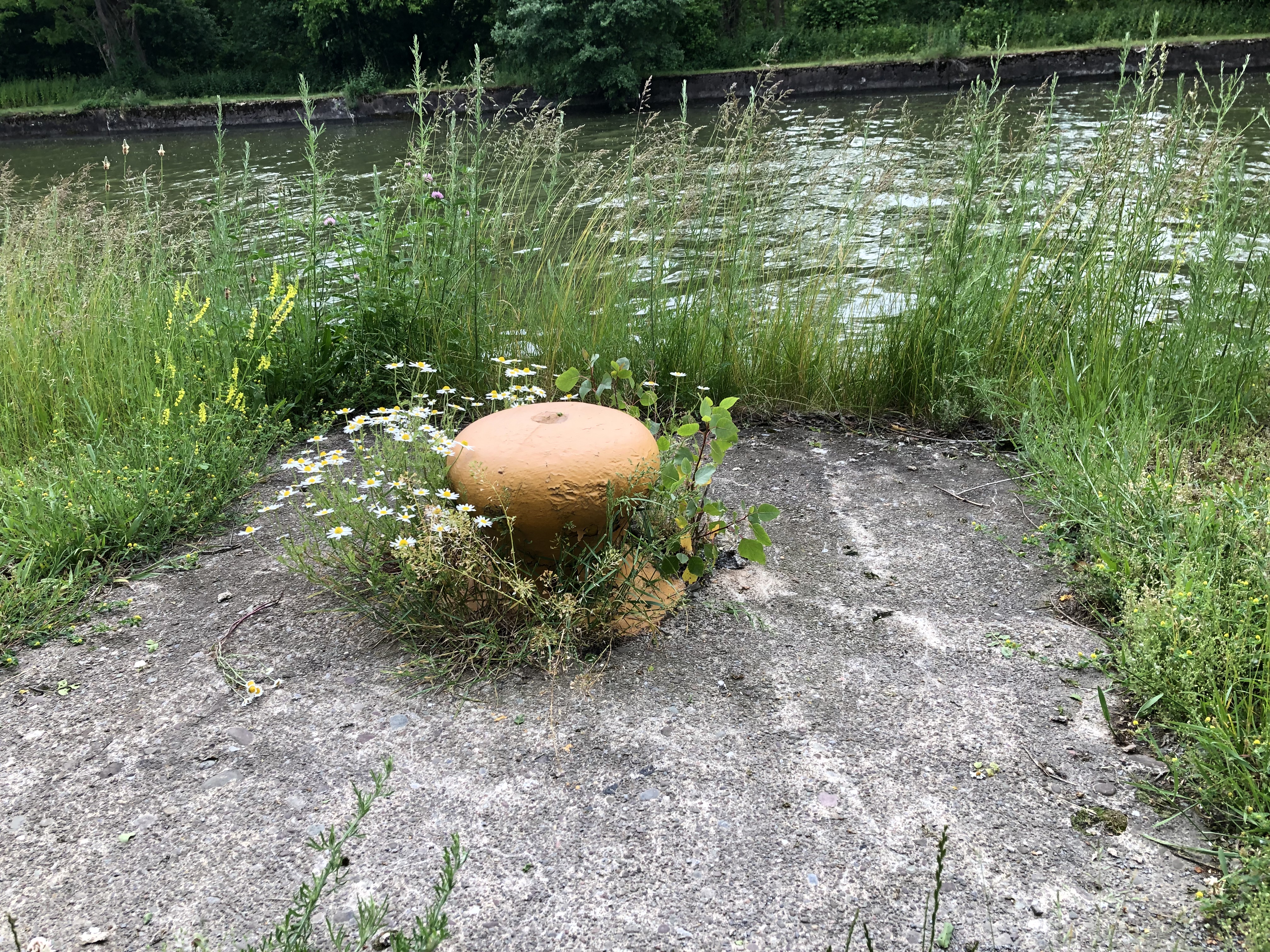
    A lovely evening walking along the Erie Canal certainly beat eating at the hotel bar and watching television.  Getting out and seeing the world in earnest is my goal.  The Erie Canal Heritage Trail, paved in stone dust and lined in stretches with bollards for tying down barges once upon a time, was a lovely place to spend the final hours of Monday sunlight.

  • Pabos: A Long Way From Home

    On the edge of a lawn on County Road 42 in Fishers, New York is a seven foot pyramid built in 1959 to honor a man named Pabos.  Pabos was a Basque explorer who traveled deep into the wilderness of North America only to die here 400 years ago on June 10, 1618, a little more than two years before the Pilgrims settled in Plymouth.  His grave is one of the oldest known European graves in North America.  That his final resting place was here in this Rochester suburb is fascinating.  That he is remembered at all is an accident of history.

    The Basques are people from the region in Spain that borders France.  They were focused on commerce, not settlement, and were very active fishing, whaling and trading in the Gulf of St Lawrence in the 15th and 16th centuries.  They would sail over from Spain and establish semi-permanent fishing and hunting camps in that great estuary, fishing for cod and hunting whales for a century before Jacques Cartier explored the St Lawrence River and claimed the northern lands for France.  The Basque traded with local tribes and learned to speak their languages.  Over the decades they moved further and further inland up the St Lawrence River, eventually reaching Lake Ontario and beyond.  Like his fellow Basque explorers, Pabos was likely looking for new fishing grounds, tribes to trade with and for the elusive Northwest Passage to Asia.  He likely followed the shoreline of Lake Ontario to Irondequoit Bay and then up Irondequoit Creek to see where it would take him.  Pabos may have been the first white man to walk through the old-growth forests that covered Western New York in 1618.  How he died is lost to history, but disease, illness, accident and violence claimed many explorers and the native tribes they encountered along the way.  Smallpox and other diseases brought by early visitors decimated local tribes well before the first permanent European settlers arrived.

    Almost two centuries before Victor, New York was incorporated as a town in 1812 and laborers started digging the Erie Canal something took the life of Pabos in this remote corner of Upstate New York.  What we know is he wasn’t alone.  Someone in his party buried him 300 feet from this monument and marked his grave with a limestone gravestone engraved with his name and the date of his death.  And it was there that Pabos rested in peace, lost to history until his grave was discovered in 1907 by Fred Locke, inventor of the porcelain insulator.  Locke was digging for clay when he unearthed the limestone marker of Pabos’ grave.  Had Pabos been laid to rest a few hundred feet away, his grave may never have been unearthed.  Lost forever to the accumulation of sediment, or covered over by the construction of Wangum Road or the Auburn and Rochester Railroad.

    The larger pyramid monument that sits alongside Wangum Road was built and dedicated in 1959 after a decade of extensive research on Pabos by George Sheldon.  That dedication was noted in the Rochester Democrat and Chronicle on June 10, 1959.  Sheldon and the local Boy Scouts built this pyramid and placed the plaque to honor Pados.  The actual gravesite sits 300 feet away from the pyramid on private property.  Portions of the trail he walked his final steps on still exist to this day.

    Pabos thus lives on because someone in his group carved his name and date of death on a piece of limestone, and someone stumbled upon that limestone 289 years later, and someone a generation after that dedicated ten years of his life researching the Pabos and how he came to be in this place, and with the support of the community dedicated the pyramid monument that marks this path through history.  Ironically, the person who survived and paid tribute to him with the carved gravestone is lost to history.  Yet they set in motion the series of events that bring us to this moment, 400 years later, acknowledging a Basque explorer who died alongside a creek deep in the wilderness far from home.