Tag: Lawrence

  • The Bread and Roses Strike

    Lawrence, Massachusetts was the epicenter of two significant events in the history of industrial labor.  The first was the Pemberton Mill collapse, which I wrote about yesterday.  The second was the Bread and Roses Strike in 1912.  The strike began when mill workers realized that the mill owners chose to pay them two hours less in wages in reaction to a law passed in Massachusetts requiring women to work a maximum of 54 hours instead of 56 hours.  The mill owners weren’t exactly looking out for the welfare of the immigrants who worked in their mills, and took the cold calculation that if someone was working 54 hours they should be payed for 54 hours, not more.

    On January 11th the workers at the Everett Mills found that their wages were reduced and walked out, beginning the strike.  The next day the Washington Mill discovered their wages were reduced and followed suit.  Everntually upwards of 25,000 mill workers were on strike.  Police and the Massachusetts National Guard were brought in to “keep the peace” and instead poured gas on the fire as violence escalated.  One young woman named Anna LoPizzo was killed and instead of prosecuting the person that shot her the union organizers were framed for murder.

    As the strike continued for weeks families started sending their children on the train to the homes of sympathizers.  When another group of children were gathered together to be sent to more homes, the mill owners and police tried to prevent it.  This led to national attention on the working conditions that the mill workers were living with.  Eventually the mill owners agreed to a 5% raise to end the strike but tensions remained high.  One immigrant was beaten to death for wearing a pro-union pin.

    Over time the higher wages of workers in the mills prompted a shift in manufacturing of textiles, shoes and other items first to the south and eventually overseas.  The horrific working conditions that the Lawrence mill workers labored in shifted to these other places too.  When I hear about sweat shops in China or other places I can’t help but think about the original sweat shops along the banks of the Merrimack River.  The mills didn’t start this way, but over time the plight of the workers degraded  as the greed of the mill owners increased.  Now and then it’s good to look back on the history of the Industrial Revolution to understand why labor laws have evolved the way they have.
  • The Pemberton Mill Disaster

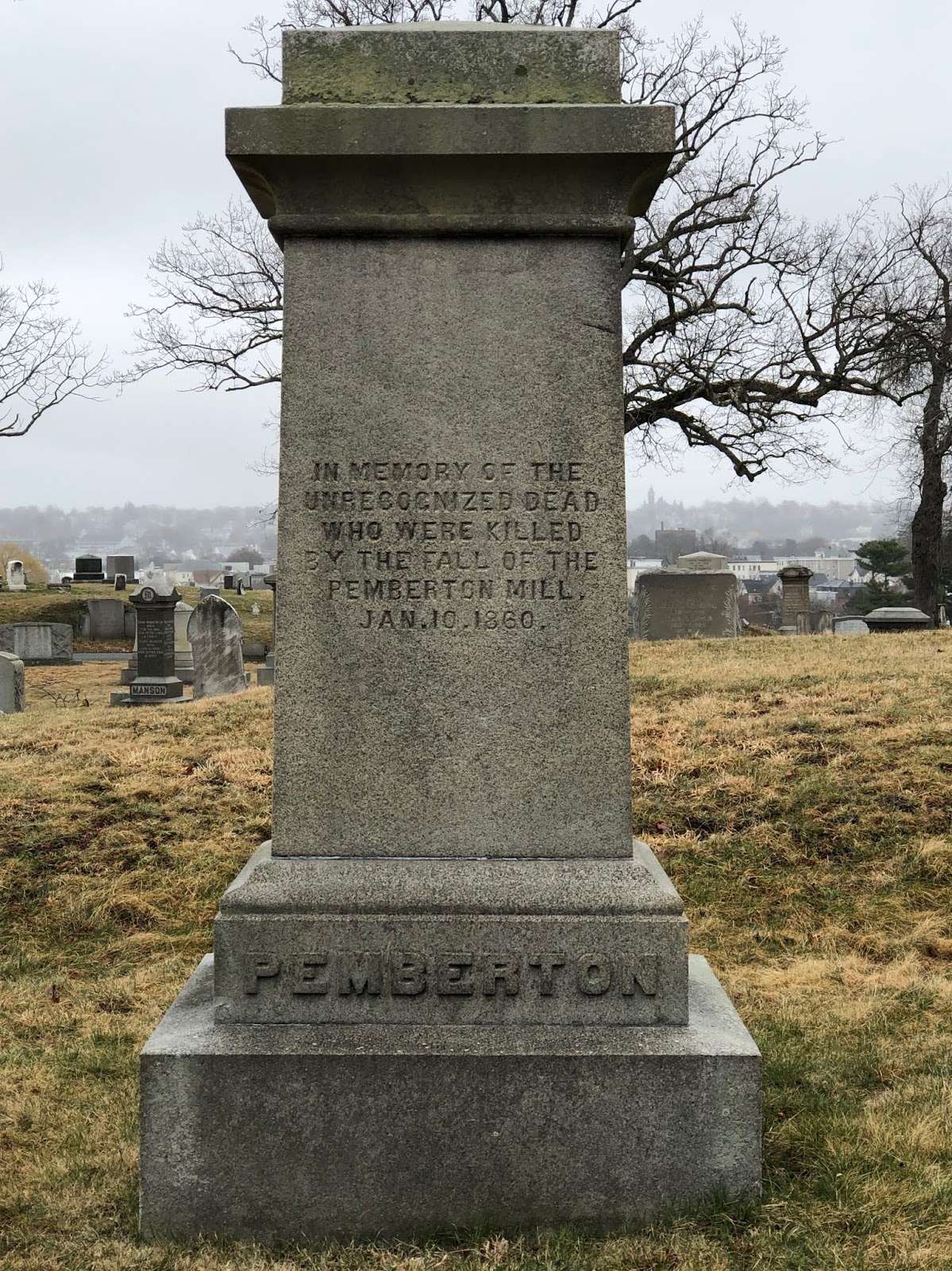
    On a quiet hill overlooking the City of Lawrence, Massachusetts is a monument memorializing the 145 mill workers killed on January 10th, 1860 when the Pemberton Mill collapsed.  Another 166 were injured.  Many victims were women and children.  As recent immigrants to America, the victims were buried at Bellevue Cemetery and this simple monument marks time serving as a reminder of the souls who perished that day.

    The Pemberton Mill disaster remains one of the worst industrial accidents in history.  If it were to happen today the mill owners would be imprisoned for criminal negligence.  The mill was built by the Essex Company in 1853 and was sold at a loss to George Howe and David Nevins, Sr. four years later during an economic downturn.  Howe and Nevins jammed more machinery into the building to make it more profitable.  This proved disastrous as three years later the building collapsed on itself with 800 mill workers inside.

    Immediately after the collapse rescuers converged on the pile of rubble to try to dig victims out.  Sometime during the rescue a lantern caused a fire that quickly grew to an uncontrollable inferno as oil-soaked wooden beams became tinder.  Rescuers could hear dozens of people screaming in terror as the flames raced through the rubble, eventually extinguishing the voices one by one.

    This is one of the most horrific stories I’ve ever read about, and it happened along the banks of the Merrimack River in Lawrence.  I’ve heard about the Pemberton Mill disaster, but I never really knew the extent of the tragedy.  For the young mill workers hoping to earn an honest wage in America, this was a brutally cruel end to their hopes and dreams.

    David Nevins, Sr. lived a long life, becoming a wealthy and generous resident of Methuen, Massachusetts.  The library in town is named after him.  Howe lived a long life too, but seems to have been less generous with his money.  The names of the workers who perished in the mill are long forgotten by history.  But their final moments serve as a stark reminder of what can happen when you stretch the limits of safety in the workplace.


  • Bloody Brook

    There’s a tiny brook that flows from Searles Pond near Holy Family Hospital and feeds into the Spicket River just before it in turn feeds the Merrimack River in Lawrence.  It’s name betrays a violent history, long before Lawrence and Methuen become heavily developed urban environments.  Google has led me a couple of times to a very useful site that details the history of Methuen and some of the surrounding area that once was part of Methuen.  You can Magenweb here.

    The name Bloody Brook was said by George Frederick, late town treasurer and authority on Indian lore, to come from a terrific battle between the Agawams and the Tarrantines in the days before the English settlement. As near as white men could tell after they came, about September 1615 the Tarrantine Indians of Maine had a poor harvest so they invaded the Merrimack Valley to raid the fields,and naturally the local Indians resisted as best they could. It is said that clubs and stone axes, rather than arrows, were found in this area, indicating the closeness of combat. 

    The Tarrantines were part of the larger Mi’kmaq tribe of coastal Native Americans who lived from Maine to Newfoundland.  For them to make the long trip down to what is now Methuen to raid the fields of the Agawam speaks to their desperation.  There is another famous Bloody Brook that points towards the better-known history of conflict between the white settlers and Native American population.We hear a lot about the encroachment of European settlers in the area and the conflicts that arose with the Native American population as a result.  The conflict between tribes is a lesser known, but no less violent history of the land we live on today.  Names like this dot the map, just waiting for someone to remember the ghosts who once inhabited this land.


  • Straightening the Spicket

    Straightening the Spicket

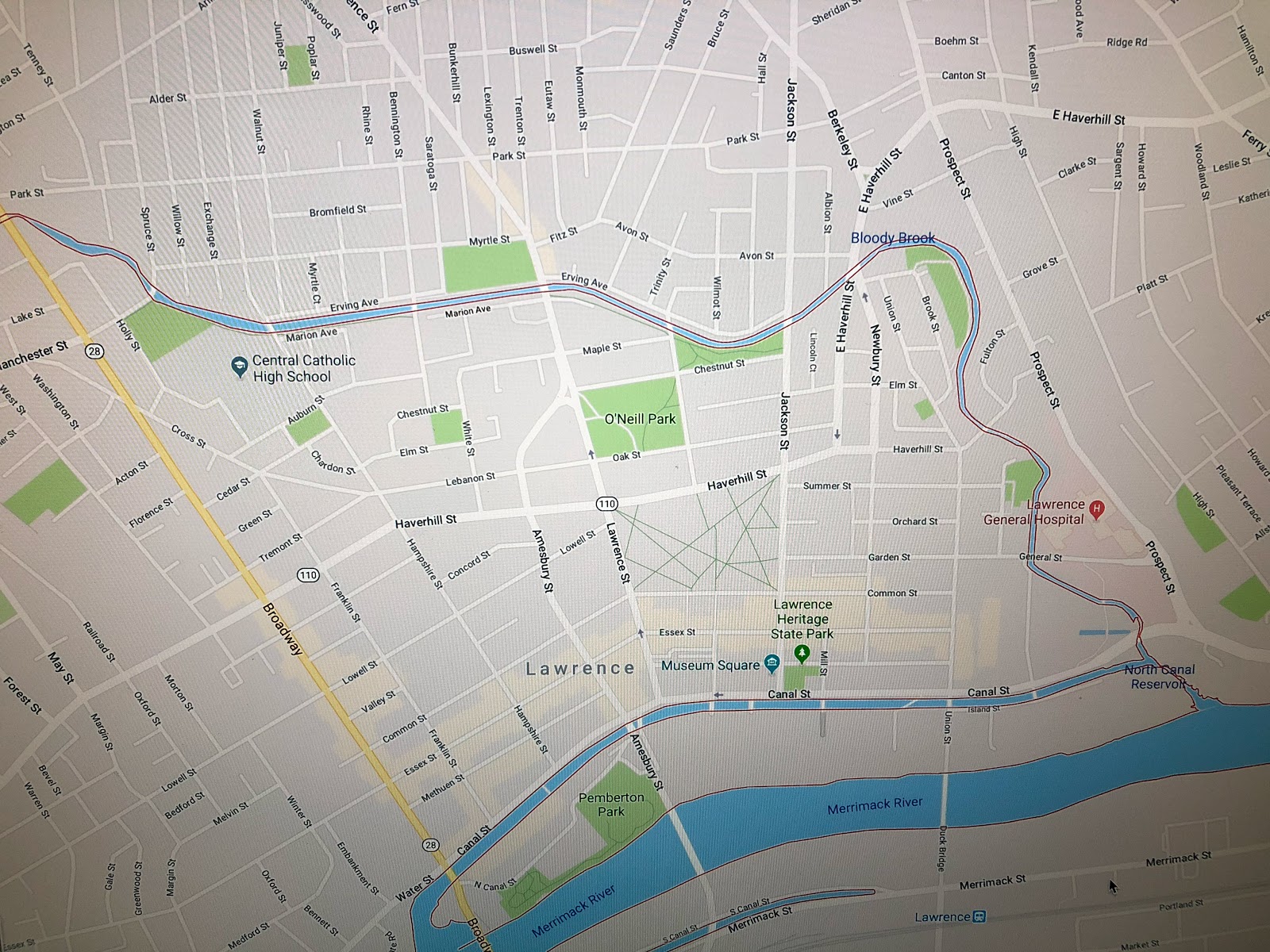
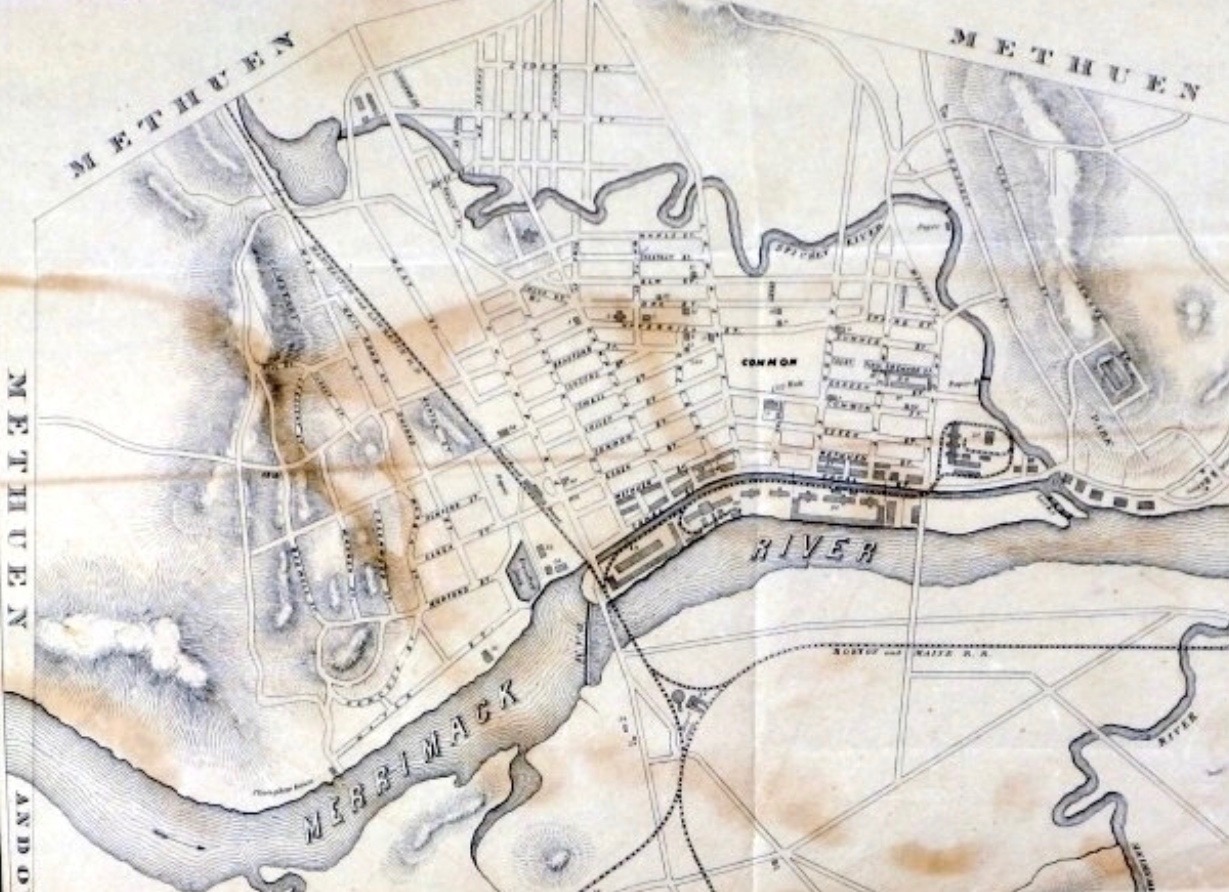
    The Spicket River flows from New Hampshire into the Merrimack River in Lawrence, Massachusetts.  The river has changed over the years, particularly during the explosive development of Lawrence and Methuen in the Industrial Revolution.  By the late 1880’s the City of Lawrence had enough of the typhoid breeding ground that the river had become and decided to straighten the river.  Looking at the first map from the 1850’s followed by a Google map from 2018 you see just how much they changed the Spicket River in the Lawrence stretch.

    Unfortunately, they didn’t dig the channel deep enough and the river bed can’t handle the floodwater that were once absorbed by the natural flow of the meandering river that once flowed through the city.      Heavy rains combined with spring melt-off creates a flood plain that makes some areas of the city impassible.  Perhaps no place carries this burden more than Central Catholic High School, which sits right where the the flood plain once acted as a sponge for the river.  The city doesn’t seem to be in a hurry to correct the situation, so every few years there’s a lake where the CCHS parking lot once was.  The price of progress, or the price of poor engineering?

  • Boomtown: Lawrence, Massachusetts

    Boomtown: Lawrence, Massachusetts

    In 1845 the land along the Merrimack River that would soon be called Lawrence had a population of 104.  Five years later the population had exploded to 8,358.  By 1920 the population had swelled to a high of 94, 270.  All these people arrived in Lawrence as the river was dammed, canals were dug, brick buildings were constructed, and water was diverted to fuel the entire enterprise.  Water power moved everything, including the people who moved here for the work the mills provided. 
    Lawrence is ten miles downstream from Lowell, which was the most successful textile city in North America.  The Essex Company wanted to duplicate that success using the same Merrimack River water that Lowell used.  The first step was to build the great stone dam in Lawrence to better regulate the flow of water to the mills.  Next, as in Lowell, a power canal was built to channel the energy of that water to the mills.  This powerful water had to go somewhere, and it was directed through turbines that turned gears that turned leather belting that turned the looms that thousands of factory workers tended.

    And it didn’t stop with the loom workers.  The mills had to be maintained and grow.  The workers had to eat, and live somewhere, and go to church, and their children had to go to school.  Banks and hospitals and trolleys and parks and stores and houses and roads to connect it all grew like concentric rings out from the turbines.  Lawrence, like Lowell before it, became a boomtown.  Like Lowell, it thrived until cheap electricity and labor pulled textile jobs to the South and eventually overseas.

    Unlike Lowell, which has a major university and political clout in the Commonwealth of Massachusetts that enabled it to rebound more quickly, Lawrence was lost without the manufacturing jobs for decades.  The loss of jobs led to an exodus of many of the people who were the backbone of the community, and that void was filled with poverty, helplessness, riots in the 1980’s, insurance scamming in the form of staged accidents and arson, and drugs and crime led to Lawrence being one of the least attractive places to live in New England.

    And yet the bones of the city are strong.  There’s beauty in the mill buildings and homes that the textile wealth brought to the community.  Looking beyond the criminal element, there is a vibrant immigrant community that is family-oriented, hard-working and chasing the American dream.  Lawrence is a city poised for explosive growth, just waiting for the next economic turbine to power it all.