Tag: Little Compton

  • A Visit with Benjamin Church

    A seasonably warm Sunday lured me from a visit with friends in Mattapoiset, Massachusetts to Little Compton, Rhode Island to finally meet Benjamin Church. Church was appointed Captain of the first Ranger force in America in 1675 by the Governor Josiah Winslow of Plymouth Colony. He was famous for being the guy leading friendly Native Americans that finally killed Metacomet (King Philip). His greatest innovation was in imitation: adopting the Native American style of fighting to allow his forces to survive and find success in battles with the French and hostile native population.

    What made Church honorable was his respect for the native population and his desire to coexist with them. While many around him were inclined to encroach and eventually push aside native tribes, Church wanted to coexist and work with them. This led to recruiting friendly tribes to assist in King Philip’s War and in later battles with the Abenaki and French in Acadia. War is a dirty business, and there was plenty of atrocity committed on both sides, but Church seemed to live by a code of honor untarnished by historical perspective.

    Today Church lies in rest in a quiet triangle-shaped graveyard in the middle of Little Compton with his wife buried next to him. A monument honoring him stands at his feet, and someone glued an Army Ranger tab just above his engraved name. That engraving is fading away now, barely legible after 300 years of exposure to the elements. If you asked a thousand people in New England who Benjamin Church was, maybe one or two would know. Time fades memory faster than it does engraved stone.

    Here lyeth interred the [body]
    of the Honorable
    Col. Benjamin Church, Esq.,
    who departed this life, January 17, 1717-8 in
    the 78 yeare of his age.’

    On a beautiful Sunday afternoon I was the only visitor, but a group of teenagers were playing basketball nearby. I wondered if they knew the story of the soldier buried nearby? Does their local school teach children about the war that happened right across the river, or about the man quietly marking eternity in a faded grave in the middle of town? I hope so.

    Fading history
  • The Rhode Island Red Monument

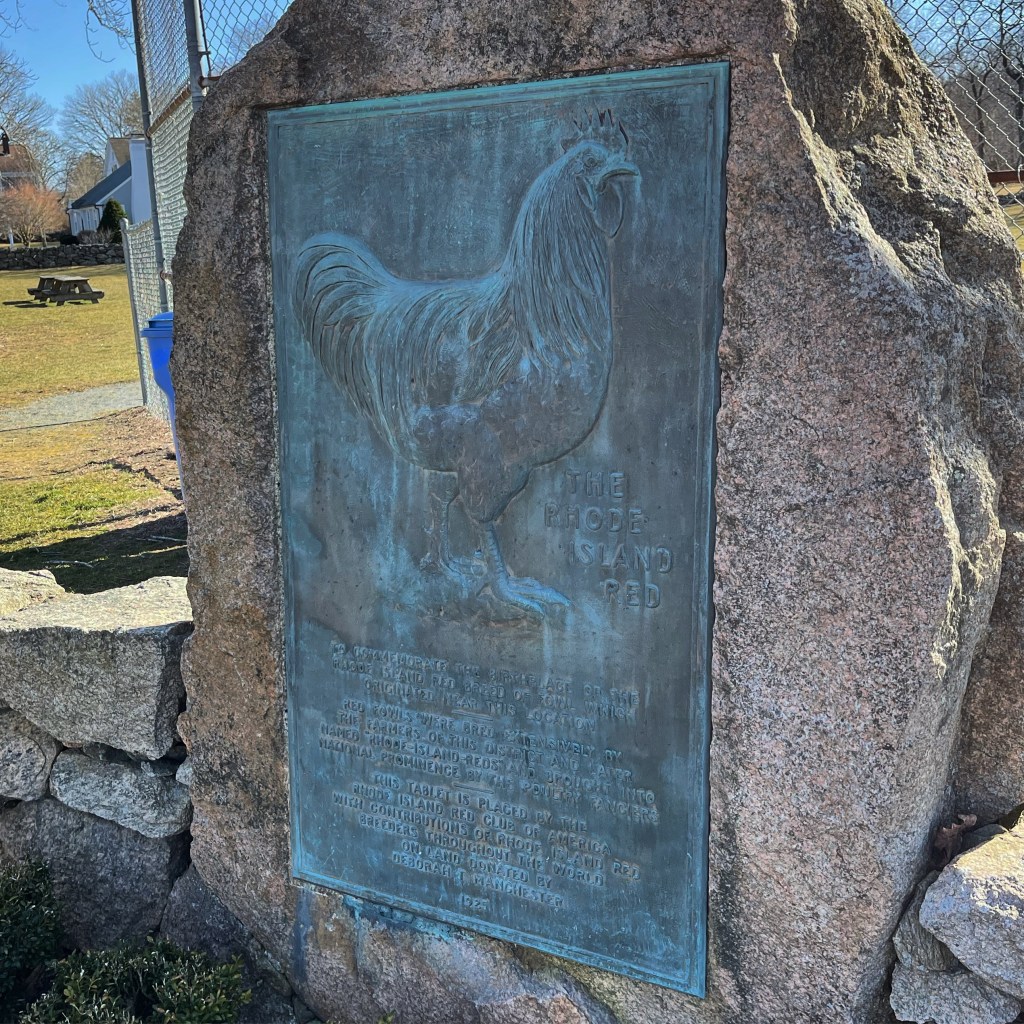
    One of the joys of travel is stumbling upon roadside curiosities. On my pilgrimage to visit a favorite hero of King Philip’s War I came across a monument to the Rhode Island Red that drew my attention. The Rhode Island Red is a hen, of course, that famously and productively laid eggs particularly well, which led to breeding of this particular character to make eggs a common and reliable staple of our diet. It seems the Rhode Island Red was first bred on a farm in Little Compton, Rhode Island.

    In 1925 a group of Rhode Island Red enthusiasts erected this monument to the hen, commissioning an artist named Henry Norton to make it. But here’s where the story gets interesting. One group wanted the monument to be erected at the actual farm where the hens were first bred. Another group wanted it in a more prominent location in town (where I came across it, validating their choice I suppose). For a small town, this was pretty heated, with both sides trying to establish a pecking order. At the unveiling of the first monument the opposing group didn’t show up, apparently feeling the location was pretty… fowl. A year later they erected their own monument at their preferred site. The 1925 monument features a rooster, the 1926 monument features a hen. But a well-placed hen. They really showed ’em.

    The 1925 Rhode Island Red Monument

    The inscription on the 1925 monument reads:
    “To commemorate the birthplace of the
    Rhode Island Red breed of fowl which
    originated near this location
    ___
    red fowls bred extensively by
    the farmers of this district and later
    named “Rhode Island Reds” and brought into
    national prominence by the poultry fanciers
    ___
    this tablet placed by the
    Rhode Island Red Club of America
    with contributions of Rhode Island Red
    breeders throughout the world
    on land donated by
    Deborah Manchester
    1925″

    This entire incident is described in the monument’s Wikipedia page in delightful detail. Not having the back story when I came across the monument, I wasn’t aware of the other monument. Now I feel compelled to return to Little Compton again sometime to find it. In the meantime, Norton’s 1925 monument quietly marks time, closing in on its 100th birthday. Placed on the National Register of Historic Places in 2001, this monument to a chicken has secured its own place in history.