Tag: Mary Oliver

  • Making Room

    Things!
    Burn them, burn them! Make a beautiful
    fire! More room in your heart for love,
    for the trees! For the birds who own
    nothing—the reason they can fly.

    Mary Oliver, Storage

    We talk of downsizing. Simplifying. Getting rid of stuff that doesn’t matter in favor of that which matters very much: Elbow room for the body and soul.

    Leaving the anchor behind and setting course for adventure! Clearing the runway and lightening the load! Surely there’s liberation in releasing the weight of years of accumulation: stuff, beliefs and biases, people trying to hold you to what you once were.

    What do we cling to that is holding us back from soaring?

  • Turning Inward for Answers

    He went to Paris
    Looking for answers
    To questions that bothered him so
    — Jimmy Buffett, He Went to Paris

    “As we grow old, the beauty steals inward.” — Ralph Waldo Emerson

    And now I will tell you the truth.
    Everything in the world
    comes.

    At least, closer.
    And, cordially.
    — Mary Oliver, Where Does the Temple Begin, Where Does It End?

    It struck me reading a book on Existentialism that it’s almost impossible to arrive at enlightenment and sagacity when life becomes relentlessly hectic. Try absorbing deep thoughts from another era when you’re exhausted and grabbing a few pages in between commitments and sleep. We’re all so damned busy that we don’t take the time to understand the universe, let alone ourselves. The maze might have a beginning and an end, but we get so caught up finding the cheese that we forget to figure out where we are.

    Busy never answers, busy avoids answers.

    As we stack experiences one atop the other, do we take the time to sort them into insight? We spend so much time focused on becoming and belonging that we short the time required to being. The quest for answers never really ends, but we can edge closer to that which resonates for us. It seems the benefit of aging is capturing the time that eluded us when we were younger to sit with deep thoughts, reflect on the universe and find ourself.

    The real question is, why do we wait so long to sift through the answers?

  • Emptying the Noise Bucket

    Wherever I am, the world comes after me.
    It offers me its busyness. It does not believe
    that I do not want it. Now I understand
    why the old poets of China went so far and high
    into the mountains, then crept into the pale mist.

    Mary Oliver, The Old Poets of China

    We’re all busy, and compounding our generally hectic lives, the world wants our full attention. It throws attention-grabbing headlines, distressing developments, and plenty of opinion about all of it at us and wants us to join the maddening chorus. Surely these are troubling days that shouldn’t be ignored. And as citizens of the world we must pay attention and work to improve our general lot. But, like our mobile devices that long ago became an extension of our brains, we should never forget to recharge our batteries regularly.

    “To become empty is to become one with one with the divine—this is the Way.” — Aza Kenzo

    When our focus turns to the noise outside we don’t hear our inner voice. We lose our compass heading. We miss a beat. And in that lapse our best work—our purpose, suffers. We must empty the bucket of noise and fill the void with silence. Luckily, solitude is just a walk or a garden full of weeds away. Simply leave that phone behind, step away from the noise and listen to yourself for awhile. We don’t owe the world all of our time, no matter how much it insists upon it.

    “The music is not in the notes, but in the silence between.” — Wolfgang Amadeus Mozart

    The thing is, that bucket of noise is going to keep filling up, no matter how much we try to empty it. As Mozart structured his symphonies, we ought to structure the music of our own lives. The magic isn’t in the noise at all, but in the silence in between. If we wish for more magic in our lives, if we wish to compose something that transcends the chatter of everyday life, if we simply wish to reset our jittery compass, then we must empty the noise bucket and dance with the silence left behind.

  • Wanting Wild

    “I try to be good but sometimes a person just has to break out and act like the wild and springy thing one used to be. It’s impossible not to remember wild and want it back.” — Mary Oliver, Green, Green is My Sister’s House

    If we’re lucky, we never really grow up, we just get a bit more creative with our diversions. I used to crave responsibility, now I try to build enough flexibility in my schedule to chase waterfalls. Intense curiosity about the world around us is the key. Life is a quest, after all, adulting be damned. What are we wild things to do but seek adventure where we might find it?

    “In conclusion, it appears that nothing can be more improving to a young naturalist, than a journey in distant countries.” ― Charles Darwin, Voyage of the Beagle

    Adventure is easier when you’re on the road. You see things all the time that stir your soul. It’s much harder when you’re working in an office or sheltered in place at home. If we don’t venture out into the world we’ll never find out what we’ve been missing. Charles Darwin found adventure on the other side of the world, Henry David Thoreau found it a short walk from his bed. Adventure isn’t about how far you go, it’s about getting out of your own shell. What is a shell but a prison of our own making?

    Wild is always stirring about inside of us. We must want it back in our lives enough to seek it. The world will always ask for everything we’ve got. We ought to be the wild thing that rebels against that and turns towards adventure instead.

  • To Feel, and Dream, and Go

    “Books and books and books—some five hundred volumes in all. Books of the sea and books of the land, some of them streaked with salt, collected with love and care over more than twenty-five years.
    Melville, Conrad, London, Stevenson; Gauguin and Loti and Rupert Brooke; Lubbock, Masefield, De Hartog—Slocum and Rockwell Kent; Trelawny and Cook and Bligh; Chapelle and Underhill—Nansen, Frobisher, Villiers and Scott and Louis Becke. Homer, Gerbault, and Tompkins. Hundreds more: all cast in a common mold—blessed with the genius that makes men feel, and dream, and go.
    And a special section of books that deal with the greatest frontier of all—the relationship between men: Marx and Whitman, Thoreau and Henry George, Victor Hugo, Thomas Paine and Jefferson. Lincoln and Emerson, Rousseau, Voltaire and Upton Sinclair, Shaw. Byron, Mark Twain, Roosevelt, Garrison, Jack London again and Shakespeare.”
    Sterling Hayden, Wanderer

    Well, there’s a traveler’s reading list for you. Hayden misses some he ought to have included, Beryl Markham comes to mind, but on the whole he’d built a library of transformation. And so must we. What carries your imagination to new places? What moves you?

    Hayden might have loved Mary Oliver poems. The Summer Day, in which she famously prods us to ask ourselves: “What is it you plan to do with your one wild and precious life?” was published just four years after Hayden passed away, so it’s not one he would have read. But they surely spoke the same language. The feelers, dreams and goers instinctively know when they encounter a kindred spirit.

    And what of us, friend? What are our libraries whispering? Our challenge is to do more than feel and dream. Our challenge is to go. Books stir the imagination and offer a map. It’s up to us to learn what our compass is telling us and chart a course. It’s up to us to weigh anchor and act on our dreams.

  • Consider Life an Adventure

    “An adventure is only an inconvenience rightly considered. An inconvenience is only an adventure wrongly considered.” ― G.K. Chesterton

    Admittedly, I’m tired writing this. Two weeks of travel and burning the candle at both ends and I’m worn out. But that’s why we dance with coffee, isn’t it? To press ahead just a bit further.

    The thing is, we’ve had a couple of years to reset. We all did the best we could under the circumstances. Getting back to whatever this normal is gives us a chance to stretch our imagination more. To find new adventures just around the corner, and to have the gumption to venture much farther. Not to fill our InstaGram feed or gain subscribers, but to shake loose of the cobwebs of the commonplace and experience the world.

    “Rise free from care before the dawn, and seek adventures.” — Henry David Thoreau

    Who ever looks back with pride on a moment when you decided to sleep in instead of dancing with adventure? We ought to consider life an adventure and do more with that notion. We ought to rise and seek more from our days, for we only have so many to work with. We’ve spent time with people on their deathbed who literally can’t go outside to see the stars, who are we to complain about stepping out into the world? Dance with the gift of freedom. Be part of something livelier.

    “Who can guess the luna’s sadness who lives so briefly? Who can guess the impatience of stone longing to be ground down, to be part again of something livelier? Who can imagine in what heaviness the rivers remember their original clarity?
    Strange questions, yet I have spent worthwhile time with them. And I suggest them to you also, that your spirit grow in curiosity, that your life be richer than it is, that you bow to the earth as you feel how it actually is, that we—so clever, and ambitious, and selfish, and unrestrained— are only one design of the moving, the vivacious many.”
    Mary Oliver, The Moth, The Mountains, The Rivers

    We all have our shackles of responsibility and routine. We can bend our days to find adventure while still honoring our core responsibilities. And we should question our routines when they hold our rambunctious spirit in place. Consider, for a moment, that convenience is a shackle disguised as a mindset.
  • Live in the Open-Mindedness

    I live in the open mindedness
    of not knowing enough
    about anything.

    — Mary Oliver, Luna

    There’s a liberation in knowing your limitations in this world. Understanding what you don’t know offers a fork in the road to either learn more or move on and embrace your ignorance. Which we choose is determined by who we want to be, or who we must be.

    I was presented a wine list by a waiter during a team dinner at a high end restaurant. Scanning the list, I quickly found the familiar wines. And hundreds of wines I’d never heard of before, each categorized in general groupings based on the region of the world they came from. Determined to try something new, I welcomed the sommelier who quickly rattled off a few questions that brought us to a bottle. The sommelier and I each met that fork in the road at different points in time. Sometime in his past he embraced learning about each of those hundreds of bottles. When I reached that same fork he was right there to guide me. And every other name and region on that extensive list faded away from my mind.

    Not knowing enough about anything and knowing just enough about something aren’t so different. Being open-minded about experiencing what the world brings you offers opportunity. Experience develops the confidence to accept what you’ll never know.

  • Playing At the Edges of Knowing

    I believe I will never quite know.
    Though I play at the edges of knowing,
    truly I know
    our part is not knowing, but looking, and touching, and loving,
    which is the way I walked on,
    softly,
    through the pale-pink morning light.

    — Mary Oliver, Bone

    Like the beach Mary Oliver walked in this poem, life ebbs and flows. We either surf the rip or get pulled under by it. This latest period of chaos could overwhelm us or strengthen our resolve to persevere in the face of it.

    We never quite know all that we seek to understand. Just when we think we’ve got it figured out the world throws another curveball at you. Coming out of a pandemic, thinking that things will finally get better and… they don’t. Not yet anyway. You know that this too shall pass, somehow. But life asks us to wait just a bit longer still. Or life tells you that your time has come, sooner than you expected it to. Just when you thought you’d arrived.

    Our part is not meant to be easy. Our part is not knowing, but staying with it anyway. Our part is to support one another in the face of uncertainty.

    Amor Fati, or “love of fate”, is the stoic’s answer to these times. Amor is not quite right. We don’t have to love our fate. But accepting it frees us to focus on the moments we have together. While there’s still time.

  • A Wednesday Walk in the Woods

    “Listen! Let the high branches go on with their opera, it’s the song of the fields I wait for, when the sky turns orange and the wind arrives, waving his thousand arms.” — Mary Oliver, Wind

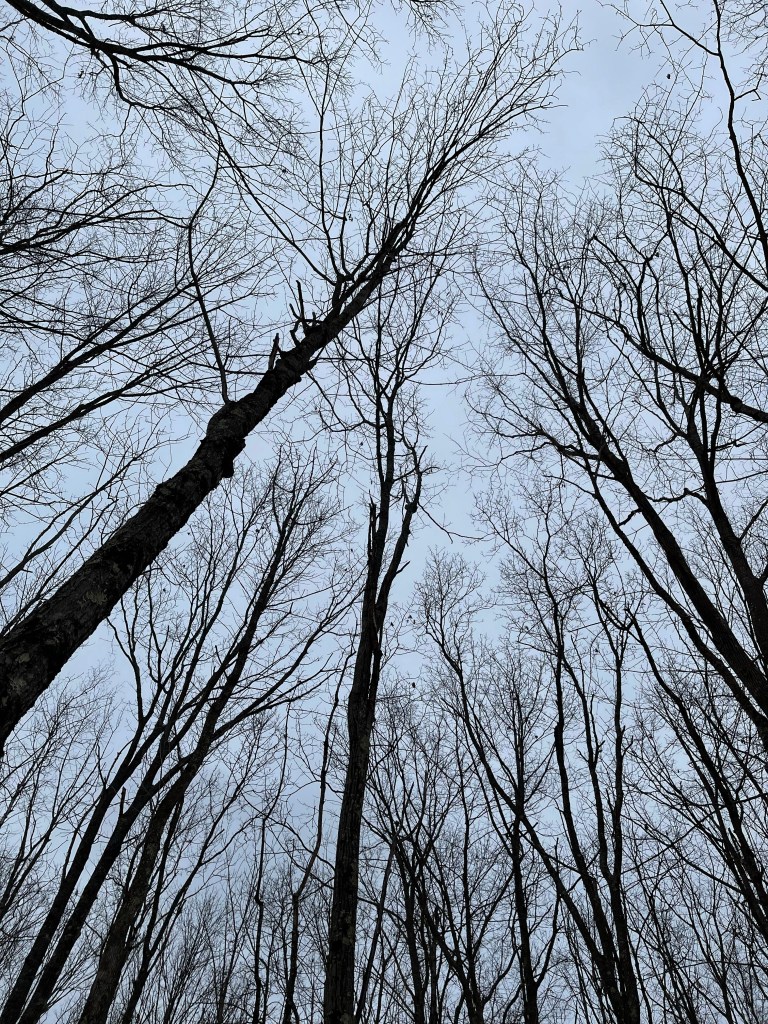
    The woods were quiet save for the steady clump, swish, click of this clydesdale making his way through the fields and woods on snowshoes. The snow had transformed from powdery bliss Sunday to snowball clingy in the warm sun. In New England you work with whatever Mother Nature gives you, and a lunch walk on a warmish day brought isolation from humanity and companionship from thousands of naked old friends biding their time to bud in Spring.

    Steadily I make my way through the forest to revisit favorite spots. I have memories of who I once was in certain places, for the trail whispers. Why do we settle on the familiar so often, when the world offers so much to discover? The trick when walking in familiar woods is to look for the different. The most obvious tell was the snow itself, tracks and consistency completely transformed in a few days, and it will be again on every visit.

    Autumn leaves lay scattered near a dug-up clump of snow. Deer tracks? No… Canine. The tracks and leaves tell the rest of the story. I realize I’m telling my own story with every step. I wonder who might read it? The trees stand stoic and unmoved.

    I climb up a small rise on virgin snow. Something catches my eye and I walk closer for a look. Someone built a lean-to between two oak trees, with netting and fallen tree branches making up the roof. This wasn’t new, just unnoticed on prior walks. They’d wanted it that way, of course, building it up away from the trail. I wondered at the builder for a moment, and left the mystery unsolved. The world is full of questions, I don’t feel compelled to answer every one of them.

    Turning back, I recalled this line of poetry from Mary Oliver about tree branches waving in the breeze. We know this song, the woods and I. Looking around one last time I look for an excuse to linger. They stand in cold indifference and show me the way home.

    Biding their time
  • A Moment With Snow

    Aren’t there moments
    that are better than knowing something,
    and sweeter? Snow was falling,
    so much like stars
    filling the dark trees
    that one could easily imagine
    its reason for being was nothing more
    than prettiness.

    — Mary Oliver, Snowy Night

    I know I have some readers in other parts of the world where snow is a distant memory or an impossibility. You might wonder why we carry on so much about the stuff, and it’s hard to nail down the reasons for the delight when we finally get snow again. While most of us have a love/hate relationship with it for all the joy and misery it brings, I think of it as an old friend that’s been gone too long.

    Oliver’s quote is from a magical poem about encountering an owl on a snowy night. I quote Oliver poems perhaps more than I should in this blog, but I believe in mixing wonder into our lives. Oliver had a keen eye for the stuff, and jumbled her words just so to share it with you and me and generations who we haven’t imagined yet. That’s magic in itself, isn’t it?

    You develop a nose for snow, and sense when it’s coming. You prepare for it as best you can, doing the yard work you put off way longer than you should have, move the shovels into a more convenient place, and the snowblower too if you have one. And then you wait for the first flakes to begin drifting from the sky, probing the land like a pilot probing a channel. Soon the rest follow and the world transforms before your eyes. Snow brings new perspective on a place you’ve come to see a certain way. Like a poem, really, that’s dropped on you at just the right moment.