“I believe it is important that this country sail and not lie still in the harbor.” — John F Kennedy
When I was a kid, Hyannis, Massachusetts was the place we’d go to walk Main Street and buy some candy. When I got a little older it was the place to hang out with college friends or to catch a ferry to Nantucket. Hyannis isn’t quaint or quintessential Cape Cod, it’s a bustling village in the town of Barnstable. I practice active-avoidance here the way locals avoid tourist traps anywhere in the world. But I’m not a local, just way too familiar with the place.
And yet I’d never visited the John F Kennedy Memorial. It’s a quietly-dignified and understated nod to the President who once sailed in the harbor this memorial overlooks. Finding myself with a little time to spare, I fell back on my old habit of seeking out the most interesting and often overlooked places wherever I was at the moment. And this moment brought me to Hyannis.
I remember having a glimpse of the entrance to the Kennedy Compound from the back of a station wagon as a kid, but to me that’s like watching the Lifestyles of the Rich and Famous. That’s not for me. Far more interesting is an offseason visit to a quiet memorial to honor the brief, brilliant flame that was JFK.
The memorial features a fieldstone wall with a placard of JFK. Appropriately, it faces the harbor. There’s a fountain with the quote noted above engraved around it. In the offseason it’s simply a drained pool. I’m sure in summer it’s lively and impressive. But for my purposes, its stillness was appropriate for the somber occasion for the memorial. While it celebrates the life of the man, it also reminds us of all that we missed when he was assassinated that day in Dallas in 1963.
These summer clouds she sets for sail, The sun is her masthead light, She tows the moon like a pinnace frail Where her phosphor wake churns bright. Now hid, now looming clear, On the face of the dangerous blue The star fleets tack and wheel and veer, But on, but on does the old earth steer As if her port she knew. — William Vaughn Moody, Gloucester Moors
We know when we are in the midst of something extraordinary. Anticipation creeps up on us as the minutes pass by, awaiting our participation. Awareness floods in as the magic unfolds. Joy and gratitude edge in, provoking other emotions. There comes a time when we must simply put away the camera, stop searching for just the right word or phrase, and simply be a part of all that is happening around us.
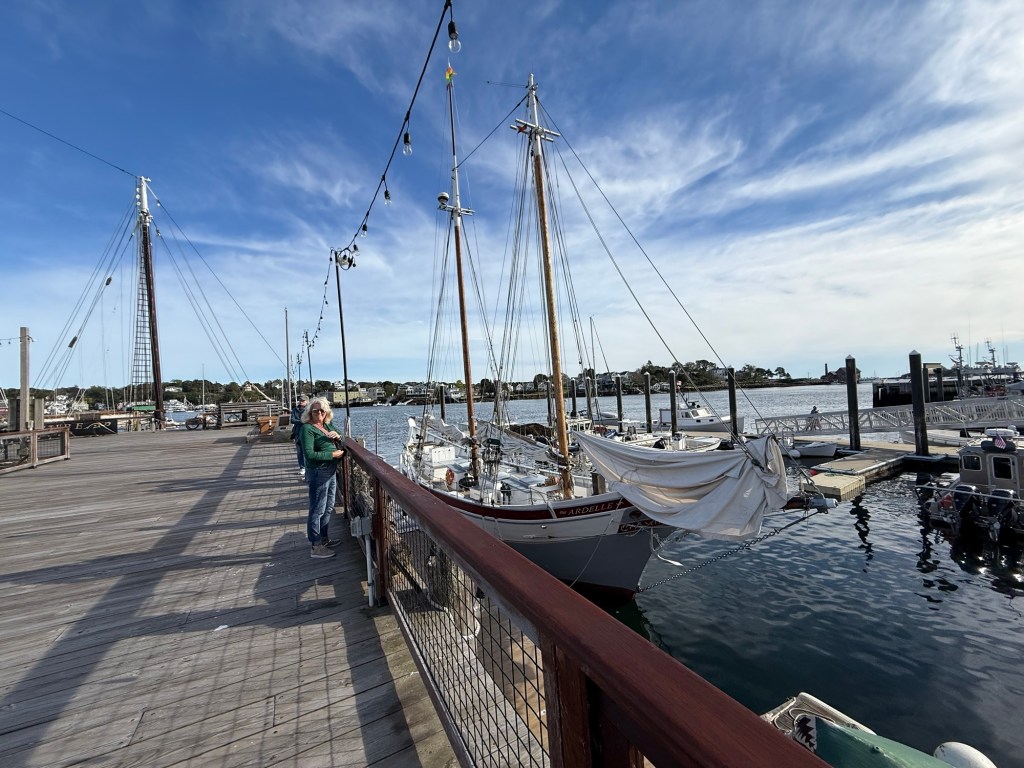
Gloucester, Massachusetts has a long history with the sea. Its famous harbor has long welcomed home fisherman and sailors from passages as far and wide as the ocean’s reach. One feels the history sailing in this harbor, and you play some small part in the play for having been here at all. The fleets of old are mostly all gone now, ghosts of what once was. But there are a few holdouts, and newcomers built in the traditional way, to offer some hint of what it was like long ago.
Harold Burnham has built several schooners in the traditional fashion. For a couple of centuries the Burnham’s have built ships in Essex, Massachusetts. Two of his schooners are harbored in nearby Gloucester, and Harold himself captains sunset cruises. You simply have to put yourself in the way of beauty and sign up to participate. And if you’re especially fortunate, you may join on a night of Celtic music to offer a proper soundtrack for a September night when the clouds are just so to harness a bit of heavenly magic.
Maritime Heritage Charters offers many opportunities to learn and experience a few hours on a schooner sailing in Gloucester Harbor. One not to miss is the Celtic Music Sunset Sail with Michael O’Leary & Friends cruise, when traditional music and song fill the heart and soul as you slip past history and witness the divine dance of fading light. The experience is one that will stay with you forever.
“People think being alone makes you lonely, but I don’t think that’s true. Being surrounded by the wrong people is the loneliest thing in the world.” ― Kim Culbertson, The Liberation of Max McTrue
I live in a small town with no traffic lights in New Hampshire that snugs up against Massachusetts. I’ve been here for three decades now and for the life of me I know I’ll never feel like a local despite knowing many of them, watching our children grow up together and watching some of those children begin to have children. How can one spend more than half their years in a town and still feel they’re an outsider?
I’ve been plotting my escape from this town for years, but then I keep running into people with a shared history and find the conversation pleasant. I stood out in the semi-frozen front yard raking up acorns and wore out my arm waving to neighbors driving past on their way back from Sunday activities. I recognize the patterns of the season in this town, from how the stars align against the hillsides to where the deer go to hide from all the hunters. There’s a rhythm to familiarity that we may wear like a warm coat.
Life is what we make of it. Where we live, what we do for work, and how much time we spend with people who don’t see the world the way we do is often up to us. We are the light in someone’s day when we encounter them, or we’re a reminder to them that they’ve got to get out of this place. The world largely reflects back what we project out to it. The last few years I’ve projected that I’d rather be somewhere else than this small town. Who can blame the town for feeling the same about me?
The thing is, we ought to be building our lives towards something, not recoiling from something. It’s a subtle difference, but the latter has us on our heels, the former has us charging ahead. One is regression, one is progression. Don’t we all want to feel like we’re making progress in our lives? When the world seems to be shrinking from us, it’s usually a reflection of our own stance with it. We must lean into our future, wherever we want it to take us. Just be sure to give a wave and a smile to the neighbors, they look like they’re going through some things too.
I thought about my car crash and my close call I started getting sentimental I said, I love this house, I love you guys I even love my rusty old car outside And I’m so happy to be alive with you Let’s do all the things we always said that we would do ‘Cause it’s a great day It’s a great day It’s a great day It’s a great day And it’s a great day to not be dead — Don White, Great Day
“The Bull Run has been a Tavern for centuries and was the first stop on the Boston-to-Albany Stagecoach route in the 1800s.” — History of the Bull Run Restaurant
Mounted to the fireplace near the bar of The Bull Run is the head of a creature they call the egopantis. When you see it, you’ll never really forget it, mostly because your first and last reaction when seeing it is, “What the hell is that thing?” Could it be a bear or a buffalo with a distinctive facial birth defect? Or someone’s art project made eternal? The tall tales told by the establishment are enjoyable but only lead to more questions. The only certainty as we navigate fact and fiction in this complicated world is that most answers are a load of bull. So we’d clearly come to the right place.
That we go through our lives with so few opportunities to see good friends over good food and fun live music is unfortunate. Life really should be a celebration; a forever birthday to mark the miracle of our dance through this time and place together. Life really is what we make of it. So we made our way to the quiet town of Shirley, Massachusetts for a night of live music with the beautiful comedic soul Don White. And we found some magic. Not just a strange bit of taxidermy on the wall magic, but the kind of magic that happens when you gather around a table with some of your favorite people in the world to enjoy some live music. We all remember the worst days of the pandemic when we’d wish for such moments to come back again. Here we are.
A place as old as The Bull Run has seen a lot of characters come through its doors. A night out with Don White, the edopantis and thee was another layer on the life experience cake. We were simply the latest weary world travelers who stopped in for the night. We may not be able to get a room at the inn like we might have once upon a time, but we can surely have a memorable evening. Memories are what stay with us, after all, so let’s do all the things we always said that we would do. We are history makers one and all.
There are different ways to walk a beach. Some walks are meditative, some are merely workouts, and some are clearly meant for people-watching. The reasons why we walk lead us eventually to where and when. Each beach offers a new lens through which we may see the world and ourselves.
My bride is a beach bunny at heart, and it turns out our pup is too. We’ve been taking her to a local New Hampshire beach for long walks and she’s grown more courageous with each bold step. She’s no water dog and won’t plunge in like our Labrador retriever would, but she’ll delightfully chase waves and bite at the sea foam. Her joy is ours, and walks on the beach have become a more frequent way of getting her away from the permanent mud season of never-winter-as-it-once-was that is our new reality.
If Hampton Beach is a long, flat walk on firm sand, Plum Island Beach offers an experience more like Cape Cod National Seashore: soft dune sand plunging steeply in places to the ocean breakers. The dunes aren’t nearly as tall as Cape Cod, but the walk can be just as wonderful. On one end is the turbulent mouth of the Merrimack River, on the other are the dunes and swirling sandbars of Plum Island State Park reaching out into Ipswich Bay. In between are rows of homes ranging from beach shacks to McMansion: beach edition luxury homes. As with everywhere exclusive, money determines the future state of the real estate here. But Mother Nature has a say too.
Plum Island is not an easy place to walk nor an easy place to live compared to other beaches in the area. Just as wealthy homeowners in the Hamptons on Long Island struggle with beach erosion and the fickle protectiveness of sand dunes, the people who dare to build homes on Plum Island face the same challenges. One day you’re living in paradise, the next you’re living through a nightmare of storm surge and wave action. It’s an audacious act to live in such places, emphasized with insurance rates that discourage the casual investor. It takes disposable income to have such homes in such places as this.
Plum Island State Park prohibits dogs, so a walk to the end with the pup was out of the question, but there was plenty of beach available for our power trio. Walking towards the Merrimack River, we met a couple walking three dogs of their own. As soon as they said their dog’s name I knew it was a locally-famous author but kept it to myself. We all seek out the beach for our own reasons, and often it’s to get away from who we are further inland. We had a small reunion on the return and went our separate ways.
Every beach has its own story to tell, just as each beach walker does. I wonder sometimes why we aren’t walking more beaches, and promised myself to add beaches to the collection of mountain summits, waterfalls and historic sites I’m collecting on my life experience list. The time bucket for such activity is now, isn’t it? We must venture out while we’re blessed with good health and a desire to do something with it. Perhaps we’ll see you out there too?
Kenoza! O’er no sweeter lake Shall morning break, or moon-cloud sail, No lighter wave than thine shall take The sunset’s golden veil. — John Greenleaf Whittier, Kenoza
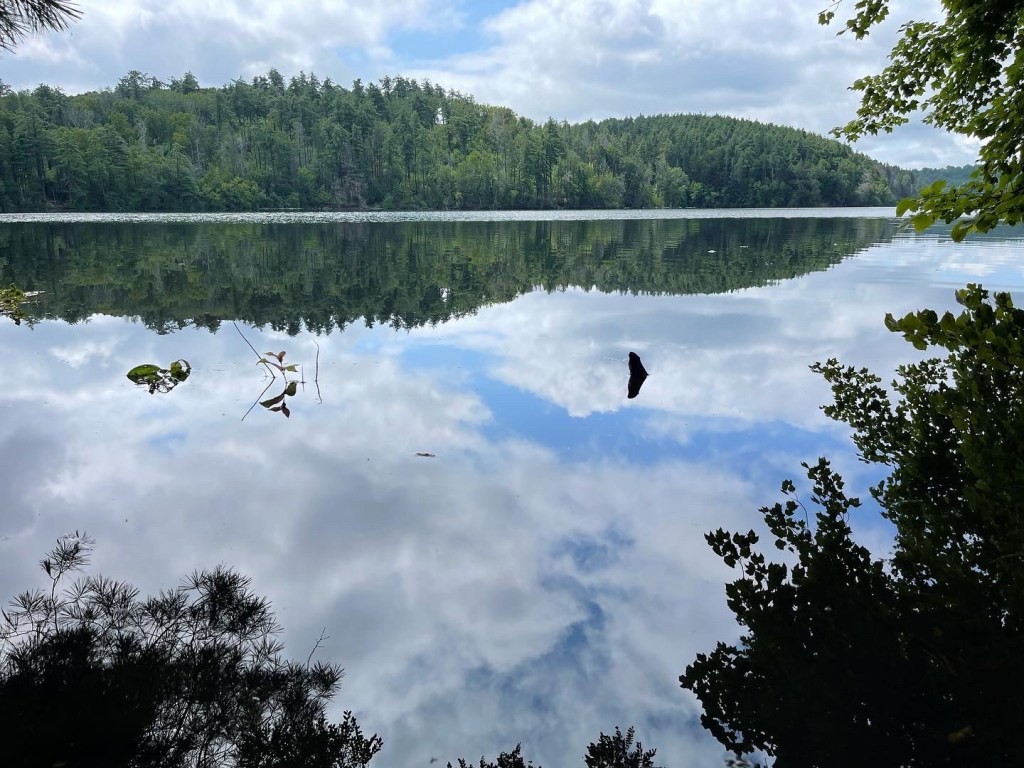
Whittier wrote this poem for the dedication for a beautiful lake in Haverhill, Massachusetts that was to be named Kenoza Lake. Kenoza means “lake of the pickerel” in the native Algonquian language, and in 1859 the locals formalized the name. There is irony in Native American place names living on when the people who’s language was being used for those names were swept away, but that’s everywhere in the world. The names always betray the past if you dig deeply enough.
Whittier was an abolitionist, and likely saw the plight of the Native Americans who once lived here with a sympathetic eye. He once lived just a couple of miles away from Kenoza Lake in a quiet farmhouse. His farm looks very much the same today as it did then. Importantly, Kenoza itself also remains pristine, today a protected reservoir that supplies drinking water to the City of Haverhill. That lends a timelessness to the lake and surrounding land that’s impossible not to feel as you walk the grounds.
The land has transformed over time. It was once deep forest, became farmland (like so much of America in colonial times) and eventually returned to forest again. That the land wasn’t developed required some luck. Dr. James R. Nichols, a wealthy scientist who made his fortune developing chemical fertilizers, acquired the farmland and set about building a castle for himself on top of a hill with views of three states. He called the place “Winnekenni”, which means “very beautiful” in Algonquian. Walking the property, today maintained by the City of Haverhill as parkland and a natural buffer for the reservoir, feels like you’ve been transported back to another time.
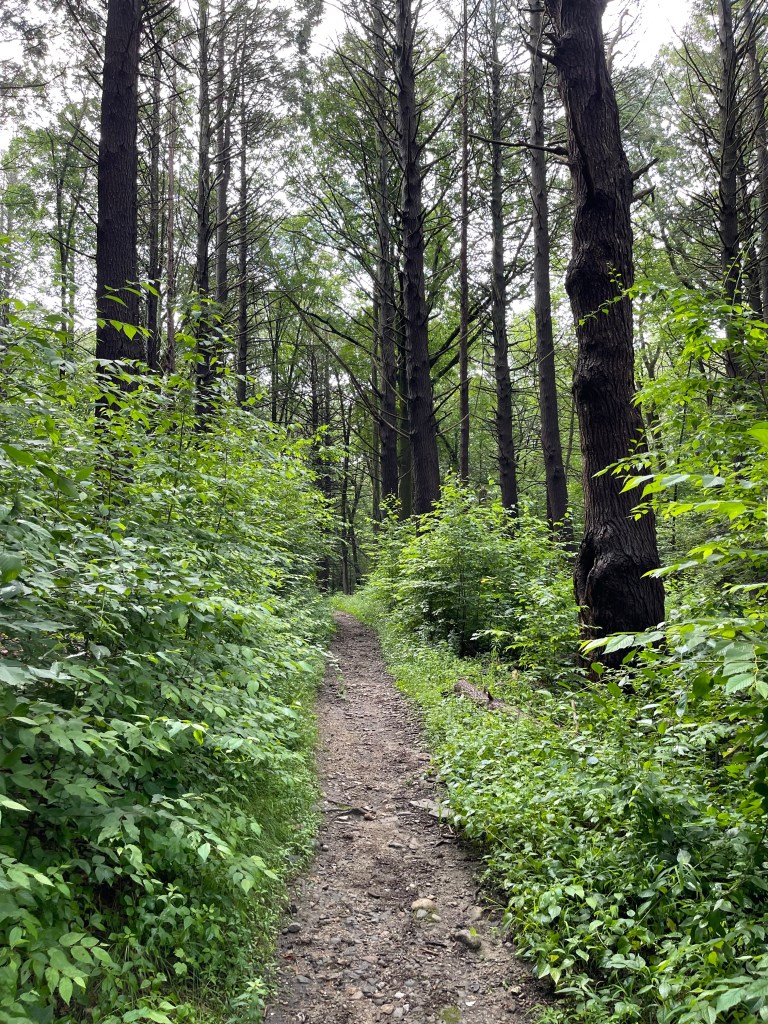
There is a network of trails throughout the the park, and you can manage a great step count by doing the entire loop around the lake. They range from gravel roads to single track paths squeezed on both sides by abundant undergrowth(including, alas, poison ivy). The trails are well-marked and it’s very difficult to get lost, as you always have the lake to show you your progress. We encountered plenty of walkers, horseback riders and mountain bikers on the trek around the lake, but never felt it was overcrowded. Indeed, on the single track we saw only one other person, a trail runner who quickly distanced himself from us.
Reservoirs, like graveyards, are time machines back to the days they were established. The lay of the land remains largely as it was then, and offers an opportunity to hear the whispers of history. It’s relatively easy to imagine how this place looked for Dr. Nichols or John Greenleaf Whittier because it’s largely that same place today: timeless, and beautiful.
Kenoza LakeWinnekenni CastleThe lake is almost always in viewLocal resident Very large Bondarzewiaceae fungi enjoying the wet summerSingle track trailOne of several memorials in the park
Duxbury, Massachusetts doesn’t have the same notoriety as its neighbor Plymouth, but the roots of history run nearly as deep here. To be fair, if people think of Duxbury at all, it’s usually as an upper class suburb of Boston. There’s plenty of wealth on display in this town. But step away from the massive homes with their perfectly manicured gardens and you’ll find a legacy that reaches back to the Mayflower. The most famous character on the Mayflower, Myles Standish, lived and died in Duxbury, and is buried in what is now known as the Myles Standish Burying Ground.
The burying ground was once adjacent to a meeting house, long gone, but marked with granite stones to indicate where it once stood. It is the oldest continuously maintained graveyard in the United States. The lay of the land is largely the same within the enclosure. The thing about graveyards is you’re walking on ground largely unchanged since the days when the people buried there were laid to rest. The entire area around a graveyard becomes housing developments and strip malls and paved roads, but these small graveyards are a time machine back to another time.
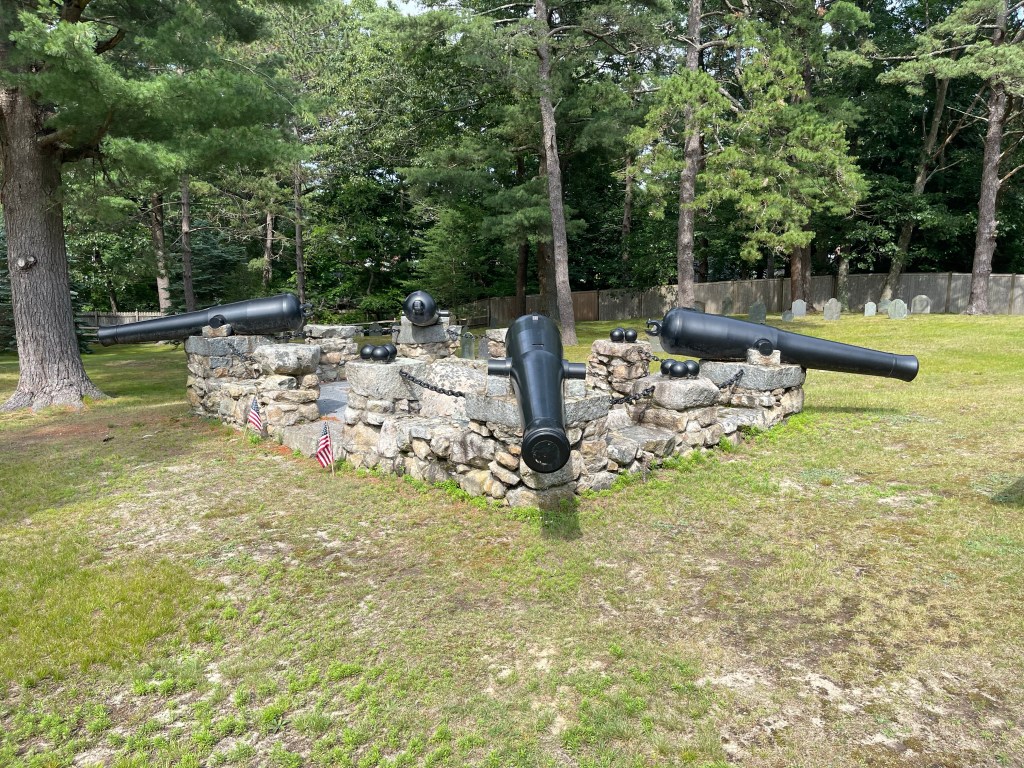
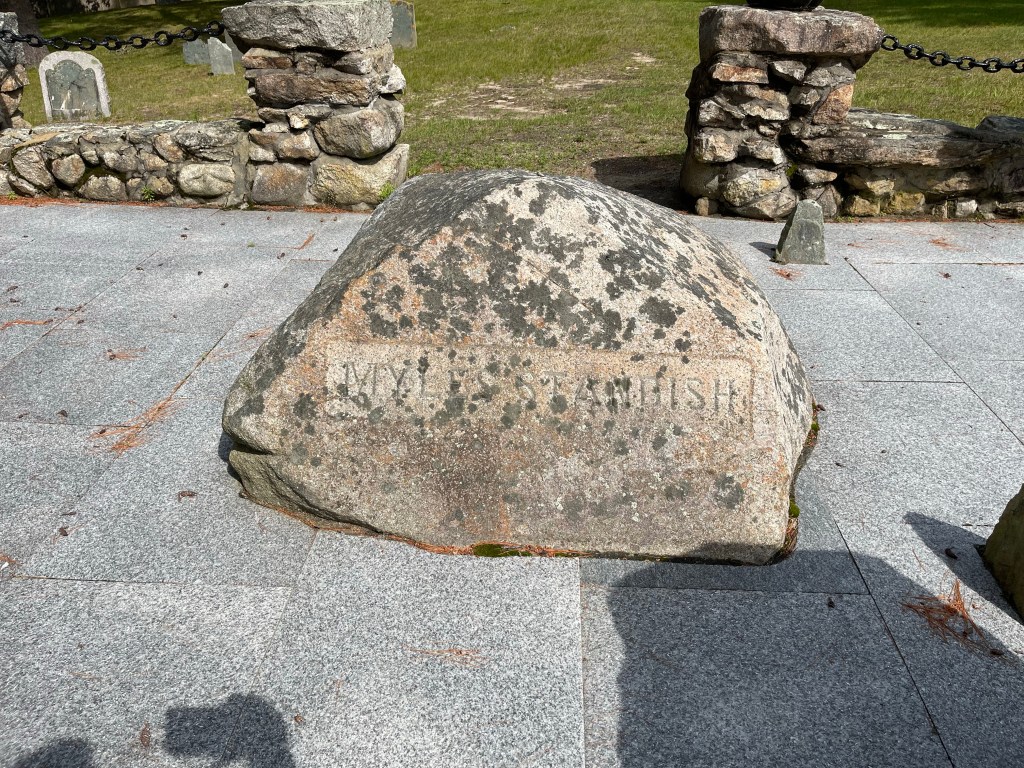
Captain Jonathan Alden, son of Mayflower passengers John and Priscilla Alden, is also buried in this graveyard, and his is the oldest gravestone in the burying ground. Standish, who died well before Alden, likely had small pyramid-shaped stones marking his interment initially, and the monument built around the spot in 1893 (you can see one of these stones behind the boulder engraved with Myles Standish’s name in the picture below). That engraved boulder, like Plymouth Rock, is something for the tourists. The monument itself, with a fieldstone wall surrounding it and four cannon mounted on each corner, projects the violent boldness of the man interred beneath.
Myles Standish was a military advisor to the Pilgrims. By all accounts he was brutal and decisive in his actions. He would preemptively attack when he heard trouble was brewing, and famously stuck the head of one rival, Wituwamat, on a pike as a deterrent to others. There seems to be no doubt that Wituwamat was lured into a room and murdered. Was this act of brutality something to be celebrated or scorned? Was there a legitimate threat to the Pilgrims, and could it have been resolved in a more diplomatic way? What’s clear is Standish believed he was fighting for the lives of the colonists, and used any method he could to intimidate those who he believed were threats to their safety. As with all history, we judge it from the comfort of distance.
At another spot in town, on a point of land jutting out into Kingston Harbor, there are four more granite stones laid out in a park amongst multi-million dollar homes overlooking the harbor. It was here that Myles Standish actually lived. I found this interesting, as a military man like Standish would normally seek the high ground. A review of a Google map later revealed a small pond nearby that would have been his source of fresh water. Perhaps Myles dined regularly on Duxbury oysters, which have become almost as famous as the town’s most notable resident.
“It is nothing to die. It is frightful not to live.” ― Victor Hugo, Les Misérables
And now the end is here And so I face that final curtain My friend I’ll make it clear I’ll state my case, of which I’m certain I’ve lived a life that’s full I traveled each and every highway And more, much more I did it, I did it my way — Frank Sinatra, My Way
At a holiday party not very far from Times Square, New York, a few of us found ourselves in conversation with a large man with a large ego. He was rattling off his successes in life, his conquests in love, his options for the future. He would be the one singing My Way and believing it all applied to him. And maybe it does.
I happen to love Sinatra’s song, My Way. We used to put it on the juke box at the Worthen in Lowell, Massachusetts late in the night (back when they had a juke box) and serenade each other in youthful optimism. We believed we were already living life our way and were poised to launch ourselves into life to do big My Way things. Life teaches you compromise and concession and sometimes knocks you down a peg or two. When things inevitably go awry, does this mean we aren’t living a full life?
To live a life that’s full means to steer purposefully towards the dreams that stir our soul while adjusting our course and the set of our sails as life reminds us that we don’t live in a controlled environment. Highs and lows and the occasional nasty storm are going to have their way with us, stall our progress, pull us well off course now and then, and generally take that My Way bravado and throw it out the window. But still we may persist.
The question to ask ourselves every day on our journey to live a life that’s full is, full of what? To be meaningful, our lives must be filled with purpose and progression, contribution and growth. We grow into a full life, not by traveling a straight line from here to there, but by navigating the hazards of living. Sometimes we choose wisely, and sometimes we find ourselves on the rocks. It is nothing to die, but surely it’s frightful not to live. The only viable choice is to patch ourselves up as best we can and keep going.
But going where? That which seemed so very important in one stage of life seems less so later. Conversely, things we once never considered seem more important now. Life is change and adaptation. If status and a list of conquests are especially important to one person, for another it might be achieving mastery of playing an instrument or in writing. It may simply mean being there for others from now until the end.
Sometimes, we have some say in the matter. Mostly, our lives are ours alone to live, yet we aren’t living solely for ourselves. Nobody said it would be easy, friend. But with reflection and purpose we might just find we live our days well enough that we can say with relative confidence and more than a little irony that we did indeed, despite it all, do it our way. That shouldn’t be frightening but, just maybe, a little thrilling.
A visit to Walden Pond can be immersive, if you go at the right time. Many people go in summer to swim and enjoy the pristine water. Many fish for large mouth bass and other prizes. But the pilgrims go to visit Henry David Thoreau’s famous pond and the woods surrounding it. I’ve watched the place change over the years, but the pond and woods remain largely as Thoreau would recognize.
You must treat a brief visit to Walden as you would a visit to a nightclub with a cover charge. There’s a flat fee of $30 USD to park. That applies for an hour or the entire day. There’s a lower fee, apparently, for Massachusetts residents. I suppose you can also opt for other ways to get to Walden Pond, but this was the simplest way to spend time at a place. The area surrounding Walden Pond is a mix of highway, commuter railroad (as it was in Thoreau’s time), capped landfill and houses increasingly further out of reach for someone choosing the lifestyle of the person who made this place famous.
Early December is considered late autumn, but my visit felt more mid-autumn, with temperatures warmer than they should be this time of year. Henry David Thoreau would have shaken his head, I think, at some of the same behavior he observed in his day leading to the climate change we’re experiencing today but generally sitting on our hands about. But it made for a lovely day to walk around the pond.
There is a well-defined path around the pond. It’s maintained and easy for most walkers to navigate. They make you feel like you’re in a cattle chute for much of it, with wire strung on each side of the path to keep wanderers from straying off the path. Signage explains this as erosion control measures. As a hiker of the White Mountains in New Hampshire, I’m all too familiar with the impact of popularity on trails and the surrounding landscape. I stay to the path, liberated from the freedom to wander, I instead focused on the environment around me.
You can hear the world encroach on you at Walden. Distant highway sounds, construction, sirens, airplanes flying overhead and the commuter train all remind you that you’re in a suburb of Boston. It’s best to acknowledge this, but let it go as Thoreau let the train go as it went past in his time. The landscape is largely preserved, the water clear, awaiting those who would linger.
When I was younger, there was no visitor center, but there was a bath house. At some point well before I came into this world some well-meaning people decided that the best way to save Walden Pond was to make it a recreation center. So a bath house was built, beach sand extended and you had a destination for family recreation. Thoreau’s cabin is on the opposite shore from the bath house, but it’s the first thing you see when you walk down the visitor parking lot. You’re either at peace with it or not, but it’s relatively benign in the off-season.
Walden Woods extend well beyond the perimeter of the pond, and we can thank people like Don Henley for their commitment to preservation. Generations of developers find a way to squeeze as much money as they can from resources, and there are plenty of people who would turn the place inside out and up. There’s a place for development in this world, but there ought to be a place for preservation too.
I’d brought a water bottle with me on the walk, warm day that it was, and decided in a moment of inspiration to fill it with water from Walden Pond. Thoreau drank straight from the pond in his day, I’m not inclined to do that without a filter. Instead, I brought the water with me for another pilgrimage. Just across that highway is the center of Concord, where Thoreau and Ralph Waldo Emerson lived. Just beyond the center is the Sleepy Hollow Cemetery, site of Author’s Ridge, where Thoreau, Emerson, Alcott and others are buried. I stopped for a brief visit on Author’s Ridge, told of my visit to his old cabin site, and poured Henry a sip of Walden Pond. Cheers Henry.
Walden PondA view of the pond just down the hill from Thoreau’s cabin site. This is similar to the view he would have had.Pile of stones next to the cabin site. I’m not loving it, but cairns are how people seem to express themselves. The site to me feels like a construction site, cleared and ready to build.The cabin site is surrounded by granite pillars to denote the position and size of the cabin.Creative cairn art rising out of Walden Pond.
So through the night rode Paul Revere; And so through the night went his cry of alarm To every Middlesex village and farm,— A cry of defiance, and not of fear, A voice in the darkness, a knock at the door, And a word that shall echo forevermore! For, borne on the night-wind of the Past, Through all our history, to the last, In the hour of darkness and peril and need, The people will waken and listen to hear The hurrying hoof-beats of that steed, And the midnight message of Paul Revere. — Henry Wadsworth Longfellow, Paul Revere’s Ride
Most every schoolchild in America learns the story of Paul Revere, who rode out to warn of the British march on Lexington and Concord on the eve of the American Revolutionary War. What you never hear about is that Revere was captured by the British on his ride between Lexington and Concord, never warning the latter town, but that one of his counterparts on that night escaped capture and completed the job.
Paul Revere and William Dawes both set out to warn colonists about the British march to Lexington and Concord, taking different routes to Lexington. They reunited in Lexington and set off together to warn the residents of Concord of the British Regulars’ imminent march. During their ride, they came across Dr. Samuel Prescott, who’d been out courting a woman named Lydia Mulliken. That chance encounter would prove fortuitous for the colonists.
Prescott decided to join Revere and Dawes to help warn the residents of Concord. During their ride, they were stopped by a British patrol, who attempted to take them prisoner. Revere was captured, Dawes was able to flee back towards Boston, and Prescott, who knew the area well, evaded capture and was thus able to complete the ride to Concord, where he warned his fellow colonists.
“We set off for Concord, and were overtaken by a young gentleman named Prescot, who belonged to Concord, and was going home. When we had got about half way from Lexington to Concord, the other two stopped at a house to awake the men, I kept along. When I had got about 200 yards ahead of them, I saw two officers as before. I called to my company to come up, saying here was two of them, (for I had told them what Mr. Devens told me, and of my being stopped). In an instant I saw four of them, who rode up to me with their pistols in their bands, said ”G—d d—n you, stop. If you go an inch further, you are a dead man.” Immediately Mr. Prescot came up. We attempted to get through them, but they kept before us, and swore if we did not turn in to that pasture, they would blow our brains out, (they had placed themselves opposite to a pair of bars, and had taken the bars down). They forced us in. When we had got in, Mr. Prescot said ”Put on!” He took to the left, I to the right towards a wood at the bottom of the pasture, intending, when I gained that, to jump my horse and run afoot. Just as I reached it, out started six officers, seized my bridle, put their pistols to my breast, ordered me to dismount, which I did. One of them, who appeared to have the command there, and much of a gentleman, asked me where I came from; I told him. He asked what time I left. I told him, he seemed surprised, said ”Sir, may I crave your name?” I answered ”My name is Revere. ”What” said he, ”Paul Revere”? I answered ”Yes.” The others abused much; but he told me not to be afraid, no one should hurt me.” — Letter from Paul Revere to Jeremy Belknap, circa 1798
Longfellow’s poem made Paul Revere rightfully famous, but he did a disservice to Dawes and Prescott. Early on the morning of 19 April 1775, it would take all of them to finish the job. It’s funny that Paul Revere’s own accounting of the night receives less attention than Longfellow’s romanticized tale. But that’s history for you, we remember it as it is told, not always as it was.
Site of Revere’s capture with the modern road beyondAutumn foliage along the route