Tag: Merrimack River

  • The Merrimack River Frontier

    Yesterday I dove deep into the Cape Cod section of John Seller’s Mapp of New England.  Today I’m looking at another fascinating section – the border between “civilization” and the “wilderness’.  I’ve written before about place names like World’s End Pond in Salem, New Hampshire.  Nothing hammers that home like seeing a map from 1675 showing the Merrimack River towns of Haverhill (“Haveril“), Billerica and Chelmsford (“Chensford“) Massachusetts as the frontier towns they were at the time.  North of the Merrimack River is wilderness in this map, South are the growing settlements of Massachusetts.  The river serves a critical role for settlers and Native Americans alike as both transportation and a border.  Settlements at this time were largely along the rivers and their tributaries, the Concord and Nashua Rivers.

    That bend in the Merrimack River northward was a critical point in the understanding of this land.  Isolated outposts like Billerica, Groton and Lancaster represented the outer reaches of people like us.  The map shows Lake Winnipesaukee and its many islands, so there was clearly knowledge in 1675 of what lay beyond, but it remained for all intents and purposes a vast, dangerous wilderness for another century until the fortunes of war, attrition in the Native American population and the shear mass of settlers from Europe turned the tide.
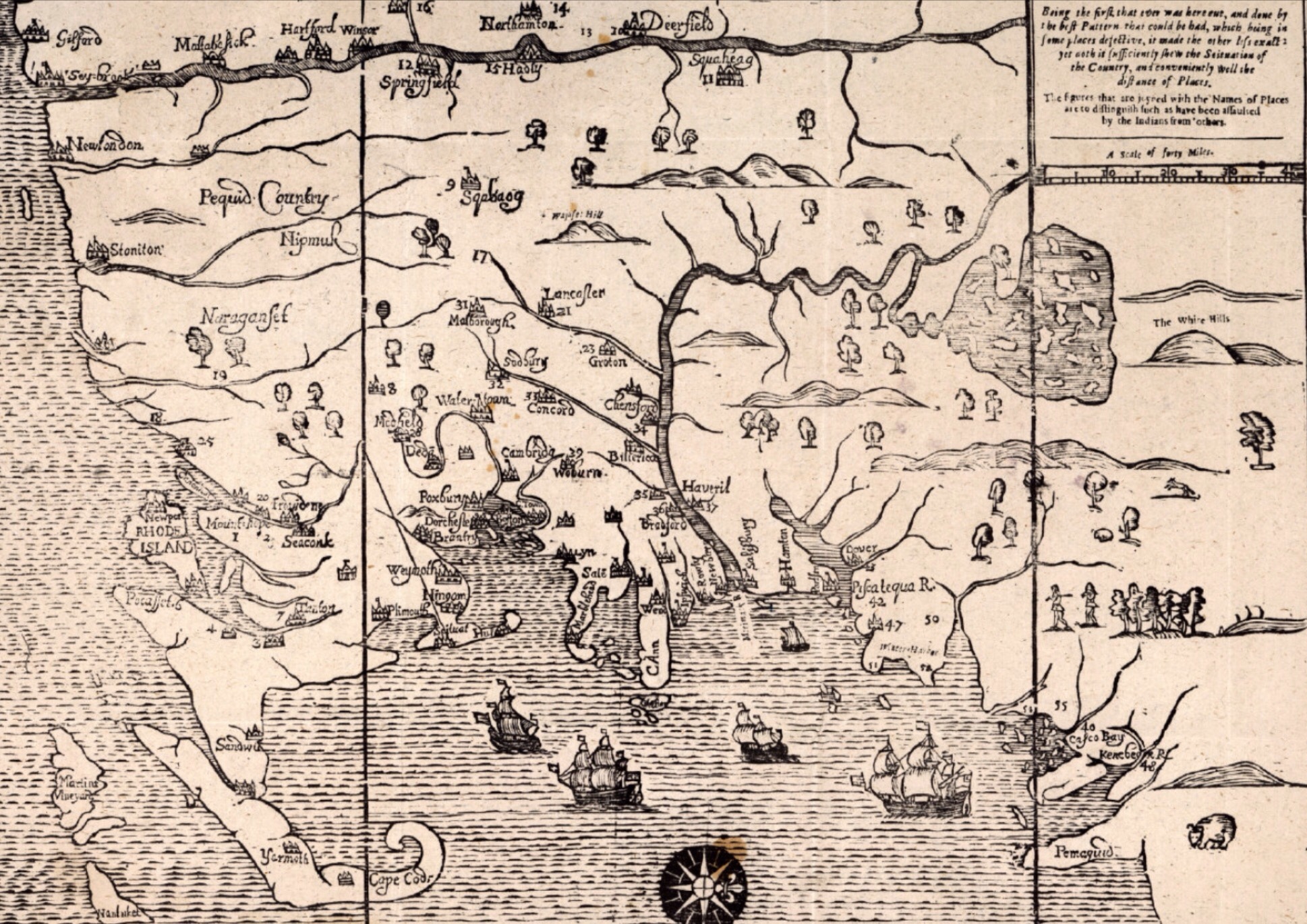
    It’s no surprise that the most notable Indian raids of the day were happening along the frontier.  York, Haverhill, Andover, Billerica, Chelmsford, and Groton all suffered Indian raids during the series of wars between the French and British.  Further west Brookfield and Deerfield had similar raids.  These frontier towns were dangerous places, and the settlers there would rarely venture out to tend their fields unarmed.  Towns like Haverhill were building fortifications and the brick 1697 Dustin Garrison for a measure of protection in the years spanning King Williams War and Queen Anne’s War.

    There were a series of conflicts between the English settlers and the Native American population that impacted northern New England.  In all cases the underlying conflict between the expansion of English settlements and the encroachment on the Native American population was a key factor.  French influence on the Native American tribes also contributed significantly in many of the raids in Merrimack River Valley from 1689 to 1713 as raiders were offered rewards for scalps and prisoners.  Living in this area for most of my life I see many reminders of that time in our history, and I always glance over at World’s End Pond and the Duston Garrison whenever I pass either.  Duston’s wife Hannah was famously kidnapped during King William’s War, her baby and many neighbors killed, marched through the town I live in by Abenaki warriors, and later escaped back down the Merrimack River on one of those raids.

    Wars Impacting Northern New England in the Early Colonial Period:

    • King Philip’s War 1675-1678 (Northeast Coast Campaign vs. Wabanaki Confederacy)
    • King William’s War 1689 – 1697 (French and Wabanaki Confederacy)
    • Queen Anne’s War 1702–1713 (French and Wabanaki Confederacy)
    • Dummer’s War 1722-1726 (Wabanaki Confederacy)
    • French and Indian War 1754 – 1763 (French and Mohican, Abenaki, Iroquois and other tribal alliances)

    So Seller’s Mapp of New England was a living, breathing document that was strategically important to the British and by extension the English settlers living in New England.  If matters were largely settled with the Native American population in the Southern New England areas by 1675, they were anything but settled in Northern New England.  Northern Massachusetts, including what is now coastal Maine and New Hampshire were the literally on edge, looking north and west for raiders.  That they would ultimately overpower the Native American population and New France settlements was not a foregone conclusion at the time.  Another reason it completely fascinates me.

  • Up the River

    Up the River

    Reading the history of Henry Hudson, James Cook and other explorers who were looking for the Northwest Passage across North America, I marvel at the logistics of sailing square-rigged ships up rivers like the Hudson River or the St. Lawrence Seaway.  Sailing in narrow corridors with strong currents, questionable winds with the trees and cliffs lining the shores, and no charts to help navigate with, it’s an incredible display of sailing acumen.  I’m in awe that they could do it.

    I’ve sailed up a couple of rivers, most notably the Merrimack River and the Essex River.  In each case I was in a sloop-rigged boat of about 36 feet.  We knew where the channel was, and we had a diesel engine to fall back on should we need it.  That’s a far cry from the Halve Maen (Half Moon in English), Henry Hudson’s ship, which was a square-rigged and 85 feet long.  Hudson sailed up the river that bears his name in September of 1609 with a crew of about 20 men.  They sailed as far as present day Albany before turning around.  Albany would become a hub of trade with the interior over the next 100 years and the river would become well known, but Hudson was essentially sailing with one hand tied behind his back.

    The Basque were exploring North America before Hudson made his voyage into the interior.  I’ve documented previously the adventures of one soul who made it all the way to Rochester, New York before he perished.  The French were also actively exploring the interior, and of course the Spanish were focused on areas farther south on the continent.  All of them exhibited exceptional courage and skill in navigating these waters.  As a casual and occasional weekend sailor I’m deeply impressed with what they were able to accomplish.  Lost to history of course are the many who failed to make it home from these voyages.

  • Warmer Winters

    We happen to be having a relatively mild winter this year.  Last year was a different story.  Next year may be the coldest ever recorded for all I know.  But on the whole the trend seems to be towards warmer winters.  I read once about the early settlers in the New England region ice skating on the Merrimack River from Newburyport up to Haverhill.  The river in the stretch is tidal and brackish water.  It’s hard for me to comprehend a winter, or a series of winters, when this stretch of river would freeze enough to safely skate.  But then, our winters are different now than they once were.

    I’ve contemplated the impact of obliquity on the winters over the last 300 years.  If settlers were skating on a frozen Merrimack River in 1719, what is the impact of axial tilt on our ability to do the same in 2019?  Don’t get me wrong, I’m a believer in the impact of mankind on climate change, but how much is that impact exacerbated by obliquity?  I ran into this quote on NASA’s Earth Observatory site that describes the impact over time:

    “As the axial tilt increases, the seasonal contrast increases so that winters are colder and summers are warmer in both hemispheres. Today, the Earth’s axis is tilted 23.5 degrees from the plane of its orbit around the sun. But this tilt changes. During a cycle that averages about 40,000 years, the tilt of the axis varies between 22.1 and 24.5 degrees. Because this tilt changes, the seasons as we know them can become exaggerated. More tilt means more severe seasons—warmer summers and colder winters; less tilt means less severe seasons—cooler summers and milder winters. It’s the cool summers that are thought to allow snow and ice to last from year-to-year in high latitudes, eventually building up into massive ice sheets. There are positive feedbacks in the climate system as well, because an Earth covered with more snow reflects more of the sun’s energy into space, causing additional cooling.” – NASA, referencing Milutin Milankovitch 

    The question I have is whether 300 years is enough time to have the dramatic impact, or whether we’ve sunk our own boat through carbon emissions?  The impact of obliquity takes thousands of years.  And yet there’s a significant difference in the types of winters we have today versus what we had roughly 15 generations ago.  These are the questions that stir the inner scientist in me.  Far more than whatever my teachers were dumping on me in school ever stirred me.  It’s all about the questions you ask yourself when it comes to learning…  or life.


  • First Sail

    First Sail

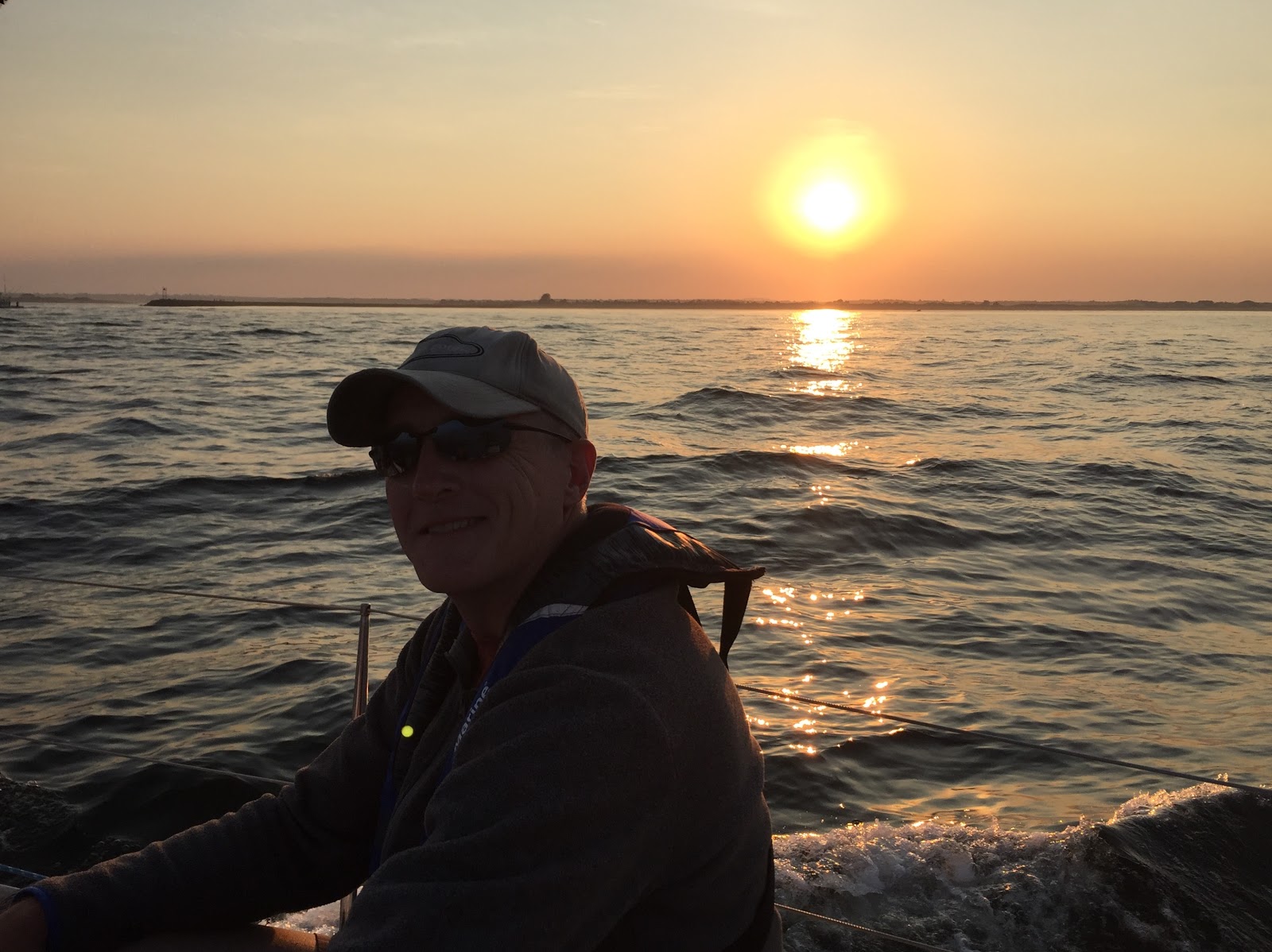
    Sailing season got off to a great start with a sunset cruise last night on Fayaway.  Any sail out of the Merrimack River begins with motoring out of the river.  There’s some setup involved in this process, and there’s a fair amount of checking out the stream of power boats zooming past you.  Sailing proceeds at a different speed than power boating.  There are benefits to both, but at that moment I wasn’t interested in getting someplace faster.

    Approaching the mouth of the Merrimack the channel zig zags sharply.  Best to pay attention to the navigation buoys in this stretch.  Fishermen line the shores of Plum Island and Salisbury Beach fishing for striper and whatever else is biting today.  Seals bob in the current looking us over curiously.  The ride out is long but always different.

    Steady winds greeted us out of the mouth of the Merrimack, and we headed north for a run up the coast.  It’s always amazing how far away from your day-to-day you feel when you get out on any body of water.  The Gulf of Maine certainly gives you that feeling.  Today’s sail takes us three miles off the coast of Salisbury, Seabrook and Hampton before we tack and make our way back towards the river.  A simple sail all things considered.  Nothing overly technical about it, just pleasant conversation and dodging lobster pots.

    Just before we tacked for home we saw splashing off to Starboard.  At first we thought perhaps whales, but as we drew closer we saw fish jumping out of the water and splashing down to the surface.  We were looking at dolphins hunting for fish in the rip, and dozens of fish exploding out of the water to escape.  The fish shined silver and gold in the reflection of the setting sun, and indeed looked like the rays of the sun as they arced outward in their attempt to live to see another day.  Always in moments like this I regret not having my camera with me.  These aren’t moments when an iPhone can do the job.

    So we sailed back to the Merrimack River, and when the wind finally petered out motored the rest of the way.  The ebbing tide combined with the current from the river made it a slow go coming back in, and the midges were able to make their presence known in swarms.  Thankful for bug spray, sunsets, good friends, a sound boat and another great day on the coast of somewhere beautiful.

  • The Merrimack River

    The Merrimack River runs from the Lakes Region in New Hampshire to the Atlantic Ocean.   Source to Sea it’s roughly 117 miles long from the confluence of the Pemigewasset and Winnipesaukee rivers at Franklin, NH to the mouth at Newburyport, Massachusetts.  This stretch of river has served as a source of food, commerce and transportation for thousands of years.  Depending on who you believe, the name is derived from Native American words merruh and auke, which together mean “the place of strong current”.  The Merrimack lives up to that name.

    The powerful current of the Merrimack drew the attention of the Boston Associates, who expanded their manufacturing operations from Waltham to the Pawtucket Falls in what was East Chelmsford, and soon would be known as Lowell (named after the founder of Boston Associates, John Cabot Lowell).  The massive success of the textile mills in Lowell was quickly duplicated in other locations along the Merrimack, sprouting the cities of Lawrence and Haverhill in Massachusetts, and Manchester and Concord in New Hampshire.

    The explosive growth of colonial expansion and then the textile industry transformed the Merrimack River from sleepy Native American fishing villages to massive red brick cities connected by an increasing network of roads.  Dams and canals have changed the flow of the river and impacted the migration of salmon.  In many ways the river has changed forever from what it was in the early 17th century, but much of the river looks essentially the same as it did 400 years ago.

    If 60% of an adult man’s body is made of water, then much of mine is Merrimack.  I’ve lived most of my life in the Merrimack Valley, spent my college years rowing between Lowell and Nashua, visiting my father’s home along the river in Franklin, hiking the old Native American trail network from Lowell to Andover and now sailing out of Newburyport.  The brook in my backyard flows into the Spicket River, which in turn flows into the Merrimack River in Lawrence.  The Merrimack River continues to shape me, as it shapes the eastern border between New Hampshire and Massachusetts.

  • Red #2

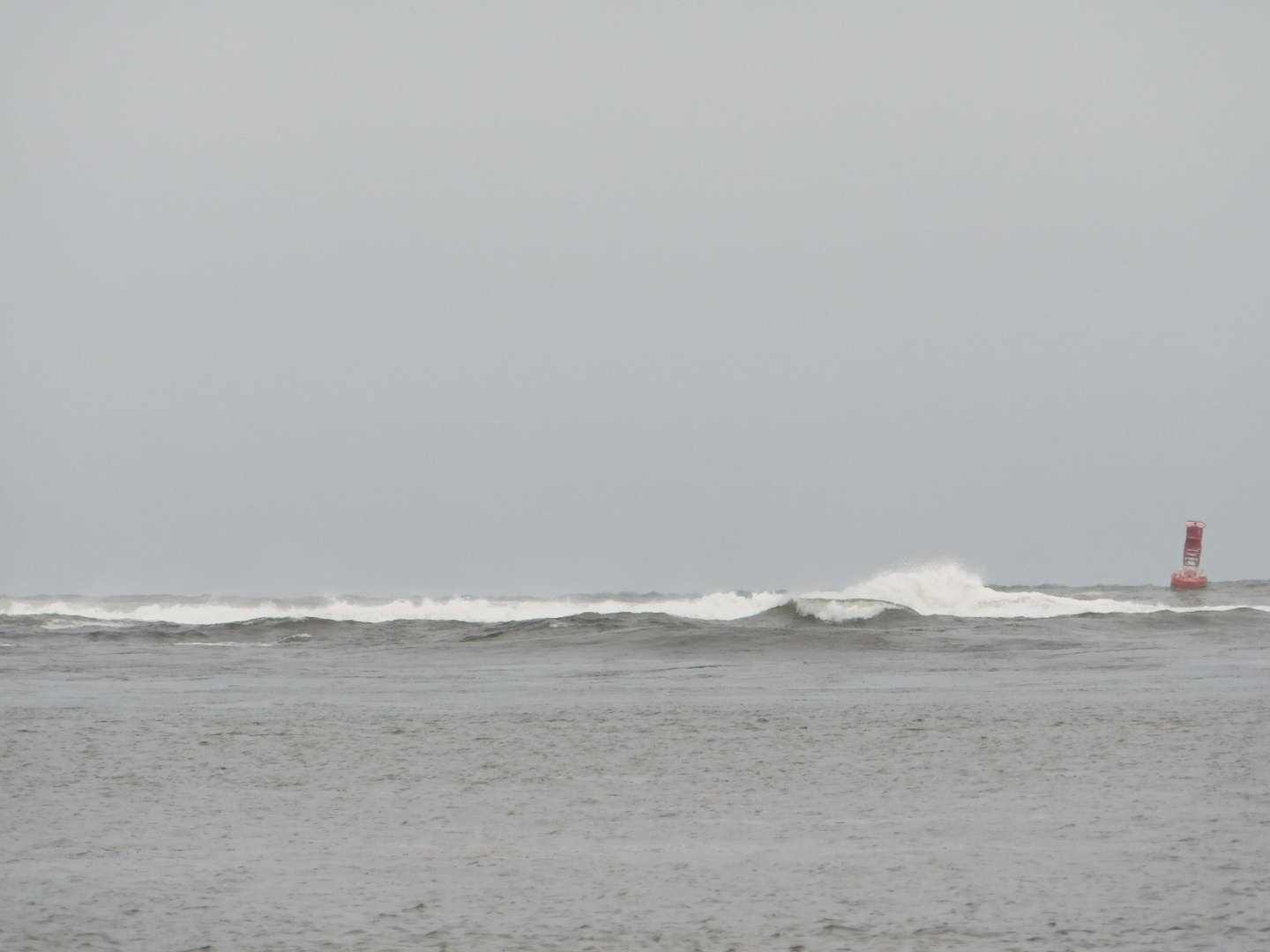
    Standing watch at the Mouth of the Merrimack River is Red # 2.  Red # 2 is a navigational buoy that rides out some of the most violent conditions on the East Coast.  Red # 2 is not as well known as MR, which is the first red navigational buoy on the approach to the Merrimack River and the one that most boats set their course to.  MR is the glamor buoy in this part of the Gulf of Maine.  Important, much discussed by boaters and the mark of choice on the GPS.  MR is not just a navigational buoy, it’s a destination.

    Such fame is not in the cards for Red # 2.  But I’d contend that Red # 2 is responsible for more safe passages through the Mouth of the Merrimack than any other.  Set beyond the Salisbury Jetty, Red # 2 marks the channel around the treacherous sand bars beyond the jetty.  Without Red # 2 boaters would be tempted to cut the corner around the jetty on their way north.  These pictures shows the waves breaking over the sandbar between the jetty and our friend Red # 2.  On a calm day a boater wouldn’t realize just how dangerous a tight course around the jetty would be.  So thank you Red # 2, you’re tops with me.