Tag: Methuen

  • In Search of a Border Marker

    In 1622 Captain John Mason was granted the land between the Kennebec River and the Merrimack River and the territory was named New Hampshire. The border with Massachusetts wasn’t the middle of the river, but a distance three miles north of the river’s shore. This made for an interesting, zig-zagging border that meanders along as the Merrimack River has from long before settlement by the English. That’s 398 years of continuous service as the official border between two similar yet completely different states. Barring wholesale changes in the borders that virtual sharp point should remain forever.

    Today, instead of eating lunch like a normal person I drove over to find the sharpest point on the border between Massachusetts and New Hampshire at a spot that on a map looked to be accessible in two directions. Using Google I zoomed in on the satellite image and decided the easiest possible way to get to this point was to walk the maintenance “road” that ran under the power lines adjacent to Route 213 in Methuen, Massachusetts. This worked out well until I reached the place where I needed to head north to the border point and scanned a swampy mess overgrown with cattails and impenetrable brush. This hike turned into a dead end but a good education on the lay of the land.

    Next option was to drive to the town transfer station, which was the next closest public land, to see if I could get to the woods that the border ran through that way. I had a great conversation with the woman weighing trucks in at the entrance, and she was politely curious about the quest that I was on, but received a no-go from the decision-makers on the other end of the radio. Not to be on this day. And that leaves me two options. Find another way in, potentially across private land, or to simply wait for the heart of winter when the ground is frozen solid to attempt the power line route again. I suppose there’s a third option of just dropping this pursuit of a border marker that may not even be there, but tell me, what’s the fun in that?
  • Mystery Hill

    I live roughly a mile and a half from a place called America’s Stonehenge.  It’s also known as Mystery Hill, and I like that name a bit more because it infers that there’s much about the site that is unknown.

    Here’s a great description of the site from the mysteryhillnh.info web site:

    The Mystery Hill archaeological site, better known today as America’s Stonehenge, is situated on the exposed bedrock summit of Mystery Hill in North Salem, New Hampshire. The site consists of a core complex of 13 stone chambers, several enclosures, niches, stone walls, stoned lined drains, small grooves & basins, and other features which covers about one acre on the summit. Extending outward from and surrounding the core complex, are more stone walls, niches, standing stones, and two procession ways. Along the perimeter of the summit are four confirmed astronomical alignments. Below the summit on the slopes of the hill are a 14th chamber, two utilized natural caves, springs, stone walls, stone cairns, niches, standing stones, and other features. In total, the site covers about 105 acres.

    I’ve lived in close proximity to this site for twenty years.  And yet I’ve only visited it twice – once alone and once with my daughter.  If you’re an archaeological buff, an astronomy buff, or a mystery buff its a great place to visit.  I’m a history buff and like to understand the place I live in.  A large part of that is who lived here before me.  Mystery Hill has carbon dated evidence of people living in this area 7000 years ago.  Native Americans were most likely those people, and they most likely lived in the area well before that.  What we know for sure is that the Native American presence in the region was largely gone for a number of reasons by the time of the French and Indian War.  Colonial settlements continued to nudge further and further north and west and eventually the area because fully colonized, first as Methuen, Massachusetts and eventually as Salem, New Hampshire.

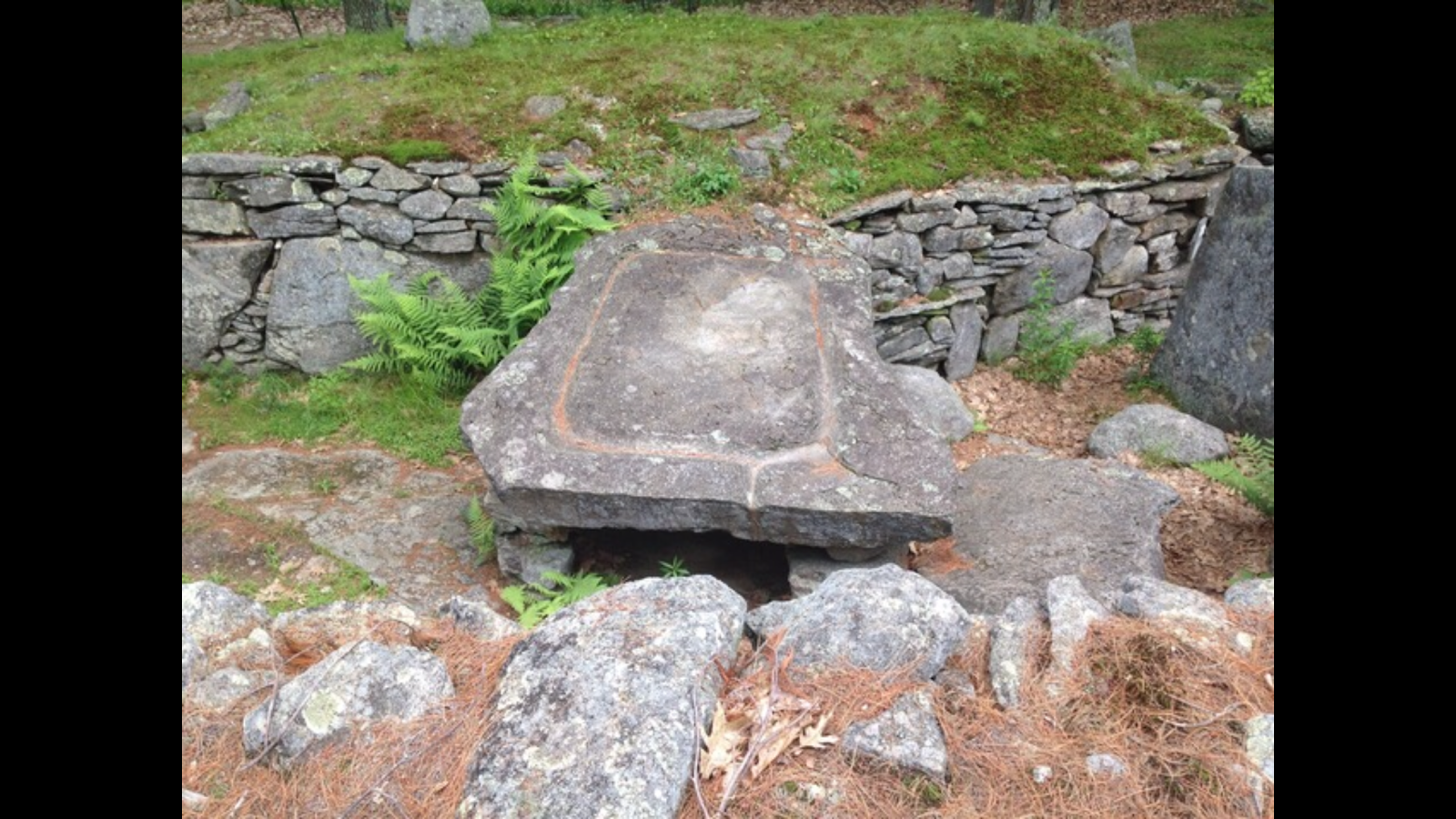
    About ten years ago a Boston television station did a live broadcast at America’s Stonehenge, and the weather person at the time, Dylan Dryer, laid down on the stone table that many people think was a sacrificial alter because of the drainage channels carved into it.  Maybe it was, maybe it was just the place where they cleaned up whatever they brought back from the hunt that day.  Either way, I thought it was interesting that she laid down on that spot.  Apparently there was no bad mojo as she’s now on national television and seems to be doing just fine.

    Look at Mystery Hill from a Google satellite map and the first thing that jumps out at you are the spokes of clear cut trees coming out from the center of the hill.  This was done by the people who manage America’s Stonehenge to provide clear lines of sight on the celestial points that are marked.  Whether this was done thousands of years ago by Native Americans or Celtic visitors or by a farmer in the 1800’s building off what was up on the hill I don’t know.  But I do know it’s impressive to see when you’re standing on the viewing platform.

    The other thing you notice when you look at that Google Satellite map is the encroaching development on all sides.  That’s accelerating with a development eating into the woods to the southeast of Mystery Hill.  I find this disappointing, but not surprising for Salem, New Hampshire.  The town seems to value real estate development and commercial space over conservation space.  But then again, Mystery Hill has been here before with waves of settlers clearcutting and farming the land around it.  And until some developer plugs condos on top of the hill it (wouldn’t put it past Salem) the site will continue to mark time one celestial year after the next.

  • Paradise in the Starbucks Drive-Thru

    I was waiting in a Starbucks drive-thru this morning and looking at the house behind it.  Before there was a Starbucks in this spot there was a Mobile station.  Before that?  Probably the yard of the house I was looking at.  Before that?  Probably farmland for a family that owned a larger plot of land in this corner of Haverhill.  Before that?  Probably a few generations of farmers.  And before that?  Perhaps the Duston family, who lived across the Little River, or another family that settled this land.  Before that?  Deep woodland that the Eastern Abanaki inhabited for centuries.

    I wonder now and then what the generations of people who lived on this land would think of it now.  Plunked down in the Starbucks parking lot, they’d be stunned to see the semicircle of cars lined up around the building as coffee addicts and Frappuccino posers each pulled up and completed their transactions.

    They call this part of Methuen Paradise Valley.  The valley today doesn’t measure up to the name.  Don’t get me wrong, there’s some lovely parts of Haverhill and Methuen.  But the spirit of the place, that intangible that prompted some folks a few generations back to name this place Paradise Valley is gone now.

    “Don’t it always seem to go
     That you don’t know what you’ve got til its gone
     They paved paradise
     And put up a parking lot.” – Big Yellow Taxi, Joni Mitchell

    Conservation and preservation are really the only way forward.  I hope people look up from their phones and lattes long enough to realize that.  Or maybe its just progress and I don’t see it.

  • Robert Rogers

    Robert Rogers

    Robert Rogers was born in Methuen, Massachusetts – twenty minutes from where I currently live.  His family moved to what was then the wilderness of Dunbarton, New Hampshire a few years later.  Rogers is famous for leading a group of colonists in the French and Indian War.  There are some who will point to his debts, drinking and war atrocities committed against women and children.  These are very much the darker part of his story.  But Rogers was very good at what he did, which is taking the fight to the French and Native America populations during war.  In war you need strong leaders, and Rogers was certainly that, leading Roger’s Rangers to fame that lasts to this day.

    I first learned about Roger’s Rangers when I was a kid watching the movie Northwest Passage.  I haven’t seen that movie in 40 years, but I’ve read up on Rogers, and everything I read makes me want to learn more about this guy.  Rogers and his Rangers wore green uniforms and did epic raids and scouting missions across vast and hostile wilderness.  Roger’s Rangers were the origin of what is now the United States Army Rangers.  Live off the land, shrug off hardship and discomfort and get the job done.

    Perhaps the most epic story I read about Rogers Rangers – and there are many – is a mission when they skated across Lake George, switched to snowshoes and trekked across snow covered forest for miles.  These were tough, athletic and versatile men who never saw a mission that they didn’t want to tackle.  On another snowshoeing mission they ambushed the enemy deep in hostile territory, only to be ambushed themselves.  Rogers and many of the Rangers managed to escape by holding off the French and Native Americans until dark, separating into smaller groups and melting into the wilderness.

    By all accounts, Rogers was a brilliant soldier who adopted Native American tactics to create his own form of fighting.  Today people talk about Navy Seals with awe.  Frankly I do as well.  Rogers Rangers would hold a place of honor at the table of military heroes in America’s history.  Many of the tactics used in the armed forces today originated with Robert Rogers.  In fact, Rogers “Rules of Ranging” are still followed by the U.S. Army Rangers of today.

    Rogers was a hero of the French and Indian War, but like many soldiers he struggled after the war.  Debt, scandal, alcoholism and war crimes muddied his reputation after the war and in the years since.   During the Revolutionary War he took the British side, and it’s said that he was the one who recognized Nathan Hale (“I only regret that I have but one life to lose for my country.”) when he was spying on the British in New York.  Hale was hanged soon afterwards.  New Hampshire, which Rogers did as much to protect as anyone during the French and Indian War, expelled him as a Tory.  He would die in poverty in London.

  • Bloody Brook

    There’s a tiny brook that flows from Searles Pond near Holy Family Hospital and feeds into the Spicket River just before it in turn feeds the Merrimack River in Lawrence.  It’s name betrays a violent history, long before Lawrence and Methuen become heavily developed urban environments.  Google has led me a couple of times to a very useful site that details the history of Methuen and some of the surrounding area that once was part of Methuen.  You can Magenweb here.

    The name Bloody Brook was said by George Frederick, late town treasurer and authority on Indian lore, to come from a terrific battle between the Agawams and the Tarrantines in the days before the English settlement. As near as white men could tell after they came, about September 1615 the Tarrantine Indians of Maine had a poor harvest so they invaded the Merrimack Valley to raid the fields,and naturally the local Indians resisted as best they could. It is said that clubs and stone axes, rather than arrows, were found in this area, indicating the closeness of combat. 

    The Tarrantines were part of the larger Mi’kmaq tribe of coastal Native Americans who lived from Maine to Newfoundland.  For them to make the long trip down to what is now Methuen to raid the fields of the Agawam speaks to their desperation.  There is another famous Bloody Brook that points towards the better-known history of conflict between the white settlers and Native American population.We hear a lot about the encroachment of European settlers in the area and the conflicts that arose with the Native American population as a result.  The conflict between tribes is a lesser known, but no less violent history of the land we live on today.  Names like this dot the map, just waiting for someone to remember the ghosts who once inhabited this land.


  • Blackbirds

    They’re back.  The rebel bike gang of the skies have come back to New Hampshire.  Where I once filled my bird feeders once or twice a week, I have to fill them daily when these swarms of Red Winged Blackbirds and Common Grackles come to town.  They swarm the feeders and you can almost watch them empty in moments.  There’s no taking your fair share and moving on with these thugs – it’s all or nothing.

    I’ve read up on changing up the feed, putting chicken wire around the feeders, or buying new feeders that they don’t like to go to.  But I’m not spending money or time on that.  With a snow storm coming in tonight, I’m not taking down the feeders either.  I’m going to fill them up and let them run out – quickly mind you, but unnaturally natural.  Maybe the desirable birds will get their fill too, maybe not.  But sometimes you need to let nature decide.  The feeders come down in a month.  I’ll continue to feed the bluebirds, which has been a pleasant success in the yard.  Maybe even the finches, depending on how quickly they blow through the thistle.  But the cardinals, jays and other birds are going to have to live off the land once the snow melts.  For now it’s ever bird for itself.