Tag: Mount Moosilauke

  • Each Leap

    It’s funny how things cluster together. Bursts of activity that lump together depending on the place that you’re in emotionally, physically, developmentally. Like jumping rock-to-rock to cross a stream, these places are where we land at a given moment in our lives.

    Some are easy to identify: “student” to “early career” to “committed relationship” to “parent” are all leaps we’re familiar with. But there are other, smaller leaps that come to mind. Over the last year I’ve had clusters of activity – hiking, chasing waterfalls, devouring poetry, home improvement projects, etc. that consumed me for a time and then I was on to the next thing for a while. Those waterfalls are still calling, just as mountain peaks are, it’s just not their time right now.

    Each leap lands you in another place in your life. Each leap changes you forever. I’ll never be who I was before I had children, nor will I ever be the same person as I was before I read The Summer Day or saw a snowshoe hare sprinting through the snow on the summit of Mount Moosilauke or a hundred other leaps large and small that have brought me to this particular landing spot.

    Each leap brings us further across the stream, further from who we once were while closer to what we might be. Knowing we’ve changed, and fully aware of the risks, we must choose which leap to take next. Sometimes we get wet, sometimes we reach a dead end, and sometimes we reach a landing spot we never dreamed of getting to. There are lessons in each.

    At the moment I’ve landed on a series of home improvement projects that demand the usual investment of time and money. But I’m already plotting my next leap, and have an eye on the one after that too. All while the characters in my life are making their own leaps, some drawing closer, others moving further away. And this is as it should be. The stream keeps flowing, even as we leap from stone to stone.

    Nothing ever has been or ever will be the same. You can’t just sit on a rock in the middle of the stream forever. You’ve got to leap again. So make it a good one.
  • From Asquamchumauke to Baker: What’s in a Name?

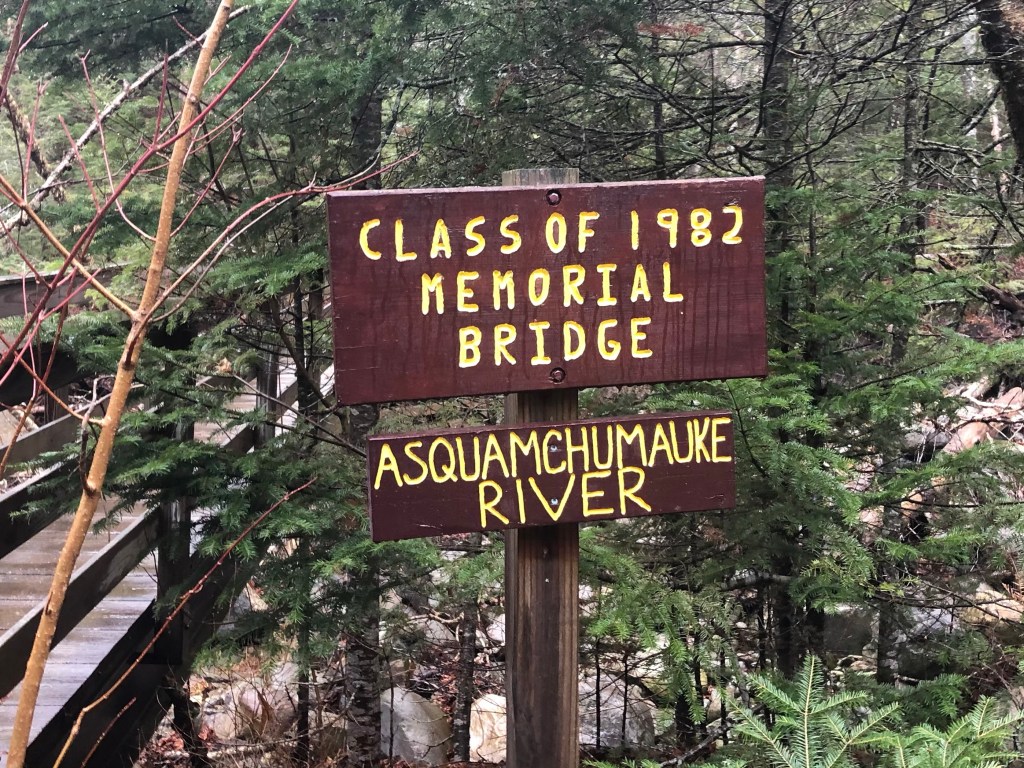
    The Baker River flows from Mount Moosilauke to the Pemigewasset River in present day Plymouth, New Hampshire. On the map the name is cut and dried: Baker. But when you cross the river at the Gorge Brook Trailhead another name emerges from the past: Asquamchumauke. History once again whispering for all who might hear.

    Dartmouth College honoring the original name

    Asquamchumauke means “crooked water from high places” in the language of the Abenaki tribes that once thrived here. It’s a lovely, descriptive name that brings romantic notions of Native Americans living in this place for generations. Yet we’ve called it Baker since well before the American Revolution. The story behind the name change is another fascinating chapter in the violent history of New Hampshire.

    Thomas Baker was a soldier in Deerfield, Massachusetts on February 29, 1704 when the Deerfield Raid occurred. Deerfield was a seminal event in Queen Anne’s War and New England history. French and Native American warriors overran the fortified settlement, 47 settlers were killed and 112 captives, including Baker, were marched up to Montreal. The Native American warriors came from around the northeast, including several tribes of the Wabenaki Confederacy. One of them was a Pennacook sachem named Wattanumman.

    Whether Baker and Wattanumman met during the fighting or forced march to Montreal is unclear, but events would bring them together again eight years later. Thomas Baker led an expedition north with around 30 men and ambushed Wattanumman, a dozen of his men and their families at the site in present-day Plymouth where the Asquamchumauke River meets the Pemigewasset River. Wattanumman and several others were killed and scalped. The men collected furs and anything of value and brought it all down to Massachusetts where Baker was rewarded for his efforts with £40.

    And this is where present-day morality meets the violent frontier morality of New England in the earliest days of our history. Both men participated in violent raids against the other in a time of war. But for fate Baker might have been killed in Deerfield, which may have extended Wattanumman’s life a few more years. Who knows? All of us are subject to the whims of fate.

    There was one other reward for Thomas. To honor what Baker and his men did in this place the name of the river was changed from Asquamchumauke to Baker, a name it still has today. With one event the life of Wattanumman was erased, and the legacy of Baker was sealed. We Americans tend to honor people with place names, while the Native Americans honored the spirit of the place itself. Asquamchumauke: crooked water from high places.

    Has a nice ring to it.

  • Hiking Mount Moosilauke

    I’ve heard about this mountain from several people. Popular because of the great payoff in views and experience for the amount of energy expended compared to other trails. I’d even heard about the Dartmouth Lodge at the head of the trail we were hiking. But you forget what you’ve heard before when you see such places. It served as another reminder that you must get out and see for yourself wonders in this world while you have time.

    There are several trails up to the summit. I’d highlighted the Beaver Brook Trail as one to do based on the cascades there, but with the gimpy ankle my hiking buddies chose an easier trail for this day. The warnings about the Beaver Brook Trail certainly discouraged trying it on an icy day like yesterday. Here’s a typical warning from the AMC: This trail may be extremely dangerous in icy conditions. Okay, got it. Instead we hiked the Gorge Brook Trail out and back. Easier, beautiful, and comparatively free of the ankle-busters you experience on most White Mountain trails.

    Ultimately, this hike made me feel better about the progress of my ankle as it wasn’t a factor. It also made me feel better about the progress of my fitness as the rowing has improved my stamina enough that I didn’t feel winded chasing jackrabbit hikers up the trails. Granted, this was an easy trail and they were likely taking it easy on me.

    Yesterday was several hikes in one. The lower section was wet and a bit muddy in places. The snow started accumulating on ice at higher elevations and prompted us to slip on micro spikes for crunchy hiking. The wind became a factor above tree line. Layers were added and thicker gloves went on. And then on the descent the micro spikes became leaf catchers and clumped up enough that we all opted to stick them back in the packs.

    Moosilauke means “bald place” I’m told, and the summit is fully exposed as advertised. What isn’t guaranteed when you hike is the view. This one would be socked in with fog and snow. No matter, for views are a notable bonus, but hiking the trail to the summit is the goal all along. I’ve got this one on my short list of summits to return to again on a clear day.

    Socked-in summit
    Foundation at summit
    In-between season where there’s snow but still exposed rock
    Snowshoe Hare (see yesterday’s post)
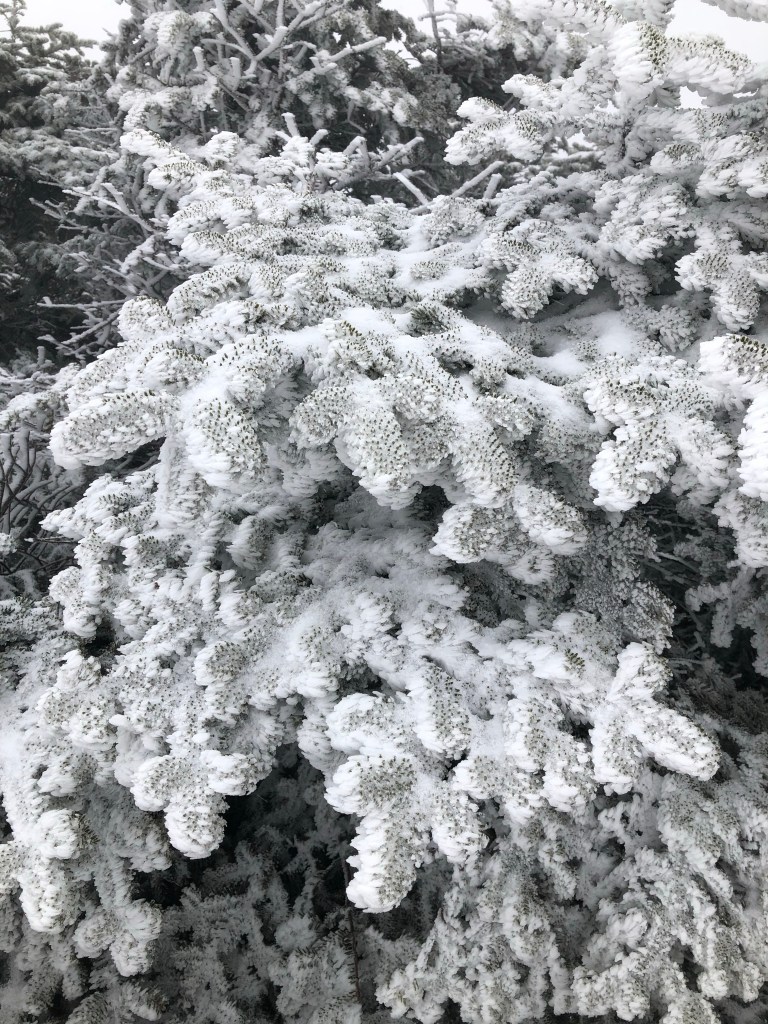
    Rime ice and snow frosting
  • Encounter with a Snowshoe Hare

    The snowy and windy summit of Mount Moosilauke wasn’t a place to linger long. We’d summited and were about to head down below tree line to have lunch when I saw some rime ice building on a cairn and took my iPhone out to snap a couple of pictures of it. Just then I heard a shout from a couple of hikers nearby and a flash of motion. One of my hiking buddies shouted “It’s a Snowshoe Hare!” and a quick glance confirmed it was indeed. With the camera already on I was able to snap a few photos as the hare bounded around me and towards the cover of trees.

    Snowshoe Hare

    The Snowshoe Hare, with the excellent Latin name Lepus Americanus, is native to New Hampshire and loves throughout North America’s colder regions. Its hair turns from brown to white in the fall, triggered by the change in light just as leaves are. The hare I saw looked huge, but it was probably about 5 pounds, which is on the heavier side of their weight range. The distinctively huge rear paws act like snowshoes to launch the hare forward. It was literally born to run in snow.

    As we descended from the summit we wondered what the heck the Snowshoe Hare ate in winter. Looking around there just wasn’t much edible stuff around. According to a State of New Hampshire survey on the animals, they eat up to 2/3 of a pound of “woody browse” per day, and also re-ingest their soft droppings…. yum. May have been better to leave it a mystery.

    Seeing a Snowshoe Hare running through snow in the wild is absolutely thrilling. The only thing more thrilling would have been seeing a lynx or fox chasing after it in a high stakes race. Nothing like that today, just a bunch of appreciative hikers buzzing about the blur of white fur that graced us with a speedy show. And it proved that when you get out there you may just see something amazing.