The snow began in afternoon this time around. Each storm is unique and memorable, if we observe the weather for what it is—alive and vital in its day. We get so busy complaining about the weather that we forget to simply coexist with it. The weather simply is, as we ourselves are. We share this day together and nevermore.
We walked together, the pup and me. On snowy streets quietly tracked with tires and footprints of those who had ventured out before us. This winter the plows wait a while before facing their task. Why bother? The snow will just keep coming. The price they will pay is the heaviness of their burden. Our price is a slow shuffle through the clinging accumulation. The snow clings to boots and paws, and we feel ourselves rise higher with each step. The pup uses her teeth to pluck the clumps off her paws. I’m not that dexterous and simply kick off the clumpiness.
All of this makes for a slow go in the snow. But our nightly walk is our ritual, no matter the weather. A hush falls over the street, but for the soft tread of boots and paws, moving through time as the layers accumulate. Each step is heard. Each step is felt. Flake-by-flake and step-by-step, we mark time with progress. Snow and boots and paws. Tomorrow will tell its own tale. Tonight belongs to the three of us.
Beauty is twice beautiful and goodness is doubly good when it concerns two wools socks in winter. — Pablo Neruda, Ode To A Pair Of Socks
There are two kinds of people in this world. Those who complain about the weather and those who dress for the weather we’ve been blessed to experience this day. The former tend to shelter in place. The latter tend to step out into it. I don’t judge either camp, but I’m clearly in the latter.
While snowshoeing Saturday morning, I came to a split in the trail. I went to the left that morning, breaking trail and returning with the thrill of having been out in it, doing the work of being fully-alive on a bright clear morning. But all that evening I thought about the path not taken. It remained unbroken and unexplored, and with that, I felt incomplete. Those paths not taken have a way of haunting us, don’t they?
The only thing to do was to go out again Sunday morning to see what was left for me. I silently hoped it would be unbroken still, that I might finish what I started. I saw footprints in the snowshoe tracks I’d laid and thought to myself that the opportunity was lost. But the footprints crossed the bridge and then turned back, indicating someone inclined towards common sense. Why continue on trails without the proper gear?
The thing is, I had the proper gear. And so I kept on walking to that fork in the path and turned right onto a gloriously unbroken trail, blazing a path for any who might follow. There is sheer delight to be found in the cold stillness of a pristine snowy forest, so long as you’re prepared to be out in it and have the tools to make your way back out again no matter what.
Having completed that walk, I doubled down with another, bringing the pup to the beach for a second winter walk. That proved far colder with wind chill cutting through our gear. Cold is one thing, cold wind is something else entirely. Even proper winter gear will let you know when it just isn’t enough. We simply have to listen to what nature is telling us.
The pup loves the beach and could have stayed all day but for the wind. Even clad in a winter coat of her own, she knew when we were having too much of a good thing. Sometimes the best thing to do is to step out into it. And sometimes it’s best to simply turn back with stories to tell. Two stories in fact. Twice beautiful, simply for having ventured out to meet them.
Two paths diverged. Hampstead Conservation Land.Snow on dunes. Hampton Beach State Park.
“I wonder if the snow loves the trees and fields, that it kisses them so gently? And then it covers them up snug, you know, with a white quilt; and perhaps it says, “Go to sleep, darlings, till the summer comes again.” ― Lewis Carroll, Alice’s Adventures in Wonderland
We are having a proper winter in New Hampshire this season. The cold is unrelenting and the snow consistent. It isn’t inclined to melt away when the days are frigid. Instead we have sublimation of the snowpack, and a sting on the skin. As we step into February, I write of the last day of January 2026, and a walk in the woods I’ll remember as particularly remarkable (so much so that I’m remarking on it).
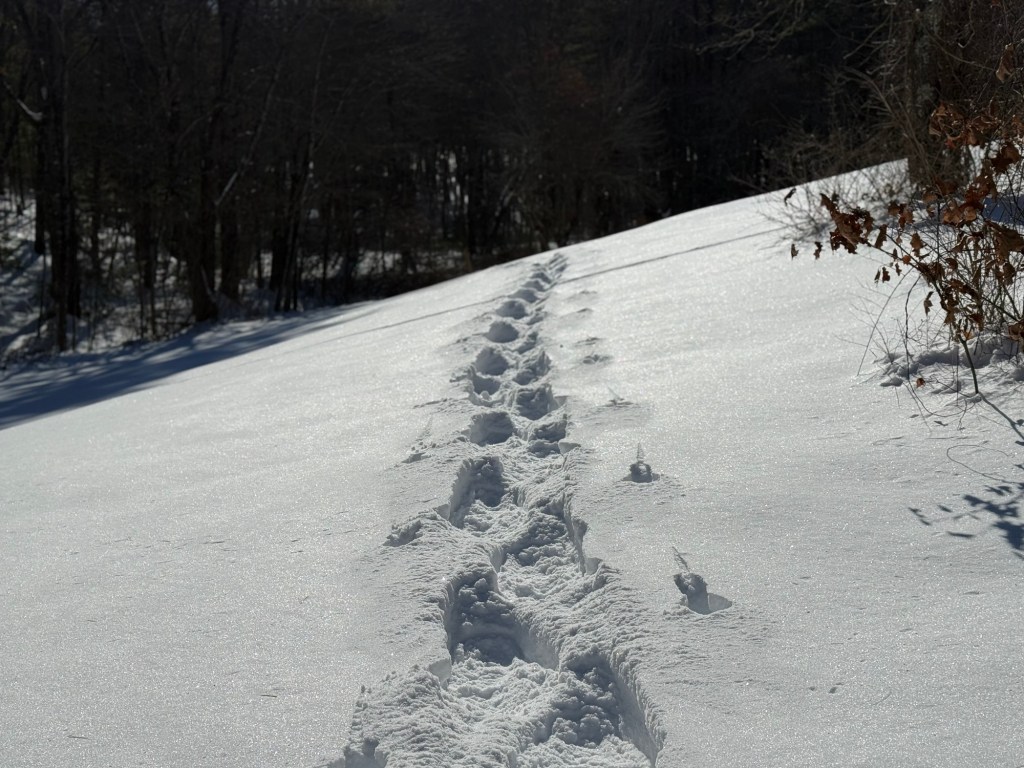
Almost a week after the region’s big snow, I finally had some time available to head to the local conservation area for a walk in the woods on my snowshoes. I went with trepidation, for I know the damage that can happen to a trail after a week of people and their pets post-holing through deep snow. But the parking lot was surprisingly empty for a Saturday morning, and the trails themselves were relatively clean. Post-holed for sure, but it’s been so cold and the snow so fluffy that it wasn’t the icy hellscape I thought it might be.
I still chose to break trail on pristine snow whenever the opportunity presented itself. Making a bee-line across steep terrain from one broken trail towards another. Some of the drifts were pretty deep, almost 4 feet of powder, but my snowshoes were up to the task. Thankfully, so was I!
Large portions of the conservation land’s trail network were completely unbroken. I smiled to myself at the lucky break and braced myself for the work ahead. Breaking trail on snowshoes is a great workout, and I’d gone out by myself with nobody to share the load. This is where being well-acquainted with working out comes in handy. I’m no Olympian, but I can break a trail for a few miles without passing out from the effort.
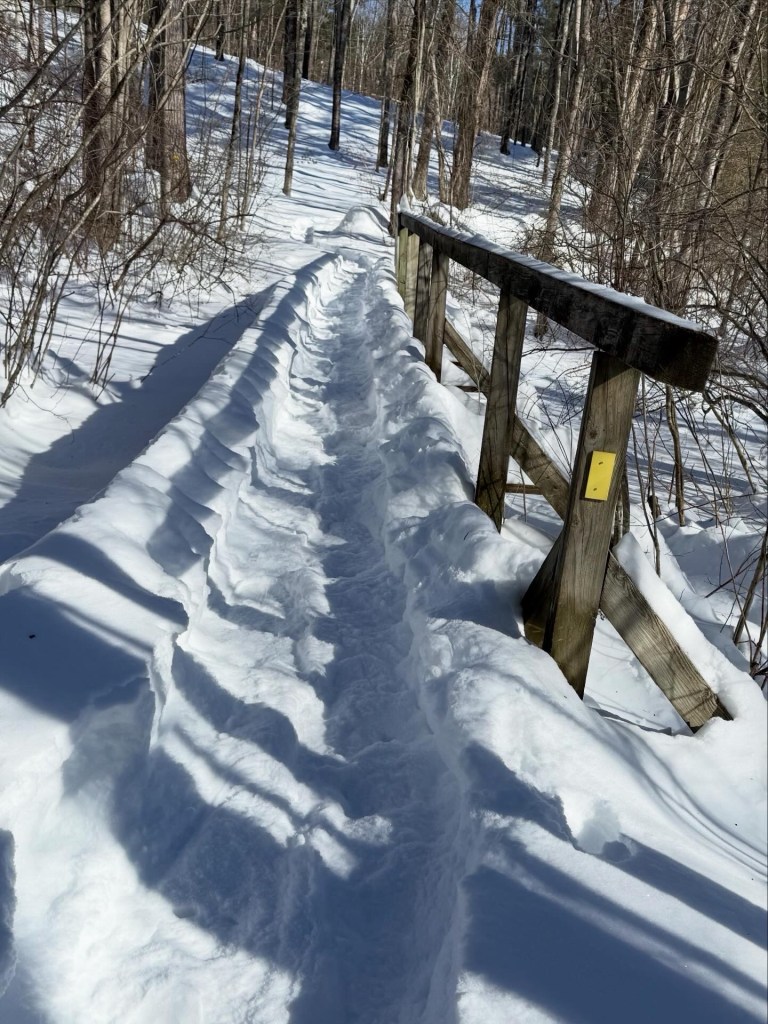
The larger trail network required an out and back over a bridge spanning wetland. On the way to it the bridge was untouched by anything but snow. On the return, I captured a picture of the trail I’d made on the out and back. It will be interesting to see what it looks like today, with a broken trail that others may have since walked.
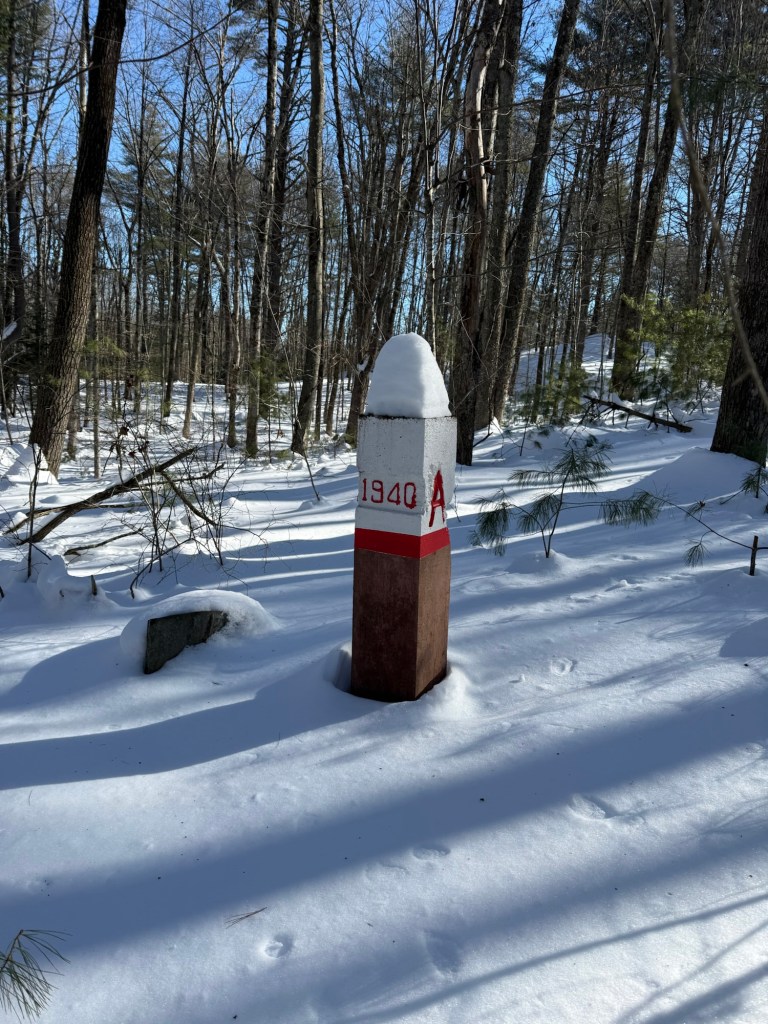
In one section, I revisited a town border marker that someone has since painted white with red lettering to make it more obvious to visitors. A is for Atkinson. There’s an H on the other side for Hampstead. Most of the trail network covers the latter town.
For all my time in nature on this snowshoe walk, I didn’t see much in the way of wildlife (It’s not like I’m sneaking up on anybody marching across the snow). Ironically, when I drove home afterwards, a neighbor excitedly told me he’d had three bald eagles in a tree in his yard not more than 30 minutes before. Now we’ve had a lot of wildlife moving through the neighborhood over the years, but none of us had ever seen a bald eagle, let alone three of them together. I’m sure that they’re hungry, and with the rivers frozen over they are scoping out the local valleys to expand their menu.
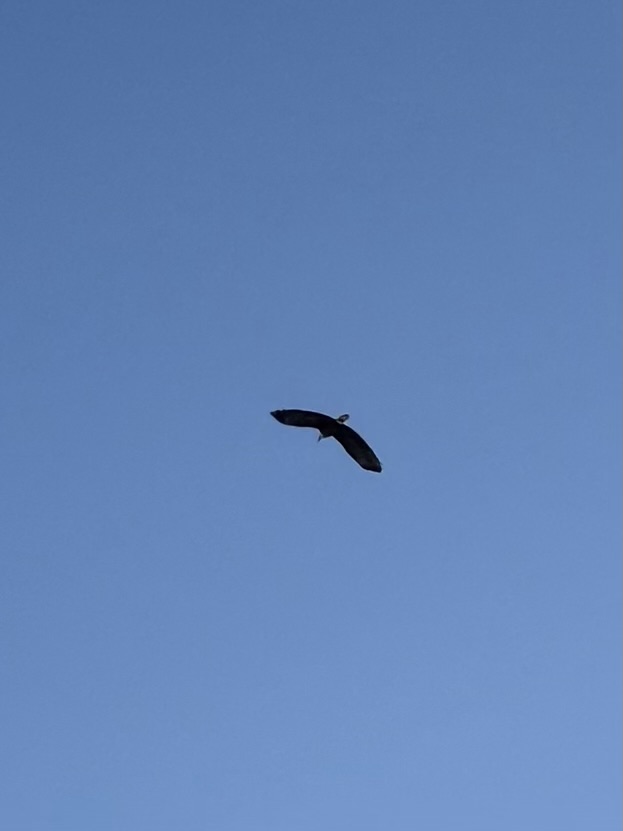
The odds were against seeing them still in the area, but I recruited the dog for a walk of the neighborhood to see if one would return. Sure enough, I was blessed with a fly-over by one of them. There’s no mistaking an eagle soaring over the landscape, and it was a thrill to see it. By the time I had my phone out to snap a picture it was already past me gliding towards open fields beyond the woods. It was a great way to cap a Saturday morning in snowy New Hampshire.
On a cool, raw and occasionally wet Sunday an avid hiker friend and I explored the trails and summits of Pawtuckaway State Park. Situated within the towns of Nottingham and Deerfield, New Hampshire, Pawtuckaway is easy to reach compared with some other mountains in New England. And of course it’s hard to call them mountains at all, if you want to get righteous about the height thing. Doing North and South Mountains together offers a gain of only 1409 feet, I’m told, but the story isn’t the elevation gain, it’s the geological interest that draws you here.
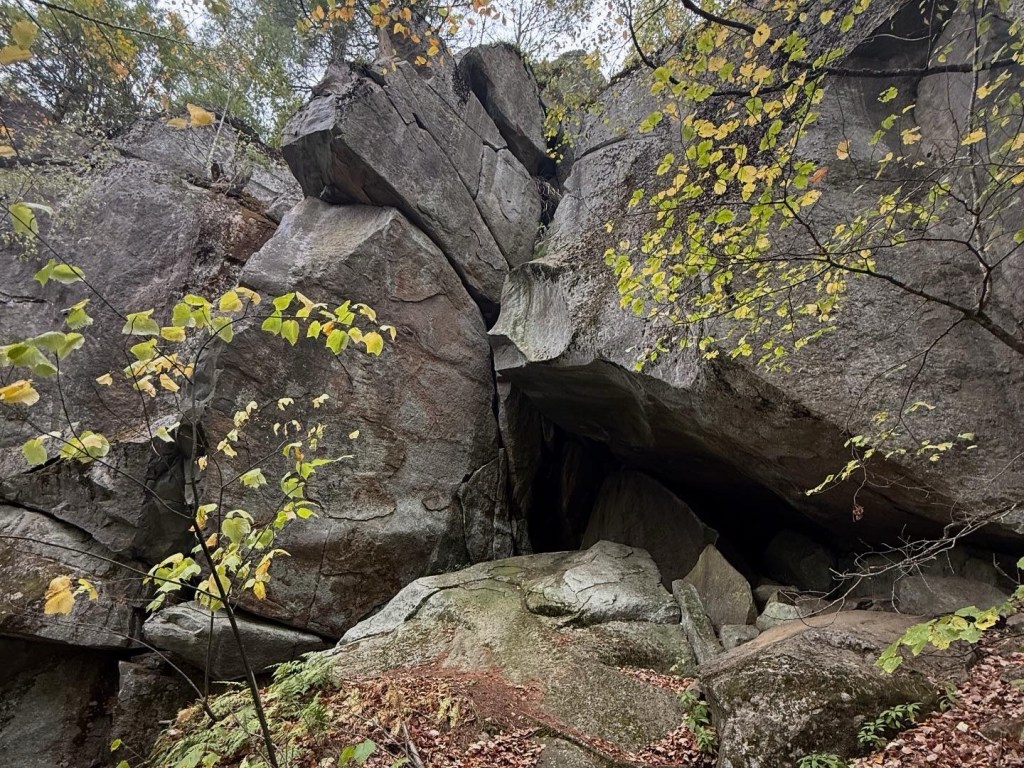
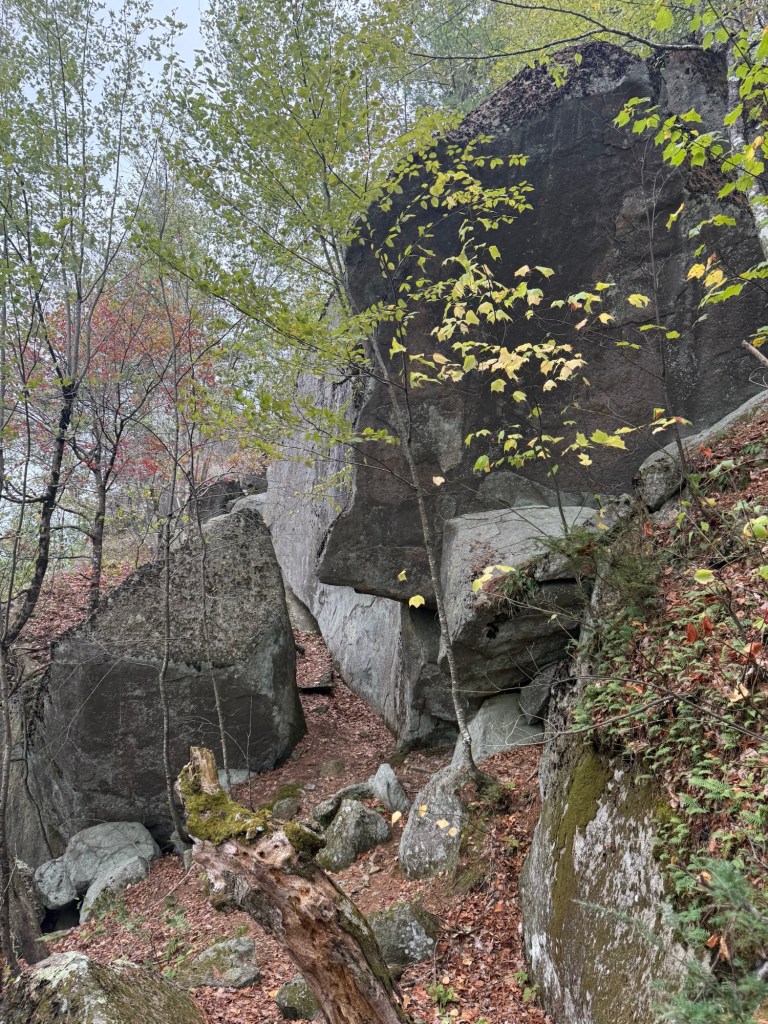
“High up on South Mountain a dike of black trap rock cuts the granite-like rock of the mountain, and breaking out rectangular blocks provides the treads and risers of Devil’s Staircase. The top of South Mountain and the firetower rising above it command a view overlooking the sea to the east and the mountains to the north. The Devil’s Den Trail to North Mountain first passes the huge Pawtuckaway Boulders. These tremendous blocks of rock ranging up to 60 feet in some dimensions and probably comprising the largest group of boulders anywhere, are strewn for about a quarter mile along the trail. Once a part of North Mountain, they were plucked by the glacier during the Great Ice Age and dumped in their present position when the ice melted. Devil’s Den was hollowed out by this same plucking action.” — Jacob Freedman, The Geology of the Mt. Pawtuckaway Quadrangle
“Forces in the earth developed a circular fracture around the solid rock, and into this fracture more magma of a different composition rose. It consolidated to form a gray coarse-grained granite-like rock called monzonite, which now makes up the circle of the Pawtuckaway Mountains in what is called a ring-dike.”— Jacob Freedman, The Geology of the Mt. Pawtuckaway Quadrangle
Winding through these fields of plucked glacial erratics, you’ll find plenty of rock climbers bouldering the monzonite, mountain bikers and the usual assortment of casual and serious hikers navigating the trails, and a surprising amount of horse manure indicating that some of the trails are very popular for horseback riding. There are gravel roads throughout the park as well, and we found these to be useful connectors between trails on our 12 mile hike.
Reading about the history of the area, it seems there was a character known as the “Barefoot Farmer of Pawtuckaway” named George Goodrich who played a large role in making it a state park. The Goodrich family farmed this rocky land, and you can find the family graveyard within the state park. I can’t imagine hiking the terrain barefoot the way he farmed it, but I suppose a few decades of barefoot farming would go a long way to toughen up the toes.
New Hampshire is in a serious drought, and you could see the impact it’s having in the streams, ponds and wetlands. Stream beds are largely dried up and the ponds are showing plenty of their muddy bottoms. The foliage is muted this year too after the stress of a dry season. But our hike coincided with the beginning of a few days of rain, and we hiked out to a misty, raw sendoff.
I’d hiked this place before, almost twenty years ago, focused mainly on South Mountain and the fire tower you can climb up. That’s surely the most popular trail because it’s relatively easy with a nice payoff in views when you reach the summit. But for my money, North Mountain and the ledges and boulders below it are the most dramatic and fascinating place in Pawtuckaway. If you go, you can’t miss them. Shoes are optional, of course, but highly recommended.
Autumn is when most people flock to the high ground, searching for vantage points from which to take in the foliage. It’s a lovely thing, that foliage. What is less lovely is the flock of people. Foliage gridlock is the ugly phenomenon of fall. So those of us who live amongst the foliage tend to avoid the popular places. Beauty can be found in the quiet places too. A single orange and red leaf drifting to rest just so is all I need. But oh, those vantage points are stunning too.
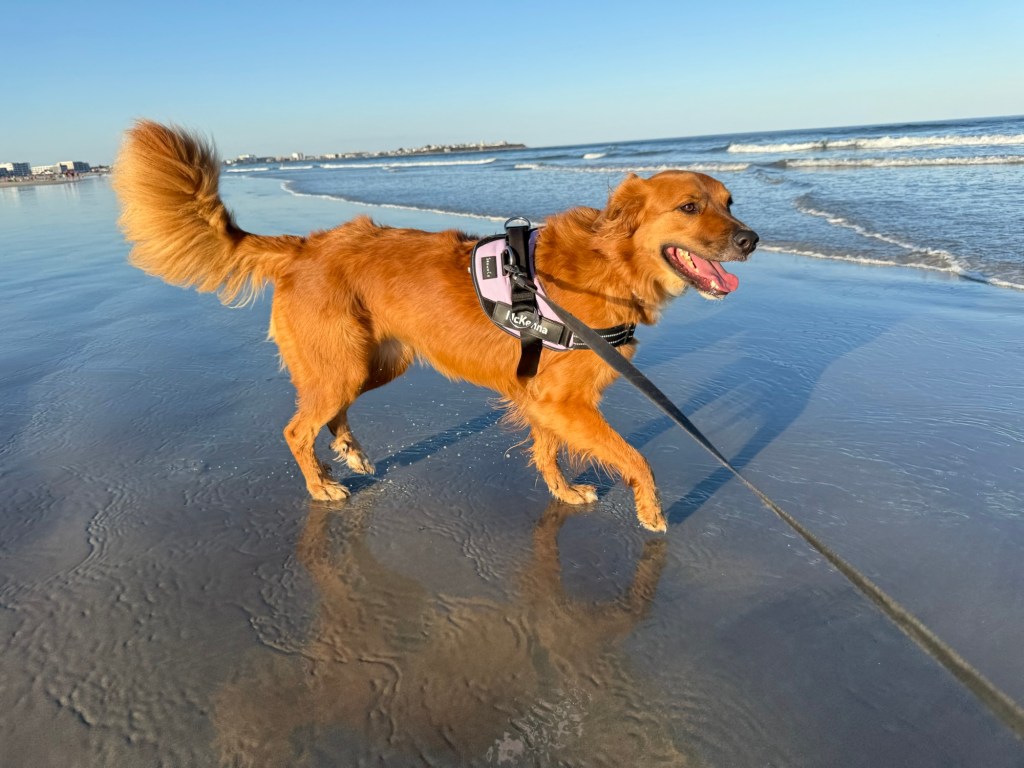
My bride and I went to the sea to walk the pup in the low tide surf. That’s just about as low ground as you can get in New Hampshire, and we reached the highest of places watching the pup play in the foam, chase seagulls, and giving the horses a sideways glance. In the offseason the horses return to the beach, riders splashing into the waves as they trot the long stretch of firm sand out and back from the state park.
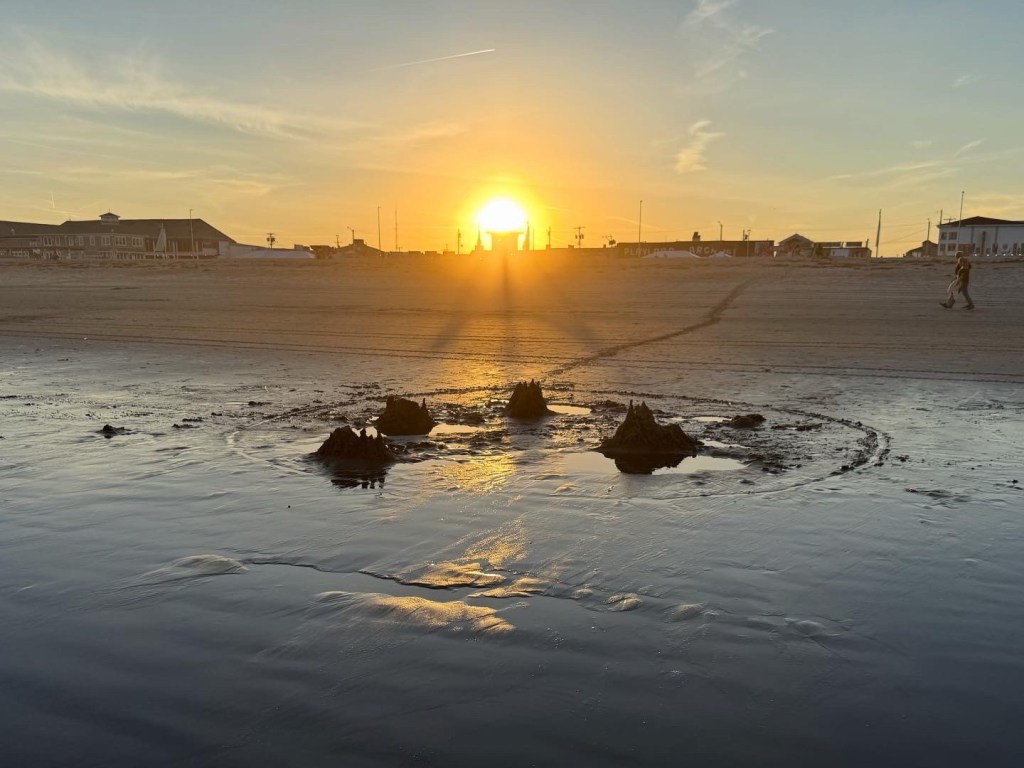
We also return in the offseason, favoring the relative quiet it offers. Late in the afternoon on a warm October day, we found we had plenty of company but still nowhere near what it must have been earlier in the day. With the surf up and churning its relentless song, the sun casting brilliant warm light as it drops to the west, there is no foliage to wonder at. Walking along the surf line to witness what the low ground has to say, seeing the joy that a beach walk draws out of my two companions, I can tell you that there is magic just the same.
“I feel ripe for something, yet do nothing, can’t discover what that thing is. I feel fertile merely. It is seedtime with me. I have lain fallow long enough.” — Henry David Thoreau, The Journal of Henry David Thoreau
If January brings with it resolution to change, February brings bitter reality. Some winters are more bitter and persistent than others. This winter is overachieving on the bitterness scale.
The pup runs out with her tail wagging, charging past the cleared path and packed snow into the deeper stuff, breaks through the frozen crust and her legs plunge into the deep. One paw trudging after the other, breaking crust and plummeting. All joy is halted and she looks back at me in despair.
“What is this?!”
“That’s bitter reality”, I whisper back to her, coaxing her out of the worst of it.
That’s February 2025.
Still, the days grow brighter. Thoughts of March are stirring, with April is right behind it. April is daffodils and fragrance. The only fragrance in February is gasoline and windshield fluid. We can look at the lengthening days and think of daffodils, even if they feel a long way off. We can work to survive the worst of winter in the hope of getting to the best of spring.
Things are darkest before the dawn, and these are the days when we feel something stir within. Thoreau’s journal entry rings true: We can feel it but we aren’t really sure what it is yet. Something is awakening within us, something profoundly ours. It’s our why, our purpose, and it is born and expressed in the things we do with it from here. Unlocked from the inertia of our darkest days into something brighter. Keep trudging pup, joyful days are stirring.
“Every single thing you do today is something that your 90-year-old self will wish they could go back and do. The good old days are happening right now.” — Sahil Bloom
Overnight snow is the best kind of snow. It’s like Christmas morning with its big reveal at first light. With it, we may think in terms of chores or play. Either way, it won’t be here forever. We must always remember that neither will we.
Snow removal completed on the home front, sun offering a brilliant day that felt warmer than it really was, I read the timely Thread above from Sahil Bloom and it reinforced what I knew I had to do. Really, I’d been thinking it all morning. Get out there in it! Find some virgin snow and glide across it with all the vigor one can muster. For we may never cross this way again.
Snowshoeing on local trails can be thrilling or discouraging, depending on the condition of the trail and the snowshoer. It didn’t start off well, with a dog walker arriving just ahead of me post-holing the trail where the snowshoers before me had been. Adding insult to injury, the dog walker didn’t clean up her dog’s poop, dropped right next to the trail. That’s no way to go through life, I thought to myself. But walkers in deep snow are quickly overtaken; I nodded hello, said hi to the pup and kept my feelings to myself. I was here for something more essential than policing other people’s behavior. I was here to fly.
The main trail had already seen visitors, and I did my part to compress the trail further—a gift for those who would follow without snowshoes. Eventually I reached an intersection where the snowshoer before me had gone left, while the side trail to the right was virgin snow extending on through the trees for as far as my eyes could see. The choice was clear.
Two roads diverged in a wood, and I— I took the one less traveled by, And that has made all the difference. — Robert Frost, The Road Not Taken
I know these woods well. I know where the waterfalls lie smothered under ice and snow, where granite outcroppings and hemlocks form a cathedral as beautiful as anything made by man. Snow transforms the landscape and forces one to learn it anew. If the trail had been broken I might have strayed further afield, but I felt an obligation to guide those who would follow my tracks. Stay on trail to show the way, and I may stray another day.
I tend to think in time buckets now. What might I do now that I won’t be able to do later in life, when I’m old and frail? Do that thing now and celebrate the gift of health and vigor. Maybe one day we will regret not watching others live their best lives while we sat on the sidelines, but I think not. This is our time too. What are we to do but make the most of this day?
Virgin snow with a worn, familiar trail revealed underneathOut and back trail compression
On and on the rain will say How fragile we are how fragile we are — Sting, Fragile
A woman in town walked out on the pond ice to take a picture of the moon and broke through the thin ice. She fought to get out of the frigid water, and when that failed, to hold on for help. After several minutes of struggle a rescuer had a hold of her and it felt like she would survive. But the ice broke on the rescuer and in his plunge he lost grip on the woman. Exhausted and hyperthermic she slipped under the water to her death. The rescuer, distraught and frozen, was himself rescued. I wondered what her plans were for the Saturday evening she wouldn’t live to see.
It’s thankfully rare for someone to drown in this pond. A friend with a long memory can only recall two other incidents in the last hundred years. He had walked on the ice himself not far from where she broke through, but knew the ice better. She had simply strayed too far from the safety of thicker ice as dusk turned to dark to see the moon. Were it an hour earlier perhaps more people in the area could have made a difference.
We all tread on fragile ground. Memento mori. Our duty is to recognize this and optimize the time we have left. Don’t fear dying, fear not living while we may.
“People think being alone makes you lonely, but I don’t think that’s true. Being surrounded by the wrong people is the loneliest thing in the world.” ― Kim Culbertson, The Liberation of Max McTrue
I live in a small town with no traffic lights in New Hampshire that snugs up against Massachusetts. I’ve been here for three decades now and for the life of me I know I’ll never feel like a local despite knowing many of them, watching our children grow up together and watching some of those children begin to have children. How can one spend more than half their years in a town and still feel they’re an outsider?
I’ve been plotting my escape from this town for years, but then I keep running into people with a shared history and find the conversation pleasant. I stood out in the semi-frozen front yard raking up acorns and wore out my arm waving to neighbors driving past on their way back from Sunday activities. I recognize the patterns of the season in this town, from how the stars align against the hillsides to where the deer go to hide from all the hunters. There’s a rhythm to familiarity that we may wear like a warm coat.
Life is what we make of it. Where we live, what we do for work, and how much time we spend with people who don’t see the world the way we do is often up to us. We are the light in someone’s day when we encounter them, or we’re a reminder to them that they’ve got to get out of this place. The world largely reflects back what we project out to it. The last few years I’ve projected that I’d rather be somewhere else than this small town. Who can blame the town for feeling the same about me?
The thing is, we ought to be building our lives towards something, not recoiling from something. It’s a subtle difference, but the latter has us on our heels, the former has us charging ahead. One is regression, one is progression. Don’t we all want to feel like we’re making progress in our lives? When the world seems to be shrinking from us, it’s usually a reflection of our own stance with it. We must lean into our future, wherever we want it to take us. Just be sure to give a wave and a smile to the neighbors, they look like they’re going through some things too.
We could all use a bit more quiet right about now. Whichever side of the cultural or political divide we fall on, it’s been a noisy, relentless year. If everything has its season, now seems a good time for some restorative quiet. Reaching quiet places is a journey with many possible routes. Which we take is less essential than the act of taking it.
We don’t need money to find quiet, just a bit more social engineering and applied creativity. Removal from the noise is the obvious way—simply turn off the relentless media and walk away. A walk in the woods would be lovely, though orange is a must here in New Hampshire during hunting season. So maybe a walk on the beach would serve better for the next few weeks. However we find nature, it offers a whispered message that eternity doesn’t care a lick about our problems. Should we?
I find the tactile more valuable than the electronic when seeking silence. Picking up a pen and scratching on a pad of paper can draw the noise right out of us and carry us to more enlightened places. Menial tasks like washing dishes or sweeping the floor may feel like chores when we begin, but carry us to quiet places as we work our way through the task.
Ironically, sometimes the opposite of silence is just the answer. Lately I’ve returned to some music from my childhood that I’d pushed aside when a younger version of me thought it wasn’t cool enough. It’s probably still not cool enough, but neither am I, so who cares? I know all the words and that can be enough at this stage. Sometimes it’s not physical quiet at all, but internal quiet. Music drowns out the other noise around us and reminds us that some noise is joyful. That negative noise just gives up and floats away for a while.
We aren’t monks or hermits, most of us anyway, and sequestering ourselves in quiet solitude isn’t a forever act, but a cyclical act of renewal. Just as the trees have shed their leaves and gone dormant, we need to give our minds the time to go dormant too. The noise level will inevitably rise again, but quiet has its place. Perhaps more than ever.