Tag: New Hampshire

  • On Foliage and the Passing of Time

    “Who made the world?
    Who made the swan, and the black bear?
    Who made the grasshopper?
    This grasshopper, I mean-
    the one who has flung herself out of the grass,
    the one who is eating sugar out of my hand,
    who is moving her jaws back and forth instead of up and down-
    who is gazing around with her enormous and complicated eyes.
    Now she lifts her pale forearms and thoroughly washes her face.
    Now she snaps her wings open, and floats away.
    I don’t know exactly what a prayer is.
    I do know how to pay attention, how to fall down
    into the grass, how to kneel down in the grass,
    how to be idle and blessed, how to stroll through the fields,
    which is what I have been doing all day.
    Tell me, what else should I have done?
    Doesn’t everything die at last, and too soon?
    Tell me, what is it you plan to do
    with your one wild and precious life?”
    —Mary Oliver, ‘The Summer Day’

    Mary Oliver passed away in January this year, at the age of 83.  If I may say it, too soon.  With her passing, her question commands even more urgency than before:

    Tell me, what else should I have done?
    Doesn’t everything die at last, and too soon?
    Tell me, what is it you plan to do
    with your one wild and precious life?”

    This afternoon I drove back from meetings in Boston, flipped open my laptop and diligently followed up on the list of items that demanded my time.  All save one, which required closing the laptop, stepping outside and finding foliage.  New Hampshire glows in orange, yellow and red in October, and I’ve spent entirely too much of the first eleven days of the month indoors or behind the wheel of my car.  So a walk down to a local pond on a gusty day felt more like living than crafting another email for somebody’s spam filter.

    Foliage stirs up memories of autumns past, and I try to push those aside.  Not because the memories aren’t mostly pleasant, but because there’s more than enough living now to occupy my limited brain cells.  And there’s only today; words we all know but seem to push aside for the distraction of the moment.  “What else should I have done?”  Indeed.  Take “what is it you plan to do with your one wild and precious life?” and replace “life” with “day”.  For really, that’s all we have, isn’t it?  The foliage illuminates the cold black water of a small pond nearby, and soon those leaves will float down onto the water, drift along the surface for awhile and then slowly slip quietly under the surface to return to the earth.  The briefness of this life exemplified in a single leaf.  Had I not gone to witness the foliage would the opportunity have been there tomorrow?  Surely that’s a trick question.

  • Solving the Wren Riddle

    I was clearly wrong. My educated guess was off the mark. My attempts at online research failed. Apps I trusted to point me in the right direction flopped. So it goes.

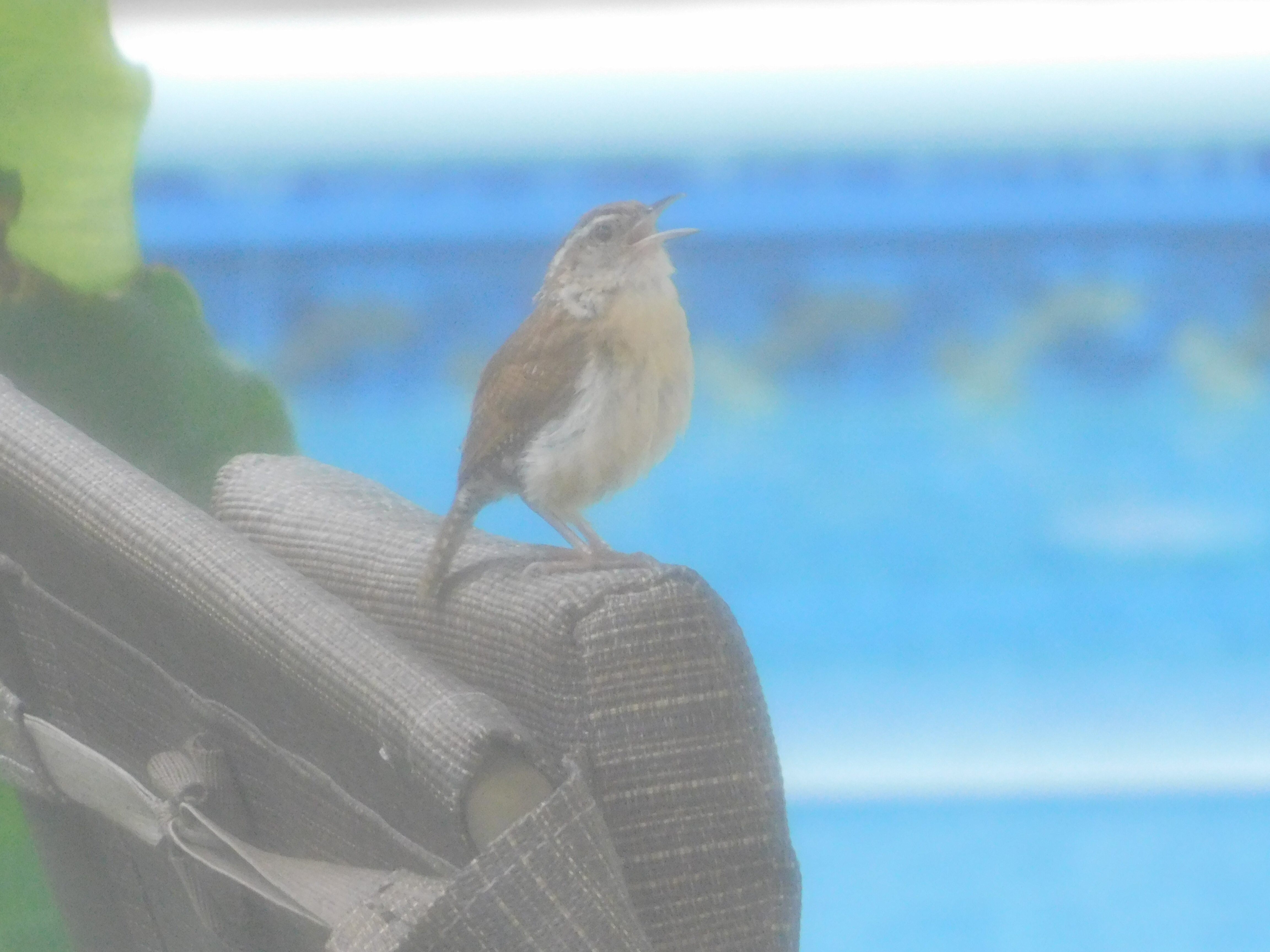
    I’ve written about my attempts to identify a bird I wasn’t familiar with that has moved into the neighborhood. And not just this neighborhood but I’ve heard a similar song on Cape Cod, as if it was following me across the Bourne Bridge, taunting me all along.  After many fruitless searches I’d finally settled on the Brown Thrasher as the most likely candidate, and have referred to the Brown Thrasher ever since.  But it wasn’t a Brown Thrasher at all.  It was a Carolina Wren.

    The Carolina Wren, as the name indicates, is typically seen (and heard) further south of here.  I’ve seen another “southern bird”‘, the Baltimore Oriole, in Massachusetts and New Hamphire, but this was a new song; a song I couldn’t get out of my head until I solved the riddle.  An app that records birds singing and analyzes it like Shazam continually got the wrong answers.  So I tried a different app, and still continually got the wrong answers.  Frustrated, I emailed the .m4a voice file to Chirp, the second app I tried, and they responded within 24 hours with the elusive answer; Carolina Wren.  A quick search online confirmed this was indeed the singer I’d been searching for all season.  It seems the bird song apps use a strong location filter to eliminate matches that wouldn’t normally be found in your area.  And Carolina Wren’s weren’t thought to settle in New Hampshire so Chirp was eliminating it as a choice.  Well, welcome to the Granite State, my southern friend.

    The New York Times recently published an article detailing the decline of North American birds, and followed that with an article detailing birds moving away from natural territory as the climate changes.  New Hampshire’s Purple Finch is apparently considering a move to other climates.  Thankfully the one’s who visit my backyard haven’t felt so inclined as of yet.  But then again, I have this new visitor to my backyard whom I’ve never had before who might be singing that there’s something to this story after all.

    Carolina Wren teasing me with her song, July 2019
  • Lost in an Autumn Playlist

    Autumn. Smell the pumpkin and ripe apples and decaying leaves and wood smoke. Late September through Thanksgiving in New England offer vibrancy with the fourth sense fully engaged in the game of being alive. I could live in many places in the world, but these crisp nine weeks are when I appreciate living in New Hampshire most.

    Autumn. Blue jeans and long sleeves, the heat radiating through a mug warming your hands, wiping dew off the chair before sitting down in the backyard writing chair. Blankets pressing you down into the mattress like you’re a panini. Socks. The days grow shorter and cooler, and the wardrobe changes with the tilt of the earth. We’ve been here before, and we grow reacquainted once again with fabric on our extremities. The dance with Autumn inevitably means literally feeling her on your skin.

    Autumn. Yellow and red waves sweep first over the highlands and wetlands, moving southward and finally capturing the strongest holdouts in between. Northern vistas so stunning you can’t help but stare, and apologize profusely for being so rude. I confess my productivity decreases when I travel to Vermont or northern New Hampshire. Like stained glass in a church, the leaves demand your attention.

    Autumn. Sweetness of apples and the omnipresent pumpkin spice. Last of the harvest turned to cider and preserves. Lighter summer fare giving way to richer dishes that warm you inside out. If you haven’t lost those few extra pounds by now you face an uphill battle as caloric intake holds the advantage. Baked goods take the place of salads, rum gives way to scotch, soups and stews and casseroles tempt and delight. The scale be damned.

    Autumn. The fading crickets song grows sadder while the crows caw grows bolder. Soon the red-winged blackbirds and other transients fill the trees with a cacophony of excited conversation. The hiss and pop of an outdoor fire. And always, a playlist of standards for Autumn. There’s a soundtrack for every season, and Autumn is when my playlists grow reflective.  In the spirit of the senses, I’ll limit myself to five standards that set the tone for Autumn in New Hampshire:

    Philosophers Stone by Van Morrison (King of Autumn music)

    The Long Day is Over by Nora Jones

    I Was Brought to My Senses by Sting

    You Don’t Have to Say You Love Me by Shelby Lynne (sorry Dusty)

    Deacon Blues by Steely Dan

  • A Day at the New Hampshire Highland Games

    This weekend the New Hampshire Highland Games take place at Loon Mountain in Lincoln. Want to feel like you’re in the Scottish Highlands in America? Go to Lincoln. The games seem to grow more popular every year, now a 3-day event peaking in popularity on Saturday. Saturdays bring a crush of people soaking up all that is Scottish culture, sampling whiskey, buying kilts and t-shirts, watching the games and the pipers, listening to lectures and traditional music, and of course eating; eating fish and chips, haggis, meat pies and the like.

    Advice for anyone going: Friday and Sunday are less crowded and less expensive. Purchase tickets in advance and bring cash. Both help you avoid long lines for those using plastic to enter. Almost everything is cash only, so come with plenty. The ATM line was as long as the beer line, and three machines were down to one for a time as they struggled to keep with demand. And by all means get there early! The lines to get on a shuttle bus were extremely long. From parking my car Saturday morning (when admittedly I got a late start) to when I finally entered the games was just north of an hour. As with the ATM’s, the shuttle buses struggled to keep up with the hordes of people. Get there as early as possible!

    The New Hampshire Highland Games are spectacular, and no surprise it grows in popularity every year. Blessed with good weather, I soaked as much as possible (lot happening this weekend and I only had the one day). Waiting in lines is a requirement, but simply staking a claim on the ski slope and watching the caber toss and stone press was easy enough, and wildly fun. The crowd roared when Steve Schmidt set a world record in the stone press, and was abuzz when the announcer pointed out a bear passing by further up the slope. The crowd was here for a good time and they found it. And so did I.

    In just over a month I’ll be visiting Scotland for a week. Thats not nearly enough time to see everything, but it just means I’ll have to go back. The Highland Games were a good primer for that trip, but they certainly stand on their own as a must-do event. I’m already planning for a return next year.

  • The Fate of Trees

    Returning to the poem The Ship and Her Makers this morning as I consider the smoke alarm in my hotel room that chirped all night. Such is the glamorous life of travel. Writing instead of sleeping in is a habit I’ve developed, and there’s no sleeping in with a chirpy roommate.

    Consider:

    THE TREES
    We grew on mountains where the glaciers cry,
    Infinite sombre armies of us stood
    Below the snow-peaks which defy the sky;
    A song like the gods moaning filled our wood;
    We knew no men—our life was to stand staunch,
    Singing our song, against the avalanche.

    – John Masefield, The Ship and Her Makers

    Living in New Hampshire I know the power of trees. The white pines that dominated the forests were cut down for masts and wide plank floors and countless other uses the trees weren’t consulted on, but they’ve grown back, and New Hampshire, just behind neighboring Maine, top the nation in percentage of “above ground woody biomass”, or as we call them around here; trees.

    “Every walk in the forest is like taking a shower in oxygen.” – Peter Wohlleben, The Hidden Life of Trees: What They Feel, How They Communicate—Discoveries from A Secret World

    The irony of writing about trees thirteen stories above the largely treeless Chicago landscape isn’t lost on me. Love the city, but couldn’t live here. Give me trees. Walking amongst the tallest of them certainly brings humans back to earth. Forests are the opposite of cities in that respect too. Skyscrapers race to be the tallest, just as trees do, but they’re all in it for themselves. Not so with trees.

    But isn’t that how evolution works? you ask. The survival of the fittest? Trees would just shake their heads—or rather their crowns. Their well-being depends on their community, and when the supposedly feeble trees disappear, the others lose as well.”

    – Peter Wohlleben, The Hidden Life of Trees: What They Feel, How They Communicate—Discoveries from A Secret World

    There’s an underlying sadness in Masefield’s poem emphasized by the first line. We grew on mountains where the glaciers cry. What a portrait of what once was… we were once this grand forest, now we’re the planks under your feet and the mast above. Such are the sacrifices for mankind. Forests regrow of course, but we all lose something by the loss of old growth trees. Wohlleben wrote that in the quote above; when the supposedly feeble trees disappear, the others lose as well. The others aren’t just the other trees: they’re also us.

  • The Yin and Yang of New Hampshire and Vermont

    “She’s one of the two best states in the Union.
    Vermont’s the other. And the two have been
    Yokefellows in the sap yoke from of old
    In many Marches. And they lie like wedges,
    Thick end to thin end and thin end to thick end,
    And are a figure of the way the strong
    Of mind and strong of arm should fit together,
    One thick where one is thin and vice versa.”

    – Robert Frost, New Hampshire

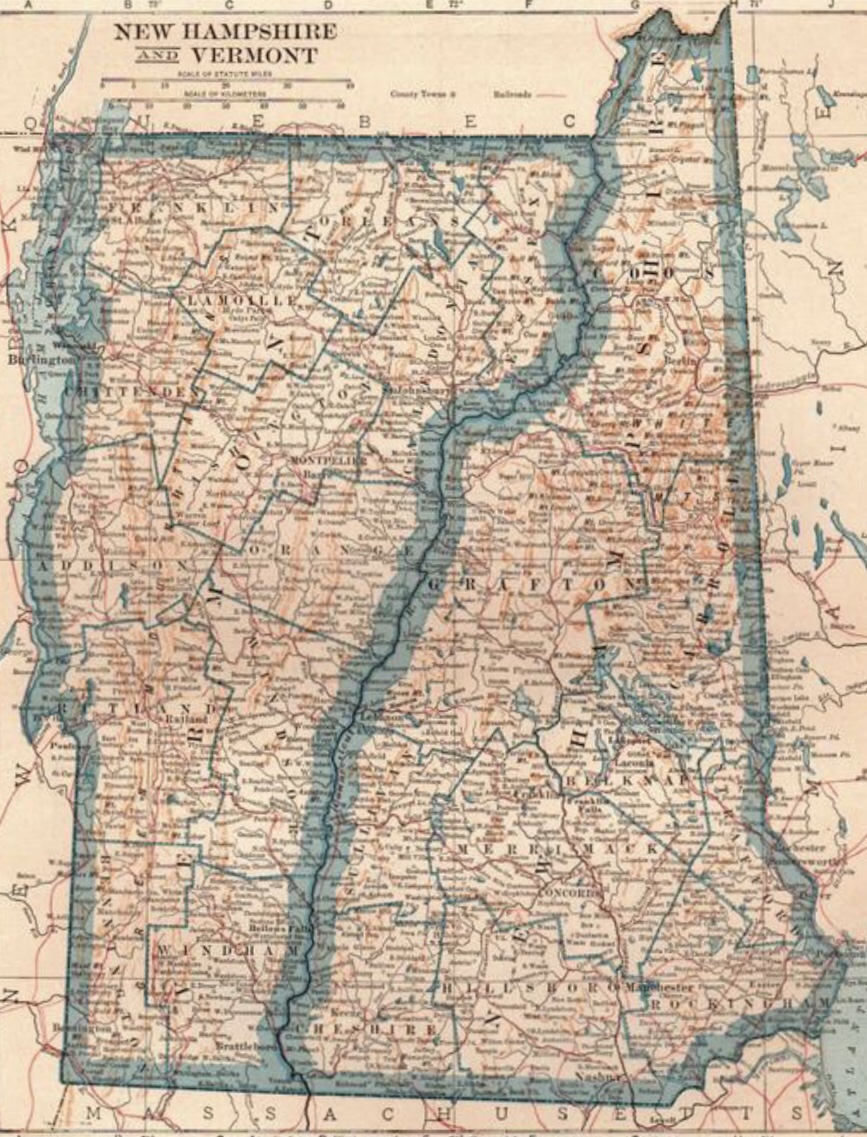
    New Hampshire and Vermont are Yin and Yang.  Almost flipped mirror images of one another, as Frost describes.  The people are similar in so many ways, and different in so many other ways.  Generally, Vermont is a “blue state” while New Hampshire is a “red state”, traditionally voting Republican (much to the chagrin of Vermont and Massachusetts).  New Hampshire has a certain active principle, Live Free or Die vibe going, while Vermont embraces a more receptive, Freedom and Unity vibe.

    The Connecticut River defines the border between the two, as determined by King George III in 1763. Vermont didn’t exist back then, the land was deemed New York’s. But that didn’t last very long; about the time it took for New York to try to collect taxes from the people there. Ethan Allen and the Green Mountain Boys chased the tax collectors right out and Vermont seceded as the American Revolution was ramping up. That’s a very New Hampshire thing to do! And ever since, these two states have been locked in an eternal embrace; interconnected yet independent. White Mountains and Green Mountains, conservative and liberal, two of the smallest states in size and population; wonder twins holding up the northern border and hugging each other for eternity.

  • From Falkirk To Portsmouth

    206 years ago next week, on September 10, 1813, the British brig General Hunter was captured after the Battle of Lake Erie. That battle deserves more attention, which I’ll try to offer on another day. This story is about the journey a pair of cannon took from the banks of the River Carron in Falkirk, Scotland to their current home near the banks of the Piscataqua River in Portsmouth, New Hampshire. The guns are of course inanimate objects, but darn it they’re surely survivors.

    Once a part of the arsenal on the brig Hunter for the British, captured and turned to service for the Americans on the brig USS Firefly, the cannon saw service in the War of 1812, the Second Barbary War of 1815 before being retired from active duty and sold with the Firefly to a wealthy merchant from Portsmouth named John Peirce. The guns were on two of the Peirce merchant ships before finally becoming a family heirloom, donated and placed in their current location more than a century ago. As Portsmouth changed they were moved closer to the building to where they are now.

    I’ve come across the guns a couple of times while walking through Portsmouth. And I’ve done a double-take each time. The ships they were in are long gone, and so are a succession of crew and wealthy owners who once valued the utilitarian efficiency of these weapons. Today they’re no longer lethal, instead standing permanently at attention, muzzles buried in the earth, as tourists, drunkards and businesspeople alike drift past, oblivious to their violent history.

    They flank the entrance to the Portsmouth Athenaeum, itself a curiosity in this modern world. The building is almost as old as the guns, and they guard it like older twin brothers might protect a younger sister. Saved from anonymity by the plaques proclaiming their role in the Battle of Lake Erie. But they’d only part of their story. Imagine all these cannon have witnessed, and the stories they could tell.

  • Love the One You’re With

    I woke up extra early today, hearing the call. Looking out the window I see a faint orange tint to an otherwise black sky. Not time yet, but close. I lay back down, but it’s no use. The call prevails. I scroll social media to distract the restless spirit. A quick scan confirms my worst fears of missing out. Aurora Borealis seen in Maine and New Hampshire last night. I switch to the Aurora app and look at the blob of green and orange stretching across the entire northern hemisphere, dipping down enough towards New England that a perch on Mount Washington or Katadin would surely offer a glimpse. Despair. I’ve missed it once again. I close the app and open Facebook to distract me. An old college friend posted pictures in Iceland… bet she saw it, I think to myself. Enough! I get up, get dressed and walk out to the crickets. No Aurora here but something equally spectacular I’m blessed to witness. The last day of August calls, and there’s plenty to see right here.

  • Stone Eggs and Red Dye

    The weekend was frustratingly productive in a Monday morning regret sort of way. Saturday was full of chores – cleaning, pruning, weeding and such. Sunday began the same way, but I felt the stir of restlessness mid-morning and started plotting concentric circles outward for places we’d never been before. When you’ve lived in a place for most of your life that’s challenging, but also surprisingly fruitful. Interesting walk with water views within an hour of home? Not hard when you live near the sea. Place you’ve never been to within that circle? Bit more challenging, but it turns out, not impossible.

    Kittery, Maine is one of those places I drive through on my way to someplace else. Sure, they have all those outlet stores, but shopping makes my brain ache. So does the Sunday traffic trying to bridge the Piscataqua River. Bridges are chokepoints, and being on the wrong side of one on the last weekend before all those kids go back to school is a recipe for gridlock. But the call of new trumped logic and we made our way to Fort Foster for a Sunday afternoon walk.

    Fort Foster sits on the northern point of the Mouth of the Piscataqua River. Historically this river has always marked the boundary between New Hampshire and what was first the Commonwealth of Massachusetts and eventually Maine. The strategic merits of the river and the natural reluctance of the Native American population and the territorial turf war with the French created the need for forts.  That need was served by Fort McClary, just a few miles inland and visible from Fort Foster.  So why another fort?

    In 1885 the United States determined a need to bolster coastal fortifications for modern warfare.  At the time, this included concrete bunkers, disappearing gun artillery designed to combat the new steel-plated modern ships, and most interestingly, anti-submarine measures like mining and guns designed to fire on submarines.  These forts dotted the east and west coasts of the United States.  Fort Foster was completed in 1901, and was active until just after World War II, when the realities of modern warfare had made coastal forts obsolete.

    Fort Foster today offers glimpses of that past.  You can still climb up into the concrete bunker and see the bolts that once secured the disappearing artillery.  But the real reason to visit Fort Foster is to walk on the unique beaches at the Mouth of the Piscataqua River, walk out on the pier to get a closer look at Wood Island with it’s lifesaving station, and Whaleback Light.  There’s been a lighthouse on this spot since 1820, and the one you see now was built in 1872.  The lighthouse keepers surely had a lonely job on that pile of rocks.

    The beach along the river is hard-pack sand cemented with silt, with granite cropping out wherever it may.  We visited at low tide and the beach extended out 50 to 100 yards in spots.  But there was a funk in the air that betrayed bacteria, and we moved on from the river beaches to those facing the ocean.  The City of Portsmouth, New Hampshire, just on the other side of the Mouth, poured a red dye into the river last month to analyze sewage flow.  There’s a red tint on the seaweed and beaches at low tide, and I wasn’t sure whether it was the red dye or the pervasive Red Tide that has closed shellfish sites in Maine for most of the summer.  Either way, it’s not a beach I would sunbath on, let alone swim in.  Damned shame, because it is a beautiful spot.

    Rounding the corner the funk disappears as the ocean breezes refresh the air.  We walked along the beach at Sewards Cove.  The beach is a fascinating jumble of worn stones, granite outcroppings and stone dust.  Picking up the stone dust, it radiated heat that lingered longer than typical beach sand might.  The beach was dominated by the rounded stones, like river rock you might put in a potted plant, of varying sizes.  One imagines the surf churning these rocks together, round and round, wearing the sharp edges down to smoothness.  The result is lovely, with all manner of shapes and sizes, all eventually becoming that stone dust that makes up the rest of the beach.  I rescued a half dozen egg shaped stones from that fate, instead subjecting them to the fate of eye candy in a beer glass on a shelf at home.  If stones had feelings they might rejoice or resent this fate, but they’ll never tell me.

    We walked as far as we could before we reached a sign that said private property, and turned back towards the river.  We opted for the path instead of the beach on the walk back, and passed groups of families and friends picnicking in nooks and crannies of the park all the way back.  It’s a million dollar view out to the Isle of Shoals and beyond to the east, and over to Portsmouth an Odiorne Point on the opposite shore of the Mouth looking south.  The park charges $20 per car, or $5 per person.  Many people simply park outside the gate and walk in, but anything more than three people and the math stops working for you.  We gave the $20 bucks and called it a donation.  Public space on the ocean is a blessing, and that private property sign reminded me that not every shore is accessible.  Andrew Jackson for a Sunday afternoon walk somewhere new?  A good trade in my opinion.

  • Hummingbirds Squeak under a Waning Moon… and Other Observations

    Cool enough for a fleece this morning. It seems summer is tilting away faster by the day. The white noise buzz of crickets fills in. Other sounds penetrate. Cars in the distance getting an early start. Birds like my old friend the Brown Thrasher announce their presence, if further away than in July.

    The mornings are especially active now. The bees and hummingbirds flitter from honeysuckle to basil gone to flower and on to the next. Each have a unique sound; not shockingly bees buzz and hummingbirds, well, their wings hum as they zip by you. I smile when the hummingbirds squeak at each other, a chorus of animated bird banter filling the yard. They largely ignore me as I sip coffee and take in the show. As if to mirror them, the squirrels are jumping tree to tree dropping acorns and hickory nuts that thump to the ground for collection later. Two scratch around my favorite white oak tree on the planet, chasing each other in young squirrel frivolity with their own chirping chorus.

    Looking up, the Waning Crescent moon greets me in a crisp blue sky. This is September blue, always embedded on my mind these last 18 years, a reference point anyone around here that day will understand. A reference point from New England to New Jersey. That day remembered in random moments like this, then gently put aside. There’s a collective joy about September in New England, with an undercurrent of sadness for the summer fading away and change in the air. But it’s still August, even if it feels like we’ve crossed. Seasons come and go, and it feels time for summer to move along too.

    Back on earth, there are a few more tomatoes to harvest, a thriving and ironic grape harvest after my public shaming in the spring, fading flowers and herbs to contend with. Like the squirrels I’ve got to get my act together and do some work to prepare for the cooler days and changes ahead. My fingers are cold from sitting outside a layer short of comfortable. Time to move. So much to do and it stirs a restlessness inside of me. But first another coffee.