Tag: Newport

  • Strokes of Virtue

    “Keep the faculty of effort alive in you by a little gratuitous exercise every day. That is, be systematically heroic in little unnecessary points, do every day or two something for no other reason than its difficulty, so that, when the hour of dire need draws nigh, it may find you not unnerved and untrained to stand the test. Asceticism of this sort is like the insurance which a man pays on his house and goods. The tax does him no good at the time, and possibly may never bring him a return. But, if the fire does come, his having paid it will be his salvation from ruin. So with the man who has daily inured himself to habits of concentrated attention, energetic volition, and self-denial in unnecessary things. He will stand like a tower when everything rocks around him, and his softer fellow-mortals are winnowed like chaff in the blast… We are spinning our own fates, good or evil, and never to be undone. Every smallest stroke of virtue or of vice leaves its never-so-little scar.” ― William James, The Principles of Psychology

    On Sunday my bride and I walked fifteen miles around Newport, Rhode Island seeing all that we could in the time we had. We might have driven from place-to-place, we might have chosen a ride service. Then again, we might have simply plunged into the many indulgences Newport offers in food and drink and leisure. But we walked instead, burning more calories than we ate, getting out in the crisp and cold air to navigate city streets and coastal boulders alike. We certainly didn’t leave Newport without enjoying some of its many restaurants and bars, but the central part of our experience was walking.

    The trick is to keep it going. Keep doing the things that bring us to a place of better fitness, greater resilience, deeper connection and richer experience. Most of us have work to do and commitments to keep that prevent brisk walks about town every day, but we can still carve out the time to do something meaningful each day. We can be actively engaged with the world simply by consistently stepping out into it—further and further with every step.

    We are a collection of habits and circumstance, spun around the sun once a year for however long fate gives us. We must rise to meet our better self. To be more resilient in the face of hardship, we must earn it with the things we do each day to be more fit, financially sound, emotionally intelligent, street smart, book smart and with the proper collection of trusted allies. What we do with our time matters deeply, if not to the universe, then surely in how we perceive our place in it.

    The quality of our life lies in our compounding habits. To be healthier than we might otherwise have been, we ought to exercise more and eat better. Even writing that I felt the cliché ripple across the keyboard with a shudder, but we know the universal truth in it, don’t we? When we inevitably get sick or have an accident, that resilient and healthy body of ours will make us more likely to rebound than we otherwise might have been. And we know it to be true that good fitness and nutrition habits allow us to be more resistant to things that a weaker body might succumb to.

    The power of teams comes into play in how we live, for that which we lack ought to be filled in by having the right team around us, just as we fill in a void that they may have. Without the right partner in my own life, I might have opted for an Uber ride back after the first ten miles, but we pressed on and saw nooks and crannies of the city we wouldn’t have seen otherwise, talking about life all the way, while burning calories and locking in memories we’ll reflect on in future days. The people we row with will either propel us to a better future or sink us. Choose carefully and see just how far you can go together.

    Writing this blog every day, I’ve come to see the changes in myself over the last five years. It’s a way to track activity, reflect on what I’ve read or experienced, and to cajole myself beyond complacency. There must be urgency in our days, and the blog is my way of reminding myself to take stock of where I am and get back to it already. I’m surely no ascetic, but I do strive for greater discipline and consistent improvement in all aspects of this brief dance with you. After all, we’re on the same team, aren’t we? Let’s see all that we can in the time we have.
  • The Newport Cliff Walk

    Newport, Rhode Island is known its notable music scene with world-renowned folk and jazz festivals, as an epicenter of sailing culture (longtime home of the America’s Cup) and the party town any sailor would want in a home port, for the Tennis Hall of Fame, but mostly, Newport is famous for its mansions. Those mansions, built as summer “cottages” by wealthy families like the Vanderbilts, are massive and interesting to tour if you want to get a sense for how the wealthy lived in the Gilded Age of 1870 to 1910. Industrial titans and savvy global traders moved here to be where other wealthy people lived—to be amongst their peers in net worth.

    The phrase “The Gilded Age” was coined by Mark Twain, and not as a complement. He was pointing to the thin veneer of wealth that hid a lot of problems underneath it. It has taken on a romanticized connotation since then, but we ought to remember that these were just people with the same issues we all face in families and relationships, with the blessing and curse that money layers into the mix. I’m not a fan of wealth politics or keeping up with the Jones as a lifestyle choice, but I can appreciate the craftsmanship of the mansions and the wealth required to build and maintain them.

    The strip of land between this collection of Gilded Age and modern-day mansions and the sea is public domain. It’s here that you’ll find the Cliff Walk. Sections of the Cliff Walk are meant for everyone to traverse. You could easily walk or roll a wheelchair on most of the paved sections between Memorial Drive and 40 Steps, the staircase that descends to the ocean. The section between Salve Regina University and The Breakers is equally well-suited for accessibility. Beyond that the path becomes best for the sure-footed. If you don’t love hopping between boulders there are sections of the Cliff Walk that aren’t for you. But there’s something for everyone.

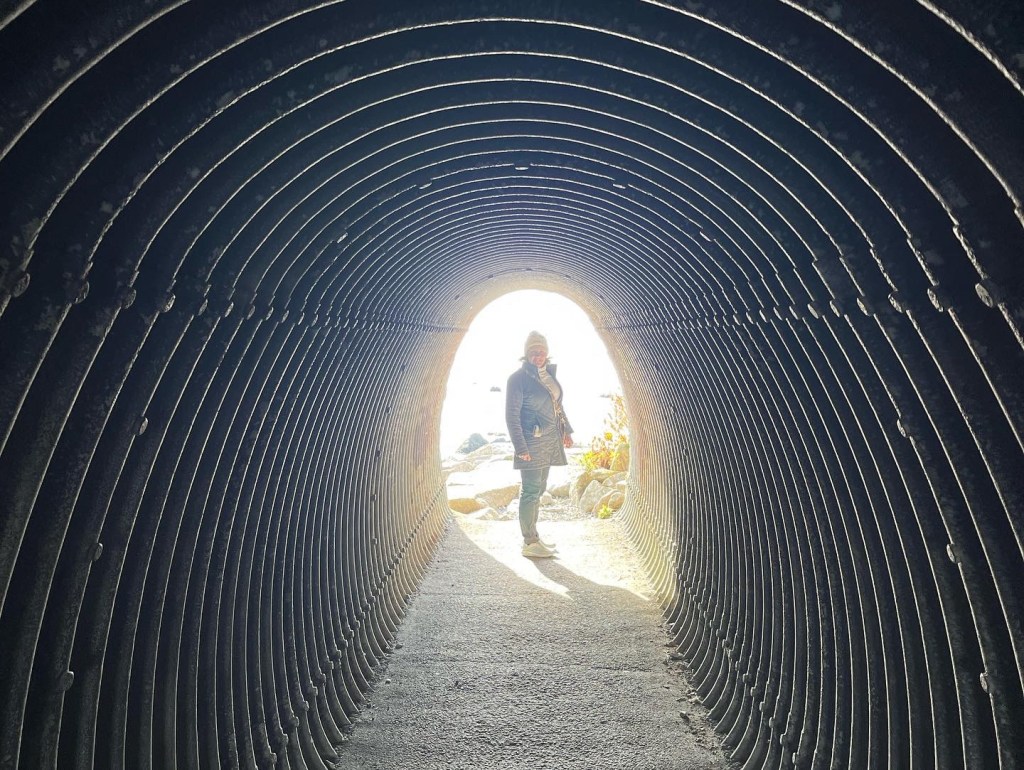
    For me, the magic of the Cliff Walk isn’t just the glimpses of manicured lawns and mansions, it’s the diversity of the walk itself. At times paved walkway, other times rock scramble or beach sand. Even a couple of tunnels to move the public quietly through the historic and high end real estate above. It’s a fascinating place to traverse, taking you from one beach to another past billions of dollars of American wealth.

    The Cliff Walk is officially 3 1/2 miles long, but we extended it to almost 6 miles, from Old Town to the Eaton’s Beach starting point, and from the end at Baily’s Beach along Bellevue Avenue to Rosecliff Mansion. On a crisp and sunny November day it wasn’t crowded but it was surely beautiful. From Rosecliff it’s an easy walk to The Breakers, the largest of the mansions and the flagship of Newport’s Gilded Age “cottages”. The fact that they called them cottages tells you all you need to know about the vast wealth of the families who visited Newport each summer.

    Ultimately, a stay in Newport is never quite long enough. I didn’t have a summer to mingle with the locals, but a mere weekend. The Cliff Walk was a great lynchpin stringing together an epic walking day in the Celestial City. It justified some of the great dining experiences we had, and have us thinking about a return trip sometime soon.

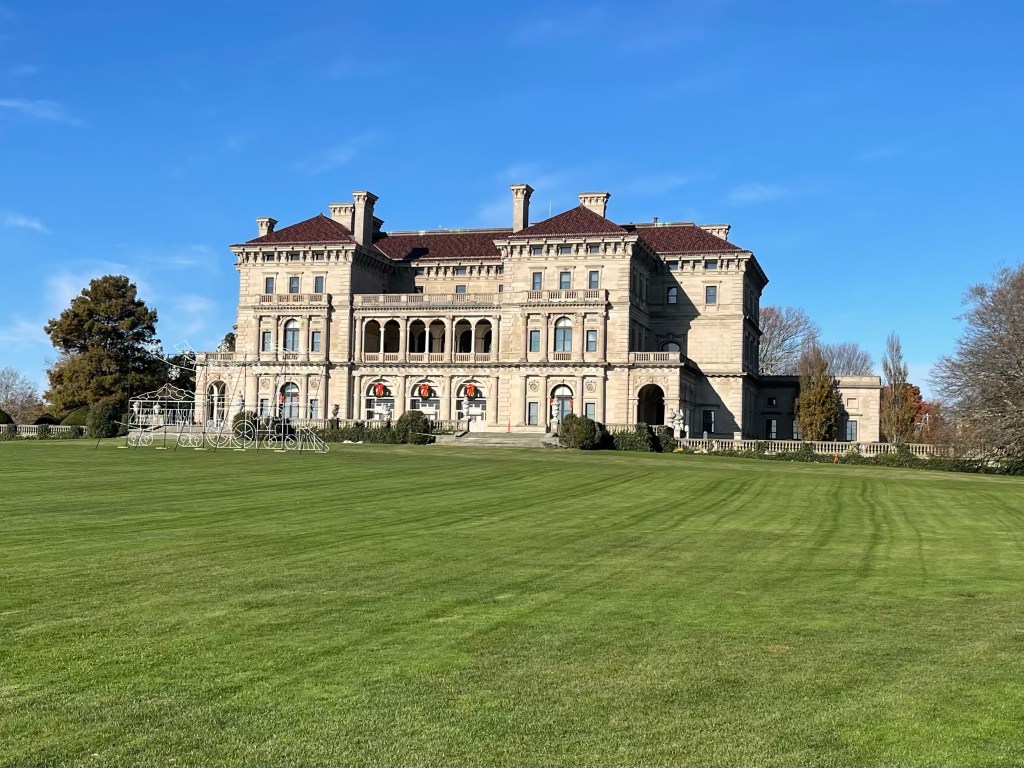
    The Breakers
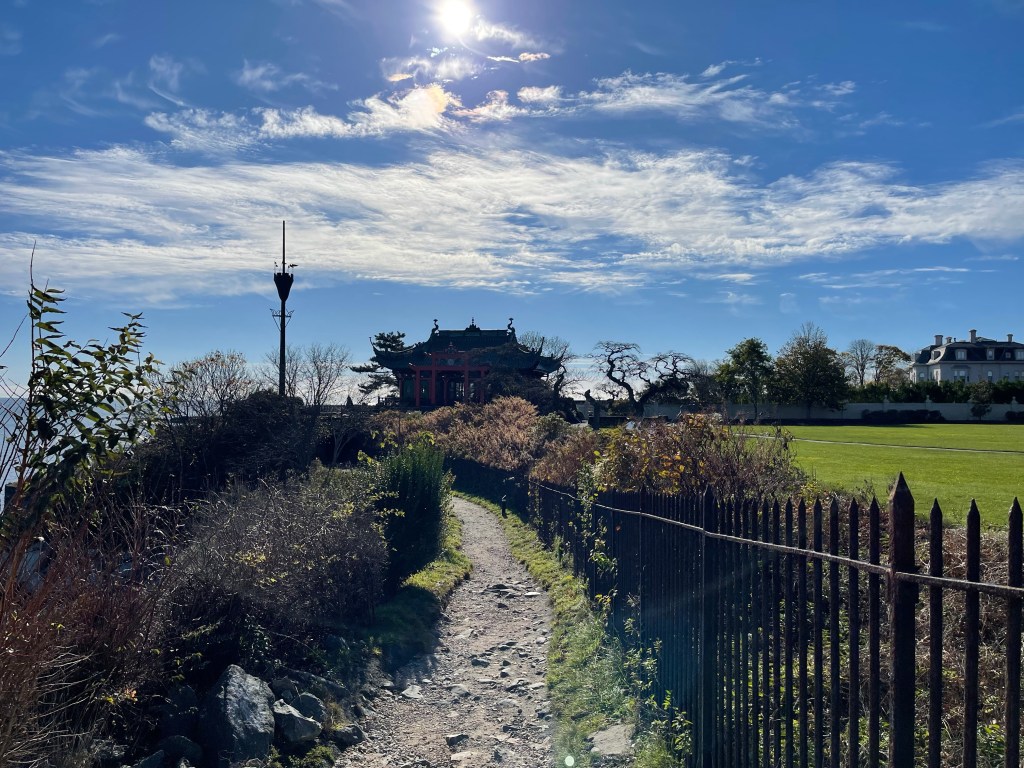
    Beautiful gazebo tucked up tightly against the Cliff Walk
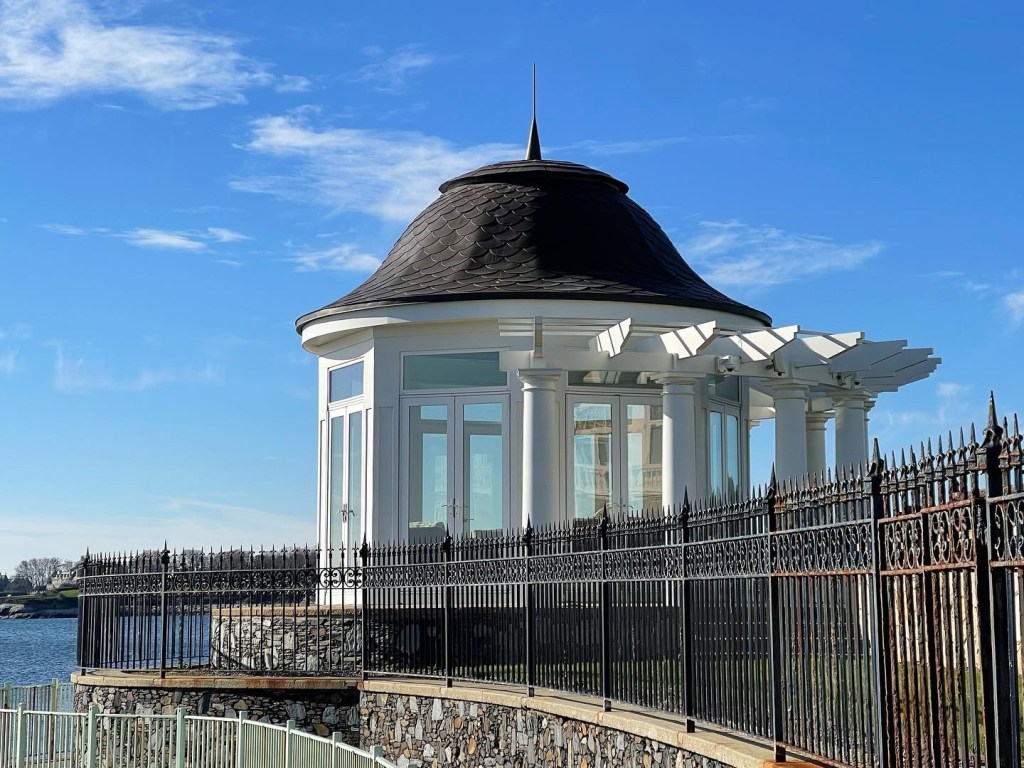
    The Tea House, shadowed by morning sun
    Tunnel under the Tea House
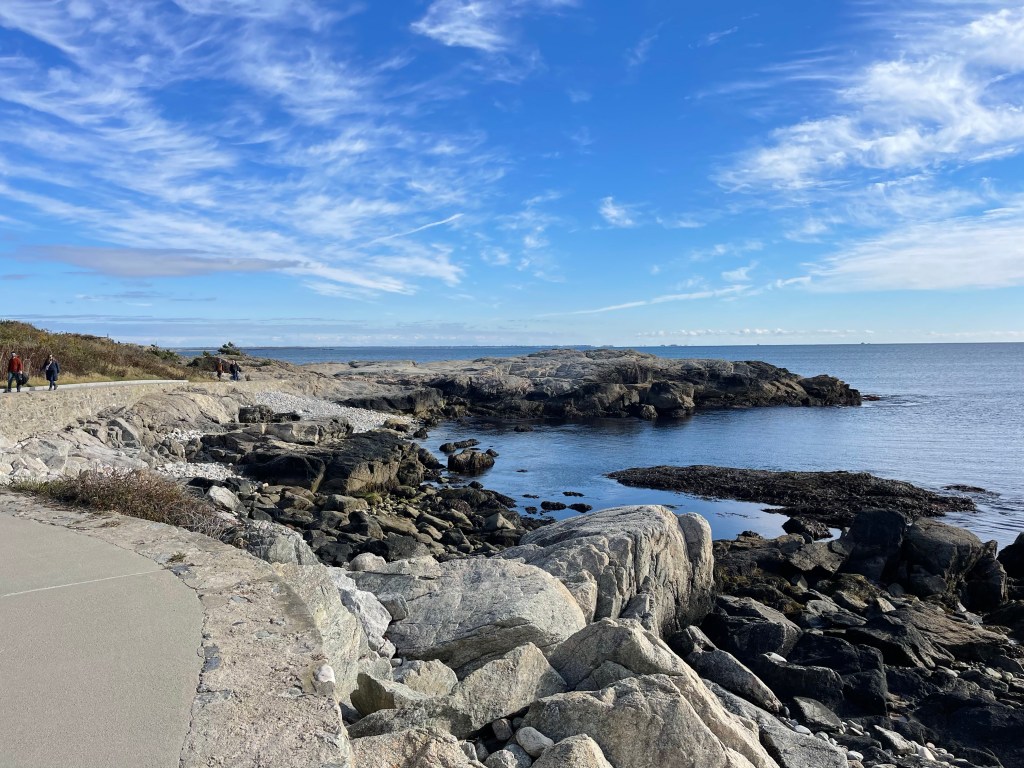
    Not all sections of the Cliff Walk are easy to traverse
    Rugged coastal beauty is everywhere between the Cliff Walk and the sea
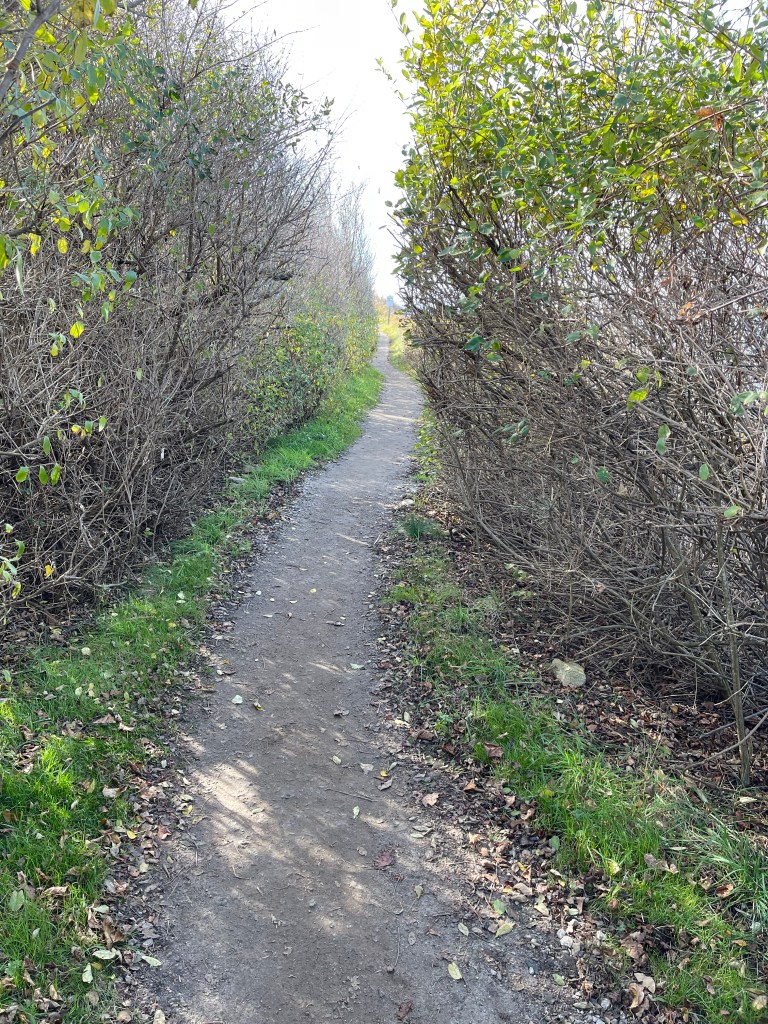
    All kinds of terrain will greet you on your walk
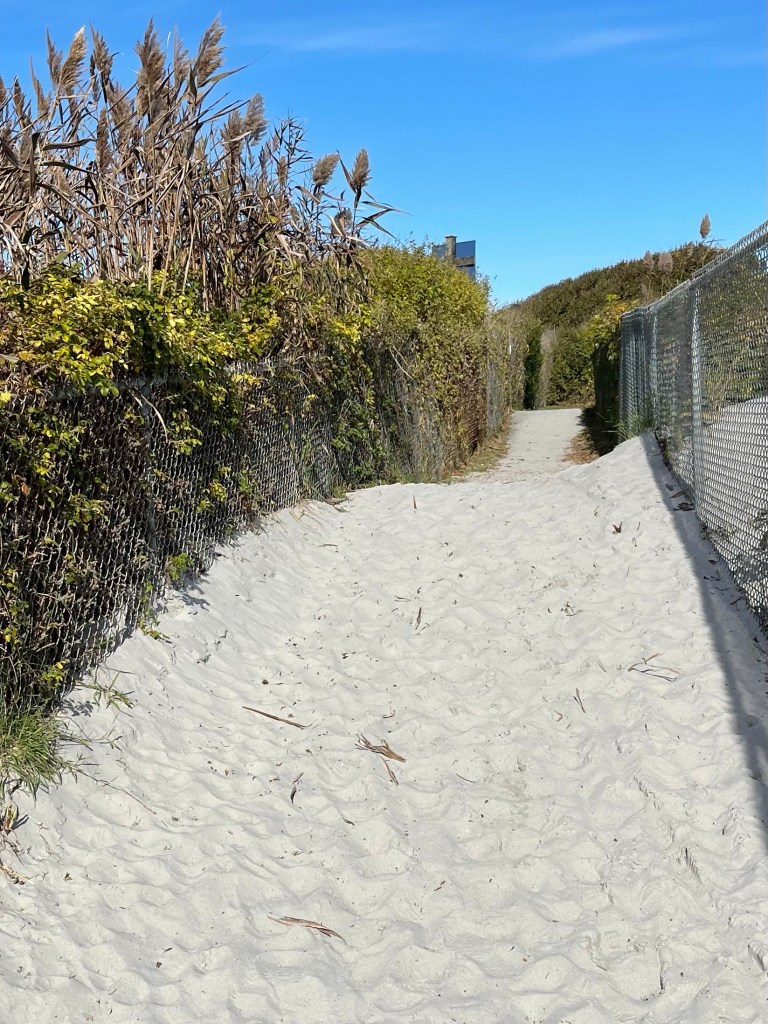
    The finale of the Cliff Walk is a walk through beach sand to the road
  • Narraganset Bay to Lake Champlain

    I drove the 310 miles between Newport, Rhode Island and Burlington, Vermont in two legs, with a brief nap at home in between. Heavy rain and a relentless, brilliant lightning display will be what I’ll remember about the first leg, and the mist covered Green Mountains of Vermont surely will be the thing I remember about the second. It occurred to me that this journey 250 years ago would have been very different indeed. Instead of driving up I-93 to I-89, my options would have been to sail south to the Hudson River for an arduous journey upriver, a risky portage to Lake George, and another between Lake George and Lake Champlain or alternatively taking the northern route up to the St Lawrence River over to Lake Champlain. Either proposition was shorter and safer than the overland I did would have been.

    Sometimes we take for granted just how far we’ve come in such a short amount of time. I’ve come to appreciate our collective technological advancement more through reading history and traveling from place to place. Communication has advanced along with the roads, and now I have the ability to talk to anyone in the world in seconds. How awed King George would have been, and what a difference good roads or communications would have made in the wars fought along the shores of Newport and Lake Champlain. That route from there to here seems a lot further given the hindsight of history.

  • An Island of Two Names

    I got to spend a little time on Rhode Island, in the State of Rhode Island, on Friday and Saturday.  It wasn’t a long stay, but with my son living in Portsmouth and working in Newport, it was a worthwhile one.  There are three towns on the island; these two and the appropriately named Middletown between them.  There are three bridges connecting the island to the rest of the state.

    The Narraganset called this island Aquidnet, and this evolved into the English calling it Aquidneck Island.  But like so many places where one population gave way to another, this island has that other name too – Rhode Island.  So the smallest state in the nation shares its name with its biggest island.  In fact its the origin of the name for the state.  Newport and Portsmouth were the original settlements and things just grew around them. But why have two names when you can just call the island Aquidneck and the state Rhode Island?  Because that’s the way Rhode Islanders like it.

    A close-up of that 1677 John Foster “Mapp of New England” shows the name as Rhode Island.  Newport is noted, and Portsmouth is shown as a town though not named.  Mount Hope is just across the water and Providence is further inland.  The map is oriented with West up and North to the right, and things are out of scale but you can clearly see Rhode Island as they knew it.

    Portsmouth was settled by a group of “Christian Disidents” seeking religious freedom.  The most famous of whom was Anne Hutchinson.  They noted their intent in the Portsmouth Compact on March 7th, 1638:  They noted their intent in the Portsmouth Compact on March 7th, 1638. This, according to Wikipedia, was the first document in American history that severed both political and religious ties with England:

    The 7th Day of the First Month, 1638.
    We whose names are underwritten do hereby solemnly in the presence of Jehovah incorporate ourselves into a Bodie Politick and as He shall help, will submit our persons, lives and estates unto our Lord Jesus Christ, the King of Kings, and Lord of Lords, and to all those perfect and most absolute laws of His given in His Holy Word of truth, to be guided and judged thereby.

    The most famous of the three towns was and is Newport of course.  It was founded after Portsmouth by some of the settlers who moved from that town down the island.  Newport’s fame came when it became the playground of the wealthy who tried to outdo each other with their summer homes, the Newport Mansions.  That wealth brought in sports that the wealthy pursued; It was home of the America’s Cup for years, and home of the Tennis Hall of Fame, complete with grass court.  Newport has a certain upper crust vibe to it, much like Nantucket.  Middletown and Portsmouth are more working class, but with equally beautiful waterfront views. The main route through all of them has evolved to be strip mall heavy, but as with many places, once you get off the retail strip things improve greatly.

    This island was occupied by the British during the Revolutionary War, and held by them for three years.  As with Manhattan and Philadelphia it was an excellent port that worked to the strengths of the British Navy, allowing them to stage troop movement against the Americans. The American Army tried to displace the British once in that time in the Battle of Rhode Island with the support of French ships blockading the British.  This was the first engagement of the combined American and French forces against the British.  It didn’t go as planned as the French weren’t particularly aggressive in the naval engagements and the Americans were driven away when British reinforcements were able to land.  British naval might may have gotten into the heads of the French, who had the tactical advantage at the time. One other notable first from the battle was the very first mixed-race regiment, the 1st Rhode Island Regiment, had their first action of the war on the island.

    I’ve got a few connections to this island, but it remains a place I haven’t spent enough time in.  The last couple of years has changed that, and perhaps I’ll explore the island even more over the next few.  But as is my nature, I’ll most likely do it in the off-season when the crowds die down a bit.  There’s a history worth exploring on Aquidneck Island, er, Rhode Island… or whatever you want to call it.

  • Joshua Slocum

    Joshua Slocum

    On April 24, 1895, Joshua Slocum sailed out of Fairhaven, Massachusetts on his gaff-rigged sloop Spray.  He returned to Newport, Rhode Island on June 27, 1898, and documented that incredible solo sail around the globe in his book Sailing Alone Around the World.  His trip and the book were worldwide phenomenons, and Slocum was a celebrity on par in the minds of commen men with Presidents and royalty.

    Slocum was born in Nova Scotia on the island and grew up on Brier Island, where his grandmother was the official lighthouse keeper.  Brier Island, on the eastern edge of the Bay of Fundy, was the site of many shipwrecks over the centuries.  I’m sure that childhood molded the man who would become world famous with his trip around the world.

    Slocum made a second voyage with Spray up the Erie Canal to Buffalo for the Pan-American Expo in 1901, which is famous for the execution of President McKinley by an anarchist.  There’s a fascinating picture on the Wikipedia page for Slocum that shows the Spray moving through one of the locks of the Erie Canal on his voyage west to Buffalo.  That would have been an interesting voyage as well.

    Slocum, a restless spirit for sure, would try another voyage with the Spray in 1909 exploring the Amazon River.  Slocum and the Spray disappeared on that voyage, never to be seen again.  Did the Spray sink?  Did natives raid the sloop, kill Slocum and dismantle the Spray for use in other ways?  Was there a fire onboard?  We’ll never know, unless someone unearths the remains of the Spray someday in the mud of the Amazon or while diving off the coast of Brazil.

    What remains is one of the great books on adventure travel, some old grainy pictures of the Spray with Slocum sailing her, and a few monuments to the two.  I visited one of those monuments in Fairhaven.  It’s a quiet little spot with a view of the harbor.  A monument behind Slocum’s pays tribute to the last surviving pilgrim, which is notable company, but Slocum’s monument stands closer to the water.  I think he’d have liked it.