Tag: Paul Arden

  • Tell About It

    Instructions for living a life:
    Pay attention.
    Be astonished.
    Tell about it.
    — Mary Oliver, Sometimes

    “If you give away everything you have, you are left with nothing. This forces you to look, to be aware, to replenish.” — Paul Arden

    Writing is simply a practice for tracking and amplifying progress in this bold act of becoming what’s next. There are no advertisements or subscription fees or hints to go buy whatever it is I’m selling that day. There’s simply a trail of breadcrumbs in the form of a daily blog for those inclined to follow along to see what this fool is up to now.

    More than that, it serves as a vehicle for sharing my attention and awareness and growth when it would be easier perhaps to just consume my share and leave the words for others. Who really has time to follow yet another blogger in this crazy world anyway? Viewed as a daily ritual leading to self-improvement and a greater awareness of my place in this world gets me closer to why. But it’s more than that, for wouldn’t a journal serve the same purpose? No, there’s something in the act of sharing everything that opens up the mind to receive more.

    To live and then to tell about what we’ve encountered along the way is to expand our lives beyond ourselves—beyond our time and place and circle of trust, and connect with some soul who may never know you but for these words. Like the tide ebbing and then flowing again, we are refreshed, alive and connected with the rest of the universe as soon as we click publish. We owe it to ourselves to have something to say in that moment. That each post may just be our last implores us to do our best with it. Living with urgency brings vibrancy to the otherwise mundane possibility of another today (sort of like yesterday). Fully aware and ready to share what we see with others forces our senses open. To find something new to be astonished about today seems a lovely way to move through a life, don’t you think?
  • Haven’t Found Right Yet

    “Being right is based upon knowledge and experience and is often provable. Knowledge comes from the past, so it’s safe. It is also out of date. It’s the opposite of originality… Experience is the opposite of being creative. If you can prove you’re right you’re set in concrete. You cannot move with the times or with other people. Being right is also boring. Your mind is closed. You are not open to new ideas. You are rooted in your own rightness, which is arrogant… it’s wrong to be right, because people who are right are rooted in the past, rigid-minded, dull and smug. There’s no talking to them.” — Paul Arden, It’s Not How Good You Are, It’s How Good You Want to Be

    It takes an advertising person to call it like it is, and Arden is certainly that. I read all sorts of books just to get a different perspective than my own. Arden sold me on his book with the subtitle: “The world’s best-selling book by Paul Arden”, which is pretty clever (for who can argue the point?) and likely sold a few extra copies to people like me who appreciate a good spin of words. It’s not a heavy lift by any means, but there are a few insights like the one above that make it worth the quick read.

    The takeaway here is that holding on to our rightness is suffocating our potential to become something more than who we are now. If we aren’t currently masters of our craft, whatever that is, then we likely haven’t found right just yet (believing we have is simply keeping us from ever reaching it). Looking at the crafts we desire to master with a clear eye, which have we come closest to reaching mastery in? Put another way, if good is the enemy of great, what have we simply settled into good enough at? We owe it to ourselves to stop posturing right all the time and make more mistakes. Good enough is a trap.

    The truth of the matter is, we never quite master anything in our lifetimes, even as we aspire to excellence (Arete). Good enough is often all most people want for themselves, me included. But arete whispers in the quiet moments, challenging the status quo. We must stop dwelling on how right we believe we are to have arrived here and dare to make mistakes more often. Otherwise, we’ll remain in a rut that feels attractive for its familiarity but is simply a destination with no end. We’ll never find excellence in a rut, we must climb up to reach it.

    Carpe diem already.

  • To Go Beyond

    “Firstly you need to aim beyond what you are capable of. You must develop a complete disregard for where your abilities end. Try to do things you’re incapable of.” — Paul Arden

    “The human spirit lives on creativity and dies in conformity and routine.” ― Vilayat Inayat Khan

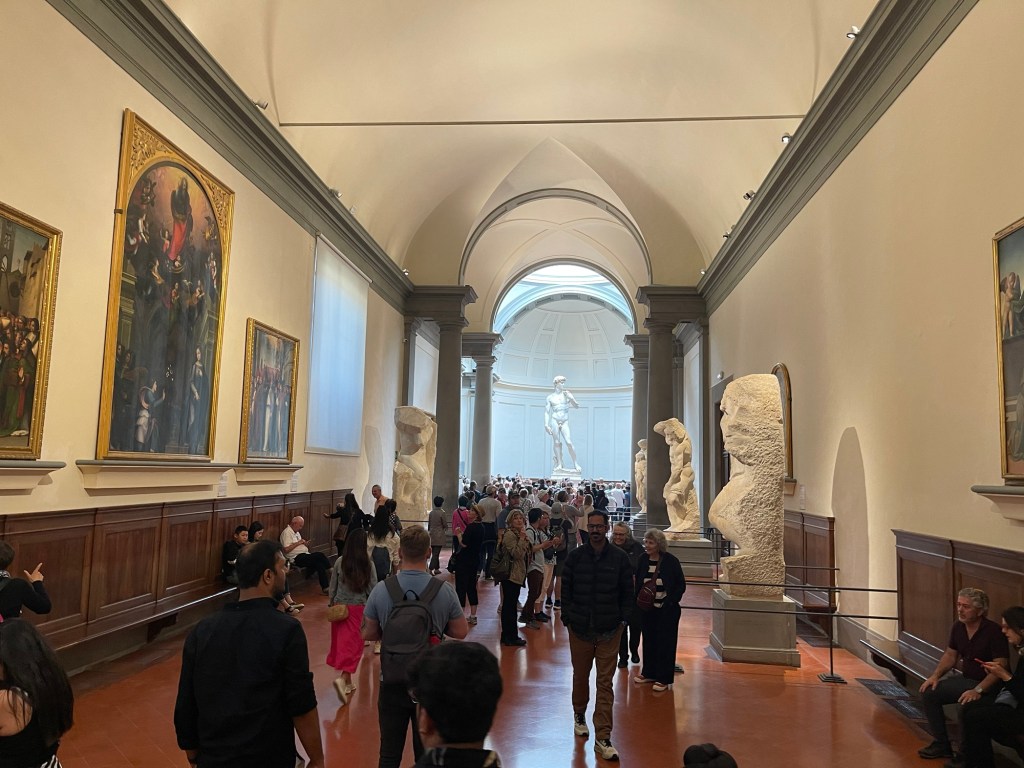
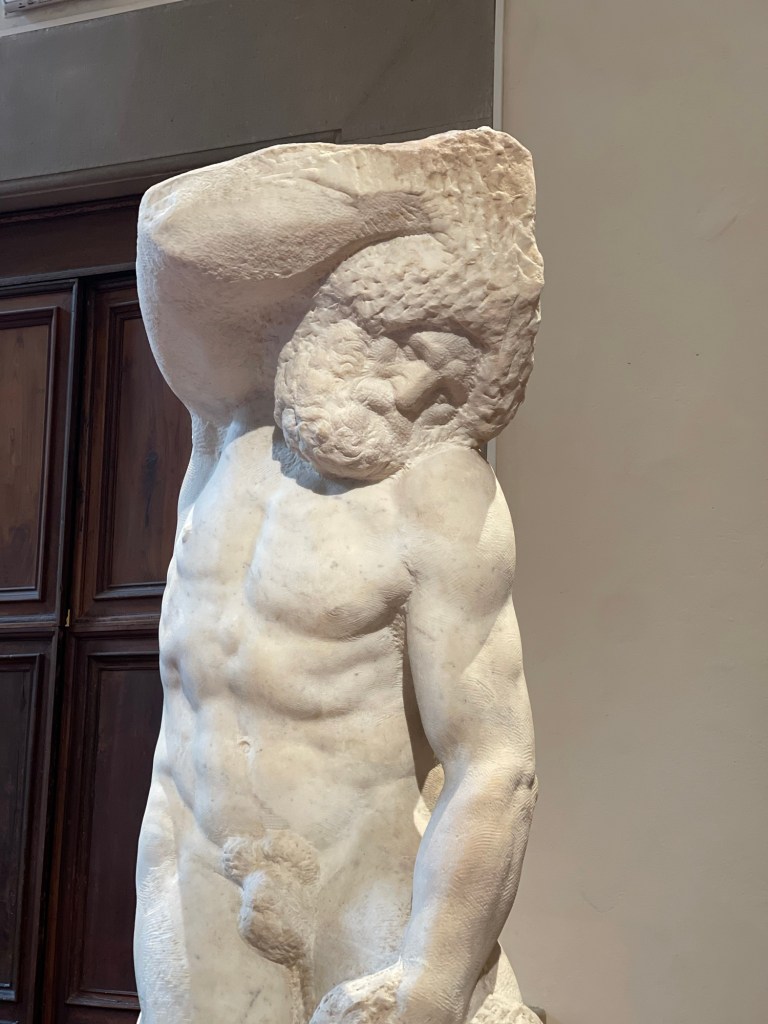
    When you walk up to Michelangelo’s David at the Accademia Gallery in Florence, some of his other sculptures in an unfinished state line the aisle on either side of you. Spending some time with each instead of just rushing past to see David is the best way to see how he released the masterpiece from the marble, as he described it. You can almost see them fighting to break free from the block, just awaiting the help of Michelangelo’s chisel. And so it is when you arrive at David, you understand where he came from—released perfection from a famously imperfect block of marble.

    The interesting thing about that block of marble was that two other artists had begun work on it, gave up on it and it sat partially chiseled and ignored by other artists who couldn’t see the masterpiece within. It wasn’t until Michelangelo saw David within that it became his project. And we are left with the brilliant result, forgetting sometimes the imperfect marble it started as.

    Lately I’ve been wrestling with the imperfect block myself, deciding whether there’s a masterpiece in there or not. To commit and begin chiseling away at something beyond what we are capable of in the moment is the only way to release something exceptional from the average. But why wait? There are no perfect blocks, only something trying to break free from what we have now. So begin with whatever it is we’ve been given and find what calls from within. In those unfinished sculptures is the pain of a masterpiece that never broke free for want of more time.

    The journey to David takes you past unfinished would-be masterpieces
    Michelangelo’s unfinished self-portrait forever trying to break free from the block