Tag: Philosophy

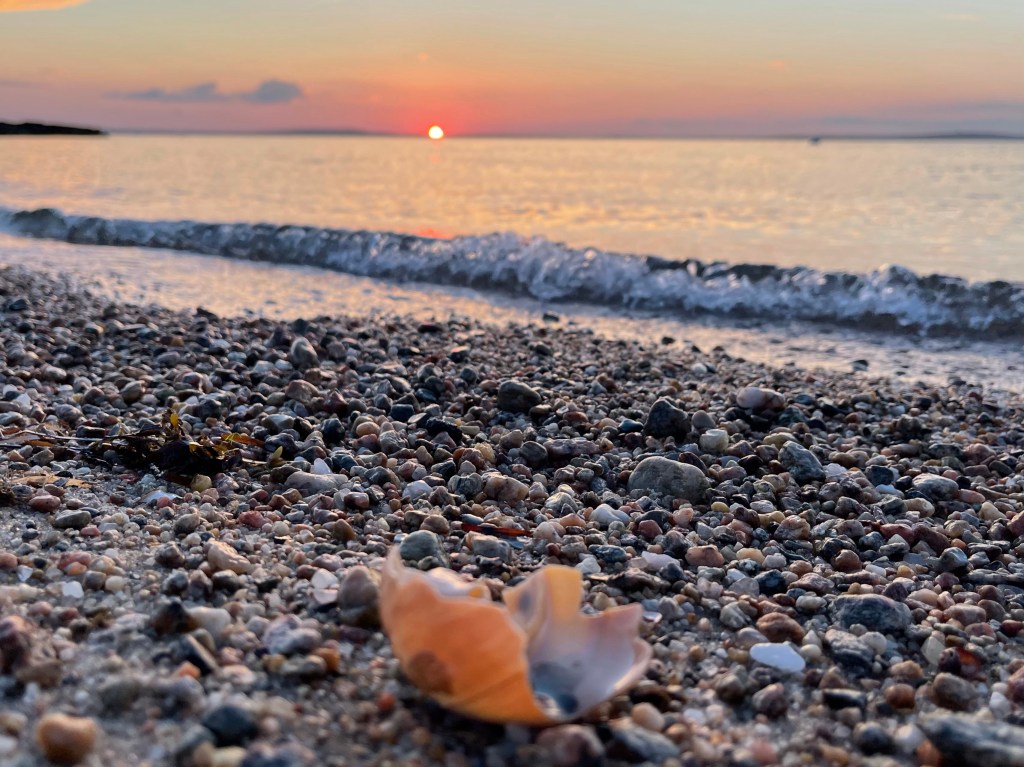
  • Soggy Bottom Sunrise

    It was early,
    which has always been my hour
    to begin looking
    at the world

    – Mary Oliver, It Was Early

    No doubt I missed the stunning pink sky on display when I hauled the kayak down to the surf line. No doubt I might have found a better picture had I just gotten up and out there sooner. But why dwell on might-have-beens? Make the most of what’s in front of you.

    There’s a lesson there for the bigger things swirling around you. Things bigger than sandy feet and a soggy bottom as you walk back into the world after greeting the new day as best you could. The world keeps doing its thing whether you show up or not. But isn’t it nice when you do show up?

  • Tides and Time

    “Eventually tides will be the only calendar you believe in.” – Mary Oliver, To Begin With, the Sweet Grass

    We get so caught up in schedules and appointments and such, when all that really matters is conversation and honoring commitments and that most intangible thing of all: progress. Are we progressing in the direction we pointed ourselves in or not? What do you do with the answer to that question?

    Like many, I’m fascinated with people that step off the calendar and follow their own path. The through-hikers and ocean cruisers and the off-the-gridders who opt out of the stories we tell ourselves about time. The older I get the more I recognize the story of time isn’t always in sync with my own natural rhythm.

    So do you reconcile this in your life? Do you favor deadlines and schedules that dictate so much of our short stack of trips around the sun? Or do you prioritize living by your own rhythm? I should think the closer you are to the latter the more fulfilling your life might be.

  • To Leap in the Froth

    May I never not be frisky,
    May I never not be risqué.

    May my ashes, when you have them, friend,
    and give them to the ocean,

    leap in the froth of the waves,
    still loving movement,

    still ready, beyond all else,
    to dance for the world.
    – Mary Oliver, Prayer

    It’s been almost a year now, and I think of you when I come across a poem like this. You were a dancer, covering a dance floor with the same elegance and ease that you’d use in a tricky conversation. And sure, you were equally at ease leaping in the froth of the waves not all that long ago. Measuring up to that standard hasn’t been easy, friend, especially in this pandemic and the lingering bitterness of political strife. You’d navigate that more easily too.

    There were times over the last year when I could have used your perspective on things, but then again, I can hear exactly what you’d tell me in those imagined conversations. So we press on, doing what must be done, leaving that stuff to sort out another day. And honor your memory with action, humor and a healthy dose of friskiness.

    When I pass, sprinkle my ashes in the ocean on an outgoing tide. Life is movement and a dance through our days. I don’t want to rest in peace when it all ends, but to skip across the waves to the ends of the earth. And there, maybe, we’ll meet again.

  • What We Create, What We Leave Unfinished

    We create ourselves by our choices. – Søren Kierkegaard

    In my house there are a hundred half-done poems.
    Each of us leaves an unfinished life.

    – Mary Oliver, Thinking of Swirler

    It’s an oddity in my character, admittedly, that I linger with poetry and well up with emotion over words. After a particularly stunning pink swirling sky at sunrise I could think of nothing better to do with my morning coffee than pair it with Mary Oliver. Life is a series of choices, one quietly laid upon the other, carrying us to eternity. I’ll regret many, but not this one.

    What will we create in our time here? What will we leave unfinished? These are the questions of a lifetime, and the questions of each day.

    I’ve mentally cast aside this blog dozens of times, but each morning I wake up and write anyway. It isn’t the writing that challenges and mocks me, it’s measuring up to the words. Knowing what’s unfinished, knowing the choices that make up a lifetime. Waking up with a chance to measure up once again.

  • Reaching Beyond the Immediacy of Our Experience

    “Men honor what lies within the sphere of their knowledge, but do not realize how dependent they are on what lies beyond it.” – Zhuang Zhou

    “The whole problem with the world is that fools and fanatics are so certain of themselves and wiser people are so full of doubts.” – Bertrand Russell

    Robert Greene, in his great book Mastery, describes the challenge a missionary had with understanding the language of a remote tribe in the Amazon. The key for the missionary to unlock the code of their language was when he realized that everything they did was based on immediacy of experience, for what was not before the tribe’s eyes did not exist.

    You don’t have to dive too deeply into social media to recognize that this trait is deeply embedded in the larger world today. So many believe at face value what they’re familiar with, and ignore the prospect that what they’ve learned might not be true. Worse, they parrot what they believe to be true, reinforcing their immediacy of experience instead of transcending it.

    Part of the problem is that people become comfortable being comfortable. Sticking with the same social circle that believes a certain thing, not challenging family or a leadership figure in your life that spouts a certain viewpoint to the exclusion of all others, and most of all, not challenging ourselves. For questioning our very beliefs can becomes very uncomfortable indeed.

    “People who do not practice and learn new skills never gain a proper sense of proportion or self-criticism.” – Robert Greene, Mastery

    To reach wisdom is to grow beyond the immediacy of our experience. This seems self-evident, doesn’t it? Growth infers expansion. To go beyond our present limitations. It’s not comfortable, but growth is never comfortable. And we must persist through discomfort to transcend it.

    “The reasonable man adapts himself to the world: the unreasonable one persists in trying to adapt the world to himself. Therefore all progress depends on the unreasonable man.” – George Bernard Shaw, Man and Superman

    The path to progress, mastery, wisdom, excellence… whatever you choose, necessitates placing yourself into the uncomfortable. This may feel at times like being overwhelmed, or being called out by others, or dealing with imposter syndrome, or a combination of all of these things. We’ve got to wade through all of this to reach beyond our limits. Where, deep down, we know that we ought to be.

  • Accepting Whatever

    “Flow with whatever is happening and let your mind be free. Stay centered by accepting whatever you are doing. This is the ultimate.” – Zhuang Zhou

    Being present in the moment requires a level of surrender that my mind doesn’t easily achieve. So I trick it with the odd mundane task like picking cherry tomatoes or deadheading the geraniums or some such thing. It’s in moments like these that I finally reach the ultimate. It won’t last, but my mind and heart sync for a few beats.

    Now is more easily achieved when hiking through a quiet forest or paddling across still water. In these situations the vastness of the universe shrinks down to the immediacy of the next step or the next dip of the paddle as drops of water sprinkle down on you from the opposite, raised blade. Your restless mind has no say in the matter in such moments. It’s just you and whatever you are doing.

    I should think that I might never reach some of the things my mind wrestles with. I should think I’ll pass one day having left too much on the table. I may curse the folly of an unfocused mind in that last moment, or celebrate the stillness that awaits me. You aren’t free until you realize that that moment is now.

  • The Thing We Ought to Be

    “The ideal life, the life of completion, haunts us all; we feel the thing we ought to be beating beneath the thing we are. We are haunted by an ideal life, and it is because we have within us the beginning and the possibility of it” – Phillips Brooks

    It sneaks up on you now and then, this feeling. It’s a nagging call for action, Thoreau described it as quiet desperation, a feeling that you’re living below your dreams and see no path to reach them. But he would also remind us that it’s okay to build these castles in the air, just build the foundations underneath them.

    What do we make of ourselves when we know what we ought to be?

    How we reconcile this in our own lives is how we determine for ourselves whether we lived a successful life on our deathbed. But let’s not get ahead of ourselves. When you pause in a quiet moment in the day and reflect on where you are and where you’re going, do you like the answer?

    The haunting is a call to action.

  • Unattempted Adventures

    “When the first light dawned on the earth, and the birds awoke, and the brave river was heard rippling confidently seaward, and the nimble early rising wind rustled the oak leaves about our tent, all men, having reinforced their bodies and their souls with sleep, and cast aside doubt and fear, were invited to unattempted adventures.” – Henry David Thoreau, A Week on the Concord and Merrimack Rivers

    There’s finally, blessedly, a plan. Places to be, filled with uncertainty and doubt, in the very near future. With one eye on the variants and another on the weather, reservations and bookings complete. There’s new hope for a return to attempting the previously dreamed of. New adventure awaits.

    The moment Thoreau wrote of above took place when he was a young man, before his brother passed away from tetanus, before he wrote Walden or Civil Disobedience. Just a couple of young adventurers waking up along the Merrimack River in Tyngsborough, Massachusetts ready to take on their previously unattempted. It captures that moment of waking up excited and recharged and bursting to get out there and do what you’ve been scheming to do. It’s a more comma-intensive version of my favorite Thoreau quote of all:

    “Rise free from care before the dawn and seek adventures.”

    It should be no surprise to readers of this blog that I’m scheming again. Ready and willing to burst from this big empty nest of a tent and get out in the world again. Big adventures planned for September and October. Micro adventures to fill the gaps, beginning immediately. Room for a pivot here and there, to be sure, but if you don’t plan it and take the leap you’ll just put it off for another day that may never come.

    When you woke up this morning and took stock of the world around you, did it give you a bit of a thrill? If you aren’t buzzing with anticipation, what are you waiting for? Cast aside your doubt and fear and get to it already. Tackle those unattempted adventures.

  • Table of One

    “We are here to awaken from our illusion of separateness.” – Thich Nhat Hanh

    I went to a restaurant last week for dinner. We sat under a covered patio on a beautiful night, hard surfaces all around and a low buzz of conversation reverberating from table to table throughout the space. Halfway through dinner a group sat at a table nearby and began loud talking to each other, and I listened as the rest of the tables reacted. We all want to be heard, and the natural inclination is to raise your own voice. The restaurant transformed right before my ears to a dull roar.

    We live with technological amplifiers that drive our differences home, stir the pot and separate people into us and them. The world is full of voices seeking to be heard, and people will amplify differences for attention and profit. Just like that restaurant, we find ourselves in a place where the only way to get attention is to shout. But when everyone is doing the same thing you reach a point of diminishing returns.

    The thing is, that group that sat down looked like a fun bunch of people. So did the people at the other tables. I might be slightly biased, but so are we. But we were all placed in a position where we were competing to be heard against the other tables around us. Each expressing themselves to an audience that was finding it hard to follow along.

    The world has never felt more separated. Yet each of us are connected and largely the same. With similar hopes and dreams and a basic need to be heard and understood. Our separateness is an illusion. We were all on the same patio, in the same restaurant, no matter which table we sat around.

  • Change Begins With Understanding

    “When you plant lettuce, if it does not grow well, you
    don’t blame the lettuce. You look for reasons it is not
    doing well. It may need fertilizer, or more water, or
    less sun. You never blame the lettuce. Yet if we have
    problems with our friends or family, we blame the other
    person. But if we know how to take care of them, they will
    grow well, like the lettuce. Blaming has no positive
    effect at all, nor does trying to persuade using reason
    and argument. That is my experience. No blame, no
    reasoning, no argument, just understanding. If you
    understand, and you show that you understand, you can
    love, and the situation will change.” – Thich Nhat Hanh

    I have a low tolerance for blame. Blame doesn’t reach for solutions, blame swims in the dark pool of emotion trying to drown everyone else. There’s no productivity in blame.

    And yet I struggle with it. Blaming the world for not choosing better leaders, blaming the unvaccinated for the Delta variant, blaming myself for not focusing more on disciplined action during a pandemic. And what does that do? Stirs resentment with all that is around us. And so I work to drown the blame instead of directing it at others. Seek first to understand, then to be understood. Look for solutions instead of scapegoats.

    I know why the lettuce won’t grow: there’s a determined and hungry family of rabbits who keep eating it. And in knowing that I can find a solution. A fence, or a dog, or raised beds… the solutions come to you when you start looking for one. And isn’t that what we desire most? To change the situation we first must change our state. And to see with an open mind.