Tag: Philosophy

  • From This Moment

    “How quietly I
    begin again

    from this moment
    looking at the
    clock, I start over

    So much time has
    passed, and is equaled
    by whatever
    split-second is present

    from this
    moment this moment
    is the first”
    – Wendell Berry, Be Still In Haste

    Two weeks into the New Year. About as distracting a beginning to a New Year as I can ever recall. We know where we’ve been, where we’ve come from. But what comes next? We change from moment to moment with the ticking of the clock, but what do we do with that change?

    Start over. Again.

    “Time does not exist. There is only a small and infinite present, and it is only in this present that our life occurs. Therefore, a person should concentrate all his spiritual force only on this present.” – Leo Tolstoy

    Sometimes it feels like we’re marching on a treadmill, especially during a lockdown, but you look back and see progress despite the illusion. A pile of actions that didn’t work. A few, sifted through the remains, that did. What do we make of it? All that has passed, has passed. This moment is the one that counts. This moment is the first.

    Keep trying. Again. And again.


  • Poised, and Wise, and Our Own, Today

    In times when we thought ourselves indolent, we have afterwards discovered that much was accomplished, and much was begun in us.– Ralph Waldo Emerson, Essays: Second Series, “Experience (and all subsequent quotes in this post)

    I got lost in the headlines for a bit before writing today. Getting spun up in politics and pandemics and the bad behavior of others. It’s important to be aware, to have an informed opinion to fight the good fight. I suppose… but indignation doesn’t spark the creativity I aspire to. And so a return to Emerson was in order.

    These are dark, wasted days if you choose to believe it. Alternatively, they’re the best, most productive days of our lifetimes. What do you prefer?

    “Every ship is a romantic object, except that we sail in. Embark, and the romance quits our vessel and hangs on every other sail in the horizon. Our life looks trivial, and we shun to record it.”

    Comparison is a bear. How we’ve spent the last year compared to someone else does us little good. I think of wasted opportunities and stop myself, for there’s no use going down that path. For all the madness of the last eleven months much was accomplished. Much is being accomplished. We might not see it just yet.

    “Life itself is a mixture of power and form, and will not bear the least excess of either. To finish the moment, to find the journey’s end in every step of the road, to live the greatest number of good hours, is wisdom. It is not the part of men, but of fanatics, or of mathematicians if you will, to say that the shortness of life considered, it is not worth caring whether for so short a duration we were sprawling in want or sitting high. Since our office is with moments, let us husband them. Five minutes of today are worth as much to me as five minutes in the next millennium. Let us be poised, and wise, and our own, today.”

    I’ve used the quote above before in this blog. It’s a favorite and I’ll likely use it again. Emerson whispers persistently, for all who might listen. I return to it now and then to remind myself of the worth of this day. Of this hour. Of these next five minutes. What shall we do with them, that we might record as remarkable in these times?

    “Men live in their fancy, like drunkards whose hands are too soft and tremulous for successful labor. It is a tempest of fancies, and the only ballast I know is a respect to the present hour.”

    I began the day with headlines… a tempest of fancies designed to distract and provoke and draw us out of our own heads. But we all have our own ships to sail. There’s urgency in the moment, generational urgency, and we should support those who rise up to meet it. But focus on moving down your own path too. Respect the present hour. Emerson insists.

  • The Birds and Stars Remind

    Let’s face it, the days between the US National Election and the events of January 6th were some of the craziest we’ve ever witnessed in our lifetimes. Not since 9/11 have I been so angry and distracted as I was on the afternoon of January 6th, 2021. And it can be easy to wrap yourself around the pole of ongoing coverage and online opinion and speculation. I let myself indulge in some of that too.

    And then last night I took a walk outside on a brilliantly clear night and saw Orion poised above me. Orion has seen it all before and recognizes the smallness in our human lifetimes. This is big by human standards, but we’re like ants to the universe, and not the big ants but the tiny little ones that you have to squint to make out the features on. Orion whispered “This might be a big week for you but this ain’t nothing to the universe, kid.”

    Earlier this morning I waited for the water to boil for my morning jolt of goodness and watched the birds flitter about from the feeder to the ground, ground to the shrub, and back to the feeder. This crowd featured bluebirds and cardinals and mourning doves and sparrows. Mostly taking their turns at the feeder (except for the mourning doves who rely on scraps falling to the ground), but sometimes impatient with each other to get a move on so they can have their turn. This frenzy continued on well past the coffee being ready. Small little things fighting for their share and a little bit more. Perspective is where you find it.

    This week we saw people acting like squabbling birds at the feeder not wanting to take turns, while others pounced on the scraps below. It was maddening, and the days ahead are fraught with peril. But a walk or a glance outside offers lessons in perspective. We have work to do. A lot of work. But the worst of this will pass if we work together to make things better. Generally humanity is moving ever so slowly towards a better place. We might see this if we break our focus on selfishly fighting amongst ourselves. This ain’t nothing to the universe kid. This too shall pass.

  • Too Cloudy to Forecast

    The plan was to drive out to the wrist of Cape Cod for a sunrise picture. I’ve patiently waited for the right weather window to appear, and when my head hit the pillow it seemed all was a go. But the weather always has other plans, and teaches you to listen even when you want to hear something else. And at 5 AM the clouds obscured everything above Buzzards Bay. A check on cleardarksky.com confirmed that my destination was also overcast with transparency rated as too cloudy to forecast. And so I wrote instead.

    I’m working on my own forecast. Specifically the ten year plan, for the influencers I read tend to recommend thinking in decades not years. Seth Godin just had a great post about it yesterday, which likely planted it front and center on my brain. But he’s not the only one thinking in ten year chunks, and I’d like to be more forward thinking myself. Ten years seems about right for me too.

    Does creating a ten year plan run counter to living in the now? I don’t believe so. I believe it sharpens the focus on now. Instead of going with the flow you’re making the most of the opportunity that now creates. And you’re more inclined to check boxes you might have otherwise put off for some date in the future.

    Ten year thinking involves calculus on maintaining good health and fitness, mental sharpness, financial responsibility and investments to achieve goals, relationships and career. What kind of person do you have to become not so far from now? What do you need to do today to move you closer to that? What do you need to stop doing?

    The future tends to be too cloudy forecast, but we can always move to clearer skies. Or bide our time. As the last year has taught us, the unexpected will surely surprise us, but if we build enough resiliency into our plans we can get beyond even the deepest valleys. We can only see just so far of what lies ahead of us.

    But Mousie, thou art no thy-lane,
    In proving foresight may be vain:
    The best laid schemes o’ Mice an’ Men
    Gang aft agley,
    An’ lea’e us nought but grief an’ pain,
    For promis’d joy!

    Still, thou art blest, compar’d wi’ me!
    The present only toucheth thee:
    But Och! I backward cast my e’e,
    On prospects drear!
    An’ forward tho’ I canna see,
    I guess an’ fear!
    – Robert Burns, To a Mouse

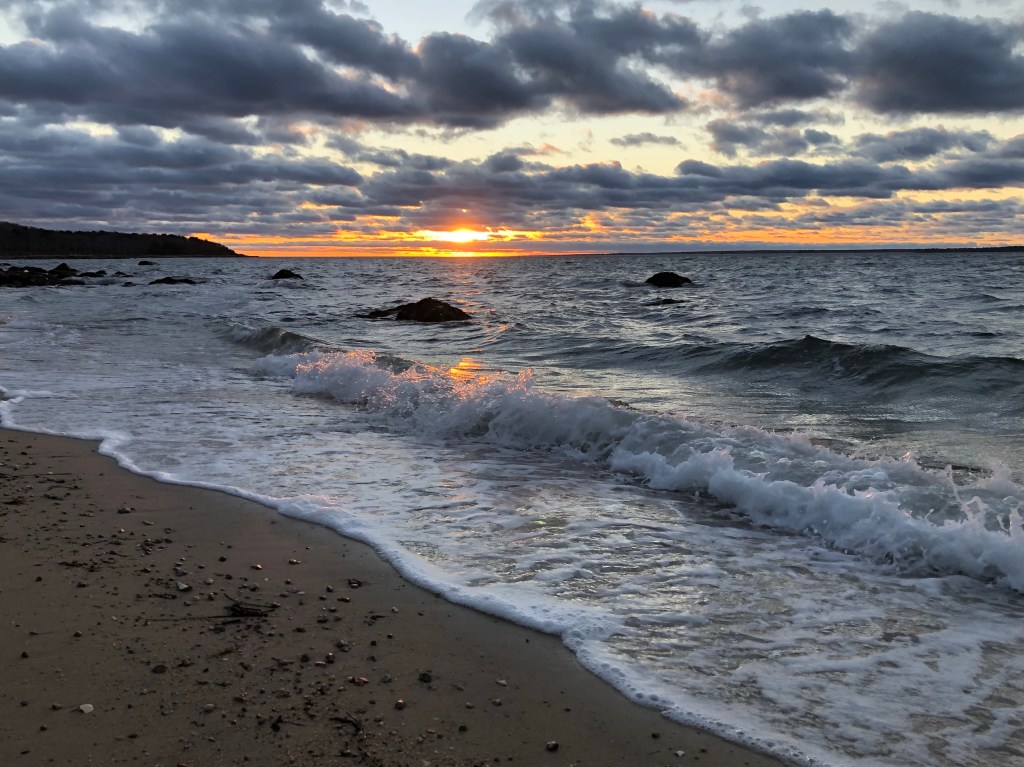
    Last night I saw the potential for a nice sunset down Buzzards Bay. I walked down to a better viewpoint and waited it out in the gusty wind. I thought it would make a nice bookend with the sunrise this morning, but since that never materialized the sunset turned out to be the only picture. I’m glad I didn’t hold out for just the sunrise instead. It serves as a good reminder to enjoy the moments along the way even as you plan and scheme and guess at the future.

    Sunset, Buzzards Bay
  • Bold

    “So long as I am hanging on
    I want to be young and noble.
    I want to be bold.” – Mary Oliver, Desire

    There’s that word again. Bold. I chase it down, let it challenge me. Take a deep breath and get after it yet again. To rise free from care before the dawn and seek adventures, as Thoreau put it so well.

    Latin words for bold translate to audax, confidens, fortis, and they all fit. To be a bit audacious, confident and fortified are generally celebrated in this harsh world. We all aspire to a bit of boldness in our actions, don’t we?

    It’s the last day of the year that most everyone would love to see go away. And yet great things happened despite it all. I started to take stock of the exceptions to the general malaise that was this year and generally the ones I had any control over started with a bit of boldness. Deciding what to be and then going out and being it. I save the selfies for others. Ego is my enemy. Instead of celebrating those mountains climbed and the waterfalls sought out I’m quietly putting them in my memory bank with a smile. That’s what archives and search are for.

    What have we done with our time this year? What will we do today? Next year is upon us, what shall we make of it? Begin in earnest, today.

    I have places to be and I’m excited about the future. That begins with celebrating the last day of the year and finding the next micro adventure to fill the days with wonder until the world opens up again someday. It begins with a measure of boldness.

  • 11 of My Favorite Books Read in 2020

    Looking back on this maddening year, I found I read a lot of poetry that inspired and a lot of page-turner novels that distracted. It would be easy to make half this list collections of Mary Oliver poems, but I subtracted poetry from the list altogether to focus on the craft of the written novel or book. Still, I like to bend the rules, so in making my list of top ten favorite books for the year, I chose eleven. This was a nod to Charlie Mackesy, who spun a bit of magic in a year where it was essential. Illustrating the timeless nature of books (or perhaps how far behind I am in catching up), only four of the eleven were released in 2020. These eleven books are listed in no particular order, largely because there’s a bit of wonder in each of them. Each informed and delighted me.

    Breath: The New Science of a Lost Art by James Nestor
    “The more oxygen life can consume, the more electron excitability it gains, the more animated it becomes. When living matter is bristling and able to absorb and transfer electrons in a controlled way, it remains healthy. When cells lose the ability to offload and absorb electrons, they begin to break down.”

    I find myself thinking often about breathing after reading this book. Waking up with a dry mouth reminds me I need to be better at nasal breathing, when hiking I try to control my breath and focus on how I’m taking in oxygen, and when I chew almonds I crunch with satisfaction, knowing it helps release stem cells and increase bone density. This book is highly informative and strongly recommended for anyone, well, breathing.

    The 80/20 Principle: The Secret to Achieving More With Less by Richard Koch
    “Equality ends in dominance: that is one of the messages of chaos theory. The 80/20 Principle’s message is different yet complementary. It tells us that, at any one point, a majority of any phenomenon will be explained or caused by a minority of the actors participating in the phenomenon. Eighty percent of the results come from 20 percent of the causes. A few things are important; most are not.”

    This was the most highlighted book of the bunch. Honestly, there were chapters I skimmed over because they didn’t sing a tune I wanted to hear, but the theories here are sound. I wish I’d read this book at the beginning of my career, but it’s not too late to implement the core principles in many aspects of my life.

    The Splendid and the Vile: A Saga of Churchill, Family, and Defiance During the Blitz by Erik Larson
    Hitler wanted still more force applied against Britain. America seemed increasingly likely to enter the war but would do so only, he reasoned, if Britain continued to exist. On March 5 he issued another directive, No. 24, this signed by Field Marshal Wilhelm Keitel, chief of the High Command of the Armed Forces (OKW), aimed mainly at how Germany and Japan might coordinate strategy under the Tripartite Pact, which both had signed with Italy the preceding fall. The goal, the directive said, “must be to induce Japan to take action in the Far East as soon as possible. This will tie down strong English forces and will divert the main effort of the United States of America to the Pacific.” Beyond this Germany had no particular interest in the Far East. “The common aim of strategy,” the directive stated, “must be represented as the swift conquest of England in order to keep America out of the war.”

    We all grew up sort of knowing about The Blitz. This book neatly sums up just how tenuous the situation was. I fancy myself well-informed about World War II, but I learned far more from the The Splendid and the Vile than I expected to. For all our complaints about the pandemic, most of us have no idea what real sacrifice is. Larson brings us closer to understanding with this book.

    The Boy, the Mole, the Fox and the Horse by Charlie Mackesy
    “What do you want to be when you grow up?” asked the mole.
    “Kind,” said the boy.


    A beautiful, simple book. I picked this up for my daughter as a gift and read it quickly before wrapping it up. If 2020 kicked you in the ass, read this. Then read it again. The Boy, the Mole, the Fox and the Horse is art, meditation and a warm hug disguised as a book.

    Longitude: The True Story of a Lone Genius Who Solved The Greatest Scientific Problem of His Time by David Sobel
    The zero-degree parallel of latitude is fixed by the laws of nature, while the zero-degree meridian of longitude shifts like the sands of time. This difference makes finding latitude child’s play, and turns the determination of longitude, especially at sea, into an adult dilemma—one that stumped the wisest minds of the world for the better part of human history.

    I’ve danced around this book for years, never getting around to reading it. And then I went to Greenwich and saw the chronometers ticking away in their plexiglass cases and resolved to get right to it when I returned home. This is a story of perseverance solving what was believed to be the impossible. A delightful book.

    Mayflower: A Story of Courage, Community, and War by Nathaniel Philbrick
    No longer mindful of the debt they owed the Pokanokets, without whom their parents would never have endured their first year in America, some of the Pilgrims’ children were less willing to treat Native leaders with the tolerance and respect their parents had once afforded Massasoit.

    Living in New England, you can’t really get away from the story of the Pilgrims. But the part we seem to forget with the Pilgrims is how much they relied on luck and the strategic kindness of Massasoit to survive at all. It seems I’m a descendent of a Pilgrim (or two), so I’m told, and that lineage makes me all the more indebted to the Pokanokets who assured that those first few years here weren’t the last for the passengers on the Mayflower. As the quote above suggests, that indebtedness seemed to skip the next generation, paving the way for the tragedy of King Phillip’s War.

    Draft No. 4: On the Writing Process by John McPhee
    That four-to-one ratio in writing time—first draft versus the other drafts combined—has for me been consistent in projects of any length, even if the first draft takes only a few days or weeks. There are psychological differences from phase to phase, and the first is the phase of the pit and the pendulum. After that, it seems as if a different person is taking over. Dread largely disappears. Problems become less threatening, more interesting. Experience is more helpful, as if an amateur is being replaced by a professional. Days go by quickly and not a few could be called pleasant, I’ll admit.

    Reading McPhee, like reading Hemingway, it’s easy to get just a bit intimidated. The beauty of this book is that he pulls back the curtains to show you the way. Great research, editors and fact checkers smooth out the rough edges and polish the story, but the work you put into it makes the finished product shine.

    Cape Cod by Henry David Thoreau
    The ocean there is commonly but a tantalizing prospect in hot weather, for with all that water before you, there is, as we were afterward told, no bathing on the Atlantic side, on account of the undertow and the rumor of sharks. At the lighthouse both in Eastham and Truro, the only houses quite on the shore, they declared, the next year, that they would not bathe there “for any sum,” for they sometimes saw the sharks tossed up and quiver for a moment on the sand. Others laughed at these stories, but perhaps they could afford to because they never bathed anywhere. One old wrecker told us that he killed a regular man-eating shark fourteen feet long, and hauled him out with his oxen, where we had bathed; and another, that his father caught a smaller one of the same kind that was stranded there, by standing him up on his snout so that the waves could not take him. They will tell you tough stories of sharks all over the Cape, which I do not presume to doubt utterly,—how they will sometimes upset a boat, or tear it in pieces, to get at the man in it. I can easily believe in the undertow, but I have no doubt that one shark in a dozen years is enough to keep up the reputation of a beach a hundred miles long.

    This book, like Philbrick’s Mayflower, informs the native New Englander about the places that once were the places that now are. I have a stack of quotes from this book that I’m saving for other blog posts, but the one above reminds us that the question of sharks has been around a lot longer than we might believe. Like Thoreau I’m much more concerned about undertow when swimming in the surf, but hey, you never know…

    Siddhartha: A Novel by Hermann Hesse
    “Were not all sufferings then time, and were not all self-torments and personal fears time? Weren’t all the difficult and hostile things in the world gone and overcome as soon as one had overcome time, and as soon as time could be thrust out of the mind?

    I’ve heard enough people recommend this book that eventually I had to read it, and I finished it in 2020. Amazingly, it feels like I read this a decade ago, for all that’s happened this year. Like The Alchemist, it’s a story that teaches you a bit about yourself as you wade through it.

    Thinking in Bets: Making Smarter Decisions When You Don’t Have All The Facts by Annie Duke
    What makes a decision great is not that it has a great outcome. A great decision is the result of a good process, and that process must include an attempt to accurately represent our own state of knowledge. That state of knowledge, in turn, is some variation of “I’m not sure.”

    How do you make decisions? How can you make better, more informed decisions when you don’t have all the facts? And what is a game of strategy versus a game of chance? This book uncovers some of these answers. As with anything, there’s book smart and there’s street smart, and reading about it and understanding it in real life are different things. Duke sprinkles in some street smarts hard won on the poker tables.

    Sailing True North: Ten Admirals and the Voyage of Character by James G. Stavridis
    “The contemporary malaise is the unwillingness to take chances. Everyone is playing it safe. We’ve lost our guts. It’s much more fun to stick your neck out and take chances. The whole attitude is to protect yourself against everything, don’t take chances. But we’ve built this country on taking chances” (Quoting Rear Admiral Grace Hopper)

    A quick, enjoyable read that offers lessons learned from some of the great “Admirals” in history. This is examination of character in ten short biographies, but also an unflinching look at racism and sexism in the Navy and how that battle continues to be fought to this day. And there’s no mistaking the Admiral’s feelings about character in certain political leaders we currently suffer through. A timely message for all of us.
  • Somewhere Among Strangers

    Some days I’ll write a blog post and it will immediately take off, receiving a ton of views and a fair share of likes. Nice! But then there are the other blog posts that fall flat, barely registering a couple of views and no likes. Hmm

    Of course I love them both, as any parent might love their children, just the same. For ultimately I’m just working things out on my own, sorting out what I learn, see and do on my own terms. But that’s blogging for you: Sorting it all out, hits and misses, one post at a time. Like days stacked one atop the other.

    “Still, I ponder
    where that other is –
    where I landed,
    what I thought, what
    I did

    what small or even maybe
    meaningful deeds
    I might have accom-
    plished
    somewhere
    among strangers

    coming to them
    as only a river can”

    – Mary Oliver, A River Far Away and Long Ago

    Sometimes I’ll look back on a blog post from a year or two ago when someone likes it, drawing my attention back to the person who wrote it. I’ll ponder the words, remember who I was then and what I was doing and thinking. People who were everything who are strangers now. Strangers who have become everything. How I sorted things out then, and how I do now.

    I note the changes.

    And wonder where this life might meander next.

    And who I might become.

  • Quality Time

    “What is the state of things, then? It is this: I do not regard a man as poor, if the little which remains is enough for him. I advise you, however, to keep what is really yours; and you cannot begin too early. For, as our ancestors believed, it is too late to spare when you reach the dregs of the cask. Of that which remains at the bottom, the amount is slight, and the quality is vile.”
    – Lucius Annaeus Seneca, Letters from a Stoic

    Re-read that Seneca quote and measure your use of alive time against what you have left in the cask. If this year offered plenty of cause to question our use of time or the unfairness in the world, it also gave us time to think and to pivot towards better uses of time than we might have before. But the irony is that we can’t waste time dwelling on it, we can only use it as a guiding light for what we do next.

    Our current use of time is not rational. There is therefore no point in seeking marginal improvements in how we spend our time. We need to go back to the drawing board and overturn all our assumptions about time. There is no shortage of time. In fact, we are positively awash with it. We only make good use of 20 percent of our time. And for the most talented individuals, it is often tiny amounts of time that make all the difference.” – Richard Koch, The 80/20 Principle

    I got out and walked yesterday, pondering the narrow shoulders of the roads in my town and the number of cars driving on them in the busy stretches, and appreciating the quiet stretches with no cars where I could think. The takeaway was to remove the busy roads and walk in places where thinking is 80 percent of your walking time instead of simply surviving the experience. The time allocated to walking was always available to me this year, I just put it aside more often than I used it.

    I think back on the crazy year that was 2020, and wonder where the time went. Too much time on useless activities, chasing after opportunities that turned to vapor in the hard reality of the pandemic, and squandering time on social media, political debate, and watching entertainment of questionable quality. I spent more time with an iPhone in my hand than I should have, but tried to use that time reading the Kindle app, learning a bit of French and Portuguese, and taking pictures of the good moments.

    “The 80/20 Principle says that we should act less. Action drives out thought. It is because we have so much time that we squander it…. It is not shortage of time that should worry us, but the tendency for the majority of time to be spent in low-quality ways… If much greater work would benefit the most idle 20 percent of our people, much less work would benefit the hardest-working 20 percent; and such arbitrage would benefit society both ways. The quantity of work is much less important than its quality, and its quality depends on self-direction.– Richard Koch, The 80/20 Principle

    During those moments of thinking time while walking I turned over the key points of Koch’s book in my head, thinking about the the quality of the time spent and how to spend it better. We don’t really know what’s left in the cask, but we know it’s not as full as it once was. The 80/20 Principle is both obvious and widely ignored by most people. But why be most people? When applied to our use of time, the pursuit of quality becomes… imperative.

  • Stepping Out of Tiny Boxes

    Most people live their entire lives in tiny little boxes of their own making. I recognize the tendency because I too live in my own tiny box. But, for most people, the box we live in isn’t as tiny as it once was. It grows when we step out of it, over and over again. Until it isn’t such a tiny box after all.

    Experience is the great teacher, be it ours or the work of others before us. Reading and understanding are also forms of stepping out. Building things of significance, be they careers or causes or art or relationships, expand our tiny boxes. And journeys of consequence are also expansive in nature. I’ve never quite fit in my old box when I return from a faraway place or a mountain top, nor would I want to.

    Some choose to remain in their tiny boxes. Perhaps they find it comfortable in there. It isn’t our place to expand other people’s boxes, but we can gently coax them outside for a stretch. The sneaky part about helping other people expand their boxes is that ours expand in kind.

    Now and then I’ve realized that inside the box was far more comfortable than the place I found myself on the outside, but I couldn’t get back in again as hard as I tried. Soon any discomfort faded and I realized that it was just my hardened edges expanding to new places. I’ve learned to enjoy that feeling of discomfort more each time.

    We reach a point where we want to spend more time outside stretching, and less time pressed inside our borders. I hope that feeling never goes away, but I see it fades in some people. If you aren’t paying attention you get pretty comfortable in that box you’ve built and even stretching a little bit seems like a step too far.

    If we’re being honest with ourselves, sometimes it feels better to just stay where you’re comfortable. After all, there’s nothing cozy about leaping. Crossing chasms is scary and dangerous work. So why risk it?

    Because we weren’t born to live in tiny boxes.

  • En Passant, Knowing Your Place and Breaking Rules

    I once got in a debate with my grandfather about the rules of chess. Specifically, he would execute En Passant when I would attempt to move past his advancing pawn. At the time I thought I knew the rules of chess, but it seems I’d never fully grasped the rules the pawn plays by. It wasn’t until I took the time to learn chess at a deeper level that I realized he was right all along. And I can see him winking at me in my mind.

    For those who don’t play the game, a pawn may advance one square forward, can’t move past a piece that blocks its forward advance until that piece moves and may capture another piece diagonally forward only. Simple. And then they added another rule to help speed up the game a bit, allowing you to move every pawn two squares forward on its initial move only. Well, this created a problem as well, for if an opponent’s pawn had advanced to a point where your move two squares forward eliminated their ability to capture your pawn in it’s forward diagonal move, you were essentially stealing the already limited power from the opponent’s pawn.

    En Passant, French for “in passing“, is a rule that allows the opponent to say “not so fast!” (Well, really they would say “en passant“) and execute the move of putting their pawn onto your square where your recently deceased pawn had once been. It’s a way of telling you not to get too far ahead of yourself or you’ll pay the consequences.

    And there lies the dark side to En Passant: It’s reminding the pawns of the world to know their place, to not get ahead of themselves or they’ll suffer the consequences. En Passant was invented long before democracy, and pawns generally knew their place and skated their lanes. The bold were snuffed out if they went a step too far.

    In democratic societies we chafe at being pawns, and the bold among us do leap forward. The rules of law can still remind you you’re a pawn if you grow reckless, but mostly it’s other pawns telling you not to stick your neck out. And worse, En Passant largely resides in our own minds: Imposter syndrome, timidity, and fear of the unknown keep us skating in our own lane, one square at a time, while the big players in the world spin around us.

    A pawn that plays by the rules may advance forward diligently and become a queen or any player it wants should it reach the end. There’s a subtle message there too, and you look around and most people play that game. Skate your lane, reach the end and retire… Fine, I suppose, but a little less sparkle for your time on the board, don’t you think?

    No, there’s a place for boldness in this world. We are each in passing here for a very brief time. En Passant only applies to pawns, after all. And who said you had to be a pawn anyway?