Tag: Philosophy

  • A Small Change

    “a small change
    in rudder
    affects both the journey
    and the destination”
    – Kat Lehmann, Small Stones From The River

    There is no doubt that the year brought unprecedented storms that have collectively altered our course. But what of the set of our sail? What of the rudder? The world in all its maddeningly unpredictable ways will be what it is, but our course is largely set by us.

    Ultimately we control very little in the world but how we react to it. We change course in countless ways all the time. This year offered many lessons. And choices: Alive time or dead time? Some may say it was a lost year, but I would argue it informed us greatly about our resilience, our priorities, and our adaptability. And with that hard-won knowledge, where do we steer to now?

    A small change, consistently acted upon, determines where we go. Small, constant changes lead to a zig-zagging, undetermined course. Which is better? It depends on where you want to be and how quickly you want to get there. Both bring you places. But we don’t want to be rudderless.

    I prefer to have the tiller and a compass heading I’m confident in. React as we must to the conditions we find ourselves in, but generally keep steering towards our destination. And discover what we may. For the journey is underway.

  • Ready and Open To It

    “I am grateful for what I have not yet completed”
    – Kat Lehmann, Small Stones from the River

    With an eye towards the weather the plotting resumes. Conspiracies of wonder, awaiting launch orders, sit at the ready. Waiting to begin again.

    I’m sometimes vexed at peaks I haven’t climbed, countries I haven’t visited, waterfalls unseen, books I haven’t read…. and words I haven’t written. I dwelled in one such moment yesterday. And then I looked out the window at a Bluebird on the feeder staring in indignation at a Downy Woodpecker who wouldn’t get off the suet already. I stifled a laugh and whatever irked me faded away.

    Of all the birds who visit the yard, the Bluebird is the most aware of where I am at any given time. When I’m outside they’re high up in the tree canopy awaiting the all clear. But they also know when I’m at the window watching them at the feeder. They’re hyper-aware creatures who visit on their terms. So I observe them from a step behind where I might observe other birds. Their visits are a gift subsidized with dried worms and suet.

    They remind me to be patient; for the world will come to you if you remain at the ready and open to it.

    A side note: If you really want to wade into it, tap into the debate over whether common bird names are considered proper nouns and thus warrant capitalization. I’ve been known to stretch the rules of proper English in my blog, and though Wikipedia might refer to Sialia sialis as the Eastern bluebird, I’m just going to call it Bluebird. I always did enjoy stretching the rules.

  • Mountains

    “the mountain before you
    is just a symbol

    what you climb
    step by step
    is yourself”
    – Kat Lehmann, Small Stones from the River

    I was going to save this poem and the one that follows for hiking days, for they obviously pair well with trail work. But then I thought to myself that life is a climb all its own.

    Thinking smaller, the year is also full of challenges and wonder, mingled together like four souls coexisting in a house next to the woods hoping the Internet service measures up today.

    “a mountain
    becomes smaller
    the longer it is climbed

    by the time
    the summit is reached
    all that remains
    is a valley”
    – Kat Lehmann, Small Stones from the River

    On some hikes, the return back to the car is far longer than the trip to the summit. How does that happen on an out and back hike? One way is discovery and anticipation. The other is reflection and seeing the same things from a different perspective. Shouldn’t we marvel at them both?

    The answer lies in summiting. And then turning back. We’re never the same, are we?

  • Learning to Love Them

    “A man who took great pride in his lawn found himself with a large crop of dandelions. He tried every method he knew to get rid of them. Still they plagued him.
    Finally he wrote the Department of Agriculture. He enumerated all the things he had tried and closed his letter with the question: “What shall I do now?”
    In due course the reply came: “We suggest you learn to love them.”
    – Anthony De Mello, Dandelions

    2020 is almost over, but the damage done this year will be with us for a long time. Damage to our confidence about walking around in public places. Damage to our relationships with people who took the other side in an election. Damage to our faith in humanity itself. Which makes you wonder, what will plaque us when this is over?

    Will we not talk to “certain people” again? Will your neighbor keep their Trump sign up until 2024? Will social change gradually become accepted by the vast majority? Will we ever stand closer than six feet with strangers again? Will those who had COVID suffer from the invasive symptoms of the virus for their lifetimes? Will the planet quickly reject humanity as a virus of its own?

    So many questions developed and honed in the tumultuous forge of 2020. So what shall we do now? What could we possibly love about this year?

    We can get rid of the number on the calendar but we can’t rid ourselves of the lingering resentment for what was taken away from us when the New Year rings in: Loved ones. Friendships. Events. Time.

    We can love the lawn despite the dandelions.

    Personally, I’ve lost a step-father but grown closer to my mother. I’ve found time with friends who were supposed to be on the other side of the world right about now. I’ve missed out on a graduation ceremony and an anniversary trip to Hawaii but gained moments with my children and my wife. I’ve lost time in places far away but immersed myself in necessary home projects and sunk my hands deeper into the garden than before.

    There’s no doubt this year will leave a mark. We’ll all look back on it with complicated emotions. But even soldiers in war would talk of that time fondly for the bonds formed under duress. We’ll learn to love some of 2020, despite it all.

  • Have a Look

    “The universe is full of magical things patiently waiting for our wits to grow sharper.” – Eden Phillpotts

    Rumors of Aurora Borealis potential had me looking up at the skies last night and tracking its progress across the globe with my trusty Aurora app. Overcast skies last night combined with being too far south made it all but impossible to see it where I am, but there’s hope tonight when I’m further north. Expectations rise with the solar flares.

    Do you wonder at the skies the way that I do? I should hope so. Without magic and wonder life would be a quiet bore. A bitter slate of scarcity and distraction and isolationism. There are plenty of people in this mad world who consume and sling bile. That’s no way to live.

    The Northern Lights are big and evasive when you live far away, but there’s magic right in our midst, should we look for it. It’s in the eyes of a toddler looking at you with a soggy smile. In the vibrating purr of a cat sneaking in for body heat and affection. In the wispy steam drifting from your coffee on a cold morning. Lurking in a dusty book on the shelf that you’ve skipped over for years. It’s right under your nose waiting for your wits to grow sharper.

    Have a look.

  • Awaiting Discovery

    “It is remarkable that men do not sail the sea with more expectation. Nothing remarkable was ever accomplished in a prosaic mood. The heroes and discoverers have found true more than was previously believed, only when they were expecting and dreaming of something more than their contemporaries dreamed of, or even themselves discovered, that is, when they were in a frame of mind fitted to behold the truth. Referred to the world’s standard, they are always insane.” – Henry David Thoreau, Cape Cod

    This is a year of the commonplace and unromantic if you let it be.  Lockdowns and border closings and mandatory quarantines tend to temper the passions of the high agency traveler.  But then again, if you keep your expectations and dreams focused on regional adventuring until things open up again you might just find the world under your nose.

    Yesterday I watched a bobcat, set against the snow, on the hunt.  It was slinking along the edge of the forest where the fence announces wilderness begins.  I expect it was attracted to the bird feeder activity, for there were squirrels and juicy birds for the taking for the ambitious hunter.  Unlike my snowshoe hare encounter I wasn’t prepared for a picture, and I settled for locking her image in my brain.

    Leaving Cape Cod the other day I stopped to fill up the tank and, glancing up, noticed 9-10 osprey hovering in the wind, all clustered together.  I’ve never seen so many osprey flying together, and there they were right above me gliding gracefully about.  By the time I finished fueling the car the osprey had drifted away to awe others elsewhere, but damn if they didn’t capture my imagination first.

    For all his fame as a transcendentalist and beholder of truths, Thoreau didn’t travel very much in his lifetime.  He spent most of his lifetime in Concord, Massachusetts, with notable trips to Cape Cod, up the Concord and Merrimack Rivers to the White Mountains, to the Maine woods, and one solitary trip across an international border when he visited Quebec.  And yet he saw more than most people who travel far beyond the northeast corner of North America.

    There’s light at the end of the pandemic, though we remain in a dark and treacherous tunnel.  This isn’t the time to cross borders, but the world outside our Twitter feed remains vibrant and alive, awaiting discovery.  The bobcat,  osprey and Thoreau have each inspired me to shake off the creeping prosaic mood that shorter, darker days cloak you in and dive back into adventuring.

    Et toi?  Are you ready to re-join the hunt?  Nothing remarkable was ever accomplished in a prosaic mood.

  • White Cap

    “I am in love with Ocean
    lifting her thousands of white hats
    in the chop of the storm,
    or lying smooth and blue, the
    loveliest bed in the world.”

    – Mary Oliver, Ocean

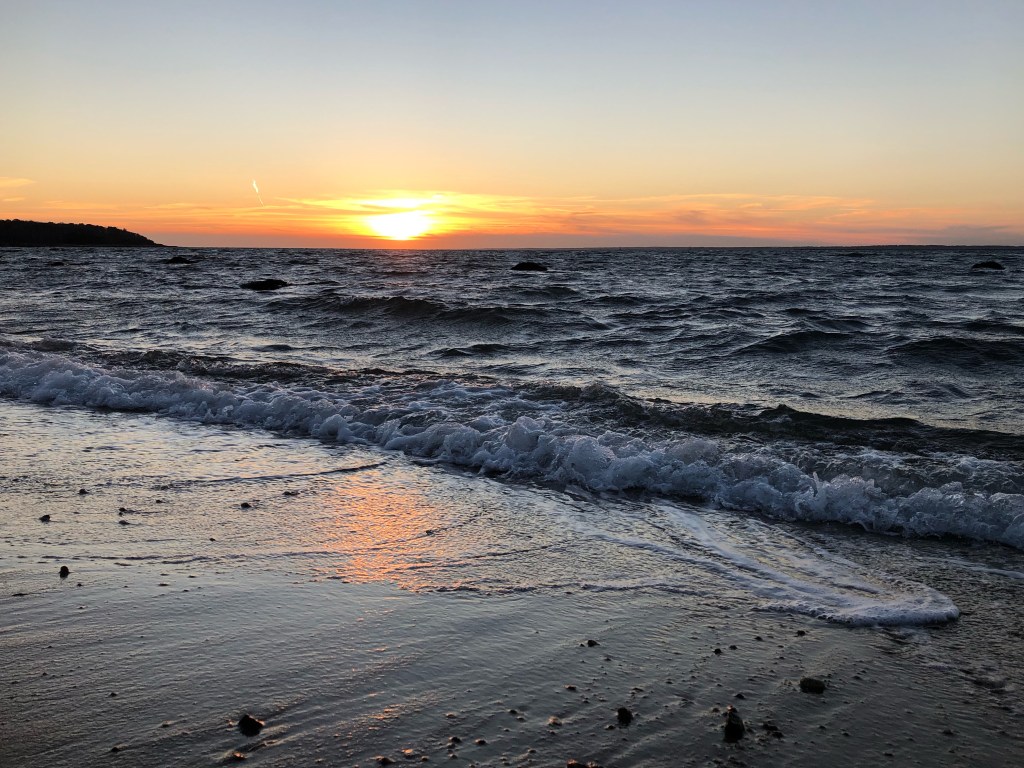
    I anticipate a white cap day on Buzzards Bay as a Nor’easter rolls through. For now the bay is restless but content to let the rain fall in abundance to its surface instead of rising up to meet it. For the march of thousands of white hats the current and wind must be more contentious than this. It will come in time, as it always does on Buzzards Bay.

    Nor’easter days are meant for hunkering down, catching up on reading and sipping hot beverages. On Cape Cod the storm will bring heavy rain and high winds. The salty water will surely rise to greet her fresh visitors. I’m a visitor myself; like a river forever moving between the mountains and the sea. I want to leave the comfort of the warm house to walk on the beach. You don’t come this far to look at it from afar. For I’m mostly water, shouldn’t I rise up to meet it too?

    Up in New Hampshire all this water will mean white hats of a different kind, with heavy snow in the mountains and clever swirls of white donning posts and mailboxes in the lower elevations. I’ll welcome the grace of snow-packed trails covering the ankle-breakers when I return to the mountains. Whenever that might be – I really don’t know. But they’ve heard my silent promise to return. We have unfinished business, those mountains and me.

    I laugh when I read polls asking where you would want to live forever. How do you choose between the mountains and the sea? Its a Sophie’s Choice question; asking one to pick between a mountain waterfall and the crashing surf. Instead I look to the Abenaki who moved for generations between the White Mountains and ocean fishing villages. They didn’t choose one over the other, they chose a life in between. And that’s where you’ll find me too.

    So today as the white caps rise, I’m reminded of the Mary Oliver poem above. I’m on the very edge of that in between for this Nor’easter, and the chop of the storm has begun. Who’s up for a walk?

  • Filling the Lantern

    “You should be a lantern for yourself. Draw close to the light within you and seek no other shelter.” – Buddhist Wisdom (according to Leo Tolstoy)

    I waited in the darkness for the sunrise. When you wake early that can be a long wait. The sunset last night was way down the bay and just after 4 PM, making this a long wait indeed. Such is winter in New England.

    But I walked outside and find it really isn’t all that dark at all. The moon is bright, a few stars shine through, and we’re well into nautical twilight start. Were I to let my eyes adjust I could get about quite well outdoors, even if it looks dark from inside the comfortable house. Perspective, on such things as light and time and relationships with others, offers insight.

    For all the darkness in this year of years, there’s still plenty of light even now. It starts from within, and shines outward on the world, reflecting and amplified by others back towards us. But sometimes it feels like the bowl is empty. If your own light is dimmed in the darkest moments, add fuel and oxygen. Seek reflection. And venture out. It’s brighter than you might believe it to be.

    December means early sunsets
  • Grains of Sand

    “Every time you wake up and ask yourself, “What good things am I going to do today?” remember that, when the sun goes down at sunset, it will take a part of your life with it.” – Indian Proverb

    I’m not sure of the source of the quote, but “Indian Proverb” seems as likely a source as any. There’s something timeless in the wisdom, even as it points out the value of a single day. That old cliché about time slipping by like sand slips through your hands comes to mind. The tighter you try to hold onto it the quicker it falls away. Making sense of time is folly; living each day as if it were our last seems a better place to focus.

    “People say that time slips through our fingers like sand. What they don’t acknowledge is that some of the sand sticks to the skin. These are memories that will remain, memories of the time when there was still time left.” – David Levithan, Invisibility

    The fact is, life is a blur. We aren’t walking down some endless beach here. This patch of sand is all we’ve got, no matter the mad swirl of wind or crash of the waves. What will stick and what will fall away?

    The central question from that Indian Proverb is “What good things am I going to do today?”, which is where those memories that remain come from. The grains of sand stuck to our hand are the interactions with others, the laughs and the tears; the memorable. Those are what make up a lifetime.

  • Good Forever

    There is no past and no future; no one has ever entered those two imaginary kingdoms. There is only the present. Do not worry about the future, because there is no future. Live in the present and for the present, and if your present is good, then it is good forever.” – Leo Tolstoy

    Here is the present, such that it is. On the whole you’d call it good (we woke up didn’t we?), yet more challenging than other days we might remember. But that’s the trap, isn’t it? Comparison to fond memories robs the present as much as dreams of the future does. There’s only today, buttercup. Dance to the song the band is playing now.

    I walked outside to a red dawn and a chorus of nuthatches noisily haw-hawing their way up and down the tree trunks. They know where the party is: it’s right here, right now! Nothing lives in the moment like a wild animal. It’s the humans who get all wound up in past moments, or stirred up about what may come to pass in the future. These are stories we tell ourselves. If I’ve learned anything balancing 5-6 books I’m reading at a time, it’s that you can’t read them all at once. So stick to the story of the present.

    The flip side of the present being good is that it isn’t very good at all. If that’s the case, then it seems we must accept what we’ve got and work on making something of this moment that is better than it might have been. Those nuthatches would probably prefer an endless summer of warm days and tasty bugs. They woke up to a leaf-less, cold November morning. But they were singing away in the trees this morning like it was Whoville on Christmas morning. You can learn a lot about living from a nuthatch.