Tag: Pilgrims

  • A Visit with Myles Standish

    Duxbury, Massachusetts doesn’t have the same notoriety as its neighbor Plymouth, but the roots of history run nearly as deep here. To be fair, if people think of Duxbury at all, it’s usually as an upper class suburb of Boston. There’s plenty of wealth on display in this town. But step away from the massive homes with their perfectly manicured gardens and you’ll find a legacy that reaches back to the Mayflower. The most famous character on the Mayflower, Myles Standish, lived and died in Duxbury, and is buried in what is now known as the Myles Standish Burying Ground.

    The burying ground was once adjacent to a meeting house, long gone, but marked with granite stones to indicate where it once stood. It is the oldest continuously maintained graveyard in the United States. The lay of the land is largely the same within the enclosure. The thing about graveyards is you’re walking on ground largely unchanged since the days when the people buried there were laid to rest. The entire area around a graveyard becomes housing developments and strip malls and paved roads, but these small graveyards are a time machine back to another time.

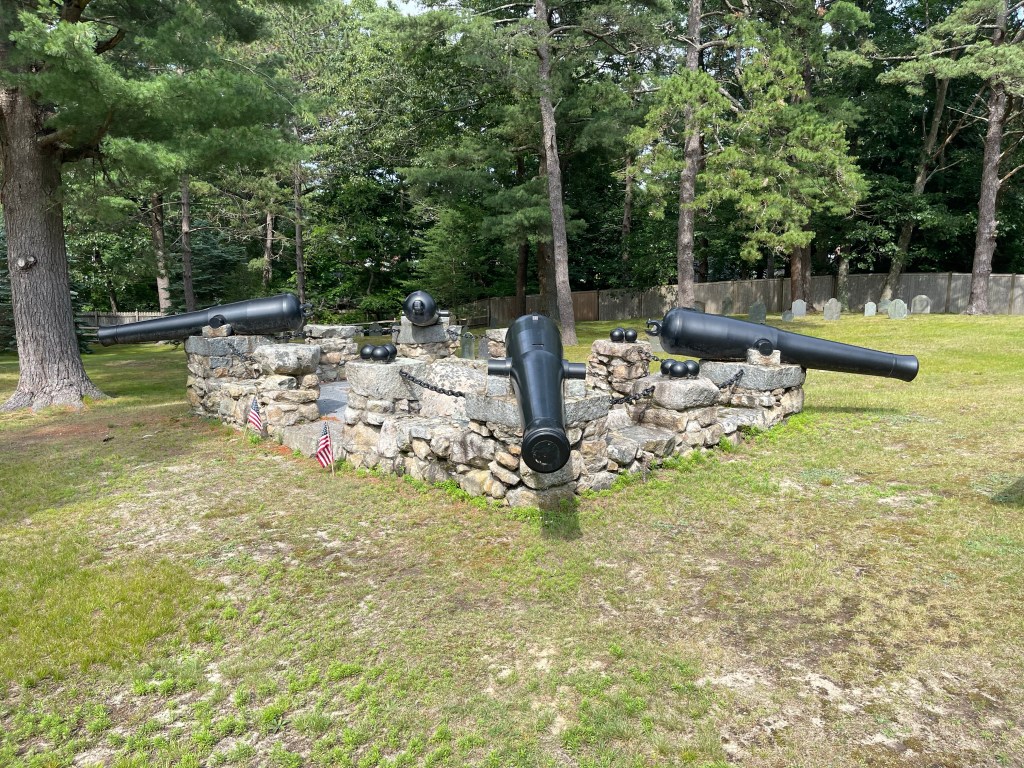
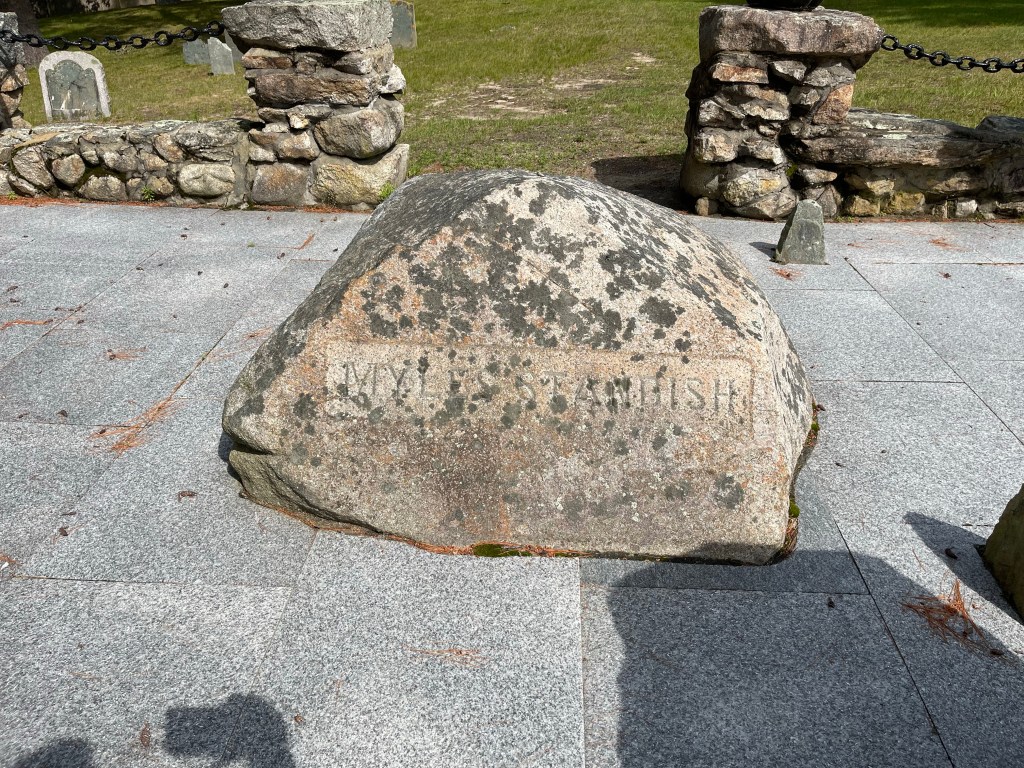
    Captain Jonathan Alden, son of Mayflower passengers John and Priscilla Alden, is also buried in this graveyard, and his is the oldest gravestone in the burying ground. Standish, who died well before Alden, likely had small pyramid-shaped stones marking his interment initially, and the monument built around the spot in 1893 (you can see one of these stones behind the boulder engraved with Myles Standish’s name in the picture below). That engraved boulder, like Plymouth Rock, is something for the tourists. The monument itself, with a fieldstone wall surrounding it and four cannon mounted on each corner, projects the violent boldness of the man interred beneath.

    Myles Standish was a military advisor to the Pilgrims. By all accounts he was brutal and decisive in his actions. He would preemptively attack when he heard trouble was brewing, and famously stuck the head of one rival, Wituwamat, on a pike as a deterrent to others. There seems to be no doubt that Wituwamat was lured into a room and murdered. Was this act of brutality something to be celebrated or scorned? Was there a legitimate threat to the Pilgrims, and could it have been resolved in a more diplomatic way? What’s clear is Standish believed he was fighting for the lives of the colonists, and used any method he could to intimidate those who he believed were threats to their safety. As with all history, we judge it from the comfort of distance.

    At another spot in town, on a point of land jutting out into Kingston Harbor, there are four more granite stones laid out in a park amongst multi-million dollar homes overlooking the harbor. It was here that Myles Standish actually lived. I found this interesting, as a military man like Standish would normally seek the high ground. A review of a Google map later revealed a small pond nearby that would have been his source of fresh water. Perhaps Myles dined regularly on Duxbury oysters, which have become almost as famous as the town’s most notable resident.
  • Plymouth’s National Monument to the Forefathers

    Plymouth, Massachusetts might not be the oldest European settlement in the United States, but you can safely say it’s where England got its foothold in America. They might have landed in Provincetown first, hit a few places along the Cape Cod coast as they looked for a better place to settle, and maybe they would have been better off if they’d landed in what would become Boston or Providence, but they landed here. And the great floodgates of immigration began, changing this continent forever.

    That narrative of settlement and conquest is… complicated. But you can make a good case that the Mayflower Pilgrims’ pilgrimage was driven by religious freedom and a desire for peaceful coexistence with the Native American population. They happened to settle in a place where the native population had recently been decimated by disease, making for a bit more elbow room to root themselves in the place, but let’s stay on point. That first generation tried to fulfill the mission as best they could.

    To honor those noble intentions, and to put a spotlight on the best virtues that we humans aspire to, the Pilgrim Society of Plymouth conceived of a huge statue that would dominate Plymouth Harbor. The original monument was supposed to be 150 feet tall and right on the water. Reason eventually took over and they moved the monument to the top of a small hill with a commanding view of the harbor, then shortened it to 81 feet.

    The National Monument to the Forefathers is believed to be the tallest granite statue in the world. There is impressive detail in the carvings and a sense of Victorian optimism about what we aspire to be throughout. The cornerstone was laid in 1850 and the monument completed in 1889. That’s a lifetime for someone in the middle of the 19th century. Throw in the Civil War and violent conflict with Native Americans as the country was settled ever westward and those ideals were challenged even as the monument was being built.

    Today the National Monument to the Forefathers stands in dignified silence, 132 years after the dedication ceremony and a year after the 400th anniversary of the settlement of Plymouth by those Mayflower Pilgrims. That big party got cancelled last year with the pandemic, the narrative of living up to the best of virtues is more challenging than ever as we Americans sort out just who we want to be, but the monument stands. Still waiting for us to measure up.

  • A Visit to First Encounter Beach

    If Provincetown claims the first landing of the Pilgrims in North America, and Plymouth claims the place they settled, Eastham is the place where they first encountered the Native American population. And like the thousands of encounters between settlers and natives to follow, it wasn’t hugs and kisses.

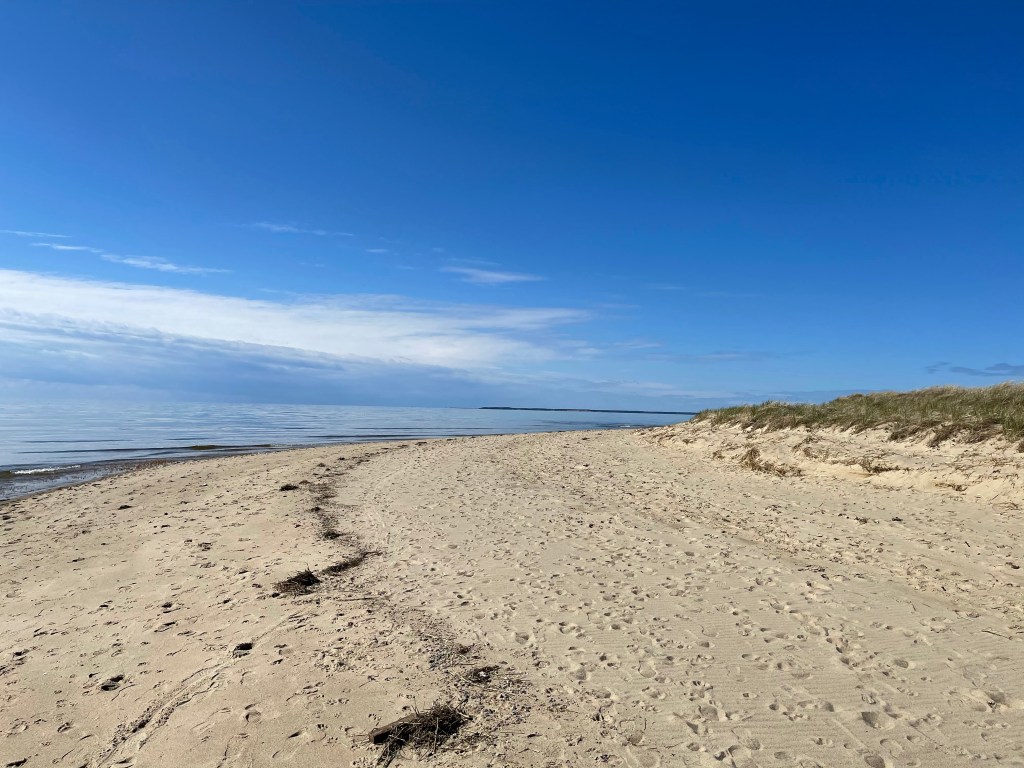
    Today there’s a popular beach with a paved parking lot on the calm waters of Massachusetts Bay. The real estate runs in the millions now, with great sunsets and a chance to swim while the sharks stake a claim on their ancestral hunting grounds on the opposite coast of Cape Cod. Really, it’s all funny money out here, but especially when you can claim a water view.

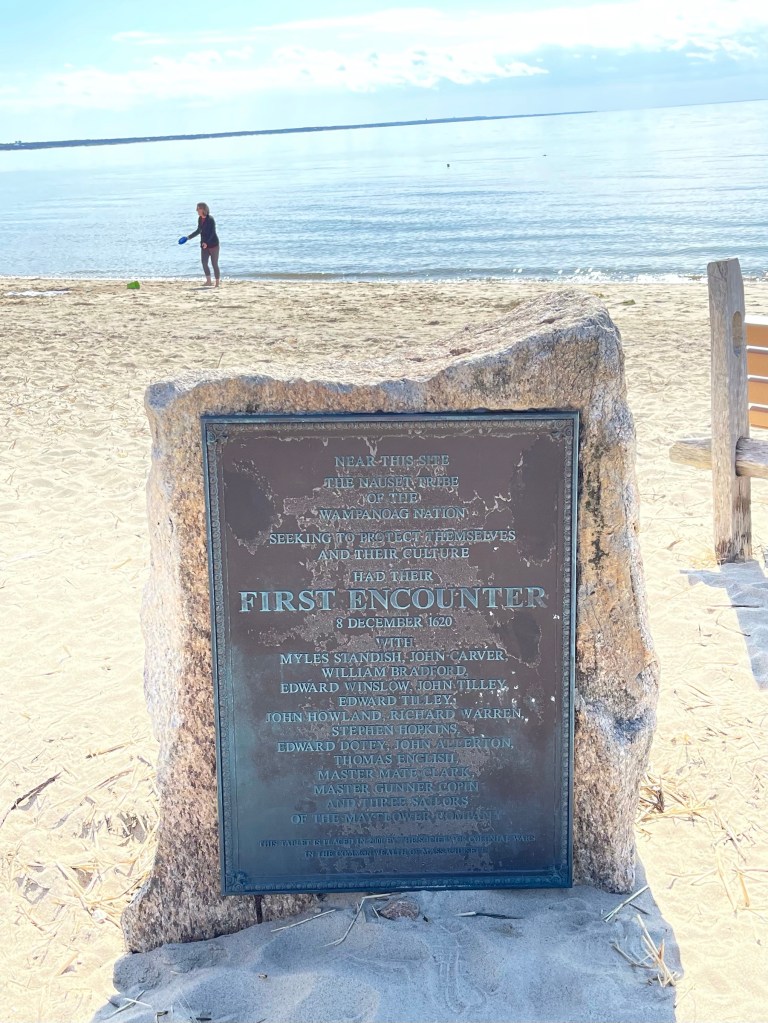
    There are two memorial plaques at the beach. One is hidden from view up the hill a bit from the beach, placed there to commemorate the tercentenary anniversary of that first encounter. The second, and more obvious one, is right as you walk from the parking lot onto the beach. Each offer a history lesson in worldview of the time.

    1920: “On this spot hostile indians had their first encounter December 8, 1620”

    2001: “Near this site the Nauset Tribe of the Wampanoag Nation seeking to protect themselves and their culture had their first encounter 8 December 1620”

    Both are true, aren’t they? But the devil is in the details, and none of us really know how that first encounter went down. We have historical record from one side but not the other. And that’s history for you; recorded by those who ultimately survive to write about it. Ultimately both inform, and the site itself pulls at history buffs like me. How do you visit Cape Cod for decades without a pilgrimage to the site of the first encounter between those who had it all and those who would ultimately take it from them?

    Now all you need is a parking spot at $15 per day for non-residents. For all the historical import of the site, today it’s mostly just a pretty, family-friendly beach. And a nice place for a quiet Spring walk with your significant other. And maybe a few hugs and kisses.

  • The Pilgrims and Pokanoket

    As you walk into the Mayflower Pub in London there’s a poster mounted high on the wall that shows the silhouettes of all the pilgrims and servants who sailed on the Mayflower to settle in America. The poster is divided in two, with the upper half showing the Pilgrims as they sailed from Europe. The lower half has the same image, but depicts those who perished before that first winter was over in gray. There’s a lot of gray… but by all rights it should have been all of them.

    The Pilgrims sailed for America too late in the season, without enough food, and sailed for the wrong place. Their charter had them settling at the mouth of the Hudson River, and instead they found themselves at the fist of Cape Cod. Turning south they almost wrecked on the treacherous shoals that have claimed thousands of ships since then. Turning back northward, the Captain of the Mayflower considered present-day Provincetown but eventually worked their way to the area that would become Plymouth., Massachusetts. Pilgrims were starting to die as freezing temperatures, tough living conditions aboard and malnutrition conspired against them. The Native American tribes were well aware of their presence and had already skirmished with them on Cape Cod at First Encounter Beach. A more sustained attack could easily have wiped them out.

    But the Pilgrims also had some lucky breaks that kept enough of them alive to establish a foothold in the region. They arrived at a place where just a few years earlier thousands of Native Americans lived. Contact with Europeans, most likely fishermen fishing the Gulf of Maine, triggered a plaque that killed thousands of people in the few years right before the Pilgrims arrived. So the native population was decimated and in no position to shove the Pilgrims back into the ocean they’d arrived on. They settled in an area with cleared fields and few adversaries. Truly fortunate to be there instead of landing in a place with a thriving and hostile Native American population.

    The other lucky break the Pilgrims caught was landing at a place where the local Sachem, Massasoit, saw strategic advantage in an alliance with the Pilgrims. The Pokanoket tribe Massasoit was Sachem of had been hit hard by the plaque that hit the tribes along the Gulf of Maine, and he was feeling pressure from the Narraganset tribe. An alliance with the Pilgrims gave him some strength in numbers that proved mutually beneficial for the short term. Ultimately this alliance would give the Pilgrims the momentum to survive and grow, but would destroy the Pokanoket in the next generation. An accident of geography brought the Pilgrims and Pokanoket together, time would drive them apart. But in the winter of 1620-1621, it would prove the difference in keeping more Pilgrims from turning into gray silhouettes on a poster 400 years later.

  • Where the Narrows Open Out

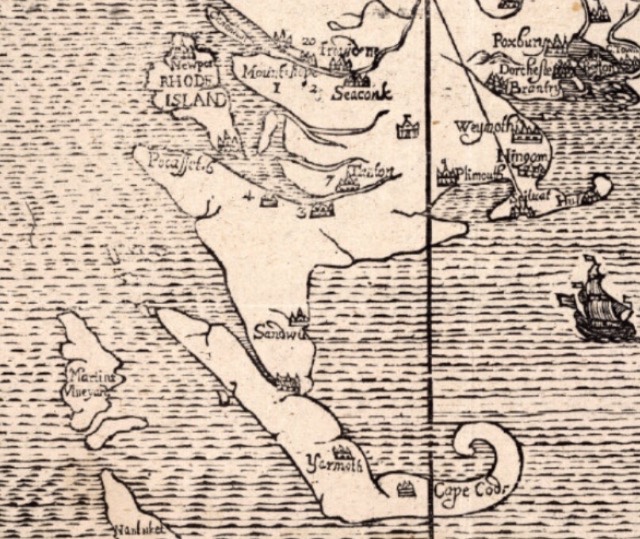
    Looking at John Sellers 1675 “Mapp of New England” I’m drawn to the place names on Cape Cod. “Yermoth“, Sandwich and Pocasset on the Cape, and the islands of “Martina Vineyard” and “Nantuket“. As with the entire map things are way out of scale, but still a fascinating snapshot of place in 1675 Cape Cod.  The other unique thing about Sellers’ map is that he turns New England on its side, offering a new perspective on the familiar shapes.

    The Pocasset Wampanoag were no strangers to Buzzards Bay, but they lived in the area that is now Tiverton, Rhode Island up to Fall River, Massachusetts and surrounding towns. If a place were going to be named Pocasset wouldn’t it be Tiverton or Fairhaven or some other place on that side of the bay? So how did this little corner of Cape Cod become known as Pocasset?

    The answer might lie in the word itself. “Pocasset” and some similar Algonquin names like “Pochassuck” and “Paugusset” all mean “the place where the narrows open out”. And that certainly applies to this part of Buzzards Bay. For the English settlers choosing Pocasset was likely easier than Pochassuck.  I can imagine the middle school jokes at neighboring towns if they’d gone that route.

    This place was likely visited by the Pocasset often as they traded with the Pilgrims at the Aptucxet Trading Post nearby. In talking about the land and the bay around them it’s probable that’s how the area was described as the bay opens up right after the point of Wings Neck. On the map Pocasset encompasses what is now Falmouth. Given the scale of the map it could be a minor point, or perhaps the entire stretch from Wings Neck to Woods Hole was considered the place where the narrows open out.

    That description fits the mind as well. Looking at old maps, reading books, and traveling to new places opens up my own once narrower mind. I break free of the daily routine and see things in a new way. So having a home away from home in Pocasset is more appropriate than I first thought.

  • The Rose Standish

    A little piece of historical trivia is the name of the very first ship to travel through the Cape Cod Canal when it opened on July 29, 1914.  Following the Jeopardy answering with a question format, What is the S.S. Rose Standish?  And the ship was the perfect choice to be first.

    Rose Standish was the first wife of Captain Myles Standish.  She was one of many who died in 1620 during the first winter after the Pilgrims arrived in Plymouth, Massachusetts.  Myles Standish would explore the Manomet and Scusset Rivers three years later considering a canal.  That canal would finally be completed almost three hundred years later with great fanfare, with a future President of the United States, then Assistant Secretary of the Navy Franklin D. Roosevelt, in attendance.

    That first ship, the S.S. Rose Standish, was a coastal passenger vessel built just two years earlier in 1912 and operated by the Nantasket Beach Steamboat Company of Boston.  On that July day in 1914, she led a parade of ships through the canal.  The celebratory mood was likely tempered by news breaking about events the previous day, when Austria-Hungary declared war on Serbia, marking the beginning of World War One.  Almost exactly four years after the canal opened that war would impact the canal itself when a German U-Boat surfaced off of Orleans and fired on a tug towing barges.  That prompted the United States Army Corps of Engineers to take over the struggling private Cape Cod Canal so ships wouldn’t have to take the more dangerous route around the cape.

    The S.S. Rose Standish would be in service into the 1930’s.  There’s a great picture from 1930 of her docked in Boston Harbor, right about when the Cape Cod Canal was being widened to its current 480 feet.  She likely outlived many of the people who witnessed that first trip up the canal 16 years before.  History is full of related twists and turns, and this story offers a good example with Rose Standish, one of the first pilgrims, a young Franklin D Roosevelt and a German U-Boat all playing a part in the same story.