Tag: Portsmouth

  • For All That Is Life

    “You must understand the whole of life, not just one little part of it. That is why you must read, that is why you must look at the skies, that is why you must sing, and dance, and write poems, and suffer, and understand, for all that is life.” ― Jiddu Krishnamurti

    Having a nightcap with friends at a clever book and bar establishment in Portsmouth, New Hampshire, my attention drifted to stacks of books all around me, chess boards and kitschy furniture from another era. This was my kind of place, and one I made note to wander around in again in daylight, when I wasn’t compelled to be polite and focused on our conversation, instead of just drifting off into this newly discovered world of wonder so tantalizingly close. Such is the nature of books—they pull you in when you least expect it.

    It’s not just books. How could it be, really? All that is life is around us, nudging us to pay attention, to immerse ourselves in the moment, to listen and understand, to act and to be a part of, to share and empty ourselves to others that we might fill ourselves up again with new and wonderful bits. Like a tide flowing in and out of a bay, our accumulation and sharing of knowledge keeps our mind fresh and alive.

    We spend a lifetime trying to understand what’s all around us, and yearning for all that ever could be. We are the audience in our own life, but also an active participant in the play. None of this is all that it could ever be, but isn’t it wonderful just the same?

  • Taking Flight… Again

    Yesterday I had the pleasure of sitting in the back seat of a Cessna as my father flew again. Getting back in the left seat of a plane was a bucket list item for our favorite Navy pilot. For me it was a chance to see him in action flying and see the world from a different perspective.

    Commercial flying offers stunning views from a 12″ oval window. I’ve sat in awe at views from 30,000 feet over New Brunswick and the landing over Boston Harbor at Logan Airport. I always try for a window seat on a red eye just so I can catch the sunrise. Flying in a Cessna is different. First, you feel much more connected to the mechanics of flying, even in the back seat. Everything is right there in front of you with instruments, controls and communication with the towers all part of your experience. And that experience! The views are close to 360 degrees, you’re flying over terrain you’ve known from the ground up, seeing it literally from a bird’s eye view at 2000-3500 feet max, and going a lot slower so can savor the view more.

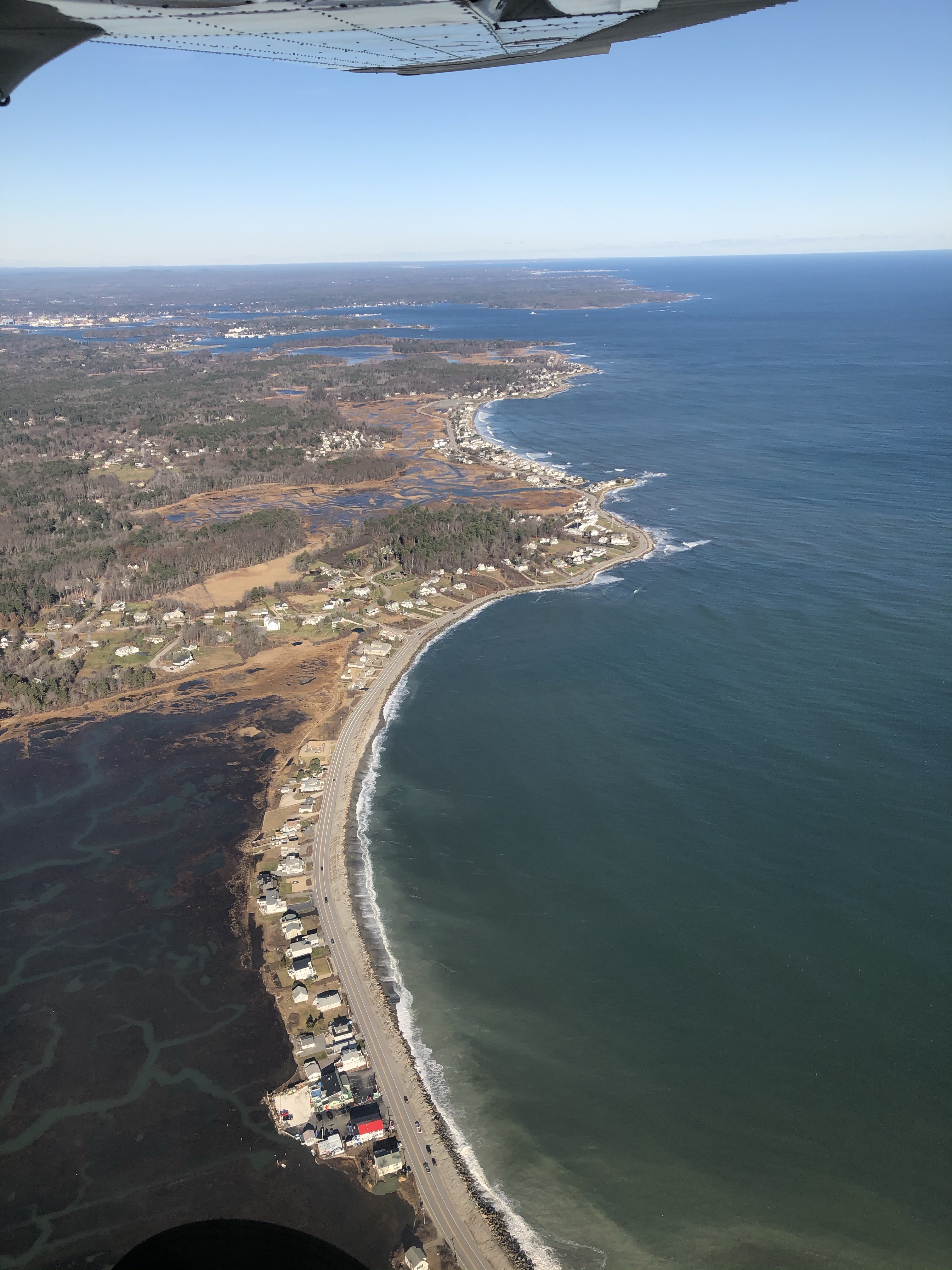
    We flew out of Lawrence Airport, followed the Merrimack River to the sea, turned northward following the beaches up to Portsmouth and then circled in for a touch and go at Pease International Airport before heading back to Lawrence, with a quick circle around the neighborhood in New Hampshire. Clear skies with some wind gusts making it interesting at lower altitudes. Listening to impressive banter between a flight instructor and a Navy pilot all the while. I kept my own chatter to a minimum; I was along for the ride, it was his experience… one I was happy to share.

    This wasn’t my first flight in a Cessna. I’d flown a similar route with the father of a girlfriend in college once. He did all the work, while I sat in the right seat and my girlfriend sat in the back. I’d told myself I’d like to get my pilots license then, and here we are years later with the goal shelved. Money and time and other priorities killed that goal. We can’t do everything, can we? Perhaps not. Watching the Navy fly again reminded me that even the professionals get busy with other things. There’s a shortage of pilots it seems, and work for those who wish to pursue it. I don’t believe I’ll pursue it myself, but the hourly fees to fly with a pro aren’t outrageous. Why wait when the opportunity is so readily available? That’s what brought us here, and the day was a highlight reel of memories and a reminder to not put things off. For me it was a nice change of perspective, and I think my smile was as big as the pilot’s.

    Merrimack River in Haverhill at Groveland Bridge

    Salisbury Beach, surf’s up

    Isle of Shoals

    New Hampshire coast, looking north to Maine

    Pierce Point, Portsmouth Country Club

    Merrimack River

  • From Falkirk To Portsmouth

    206 years ago next week, on September 10, 1813, the British brig General Hunter was captured after the Battle of Lake Erie. That battle deserves more attention, which I’ll try to offer on another day. This story is about the journey a pair of cannon took from the banks of the River Carron in Falkirk, Scotland to their current home near the banks of the Piscataqua River in Portsmouth, New Hampshire. The guns are of course inanimate objects, but darn it they’re surely survivors.

    Once a part of the arsenal on the brig Hunter for the British, captured and turned to service for the Americans on the brig USS Firefly, the cannon saw service in the War of 1812, the Second Barbary War of 1815 before being retired from active duty and sold with the Firefly to a wealthy merchant from Portsmouth named John Peirce. The guns were on two of the Peirce merchant ships before finally becoming a family heirloom, donated and placed in their current location more than a century ago. As Portsmouth changed they were moved closer to the building to where they are now.

    I’ve come across the guns a couple of times while walking through Portsmouth. And I’ve done a double-take each time. The ships they were in are long gone, and so are a succession of crew and wealthy owners who once valued the utilitarian efficiency of these weapons. Today they’re no longer lethal, instead standing permanently at attention, muzzles buried in the earth, as tourists, drunkards and businesspeople alike drift past, oblivious to their violent history.

    They flank the entrance to the Portsmouth Athenaeum, itself a curiosity in this modern world. The building is almost as old as the guns, and they guard it like older twin brothers might protect a younger sister. Saved from anonymity by the plaques proclaiming their role in the Battle of Lake Erie. But they’d only part of their story. Imagine all these cannon have witnessed, and the stories they could tell.

  • Stone Eggs and Red Dye

    The weekend was frustratingly productive in a Monday morning regret sort of way. Saturday was full of chores – cleaning, pruning, weeding and such. Sunday began the same way, but I felt the stir of restlessness mid-morning and started plotting concentric circles outward for places we’d never been before. When you’ve lived in a place for most of your life that’s challenging, but also surprisingly fruitful. Interesting walk with water views within an hour of home? Not hard when you live near the sea. Place you’ve never been to within that circle? Bit more challenging, but it turns out, not impossible.

    Kittery, Maine is one of those places I drive through on my way to someplace else. Sure, they have all those outlet stores, but shopping makes my brain ache. So does the Sunday traffic trying to bridge the Piscataqua River. Bridges are chokepoints, and being on the wrong side of one on the last weekend before all those kids go back to school is a recipe for gridlock. But the call of new trumped logic and we made our way to Fort Foster for a Sunday afternoon walk.

    Fort Foster sits on the northern point of the Mouth of the Piscataqua River. Historically this river has always marked the boundary between New Hampshire and what was first the Commonwealth of Massachusetts and eventually Maine. The strategic merits of the river and the natural reluctance of the Native American population and the territorial turf war with the French created the need for forts.  That need was served by Fort McClary, just a few miles inland and visible from Fort Foster.  So why another fort?

    In 1885 the United States determined a need to bolster coastal fortifications for modern warfare.  At the time, this included concrete bunkers, disappearing gun artillery designed to combat the new steel-plated modern ships, and most interestingly, anti-submarine measures like mining and guns designed to fire on submarines.  These forts dotted the east and west coasts of the United States.  Fort Foster was completed in 1901, and was active until just after World War II, when the realities of modern warfare had made coastal forts obsolete.

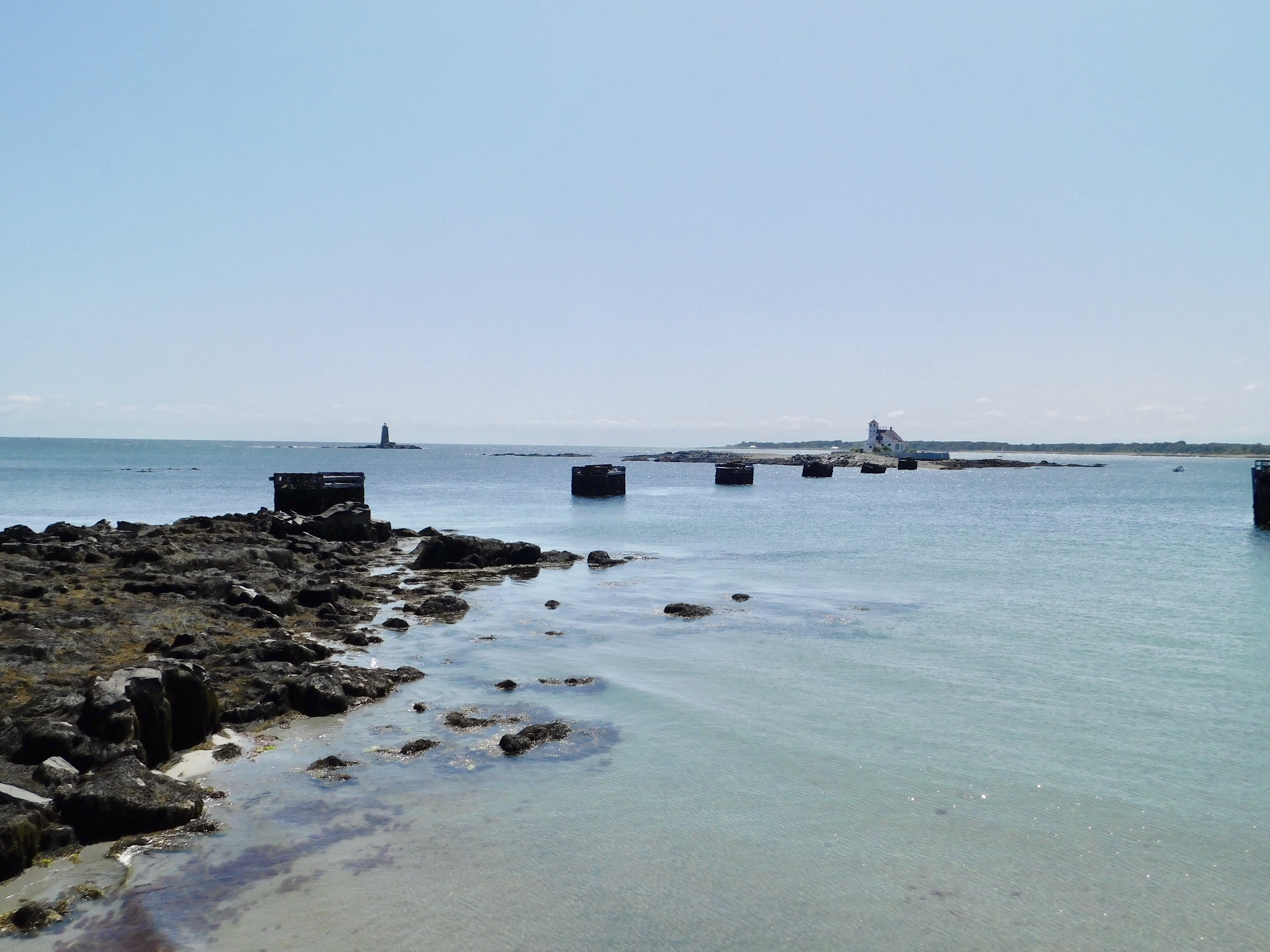
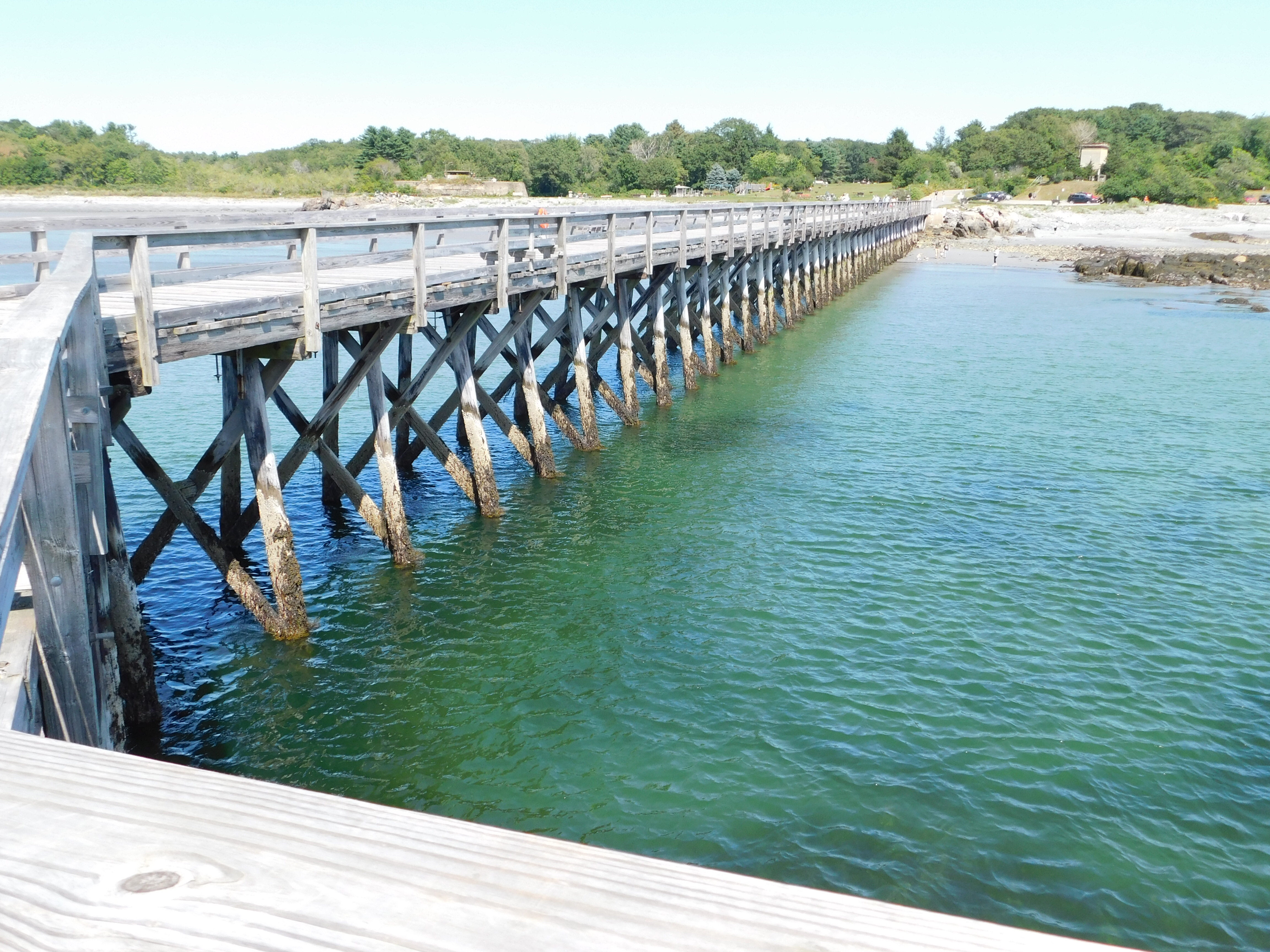
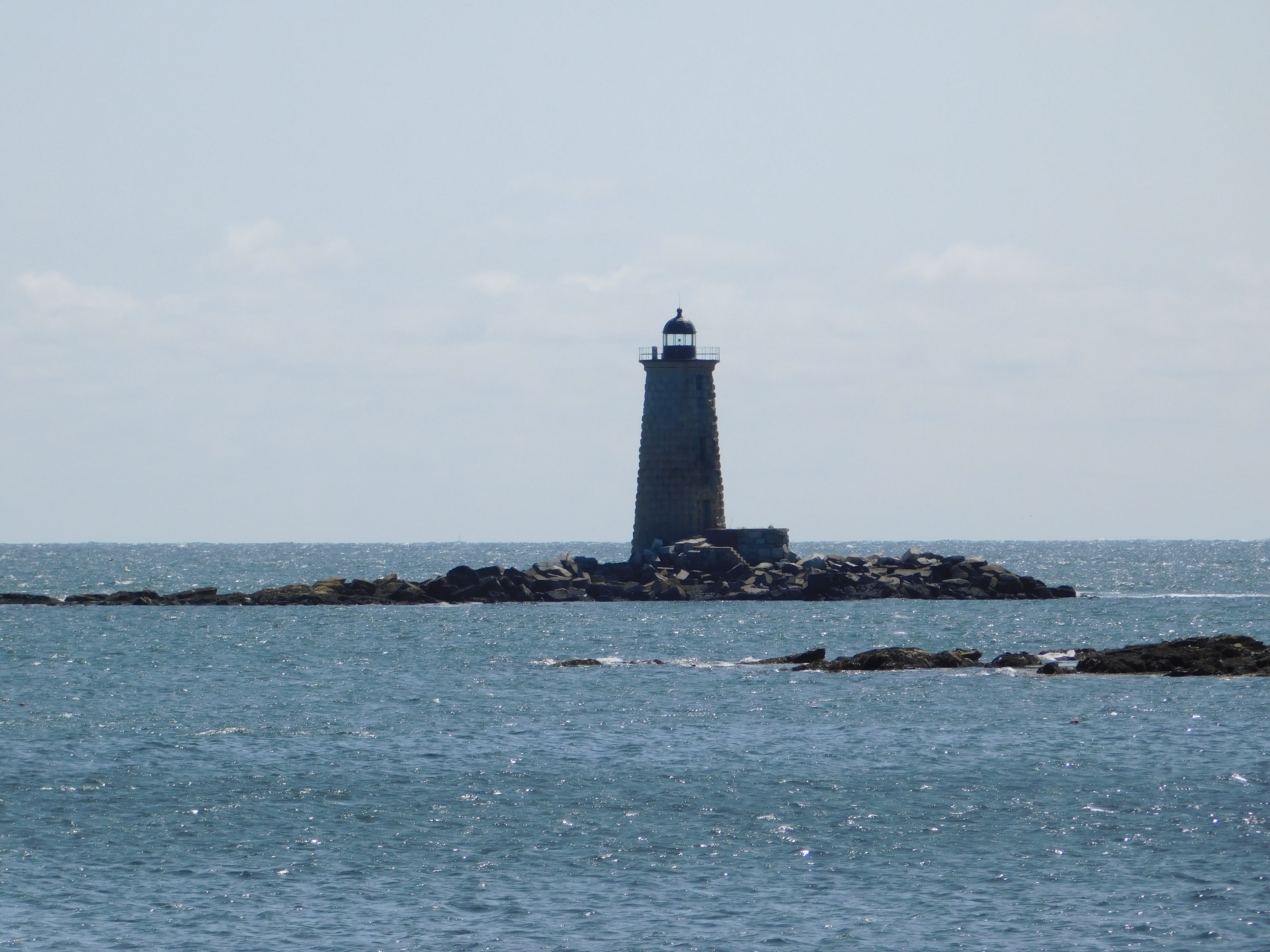
    Fort Foster today offers glimpses of that past.  You can still climb up into the concrete bunker and see the bolts that once secured the disappearing artillery.  But the real reason to visit Fort Foster is to walk on the unique beaches at the Mouth of the Piscataqua River, walk out on the pier to get a closer look at Wood Island with it’s lifesaving station, and Whaleback Light.  There’s been a lighthouse on this spot since 1820, and the one you see now was built in 1872.  The lighthouse keepers surely had a lonely job on that pile of rocks.
    The beach along the river is hard-pack sand cemented with silt, with granite cropping out wherever it may.  We visited at low tide and the beach extended out 50 to 100 yards in spots.  But there was a funk in the air that betrayed bacteria, and we moved on from the river beaches to those facing the ocean.  The City of Portsmouth, New Hampshire, just on the other side of the Mouth, poured a red dye into the river last month to analyze sewage flow.  There’s a red tint on the seaweed and beaches at low tide, and I wasn’t sure whether it was the red dye or the pervasive Red Tide that has closed shellfish sites in Maine for most of the summer.  Either way, it’s not a beach I would sunbath on, let alone swim in.  Damned shame, because it is a beautiful spot.

    Rounding the corner the funk disappears as the ocean breezes refresh the air.  We walked along the beach at Sewards Cove.  The beach is a fascinating jumble of worn stones, granite outcroppings and stone dust.  Picking up the stone dust, it radiated heat that lingered longer than typical beach sand might.  The beach was dominated by the rounded stones, like river rock you might put in a potted plant, of varying sizes.  One imagines the surf churning these rocks together, round and round, wearing the sharp edges down to smoothness.  The result is lovely, with all manner of shapes and sizes, all eventually becoming that stone dust that makes up the rest of the beach.  I rescued a half dozen egg shaped stones from that fate, instead subjecting them to the fate of eye candy in a beer glass on a shelf at home.  If stones had feelings they might rejoice or resent this fate, but they’ll never tell me.

    We walked as far as we could before we reached a sign that said private property, and turned back towards the river.  We opted for the path instead of the beach on the walk back, and passed groups of families and friends picnicking in nooks and crannies of the park all the way back.  It’s a million dollar view out to the Isle of Shoals and beyond to the east, and over to Portsmouth an Odiorne Point on the opposite shore of the Mouth looking south.  The park charges $20 per car, or $5 per person.  Many people simply park outside the gate and walk in, but anything more than three people and the math stops working for you.  We gave the $20 bucks and called it a donation.  Public space on the ocean is a blessing, and that private property sign reminded me that not every shore is accessible.  Andrew Jackson for a Sunday afternoon walk somewhere new?  A good trade in my opinion.

  • An Island of Two Names

    I got to spend a little time on Rhode Island, in the State of Rhode Island, on Friday and Saturday.  It wasn’t a long stay, but with my son living in Portsmouth and working in Newport, it was a worthwhile one.  There are three towns on the island; these two and the appropriately named Middletown between them.  There are three bridges connecting the island to the rest of the state.

    The Narraganset called this island Aquidnet, and this evolved into the English calling it Aquidneck Island.  But like so many places where one population gave way to another, this island has that other name too – Rhode Island.  So the smallest state in the nation shares its name with its biggest island.  In fact its the origin of the name for the state.  Newport and Portsmouth were the original settlements and things just grew around them. But why have two names when you can just call the island Aquidneck and the state Rhode Island?  Because that’s the way Rhode Islanders like it.

    A close-up of that 1677 John Foster “Mapp of New England” shows the name as Rhode Island.  Newport is noted, and Portsmouth is shown as a town though not named.  Mount Hope is just across the water and Providence is further inland.  The map is oriented with West up and North to the right, and things are out of scale but you can clearly see Rhode Island as they knew it.

    Portsmouth was settled by a group of “Christian Disidents” seeking religious freedom.  The most famous of whom was Anne Hutchinson.  They noted their intent in the Portsmouth Compact on March 7th, 1638:  They noted their intent in the Portsmouth Compact on March 7th, 1638. This, according to Wikipedia, was the first document in American history that severed both political and religious ties with England:

    The 7th Day of the First Month, 1638.
    We whose names are underwritten do hereby solemnly in the presence of Jehovah incorporate ourselves into a Bodie Politick and as He shall help, will submit our persons, lives and estates unto our Lord Jesus Christ, the King of Kings, and Lord of Lords, and to all those perfect and most absolute laws of His given in His Holy Word of truth, to be guided and judged thereby.

    The most famous of the three towns was and is Newport of course.  It was founded after Portsmouth by some of the settlers who moved from that town down the island.  Newport’s fame came when it became the playground of the wealthy who tried to outdo each other with their summer homes, the Newport Mansions.  That wealth brought in sports that the wealthy pursued; It was home of the America’s Cup for years, and home of the Tennis Hall of Fame, complete with grass court.  Newport has a certain upper crust vibe to it, much like Nantucket.  Middletown and Portsmouth are more working class, but with equally beautiful waterfront views. The main route through all of them has evolved to be strip mall heavy, but as with many places, once you get off the retail strip things improve greatly.

    This island was occupied by the British during the Revolutionary War, and held by them for three years.  As with Manhattan and Philadelphia it was an excellent port that worked to the strengths of the British Navy, allowing them to stage troop movement against the Americans. The American Army tried to displace the British once in that time in the Battle of Rhode Island with the support of French ships blockading the British.  This was the first engagement of the combined American and French forces against the British.  It didn’t go as planned as the French weren’t particularly aggressive in the naval engagements and the Americans were driven away when British reinforcements were able to land.  British naval might may have gotten into the heads of the French, who had the tactical advantage at the time. One other notable first from the battle was the very first mixed-race regiment, the 1st Rhode Island Regiment, had their first action of the war on the island.

    I’ve got a few connections to this island, but it remains a place I haven’t spent enough time in.  The last couple of years has changed that, and perhaps I’ll explore the island even more over the next few.  But as is my nature, I’ll most likely do it in the off-season when the crowds die down a bit.  There’s a history worth exploring on Aquidneck Island, er, Rhode Island… or whatever you want to call it.

  • Slavery in New Hampshire

    Slavery in New Hampshire

    When I think of New Hampshire, I don’t think about slavery.  Frankly, it’s inconceivable to me that someone would enslave another human being, but it was commonplace in all of the thirteen colonies in the 1600’s until 1865, when it was finally abolished after the Civil War.

    But it surely existed here.  In 1767 there were 187 slaves in Portsmouth, New Hampshire.  Portsmouth was a hub for the transport of slaves into North America and human beings were bought and sold right on the same streets we walk today.  There are as many as 200 deceased slaves under the streets of Portsmouth around Congress Street who probably died soon after arriving in the city.  Slaves that died on the transport ships were thrown overboard like garbage.

    New Hampshire wasn’t an optimal location for slaves, not because of a moral imperative, but because the land didn’t support farming using slave labor.  It simply wasn’t as profitable here, but it was still cheap enough to justify the act.  Over time, as the Industrial Revolution transformed the region to a manufacturing hub, cheap human labor used in the factories because the norm.  Slavery was pushed to the south, where plantations made slavery economically viable.

    Looking around New Hampshire, it’s not a particularly diverse population.  Perhaps that lack of slave labor meant that when it was finally abolished there simply weren’t many black people living here.  Perhaps its because when these slaves became freed they congregated in communities elsewhere.  Whatever the reason, New Hampshire remains one of the whitest states in the union.

    I’m not at all comfortable writing about slavery.  I’m not a perfect man, but I’m a free man and I can empathize with those who endured the horrors of slavery.  For all the talk of freedom in the years leading up to and after the Revolutionary War, the colonists of the time largely overlooked the plight of those who served them.  Still, there was a growing revulsion towards slavery, and over the one hundred years from when those 187 slaves were in Portsmouth the Americans reached a tipping point where it was outlawed.  Slavery remains a stain on our history, and it’s important to remember that the stain wasn’t just in the south.

  • John Paul Jones

    John Paul Jones

    Portsmouth, New Hampshire is an old town by North American standards.  Settled in 1630, it played a notable role in the American Revolution.  Paul Revere rode here from Boston to warn the town that the British were coming – by sea – to bombard them.  With a great harbor and a ready source of lumber right upstream, Portsmouth was a natural place for a shipyard and an attractive target for the British.  The forts that protected Portsmouth Harbor were one reason it didn’t burn to the ground.

    One notable resident of Portsmouth was John Paul Jones.  Jones was a Scottish-born sailor who had risen up the ranks in the British Navy before controversy over two deaths associated with Jones prompted him to get out of dodge and head for America.  Jones lived in the Philadelphia area and was soon earmarked for command of a ship in the Continental Navy.  Many raids on Ireland and the capture of a British warship at a time when victories were few and far between garnered him fame in America as a hero and in Britain as a pirate.  Beauty is in the eye of the beholder.  By all accounts Jones was a brilliant tactician and sailor.  But killing one sailor by flogging and another with a sword make it clear he wasn’t a “hugger”.

    Jones’ most famous battle was in 1779, while under command of the Bonhomme Richard.  While attempting to raid merchant ships, British warships engaged with the Bonhomme Richard and four other ships.  The 50-gun frigate Serapis was much bigger, so Jones locked onto the ship for close fighting and sniper action from marines in the rigging.  Sustaining heavy damage but refusing to surrender, this is where Jones supposedly said “I have not yet begun to fight!”  Whether true or not it made for a great war slogan and a larger than life character in Jones.

    Jones arrived in Portsmouth on August 31, 1781 and lived there for about a year, boarding at a house that still stands at 43 Middle Street.  He had been appointed command of a new ship, appropriated named America, being built at Badger’s Island just across the Piscataqua River from Portsmouth.  So boarding at the Purcell house was a convenient place for Jones.

    Jones was likely bitterly disappointed when Congress decided to give America to France as a gift for its role in winning the American Revolution, but he stayed on to oversee completion of the ship.  America was launched on November 5th, 1782 and sailed to France where it served for a brief three years before being scrapped.  It seems the Americans used green wood in construction.

    John Paul Jones ended up joining the Russian Navy and served for some time against the Turks in the Black Sea.  He died at the young age of 45 in 1892.  Buried originally in Paris, his body was exhumed and he was re-buried at the Naval Academy in Annapolis, Maryland.  Jones was considered a father of the US Navy.  His battles on the Ranger are the stuff of movies.  Whether a pirate, privateer or Continental Navy hero, he certainly lived an interesting life.  For a year of that brief life he walked the same streets I just walked today.