Tag: Rome

  • A Sequence of Everything Wanted

    “Rivers know this: there is no hurry. We shall get there some day.” ― A.A. Milne, Winnie-the-Pooh

    Slow down you’re doing fine
    You can’t be everything you want to be before your time
    — Billy Joel, Vienna

    In a dizzying turn of events, last night capped a sequence of things wanted for some time delightfully happening one after the other, from Rome to Athens to Sicily to Florence to… New Hampshire. Life is sometimes simply great timing, realized. To visit the Colosseum and the Sistine Chapel and the Acropolis and Mount Etna, to see Michelangelo’s La Pietà and David to bookend an epic trip and then return home to find the elusive Aurora Borealis dancing in my own backyard hours later is a sequence I’ll be processing for some time, thank you. This isn’t meant to be a brag about how lucky the last couple of weeks have been, rather a realization that patiently working towards something combined with a bit of good luck goes a long way in a lifetime. Amor fati.

    The thing is, I wear my impatience on my sleeve (and blog about it more often than I ought to). Some of us simply want to get right to everything as quickly as possible, knowing that time flies and we aren’t getting any younger. Sure, tempus fugit, but slow down—you’re doing fine… Vienna waits for you. Simply plot the steps, do the work, follow through and hope fortune smiles on you.

    Hope is a tricky word, and that’s where impatience comes in. Perhaps the better word is trust. We must trust the process when we build our systems. Work, marriage, fitness level, artistic contribution, social interactions, and yes, bucket list items are all lifestyle choices built on faith that doing this will lead to that. When it doesn’t arrive promptly we restless types get a bit impatient, so a reminder of all that’s come to pass helps now and then. Gratitude goes a long way.

    Life lessons are all around us, if we simply stop rushing about so much and focus on the journey. The biggest lesson is that the journey continues, and each milestone is simply a marker for where we’ve been and what we’ve seen and who we were at the time. What’s next matters too, doesn’t it? Our past is our foundation for the growth to come. We shall get there some day. For haven’t we thus far?

    Aurora Borealis, New Hampshire 10 May 2024
    Aurora Borealis, New Hampshire 10 May 2024
    Aurora Borealis, New Hampshire 10 May 2024
    Michelangelo’s La Madonna della Pietà
    Michelangelo’s David
  • To Go to Rome

    You hear a lot about Rome from those who have been there. Nearly all agree it’s a crowded place, too full of tourists and the aggressive hawkers and pickpockets who prey on them. Rome is complicated: like all cities it’s got its share of beautiful and ugliness all right there waiting for you. The layers of history are undeniably present all around, impressing on you that you are simply just one more soul passing through this place.

    And yet we pass through. Rome would be nothing but ruins were it not for the masses of people who live here and visit in such startlingly large numbers. To visit is to feel a part of the hive of humanity. Personal space is ridiculously impossible to find when you seek out the places everyone must go to. Yet we still go, feeling the call, or perhaps simply a fear of missing out.

    If Vienna waits for you, so too does Paris and Istanbul and Amsterdam and Barcelona and yes, Rome. The great cities of Europe aren’t simply waiting for us to grace them with our presence. They’re doing just fine without us, and yet they welcome us when we finally do arrive. I know that every picture or observation I make about Rome has likely already been taken or made, to be repeated again by the soul to follow me. Yet I feel compelled to share them anyway, for having been there.

    To go to Rome is to see what all the fuss is about, and to perpetuate that fuss for those who will follow one day themselves. Rome may not be the center of the universe as it once aspired to be, but it remains an integral part of our imagination. Having been, I want to believe I’ll return again one day. That, I think, is when you know a place has you in its grip. And surely, it has me.

    The Pantheon and lots of company
    Build it and they will come
  • Historical Memory

    “History is written by the victors and framed according to the prejudices and bias existing on their side.” — George Graham Vest

    History writes itself as humans progress generation-to-generation, but that’s no guarantee of it being remembered. For, as Vest, a Confederate Senator who managed to retain power after the American Civil War pointed out, our written history is only remembered when subsequent generations choose to remember it. How many billions of souls are nothing more than a footprint? How many heroic figures would have been portrayed as villains had the other side won?

    The point was hammered home for me on a visit to the Colosseum in Rome. The Colosseum affirms history—for who doesn’t know of the Colosseum?—while also emphasizing that remembering or saving anything from one generation is at the mercy of those who follow in the next. Whole sections of the Colosseum were removed and recycled into other things, which themselves may have been removed and recycled again and again. Were it not deemed sacred the Colosseum likely would have disappeared like the statue Colossus, from which it got its name, did.

    Most Emperors, Presidents and Popes fall away into history, let alone you and me. The lesson is to enjoy the ride while we’re here, but also to be so valued by those we leave behind that we’re remembered for all the right reasons. Ultimately, our lives are fragile enough as it is without the burden of being remembered beyond a generation or two after we’re gone, so we ought to simply pursue excellence for its own sake. Our time is not some dusty monument, we write our memories now. The rest is up to those who follow.

    Rome’s Colosseum
  • A Trevi Snapshot

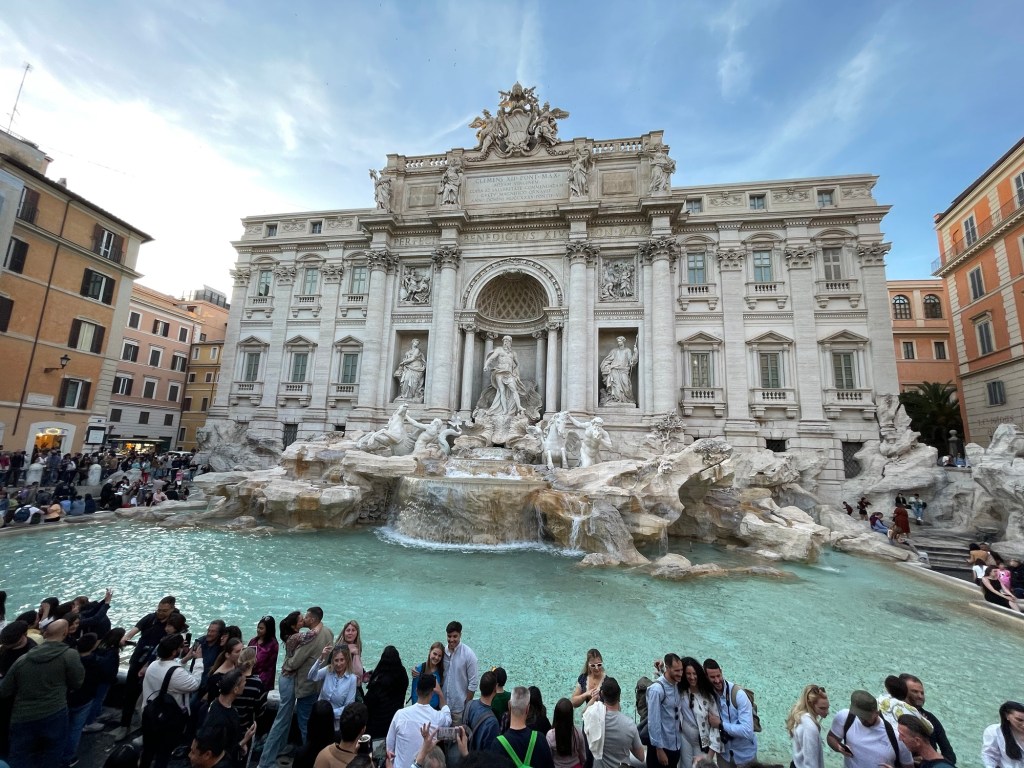
    The Trevi Fountain (Fontana di Trevi) is named after the three roads that converge where the fountain sits. It ought to translate into something more, but it’s come to mean quite a bit to those who make the pilgrimage to it. And it is a pilgrimage for tourists. It’s one of the must-see attractions in Rome, and so we did our part as confirmed tourists to visit it first.

    According to Wikipedia, the fountain was “designed by Italian architect Nicola Salvi and completed by Giuseppe Pannini in 1762”. It’s “26.3 metres (86 ft) high and 49.15 metres (161.3 ft) wide”. And it needs to be that big to accommodate the massive crowds that converge on it every day. The Trevi is worth a visit, but be prepared to have a lot of company. Just remember to take a snapshot and throw a coin in to ensure your return one day.

    The Trevi Fountain, with its statues of Oceanus, Abundance and Health.