Tag: Sagres

  • Two Henry’s

    “Arrived at the Atlantic, he pauses on the shore of this unknown ocean, the bounds of which he knows not, and turns upon his footprints for an instant….  Then recommences his adventurous career westward as in the earliest ages.” – Henry David Thoreau quoting Arnold Henry Guyot, Walking

    Infante D. Henrique, better known as Henry the Navigator, was born in 1394 and died in 1460. Henry, with political clout from his relationship with his brother the King of Portugal and monetary clout from The Order of Christ, inspired the Age of Discovery 500 years ago.  The Portuguese would go on to discover Madeira 600 years ago this year, then the Azores, and further down the coast of Africa during his lifetime, and inspire like voyages by Christopher Columbus and others well after his death.  I came across a statue of Henry the Navigator in Sagres, Portugal last year when I was exploring the area.  The statue faces towards Madeira and the coast of Africa; Henry’s focus half a millennium ago.

    No place in continental Europe makes you feel like you’re on the shore of an unknown ocean more than the western coast of Portugal.  Of course, I’d flown over that ocean to get to Portugal, but this was a time when pirates were a common threat for coastal communities and the thought of sailing beyond the horizon was likely terrifying for most.  It wasn’t until larger sailing vessels were built that the Portuguese and later other European explorers would take the leap into the unknown.

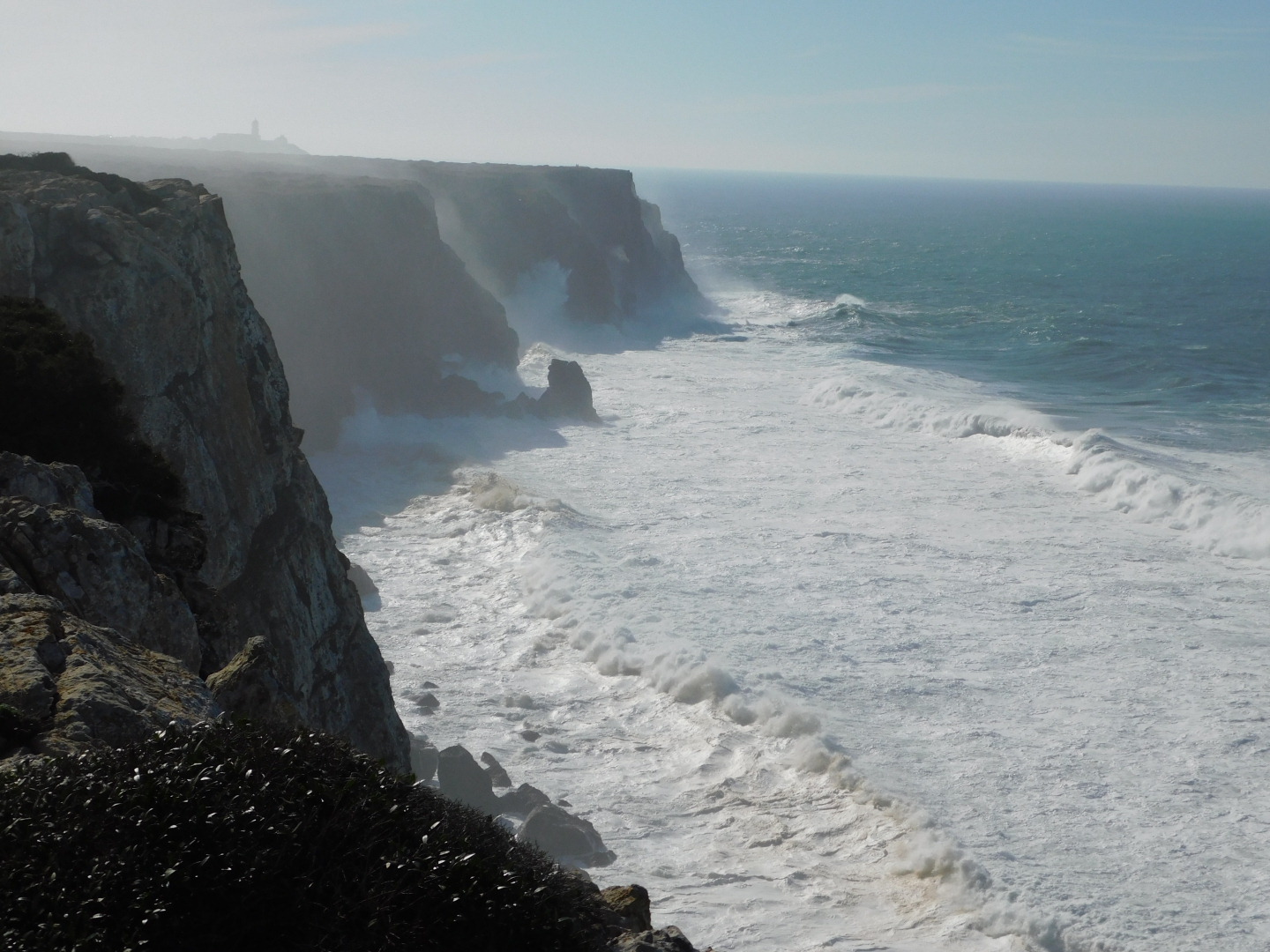
    There was a dark side to exploration, as local populations were exploited, enslaved, murdered or exposed to lethal diseases for the first time.  Progress for some is regression or annihilation for others.  The spirit of exploration and discovery is on the face admirable, and I like to think I carry some of that spirit within me, just as Thoreau did.  Standing on the edge of a hundred foot cliff with breaking waves reaching up halfway to welcome me, one catches the spirit of those words; Arrived at the Atlantic, he pauses on the shore of this unknown ocean.  This would give any sane person pause.  But the courage to move on anyway opened up an entire world for these Portuguese explorers.

    I have Scottish and English blood in my veins, but I also have Portuguese blood.  I like to think that exploration and adventure are a part of my DNA.  And while my relative low risk exploration of the coast of Portugal pales in comparison to the sailors of centuries past, the serve to expand my perspective on the original European explorers who first set sight on America.  As visiting Portugal opened up my perspective on where these souls came from, visiting the Santa Maria replica gave me a greater appreciation for just how small those Nau’s were.  On a vast, unknown ocean, with no previous knowledge of currents and at the whim of the weather, courage was only part of what these explorers needed.  They also needed luck.

    Henry David Thoreau quoted Guyot even as he disagreed with many of his theories.  Thoreau was an explorer whose vehicle of choice were his feet.  I think he would have been fascinated with the fisherman’s trails, the stunning Rota Vicentina, that wind along the coast from Sagres north. Hiking this trail was a highlight for me, and I wish I’d had more time to fully explore the region.

    Thoreau writes of the magic of exploration, and his tendency to head southwest in his journeys away from home.  There is no point further Southwest in Portugal than Cape of St. Vincent and it’s distinctive lighthouse. Had Thoreau stood on the cliffs, as I imagine Henry the Navigator once did and I had the opportunity to do in my own humble way, I think he might have looked westward and recalled his own words, appropriate for this extraordinary place:  “We go eastward to realize history and study the works of art and literature, retracing the steps of the race; we go westward as into the future, with a spirit of enterprise and adventure.  The Atlantic is a Lethean stream, in our passage over which we have had an opportunity to forget the Old World and its institutions.”  That spirit seems as true today as it was in 1860 or in 1460.
  • Portugal: The End of the World

    Started strong on this blog, then petered out as the realities of a job spiraling downhill combined with an irony-filled sales kick off meeting in Portugal left me with not much to say.  Which of course is not the case at all with all that going on.  I’ll work to be more consistent.

    The sales kick off meeting was the usual stuff that goes on when a company goes to great lengths to inspire a sales team.  Well prepared executives telling us how great things are.  Product Managers telling us how great things are going to be.  Sales awards for the past and optimistic spin on the future.  And a dose of ass-kissing and opportunistic positioning by the sleazy element.  Still, as with most companies the majority of employees are truly great people who work hard, are ethical and want to do good things.  I wish them well, and hope they clear the hurdles ahead of them.

    The real adventure in Portugal began when the meeting was over.  I drove from Lisbon to Sagres for some hiking along the coast, fresh seafood and time to reflect in a place completely new to me.  The drive down from Lisbon began on the extraordinary Vasco da Gama Bridge over the Tagus River, continued across a changing landscape of vineyards and cork tree groves that gave way to more arid climate as I approached the Algarve Region.  My destination was the end of the world.

    Sagres was once called that – the end of the world.  The rocky cliffs of Cape St Vincent were the southwestern corner of “civilization”.  And no wonder they thought so.  The rolling waves of the Atlantic Ocean crashing into the cliffs of Western Europe certainly felt that way.  Ships rounding the Cape of St Vincent looked to the treacherous cliffs and prayed for favorable winds to keep them from being bashed against them.  Many of their prayers were unanswered and countless sailors perished along this coast.  Imagining the New World beyond the horizon was likely beyond the scope of many of the people living in the Middle Ages.

    Sagres today is a sleepy surf town, full of beautiful vistas and great seafood.  The world back then, as in many places, was a lot more violent and uncertain.  Sagres is incredibly rich in history.  Pirates and privateers raided this coast to rape and pillage and enslave those they didn’t kill outright.  Explorers setting sail from this region mapped the African coast, opened up the sea route for spice trade and eventually circumnavigated the world.  Sagres was the home and final resting place of Henry the Navigator (Prince Henry the Navigator – Wikipedia) who changed the narrow view of Europeans in this time and fueled the Age of Discovery.

    Hiking a portion of the Rota Vicentina in the offseason provided me with a glimpse into the past.  I was struck by the powerful waves of the Atlantic colliding with the sheer cliffs along the coast, and the splendid isolation as the trail moved towards the interior.  For much of my hike I was alone.  Fishermen and tourists were clustered at the lighthouse on Cape St Vincent, but after that I saw five other people on the rest of my 12 mile hike.  Offseason for sure.  Soon after passing the last of the fisherman precariously dangling their poles over the cliffs near Cape St Vincent I found myself virtually alone in the harsh, beautiful terrain.  The footing is challenging; alternating between red sand and sharp limestone and sandstone ready to trip and greet the careless walker who dares to enjoy the stunning scenery for more than a step or two before validating the path.

    Portugal, like Newfoundland, offers seclusion mixed with warm encounters with friendly people.  It’s still relatively unknown as a vacation destination, but that will change.  As indicated by the graffiti I saw throughout Portugal and the broken glass on the trail, not everyone embraces leaving no trace.  I hope that the cultural intolerance for these things increases in the years to come.  I fell in love with this place and hope it never becomes the overbuilt, resort-clogged destination that some other parts of the Algarve have become.

    And now I’m back, with memories, pictures and video of this incredible place.  As with all solo travel I felt the conflicting emotions of savoring the meditative qualities of going it alone with the longing to have shared it with family and friends.  Hopefully I’ll see you again Sagres.