I live roughly a mile and a half from a place called America’s Stonehenge. It’s also known as Mystery Hill, and I like that name a bit more because it infers that there’s much about the site that is unknown.
Here’s a great description of the site from the mysteryhillnh.info web site:
The Mystery Hill archaeological site, better known today as America’s Stonehenge, is situated on the exposed bedrock summit of Mystery Hill in North Salem, New Hampshire. The site consists of a core complex of 13 stone chambers, several enclosures, niches, stone walls, stoned lined drains, small grooves & basins, and other features which covers about one acre on the summit. Extending outward from and surrounding the core complex, are more stone walls, niches, standing stones, and two procession ways. Along the perimeter of the summit are four confirmed astronomical alignments. Below the summit on the slopes of the hill are a 14th chamber, two utilized natural caves, springs, stone walls, stone cairns, niches, standing stones, and other features. In total, the site covers about 105 acres.
I’ve lived in close proximity to this site for twenty years. And yet I’ve only visited it twice – once alone and once with my daughter. If you’re an archaeological buff, an astronomy buff, or a mystery buff its a great place to visit. I’m a history buff and like to understand the place I live in. A large part of that is who lived here before me. Mystery Hill has carbon dated evidence of people living in this area 7000 years ago. Native Americans were most likely those people, and they most likely lived in the area well before that. What we know for sure is that the Native American presence in the region was largely gone for a number of reasons by the time of the French and Indian War. Colonial settlements continued to nudge further and further north and west and eventually the area because fully colonized, first as Methuen, Massachusetts and eventually as Salem, New Hampshire.
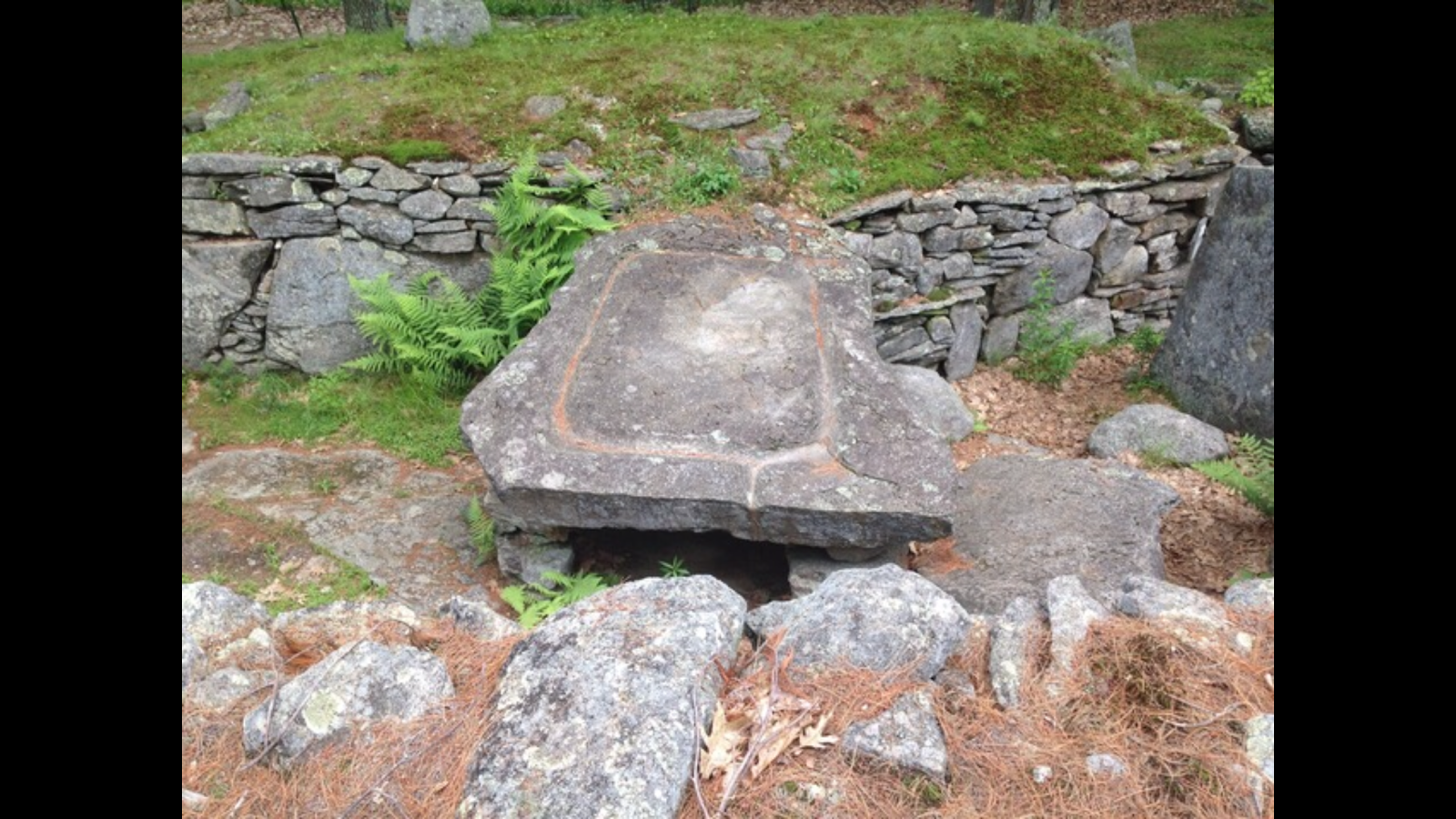
About ten years ago a Boston television station did a live broadcast at America’s Stonehenge, and the weather person at the time, Dylan Dryer, laid down on the stone table that many people think was a sacrificial alter because of the drainage channels carved into it. Maybe it was, maybe it was just the place where they cleaned up whatever they brought back from the hunt that day. Either way, I thought it was interesting that she laid down on that spot. Apparently there was no bad mojo as she’s now on national television and seems to be doing just fine.
Look at Mystery Hill from a Google satellite map and the first thing that jumps out at you are the spokes of clear cut trees coming out from the center of the hill. This was done by the people who manage America’s Stonehenge to provide clear lines of sight on the celestial points that are marked. Whether this was done thousands of years ago by Native Americans or Celtic visitors or by a farmer in the 1800’s building off what was up on the hill I don’t know. But I do know it’s impressive to see when you’re standing on the viewing platform.

The other thing you notice when you look at that Google Satellite map is the encroaching development on all sides. That’s accelerating with a development eating into the woods to the southeast of Mystery Hill. I find this disappointing, but not surprising for Salem, New Hampshire. The town seems to value real estate development and commercial space over conservation space. But then again, Mystery Hill has been here before with waves of settlers clearcutting and farming the land around it. And until some developer plugs condos on top of the hill it (wouldn’t put it past Salem) the site will continue to mark time one celestial year after the next.
