Tag: Snowshoeing

  • Virgin Snow

    “Every single thing you do today is something that your 90-year-old self will wish they could go back and do.
    The good old days are happening right now.”
    Sahil Bloom

    Overnight snow is the best kind of snow. It’s like Christmas morning with its big reveal at first light. With it, we may think in terms of chores or play. Either way, it won’t be here forever. We must always remember that neither will we.

    Snow removal completed on the home front, sun offering a brilliant day that felt warmer than it really was, I read the timely Thread above from Sahil Bloom and it reinforced what I knew I had to do. Really, I’d been thinking it all morning. Get out there in it! Find some virgin snow and glide across it with all the vigor one can muster. For we may never cross this way again.

    Snowshoeing on local trails can be thrilling or discouraging, depending on the condition of the trail and the snowshoer. It didn’t start off well, with a dog walker arriving just ahead of me post-holing the trail where the snowshoers before me had been. Adding insult to injury, the dog walker didn’t clean up her dog’s poop, dropped right next to the trail. That’s no way to go through life, I thought to myself. But walkers in deep snow are quickly overtaken; I nodded hello, said hi to the pup and kept my feelings to myself. I was here for something more essential than policing other people’s behavior. I was here to fly.

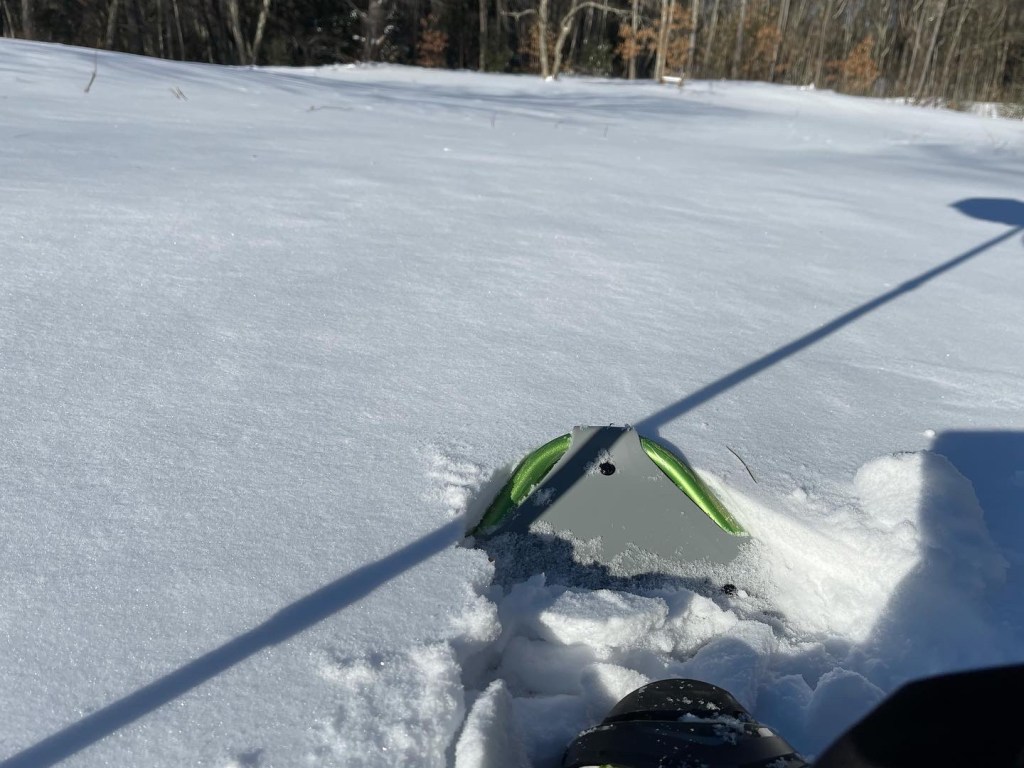
    The main trail had already seen visitors, and I did my part to compress the trail further—a gift for those who would follow without snowshoes. Eventually I reached an intersection where the snowshoer before me had gone left, while the side trail to the right was virgin snow extending on through the trees for as far as my eyes could see. The choice was clear.

    Two roads diverged in a wood, and I—
    I took the one less traveled by,
    And that has made all the difference.
    — Robert Frost, The Road Not Taken

    I know these woods well. I know where the waterfalls lie smothered under ice and snow, where granite outcroppings and hemlocks form a cathedral as beautiful as anything made by man. Snow transforms the landscape and forces one to learn it anew. If the trail had been broken I might have strayed further afield, but I felt an obligation to guide those who would follow my tracks. Stay on trail to show the way, and I may stray another day.

    I tend to think in time buckets now. What might I do now that I won’t be able to do later in life, when I’m old and frail? Do that thing now and celebrate the gift of health and vigor. Maybe one day we will regret not watching others live their best lives while we sat on the sidelines, but I think not. This is our time too. What are we to do but make the most of this day?

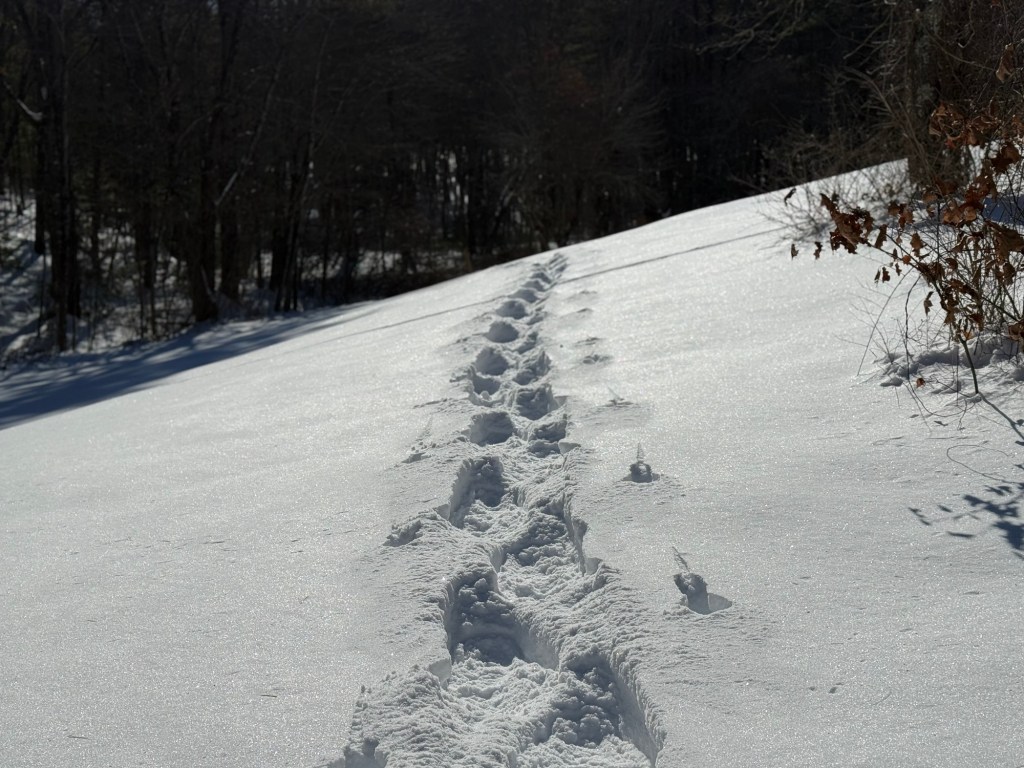
    Virgin snow with a worn, familiar trail revealed underneath
    Out and back trail compression
  • A Snowball Walk in the Woods

    There are winters when it seem to snow, relentlessly, mercilessly, every day. The types of winters that wiped out half of the pilgrims on the Mayflower. “Hungry? Eat more snow!” kind of winters. This was not that kind of winter in New England. And now that we’re well into March, when the sun is higher and the snow melts quickly, it seems clear that opportunities to celebrate winter are drawing to a close.

    Blame it on seasonal variability or jet streams run askew or climate change, whatever the reason, the opportunities to fly across snow on skis or snowshoes wasn’t quite available locally. None of that quick lunch hour snowshoe hiking presented itself this year in southern New Hampshire. And truthfully, I missed it. When friends invited me to hike up north after a heavy snowfall on Saturday, I leaned in towards it but pivoted back to home. I wanted to savor the local trails instead. It turned out to be a sound decision.

    Driving over to a local town forest, I expected the parking lot to be jammed full of fellow snow lovers. Instead, I found it relatively quiet. Tracks indicated others had set off on snowshoes, while a few chose to post-hole their way through the snow, wrecking the pristine trail. This would prove a problem on the wooded trails, but in the fields I simply flew off on my snowshoes to break my own trail. After all, this was what I missed most this winter—flying atop unbroken snow.

    It proved to be as delightful as I’d hoped it would be, but already the sun was up and working on the snow pack. The trees began dropping snowballs, often with small branches, which dampened my enthusiasm for the wooded trails. The fields were better, and I thumped my way around in earnest, seeking that flying feeling until I was breathless. Stopping for a rest, I looked around and listened. Nothing but snowballs falling in the woods. Not a single human voice, or dog barking, or even a car far off in the distance. Just a clydesdale in snow, appreciating the briefness of the moment. We never know if we might have another opportunity to do something. A winter like this one teaches you to make the most of the moment before it melts away.

    A rare opportunity to fly over snow
  • Unbroken Snow & Writing

    There are different kinds of snow, and different kinds of snowshoeing. Snowshoe hiking up a mountain is very different than snowshoeing across a snow-covered field. Like walking on these terrains when there’s no snow, there’s a certain tactical change that develops with each. Hiking up a mountain, there’s a unique relief in flipping up the heel lifts on snowshoes to level your foot to the incline that you naturally wouldn’t feel on flat terrain. There’s also a wholly different intensity in grinding up an unbroken mountain trail. Steep terrain and unbroken snow are a workout. For me it’s a bit like technical writing, you know the payoff will be big but in your lowest moments the effort feels like it isn’t worth it (it’s almost always worth it).

    Flat terrain snowshoeing is a different story altogether. Easier, in a lot of ways, but that ease releases you to explore more than you might on something more technical and demanding. But that very freedom can force people to stick with the formula of the familiar. Why be uncomfortable in breaking new ground? Because that’s where things get most interesting!

    There are times when you’ve got to stay on the path. Inevitably, you’ll begin on broken ground: trails that lead from a parking lot to open fields, or woodland trails that must be honored before you reach open space. There’s an obligation, unsaid, to help groom the trail by tamping it down with your snowshoes. We do our part, but it feels like paying penance, and you look ahead to where you might break free. The very unevenness of the broken trail is what makes it a chore. Compacting broken snow means staying in your lane, taking what others have left for you and finding a path through it. Broken snow, especially when regular walkers use the same trail, exposes boulders and roots and ruts that lead to post holing on the trail. There’s a certain satisfaction in tamping down the brokenness, akin, in a way, to editing a sloppy bit of writing.

    But the real fun begins when you find an opening to fly. A small break in an old stone fence that leads you to a virgin field of unbroken snow, or a wide open field with a single broken path going across it each whispers, “It’s time: FLY!” and gives you the opportunity to break from all expectations and obligations and just go for it. Like a plane freeing itself from the obligation of the runway, launching yourself into unbroken snow is freedom. It’s just you and the snow, and you can go in any direction you want.

    Writing can feel very much the same. You chafe at the obligatory structure, you get caught up in the rules of punctuation and order, you try to clean up run-on sentences and spelling errors and the like as you go. But to really fly with writing you’ve just got to just launch yourself into it, technique and order be damned, and just see where it takes you. Inevitably to places you never imagined when you started. If you truly let yourself go you don’t worry about editing the broken trail you leave behind you. There’ll be time for that another day. No, this is your time to take wing.

    If you’ll forgive me another analogy about snowshoeing and writing, it’s the conditioning. When you haven’t been out on snowshoes in a while you forget the pace and rhythm and become a bit breathless. When you do it every day you quickly find your pace and rhythm and just get right to it. It becomes natural–a part of you. And when you reach that point you can cover so much more ground than you would otherwise. The lesson, of course, is to get to it every day.

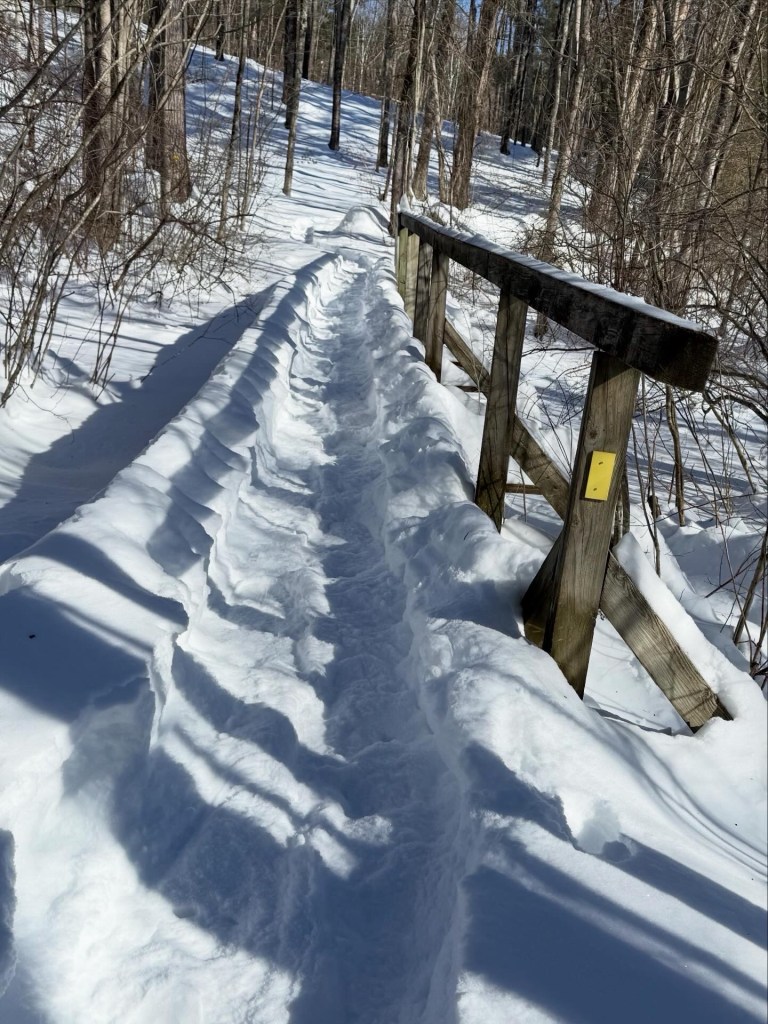
    The obligation of the broken trail
    The freedom of unbroken ground
  • On New Paths

    What good is livin’ a life you’ve been given
    If all you do is stand in one place – Lord Huron, Ends of the Earth

    If snow transforms the landscape, then a walk in that snowy terrain transforms the winter walker. Add a new path and suddenly you’re seeing the world entirely differently than you had before. Add snowshoes and you’re suddenly set free to break off trail to see new places, explore animal tracks that run off into the woods, and to see what’s on top of a rise you might have walked by at another time of year.

    There’s a popular pursuit in hiking called red-lining, in which hikers hike every bit of every trail on a map or guide. A popular red-lining pursuit in New England is hiking the AMC White Mountain Guide. The whole point of red-lining is to explore new paths – to get off the crowded hiking trails and try something new. To do it, and to belong to a small group of hardcore hikers who have also done it. And add a measure of accomplishment and camaraderie in the world of hiking. I don’t see myself hiking every trail in the AMC White Mountain Guide, but I’m fully onboard with hiking new trails and seeing the previously (for me) unseen.

    On Valentine’s Day I explored trails previously unseen in a forest I’ve spent a lot of time in. Snowshoeing with friends, we walked a trail largely by ourselves to new places. When you’re on a new trail like that, every step is a discovery, every bend in the trail is a curiosity, and every trail junction is confirmation and validation of what the map was trying to tell you all along. There’s magic in taking that image on a map for a walk and making it real.

    The day after a long walk on new trails you start thinking about the trails at those junctions that you didn’t take. You wonder at what you might have missed down that way and begin to realize the allure of red-lining. For how do you want to spend your time in this world? Sticking with the familiar or exploring new places and challenging yourself in new ways? There are other paths that warrant exploration. I’ve seen them out there, if only on a map.