Tag: Snowshoes

  • Making Tracks

    I promised myself a snowshoe walk in the woods for lunch, and dammit if I wasn’t going to honor that promise. There was more snow drifting down, quietly adding to the base layer in fluffy contentment. Day-old snow welcoming the new to the accumulation. We’re in the weather pattern now, folks. Snow-upon-snow: February in New Hampshire.

    I’d walked these woods on Sunday, but felt a return was in order. Conservation land, with trails popular with dog walkers and tree whisperers. At lunchtime on a random Tuesday in winter you don’t expect a crowd but you expect somebody. In this case one car running, its driver staring down at a phone screen, oblivious to me strapping on snowshoes and beginning my walk.

    The trail is compacted again, a day after six inches of snow and with more in the air, speaking to the popularity of the trail. I help compact it for twenty steps and then move off trail into deeper snow. This is what I came for after all: the highly addictive, calorie-burning bliss of clumping about in deep snow. I followed an old stone wall that spends its lifetime keeping the woods and fields apart, and wonder at the farmers who built it a few hundred years ago, and the generations that mended it until the woods finally wrested back control of the land. Now it’s my turn on the land, and I quietly honor those who came before me; their hard life on display.

    I rejoin the trail and the pace picks up, crossing a bridge over a stream I see a stand of old pines and step off trail to walk amongst them. Just me and the snowshoes, walking an endless blanket of white that covers the features of the land. Fallen trees, dormant vines and brambles, rocks and frozen wetland all lay together under Mother’s white blanket. And one soul clumping about above like a kid at recess. For that is how I feel, being out like this on a snowy workday.

    I think about the time. How long have I been out here? 45 minutes? An hour? Hard to say, really, and I don’t want to look at the watch or phone to find out. But I know it’s time to head back towards the car. Clumping along, I join a familiar path, newly blazed but strangely not compacted as much as other trails. I help with that task while walking under hemlock trees – old friends who I speak with now and then across the years. They’d like me to linger awhile, I smile and hint I’ll be back another day. And cross a stone wall and step out on another field of white.

    The car isn’t all that far away now. I could be in it and back in my home office in minutes. But the snowshoes want to fly some more, and so do I. Not just yet, world. I step off the path and walk back into the deep snow, a wandering soul in a quiet, timeless field. I spot a tall stone wall on a rise across an unbroken plane, set my course, and fly.
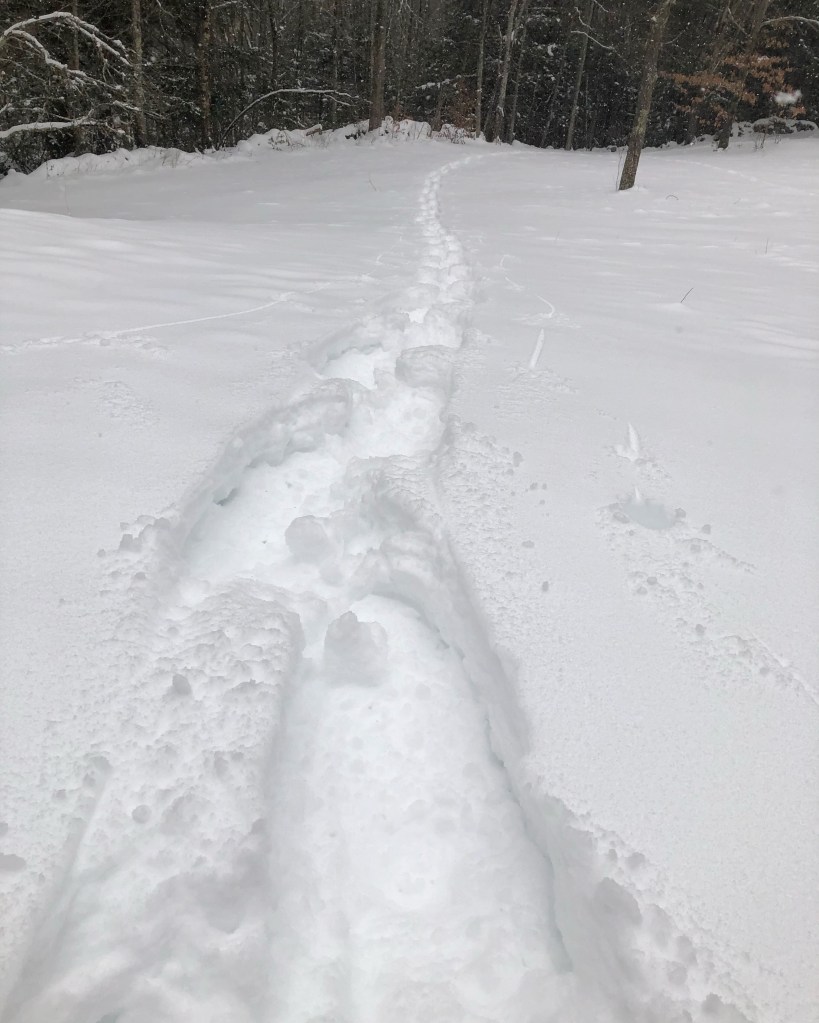
    A quick look back and then back on my way
  • Walking to Interesting

    If you watch a commercial on television, or a reporter out on a city street, or even the cast intro on Saturday Night Live in February 2021, everyone is wearing masks. A year ago you’d have wondered at it, even as the pandemic rapidly descended on the world. Today it’s commonplace, and I’m more often surprised at the outliers walking into a store without one. I stood in a line for snowblower parts and a mechanic walked briskly through the store unmasked. In a crowded grocery store I saw an elderly woman(!) without a mask on. In both cases I had the same reaction I might have had two years ago to someone wearing a mask. Isn’t it funny how the world has changed our perceptions in such a brief turn of the calendar?

    I chafe at restrictions, favoring wandering, crossing borders, friendly conversations with strangers and simply getting out there. But we all sense a light at the end of the tunnel, and we’ll reach a tipping point with vaccinations as we did with mask wearing. With more and more people I know joining the ranks of the vaccinated, a sense of optimism grows. Travel will soon be a reality again, even if a bit different from the travel of a few years ago. There’s plenty of travel available today, without worrying about the complexity of borders, just outside.

    “My vicinity affords many good walks; and though for so many years I have walked almost every day, and sometimes for several days together, I have not yet exhausted them. An absolutely new prospect is a great happiness, and I can still get this any afternoon. Two or three hours’ walking will carry me to as strange a country as I expect ever to see. A single farmhouse which I had not seen before is sometimes as good as the dominions of the King of Dahomey. There is in fact a sort of harmony discoverable between the capabilities of the landscape within a circle of ten miles’ radius, or the limits of an afternoon walk, and the threescore years and ten of human life. It will never become quite familiar to you.” – Henry David Thoreau, Walking

    Many times during the past year I’ve thought of Thoreau walking the landscape I know today. There’s plenty that’s changed since his time, but there’s also plenty that remains just as it was then. Much of it remains undisturbed, as if in a time warp, awaiting a visitor. I doubt he ever got up to the corner of New Hampshire where I walk, but I’ve walked in his woods near Walden and note the similarities.

    “Walk until your day becomes interesting — even if this means wandering out of town and strolling the countryside. Eventually you’ll see a scene or meet a person that makes your walk worthwhile.” – Rolf Potts, Vagabonding

    With a hint of the coming snow in the air, I took my snowshoes out to find new prospects. I quickly moved off the packed trail into virgin snow, crunching along on the snowdrifts through woods and fields. Cold hands soon warmed as I worked up a good pace past old stone walls and silent trees. Snowshoeing offers a slow burn, steady state workout similar to cross-country skiing. There’s a small thrill in hovering over the frozen land while blazing a new trail on snowshoes, and I felt a bit like I was flying as I crunched along.

    Reconnecting with the blazed trail at a frozen stream crossing, I noted the collection of prints of those who had come before me. Snowshoes and fat tire mountain bikes, micro spikes and dog prints spiraling in circles from the trail in patterns of joyful exuberance and the freedom of the winter woods. It occurred to me that my own tracks were more similar to the dog prints than those of the trail walkers. Wandering spirits are rarely contains for very long on defined paths.

    A simple walk in the woods, off trail, can change a person. In winter what was familiar ground becomes a voyage of discovery. Perception is how we frame the world around us, and I find it best to turn my perceptions upside down now and then. Every walk suggests something profoundly new, and winter transforms both the landscape and the visitor alike. Pausing a moment, I listened to the sound of silence. My snowshoes and I had walked our way to interesting, embracing the cold indifference of the woods to pandemics and masks and turns of the calendar.

    Walking along on familiar trails transformed into strange country, I stopped worrying about the neglected collection of stamps in my passport. Feeling a million miles from anywhere I’d every been before, I came across a border marker deep in the woods indicating I’d crossed over from the town forest of my neighboring town into the undeveloped forest of my own town. I smiled and noted that not all borders are closed. And the unfamiliar isn’t very far at all from home.

    Into the snowy woods
    Snow blanket on an old stone fence
  • What Is

    “What is left
    is what is.”
    – Wendell Berry, The Broken Ground

    Lingering soreness from a long winter hike and tackling a foot of snow with a snowblower that quite halfway through the task, leaving only shovels to overcome mechanical obstinance. Fatigue, not all of it in muscles, wished me a good morning with a smirk.

    Looking out the window, I saw the tip of a snow drift dropping down from the roof, as if a wave frozen in the middle of its break. This naturally lured me outside for a look, which led to a walkabout, which led to slipping on snowshoes for a walk in the deep snow out to the bird feeders at the edge of the woods. Silently carving my two foot path across the yard, nothing but the rubbing clumpy sound that cold snow makes when compressed. One foot in front of the other, out and back, feeders filled. Were the yard only longer, for I wasn’t quite ready to finish.

    The feeders were wiped out by Starlings. Greedy, sloppy eaters who cast away seed by the shovelful to get at the dried fruit and other choice treats they favor. What’s left is an empty feeder and a mess on the snowy ground that is gobbled up by squirrels and Mourning Doves and other such ground feeders. The food is there for this purpose, so do I have a right to complain? Only at the waste and frenzied emptying. I can either pause feeding until they find somewhere else to ransack or tolerate the intrusion. But once you commit to feeding the birds you can’t very well stop after a heavy snowstorm.

    For all the dry sameness of the inside of the house, outdoors offers something new at every turn. The second morning after a big snowfall lacks the drama of tackling the job at hand, but it makes up for it with time to have a look around. To see what’s changed. To assess the landscape and yourself. To see what’s left. What is.

  • Traction and Comfort in Winter Hiking

    The last day of January felt like it should throw up challenging hiking in New Hampshire. In fact the temperature read a solid -4 degrees at the start. But the truth is that if you aren’t breaking the trail it’s comparatively easy. The snow pack on popular trails covers up a lot of the erosion and exposed granite ankle biters that are a normal part of hiking in the White Mountains. You simply trade the pounding on your lower extremities for a different pair of challenges: traction and hours of walking with your toes pointing up.

    Think about a groomed ski slope, all corduroy and pristine. Perfect for skiing down, but imagine walking to the summit straight up that slope. How do your feet grip? How does that angle feel on your ankles and calves after about an hour? That’s the dilemma of the hiker on a snow packed trail. Snowshoes and descending butt sliders press the snow down into a version of that groomed slope, albeit it two feet wide. Step six inches off trail and your foot plunges down two feet into the abyss.

    Overcoming such challenges requires mechanical assistance. On the one hand you have micro spikes; one of the best inventions ever for handling winter traction issues. I’ve gushed about micro spikes before and generally they’re perfect for frozen packed snow. They become more challenging when the snow softens and begins to ball up under your feet. Walking on snowballs is just as enjoyable as it sounds. Another consideration is ice. I feel comfortable walking on ice with micro spikes on, but not walking up a slide with them. Trusting rubber bands with your general well being has limits. And this is where an upgrade is in order.

    A step above micro spikes are crampons, which offer more traction with a deeper spike designed to linger in your nightmares. I see crampons and think about those times I accidentally kicked myself in the back of the leg hiking in tight terrain and shudder. But then I recall a story I read about a guy who stepped out of his tent to take a leak hiking Everest or some such place. He made the unfortunate decision to not put on his crampons and promptly slid down the mountain screaming to his death. Crampons are made for comfortable late night relief in such conditions. Truthfully, I tend to avoid most “icy slide nightmare” hiking, but sometimes you run into spots where it would be the better choice. On Mount Liberty a couple of days ago I wished I’d had them a few times as I kicked my micro spikes into frozen snow hoping for footing.

    And then there are snowshoes, used by generations of people trying to get from point A to point B without post-holing every step along the way. Snowshoes have come a long way, and the best of them have crampon-like steel spikes protruding from them and a wonder for the sloped uphill hiking conditions: the heel lift. A heel lift is a metal hinge that flips up to offer welcome support for your heel. It effectively levels your foot on a slope, creating a more comfortable hiking angle. Snowshoes come in different sizes based on your weight and the type of snow you’re hiking it. I have a great set of Tubbs snowshoes that are perfect for fluffy powder walks in open terrain. Being a tall clydesdale my shoes are 36″ long, which makes them a challenge on tight trail hiking. And with the trail compacted it’s simply easier to stick with the micro spikes or crampons. Using shorter snowshoes for compacted snow would offer the best of both worlds.

    There are times when you might put all three on in the same hike. I didn’t bring crampons on my last hike but wore the snowshoes for an hour during a steep ascent in packed powder. My hiking partner that day chose to stick with micro spikes on the ascent and flew up the hill with me gasping to keep up with the extra burn of snowshoes. When I conceded and switched back to micro spikes our hiking speed equalized again. He wore his crampons on the descent while I wore micro spikes. In softening snow broken down by many hikers at that time of the day it was a toss-up. Had it been frozen and compacted as it had been in the morning the crampons would have been better.

    Ultimately accessories are successful when you start with a great pair of boots, pick the right accessory for the terrain, and are willing to switch on the fly when things change. Another truth is that if you don’t get out there in it, none of this matters. Winter is meant to be lived in fully. Being shut up in the warm house might be comforting, but don’t we spend way too much time in our houses now? Step out there. Just wear the appropriate gear.