Tag: Statue of Liberty

  • A Different Perspective on Liberty

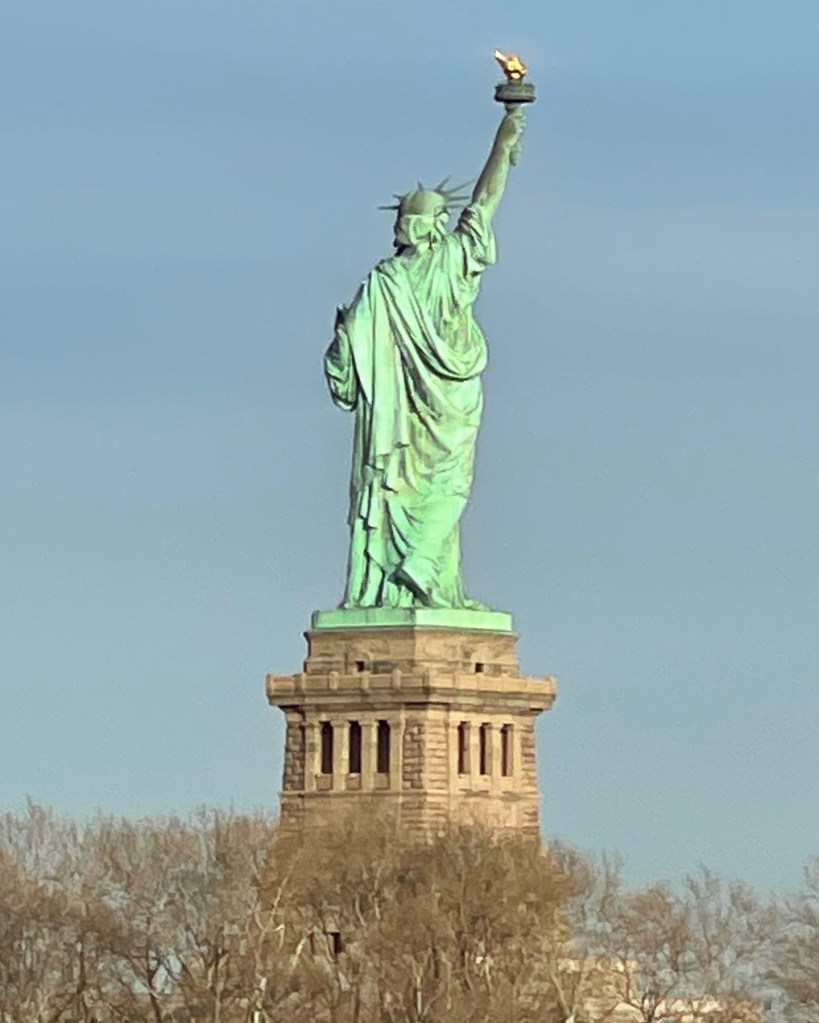
    When you see the Statue of Liberty from the New Jersey side, it feels a bit surreal. We’re all used to that image in our head of the face of Lady Liberty, but how often do we ever think of the back? Yet that’s what New Jersey sees. I recall a joke about Lady Liberty forever turning her back on New Jersey, but let’s flip that script around for what’s really been happening since 1886: New Jersey’s always had her back.

    Liberty Park offers a striking view of Manhattan and Frédéric Auguste Bartholdi’s bold vision of American liberty. He called his work “Liberty Enlightening the World”. Liberty represents the hopes and dreams of millions, standing exposed to the elements for 13+ decades. 1886 was within the lifetimes of Civil War veterans, think about what that statue meant to them. What it still means, when we look at the world with new perspective.

    Liberty connects generations, and she stoically stands, not just American’s, but for the world. The work was literally a gift from the Old World to the New. We ought to remember the message in the gift. Forget the people trying to co-opt her message for political gain, Liberty represents all of us. When you look at America’s Liberty from New Jersey, you aren’t just looking at it, you’re a part of it. And from that perspective, shouldn’t we all have her back?

  • The Compass and the Torch

    “Not like the brazen giant of Greek fame,
    With conquering limbs astride from land to land;
    Here at our sea-washed, sunset gates shall stand
    A mighty woman with a torch, whose flame
    Is the imprisoned lightning, and her name
    Mother of Exiles. From her beacon-hand
    Glows world-wide welcome; her mild eyes command
    The air-bridged harbor that twin cities frame.

    “Keep, ancient lands, your storied pomp!” cries she
    With silent lips. “Give me your tired, your poor,
    Your huddled masses yearning to breathe free,
    The wretched refuse of your teeming shore.
    Send these, the homeless, tempest-tost to me,
    I lift my lamp beside the golden door!”
    – Emma Lazarus, The New Colossus 

    There’s an interesting connection between Emma Lazarus and Henry David Thoreau.  It seems that Emma visited Ralph Waldo Emerson at his home in Concord, Massachusetts in 1876, and met the poet William Ellery Channing while visiting.  Channing was a close friend of Thoreau, and apparently never really got over the death of Thoreau 14 years prior to Lazarus’ visit to Concord.  He proved to be a tough nut to crack, but succumbed to Lazarus as he learned she was an admirer of Thoreau’s.  Channing gave her a personal tour of Thoreau’s Concord, from Walden Pond to the place he was born, and when she was leaving Concord he gave her an incredible gift; Thoreau’s compass.  I admit, that’s a breathtaking gift to me, the compass of Henry David Thoreau, the surveyor of lands and spiritual guide to generations.

    Lazarus, like Thoreau, would live a short life, succumbing to what is believed to be lymphoma at the age of 38.  But like Thoreau she lives on in words of significance created during her short tenure on earth.  Her most famous poem is The New Colossus, which was written to raise funds for the base of the Statue of Liberty, and is forever associated with Lady Liberty.  I’ve read it many times, but find new meaning in it with each reading.

    A mighty woman with a torch, whose flame
    Is the imprisoned lightning, and her name
    Mother of Exiles.

    When you absorb The New Colossus, you recognize the folly of Trump, the Tea Party and the undercurrent of white privilege that’s always been there but is recoiling under an uncomfortable spotlight.  The Founding Fathers might have been complicated in how they lived their own lives, but the ideas behind the Declaration of Independence and the Constitution were bigger than their lives.  The century after would see a nation boiling inside, putting the words to the ultimate test again and again culminating in the Civil War and Reconstruction, the settlement of the continent and the sweeping aside of Native Americans, much of the wildlife and the very land itself.  Set against this was the rise of Transcendentalism, conservation and preservation.  And all the while the immigrants kept flooding in, fleeing desperation and seeking a new hope in America.  Lazarus represents the open arms of Lady Liberty and America, with no restriction in who might be welcomed when they arrive:

    Give me your tired, your poor,
    Your huddled masses yearning to breathe free

    I know people who despair at Trump and the rise of hatred in America.  I take no pleasure in the vile and ugly amongst us.  But I also take the long view, and recognize that American is shifting once again, and the undercurrent of hatred, racism and greed is unwelcome by the vast majority in this country.  I have faith in the process and believe we’ll come out of this year like no other better for having endured.  America is a land of hope, transcendentalism is founded on the belief in the inherent goodness of people.  Emma Lazarus corresponding with Ralph Waldo Emerson and eventually visiting him shows her own interest in his thoughts and opinions.  When I read The New Colossus I think of Thoreau’s compass that was handed to Lazarus by Channing and the direct link that created between them.  I wonder if she glanced at the compass while writing The New Colossus and found the right words to say.  Words that still show us the way forward, towards our true north as a country.
  • The Devil’s Belt

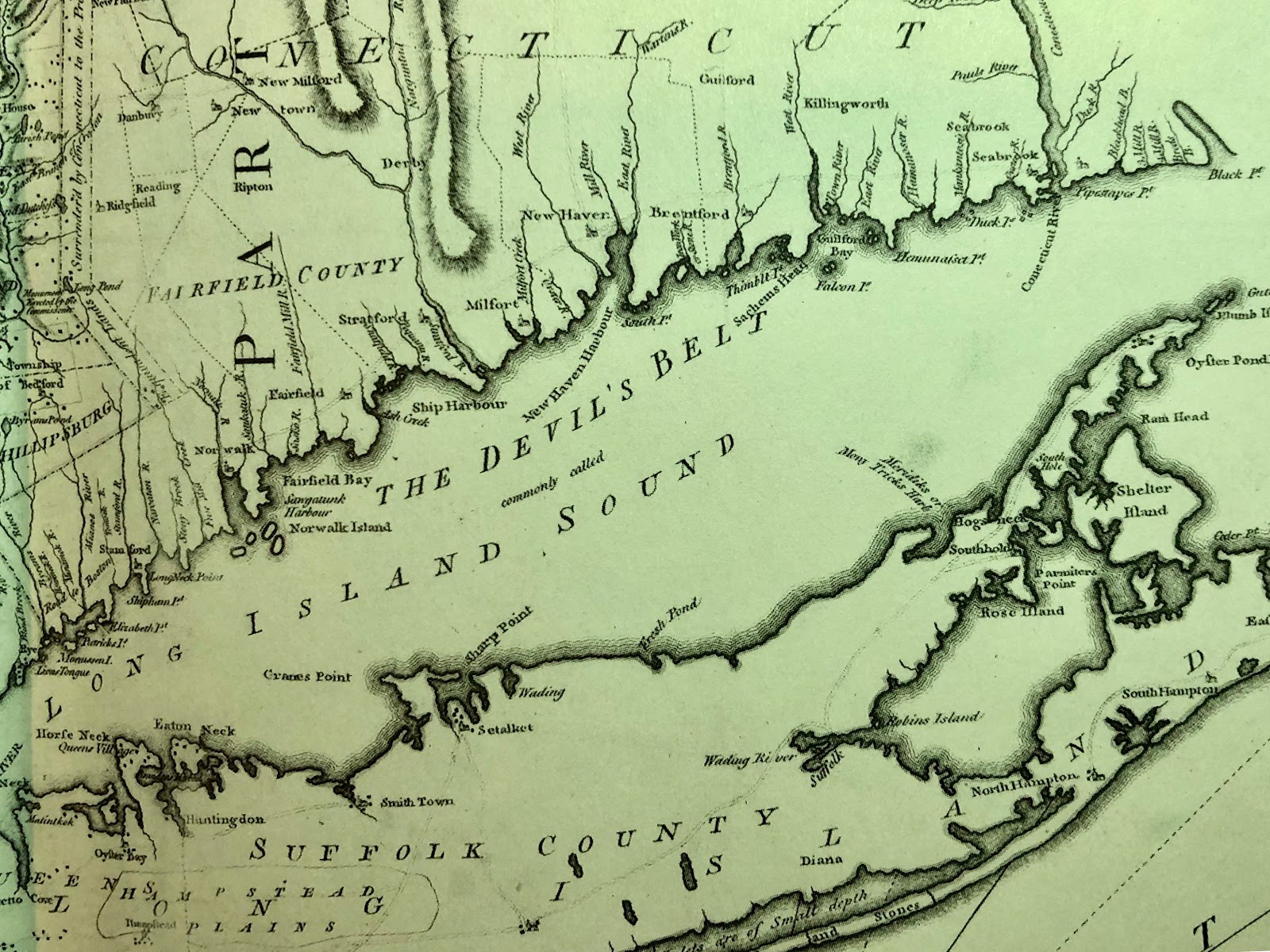
    Long Island Sound is an estuary between Connecticut and mainland New York on one side and Long Island on the other.  This body of water is renowned for its fast currents and shoals, which earned it the nickname The Devil’s Belt.  The most famously difficult portion to navigate was the narrow inlet between the East River and Long Island Sound, known appropriately as Hell Gate.

    Three early explorers mapped out this region between 1527 and the early 1600’s.  Giovanni da Verrazzano was searching for the Northwest Passage after Magellan’s circumnavigation of the globe a few years before.  He made one of the earliest maps of the North American coast from Florida to Newfoundland.  Verrazzano noted the mouth of the Hudson River and the coast of Long Island.  He may have sailed into Long Island Sound.  More than 80 years later in 1609 Henry Hudson famously sailed up the Hudson River but also explored north to Cape Cod.  And a couple of years after that Adriaen Block sailed from the East River into Long Island Sound and up the Connecticut River.  Like Verrazzano, he also explored what is now Rhode Island.  Block Island is named after him.  Block is thought to have named Hell Gate upon sailing through the narrows.  He called it “Hellegat”, which in Dutch means “hole from hell”.

    Long Island is 118 miles long.  Long Island Sound is not quite that long, but pretty close.  It’s 21 miles wide at it’s widest point.  The mouth of Long Island Sound wasn’t much easier on mariners than Hell Gate was, with The Race, the 3 1/2 miles between Fishers Island and Little Gull Island, being the site of rapid currents as the tides changed and water entered or exited Long Island Sound.  The sound is popular with fisherman and sailors alike.

    In the summer of 1951 an adventurous young man named George Post sailed out of Shinnecock Yacht Club in a 16 1/2 foot SS 114 to do something audacious.  George decided to sail around Long Island, but in typical George Post style, he planned stops along the way at Long Island parties.  George was something of a Great Gatsby with his adventurous and fun-loving spirit.  He had friends meet him with a tuxedo to change into for the party, and then the next morning it was back to sailing.

    George sailed northeast out of Shinnecock Bay, rounded Montauk, past Orient Point and down Long Island Sound towards New York City.  He had friends drop beer and food in floating packs from a plane.  George sailed past Rikers Island, and into the East River and Hell Gate, dodging floating debris and barge traffic in the East River until he finally got past Manhattan.  I can imagine what he thought when he sailed past the Statue of Liberty, rounded Brooklyn and sailed out into the Atlantic Ocean.  And I can imagine what everyone else was thinking when this 20 year old kid sailing a small boat floated past them.

    George made it back to Shinnecock, called his mother to pick him up, and got back to being a young adult on Long Island.  He was the older brother of my step-father John, and I’d had the opportunity to meet him on a few occasions over the years.  I wish I’d been more familiar with this story then, and I wish I’d asked him a few questions about it before he passed away.  He was every bit the adventurous spirit that Verrazzano, Hudson and Block were, and his younger brother is, and it would have been fun to learn more about that side of him.