Tag: Ticonderoga

  • Samuel Mott; General and Justice of the Peace

    I love random events that introduce me to people from the past.  It’s a dance with a ghost, a handshake with history.  This is one of those stories…
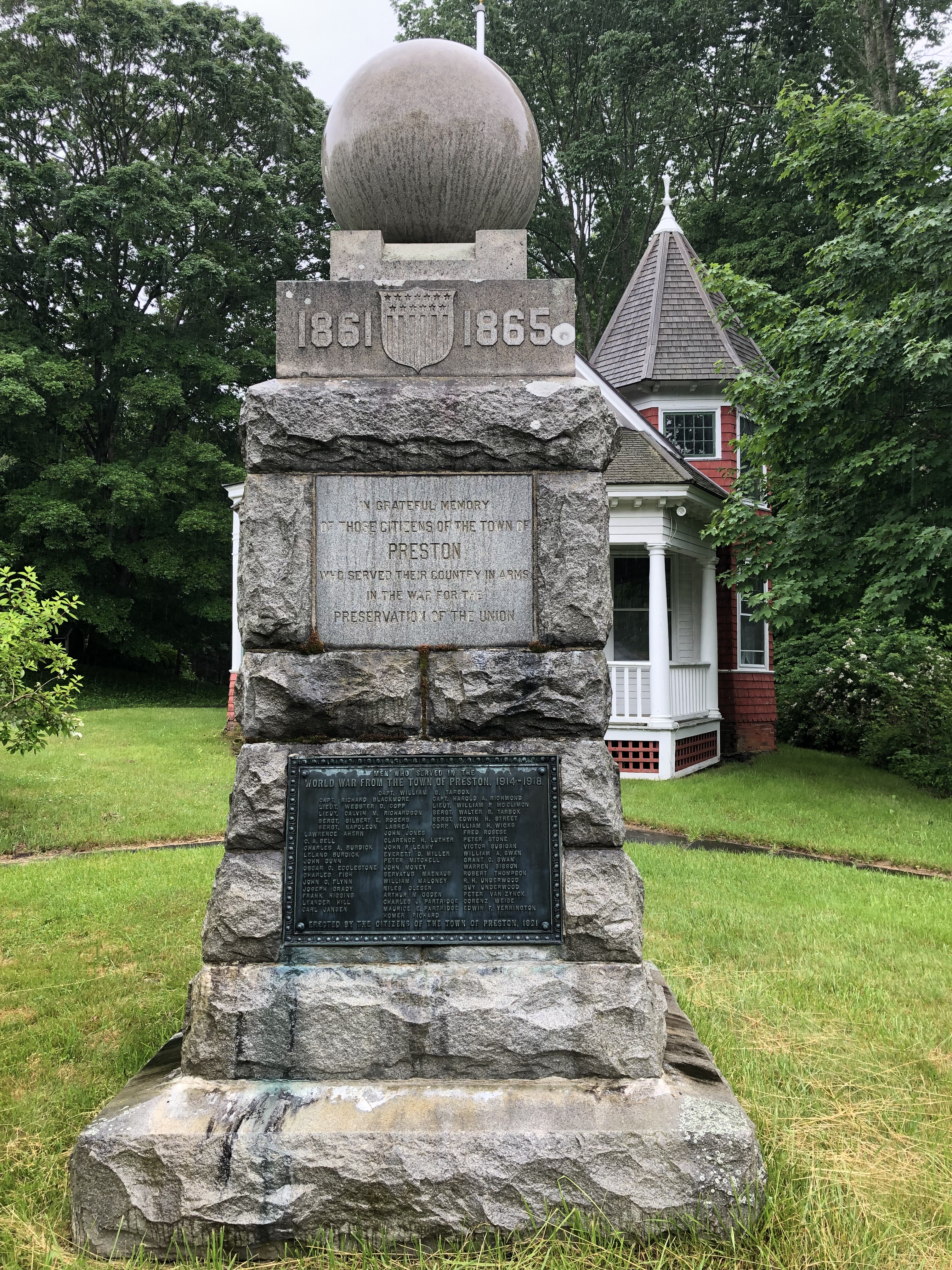
    I’d driven by this monument several times over the last few years whenever I went to Foxwoods Casino for meetings.  Shaped like a pawn on a chessboard, it was big and different and meaningful when placed on this spot, but seemed largely neglected and ignored by the thousands of cars that drive by going to and from the casino.  I’d glance over and contemplate stopping to read the engraved tributes on the monument, but the driveway was tight and not particularly welcoming for someone zipping by in a line of cars.  From the road I could read the dates on the top of the front face of the monument – 1861 1865 – the American Civil War.  Just about every town that was a town during the Civil War has a monument to those who served, and in many cases died there.  I resolved to pull into the tight driveway on my return from my meeting for a quick visit.

    By all accounts, this monument isn’t a big draw.  I may be the first person to pull into the driveway to walk around it in months.  It’s lovely and all, but let’s face it, most people aren’t thinking about the Civil War and World War One veterans of Preston, Connecticut.  The monument is right up on the road, but there are no flags commemorating those who fought, and on this rainy day no flag on the flagpole behind the monument either.  The monument was sited on the grounds of the former mansion of General Samuel Mott, who lived here and apparently, like seemingly every soldier in the Revolutionary War, hosted General George Washington.  His home is long gone, but the library that replaced the building stands watch.  The library in turn has been replaced by a newer building somewhere else in town and the old one, like the monument, doesn’t appear to have a lot of visitors.

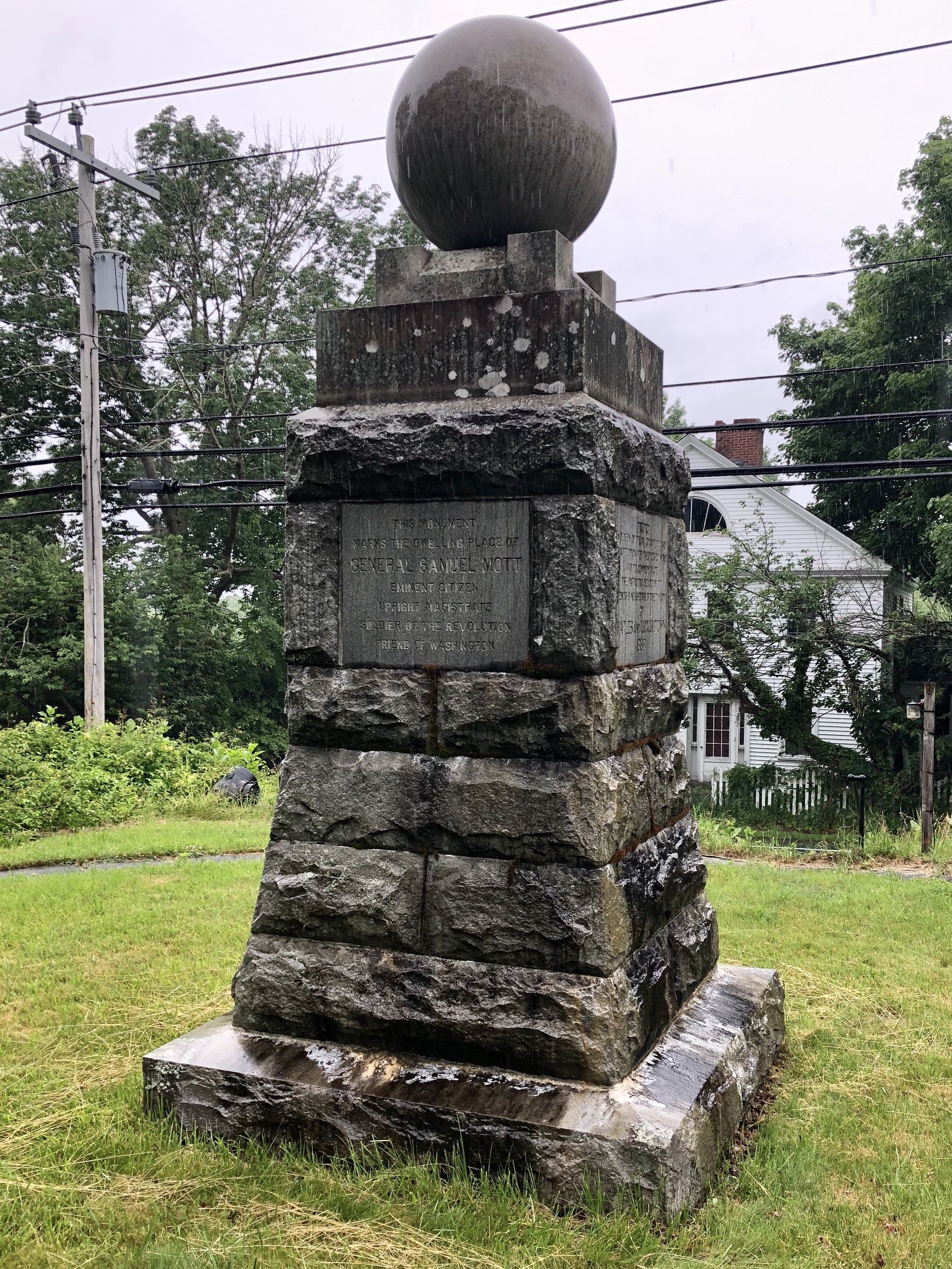
    Of the four faces on the monument, two are dedicated to the Civil War veterans from Preston who served, one to the guy who paid for the monument in 1898 (That guy gets a nod if only for preserving his name for the life of that monument for a modest cash donation.  Hey, you can’t take it with you…), and one face was dedicated to General Samuel Mott.  That face was facing the old library, meaning it was facing away from the road…  meaning that very few people ever read his name anymore.

    This monument marks the dwelling place of General Samuel Mott

    Eminent citizen

    Upright Magistrate

    Soldier of the Revolution

    Friend of Washington

    To honor the Civil War veterans, the town offered these two tributes:

    “From this town obedient to the call of patriotism and humanity went forth one hundred and fifty men as soldiers in the Civil War.”

    “In grateful memory of those citizens of the town of Preston who served their country in arms in the war for the preservation of the Union.”

    Interestingly, the town decided to bolt on a bronze tablet honoring the men from Preston who served in World War One below the “grateful memory” engraving.  I imagine there are other memorials in town to the veterans of each war, but I found it curious that they turned the Civil War memorial into a general “War Memorial” after WWI.  There’s likely a story about the bolting on of the tablet buried somewhere in the town’s history, but it speaks to Yankee frugality.  At least they faced it towards the road so people could see it.

    “Colonel (afterwards General) Samuel Mott, at whose house General Washington is said to have called, lived in Preston City; his house occupied the spot where now (1922) stands the Public Library of that town  …  Samuel Mott was appointed an Engineer in 1776.  He was Lieutenant-Colonel when he served in the Northern campaign at Ticonderoga, Crown Point and Quebec…” The Descendents of Governor Thomas Wells

    Samuel Mott wasn’t a big name in the Revolutionary War, but he served his country in some of the most critical battles in the early part of the war.  Being promoted to general was a highly political business during the war, but it does speak to some level of respect for his accomplishments to that point.  I’m sure he knew Benedict Arnold well, being a fellow Connecticut guy, and likely served under him on those early campaigns when Arnold was still a complicated hero.  Arnold led troops to Quebec through Maine and was met there by General Richard Montgomery, who came up from Lake Champlain.    The soldiers who laid siege on Quebec faced starvation, smallpox, and a determined enemy.  They barely escaped with their lives when the British sailed up the St Lawrence River in the spring to reinforce Quebec and drive out the Northern Army.  Mott is a guy who saw a lot in his time in the army.
    Mott moved to Preston in 1747, and came back after the war, where he served as the Justice of the Peace.  There’s a record online of the many marriages that he blessed from 1769 to 1811.  He died in 1813 at the ripe old age (for the time) of 78, and likely had quite a few people remembering him fondly as the gentleman who married them.  I think of that Jewish saying when I meet someone long gone randomly:  We all die twice; the day we stop breathing and the day people stop saying your name.   If that’s the case, Samuel Mott has a little more time with us.  I appreciated the call to go visit his old stomping grounds on a rainy June afternoon.  My dress shirt quickly darkened as the rain pelted down on me as I walked around the monument reading and taking pictures.  Drivers buzzing by surely thought I was crazy and they may be right.  But I’m glad I stopped, and I’ll be sure to give a nod to the General whenever I drive by that monument.


  • Battle Hill at 50 MPH

    Located on Route 4 in Fort Ann, New York between the Champlain Canal and Battle Hill is an unusual monument to the Revolutionary War battle that took place here on July 8, 1777.  You’d be forgiven if you miss it as you cruise on past at highway speed.  I only knew about it from a rest area attendant who described exactly what to look for.  As with many historical markers, it tells a story if you stop long enough to listen.

    While the tablet is barely noticeable as you speed along, Battle Hill is of course much larger, and the land above the highway sign is in the beginning stages of historic preservation.  For now, there’s only this simple marker, mounted on the ledge cut into Battle Hill in 1927, when cars came by much less frequently than they do now.  The tablet is decorated with American flags, which serve both as a tribute to those who fought here and as a way to visually find the tablet recessed into the ledge as you’re driving by.  I had to double back and park across the highway from the sign in a small pull-off.

    The Battle of Fort Anne started with defeat and retreat, as the Continental Army (mostly New Hampshire met) retreated from Fort Ticonderoga and then Skenesborough.  General Burgoyne hoped to cut off this retreat and landed 200 soldiers let by Lieutenant Colonel John Hill.  The American’s made a stand at Fort Anne, bolstered by the arrival of reinforcements led by Colonel Henry Kiliaen Van Rensselaer, who provided key leadership in the battle despite being wounded.

    While not the largest battle in the war, Fort Anne served to delay the British on their march to take Albany and create an unbroken water route from Canada to Manhattan.  This delay was critical for the Americans.  It’s was Burgoyne’s biggest mistake; instead of sailing his army right down Lake Champlain and Lake George and storming into Albany, he got sidetracked chasing retreating soldiers.  He won the battle, but helped lose the war as the delays of Fort Anne and defeat at Bennington set the stage for a larger defeat at Saratoga.  That set the dominoes in motion as the French would eventually join forces with the Americans, upping the ante significantly.

    Two interesting footnotes from the Battle of Fort Anne were the use of deception on both sides.  The Americans planted a fake deserter who convinced the British that the Americans had more than 1000 soldiers at Fort Anne waiting for them, which led them to wait for reinforcements instead of attacking.  Not to be outdone, when the British were running out of ammunition and on the verge of being overrun in the battle, a British quartermaster named John Mone used Indian war cries to make the Americans think that a much larger force of reinforcements were rushing in.  This allowed most of the British to retreat safely.  I’ve read about some of these events, but as with everything a visit helps you get a lay of the land and if you’re lucky hear the whispers of history over the roar of the traffic wizzing by.

  • Benedict Arnold

    Growing up in the United States of America, you heard a version of history that made our Founding Fathers and the generals who fought the American Revolution out to be heroes.  And in many ways they were.  The winners write the history, no doubt, but they did create a democracy that was the envy of the world while fighting off the greatest military power of the day.

    I’ve read that if Benedict Arnold had been killed at Saratoga instead of badly wounded he would be remembered as one of our greatest heroes.  There’s no doubt that he was a complicated man; aggressively ambitious to a point where he drove those he commanded, was loathed by many of his peers, but loved as a true leader by anyone who saw him in action.  
    Had Benedict Arnold not turned against the colonies, he would have been celebrated as one of our greatest military leaders for his raid on Quebec, the raid on Ticonderoga, the Battle of Valcour Island on Lake Champlain against overwhelming odds, the Battles of Ridgefield, Connecticut and Saratoga. In all of these, Arnold exhibited courage, persistence, strategic vision and competitive spirit critical in war.  He sacrificed an enormous amount of his personal wealth and political power for the Revolution, and was a key reason the British were ultimately defeated.  And yet he’s best known for his betrayal.
    You can’t take omit that betrayal when considering the man.  There’s no doubt that he deserved the condemnation and infamy he received and receives to this day for not just betraying the colonies, but also betraying George Washington and the troops he served with.  But it’s… complicated.  If Arnold weren’t such a hero in 1775-1778, his betrayal in 1780.  He remains the most famous traitor in history, and the most forgotten hero.
    I’ll try to visit a few of the places that Benedict Arnold made history in.  Not because I admire the man, but because without him I’m not sure that the Continental Army would have won in the end.  And what would our history have been then?  Unlike Washington, there aren’t a lot of “Benedict Arnold slept here” placards on the sides of colonial era homes.  But there are monuments to what he accomplished, and I’d like to explore a few of those in 2019.
  • Perspective on the Weather

    Perspective on the Weather

    It’s bitterly cold outside.  Snow boots, winter parka, bomber hat flaps tight to the face when you’re letting the dog out cold.  In general I don’t complain about the weather.  Hell I live in New England and while some call it our birthright, I view it as whining about something you can control.  Don’t like it?  Move to Florida.

    When it gets like this I think about the people who were out in these elements fighting the Revolutionary War or the French & Indian War.  No creature comforts for Colonel Henry Knox and the soldiers in his command as they hauled artillery 300 miles through the wilderness from Fort Ticonderoga to Boston to help free the city from the British siege in the winter of 1775 – 1776.  Nor for Rogers Rangers and slowly starved to death as they evaded the French and Native Americans who were actively hunting for them on lands they knew better.  No reprieve for George Washington and the soldiers hunkered down at Valley Forge in the winter of 1777 – 1778.  I could write another hundred examples but I think you get the point.

    History offers great perspective on what real hardship is.  It isn’t living in the suburbs with a gas furnace and six supermarkets within ten minutes drive and pizza delivery a call away.  No, this isn’t hardship, and I tune out those who complain about it.