Tag: Vermont

  • A Weekend at The Trapp Family Lodge

    The cow outweighed me by more than 1200 pounds and had long horns protruding menacingly to her right and left, but I edged closer anyway. Bob, the Activities Director at The Trapp Family Lodge, insisted that it was safe to walk out amongst the Highland Cows. He gave us instructions on what to do if they approached us looking for apples (fold your hands into your body and turn slowly away to show you don’t have food). And he told us when one of the cows was annoyed with us. Otherwise, we were turned out to explore the field. Turning around, I realized I was one of the few who took him up on the offer. But risk has its rewards, and being close to the cattle was thrilling.

    Highland Cow

    I’ve been to Stowe, Vermont many times over the years. Mostly I’d drive up for Heady Topper beer, look around a bit and dream of lingering awhile. I’d even stopped to visit the Trapp Family Lodge, walking into the lobby to see what all the fuss was about. Like most Americans I’ve seen The Sound of Music a few dozen times. This wasn’t the Austrian Alps, but you can definitely see why they sank their roots here. The hills are alive in Stowe too.

    The Trapp Family Lodge is a lovely place, with fires roaring and pilsner flowing freely from taps and a quiet elegance without pretense. Pictures of the family decorate the walls throughout the lodge along with art derived from the story of the family’s escape from Nazi Austria. The mountains surround the property in all directions, and the von Trapp family owns much of the land and has donated many more acres to a land trust, ensuring this view would remain largely as it’s always been.

    We’d explored some of that land on our first day at the Lodge, walking the trails to find the Chapel at the top of the hill, and circling back to check out the Kaffeehouse for a snack. There are hiking and snowshoe trails criss-crossing the woods at the resort, and we had plenty of options for getting to know the lay of the land. Mountain bikers had their own single track trails that offered challenging terrain to explore. And wide cross-country skiing trails waited patiently for the snow to arrive. This was an outdoor enthusiast’s paradise. The outdoor hot tub and spa is a great reward for having done the work.

    After meeting the Highland Cows we walked back up the hill to the Lodge, with massive ravens flying about us speaking a sophisticated language of their own. I wondered at the banter, and wished we had more time to get to know them better. But we had other places to explore, and a long hill to walk back up. It seemed the cows were on the furthest pasture from the Lodge, and we had to earn our visit. It worked out to be about a mile each way, and a good way to work off breakfast with a different vantage point.

    We made a quick trip to downtown Stowe to explore the shops and made a stop at The Alchemist to pick up our Heady Topper beer order curbside before returning to the Bierhouse for lunch and a pint. We made a point of saving room in the cooler for some von Trapp beer as well. The Alchemist helped make Stowe the heart of New England IPA country, but the von Trapp’s make a great case for pilsners with their brews. This wasn’t some mass-produced American lager, this was beer with substance.

    Brewing at von Trapp is serious business

    As luck would have it, the woman who seated us was Kristina von Trapp, the granddaughter of Maria and a Director of the resort. She was a gracious host, with a striking presence about her borne of her family celebrity but honed on an active life outdoors and running a successful business. She wasn’t quietly sitting in the corner office looking at spreadsheets, she was hands-on and engaged with the public. And that made the von Trapp experience all the more impressive.

    We resolved to come back here again in the other seasons. Stowe is beautiful year-round, even on a cold November morning when the trees are bare and the snow is just hinting that it might return again. Staying here in all four seasons seems a worthy goal. And it will help keep the refrigerator well-stocked too.

  • Mountains and Waterfalls

    A weekend in Vermont stirs the imagination, and Stowe is famously rich in beauty, romance and adventure. As with so many other places, the magic crackles and sparks here on the edges of the day. Days are filled with adventure, nights a starry dome. The edges in between are when the light dancers march across the mountains and leap and twirl in the sky. In the morning the mountains are jagged black walls that holds the rising dawn back from our eager eyes. At dusk the mountains turn ember-red as they reach for the last rays of light. My iPhone screen mocks my attempts to capture it, but try I must.

    We stayed at the Trapp Family Lodge to get the full Stowe experience. The lodge is lovely and full of the amenities you’d expect at such a place. For me the abundance of hiking trails just outside the door were a nice incentive to stay here. The spa, Bierhall and Kaffeehaus all spoil the senses. But if you’re in Stowe get your ass outside.

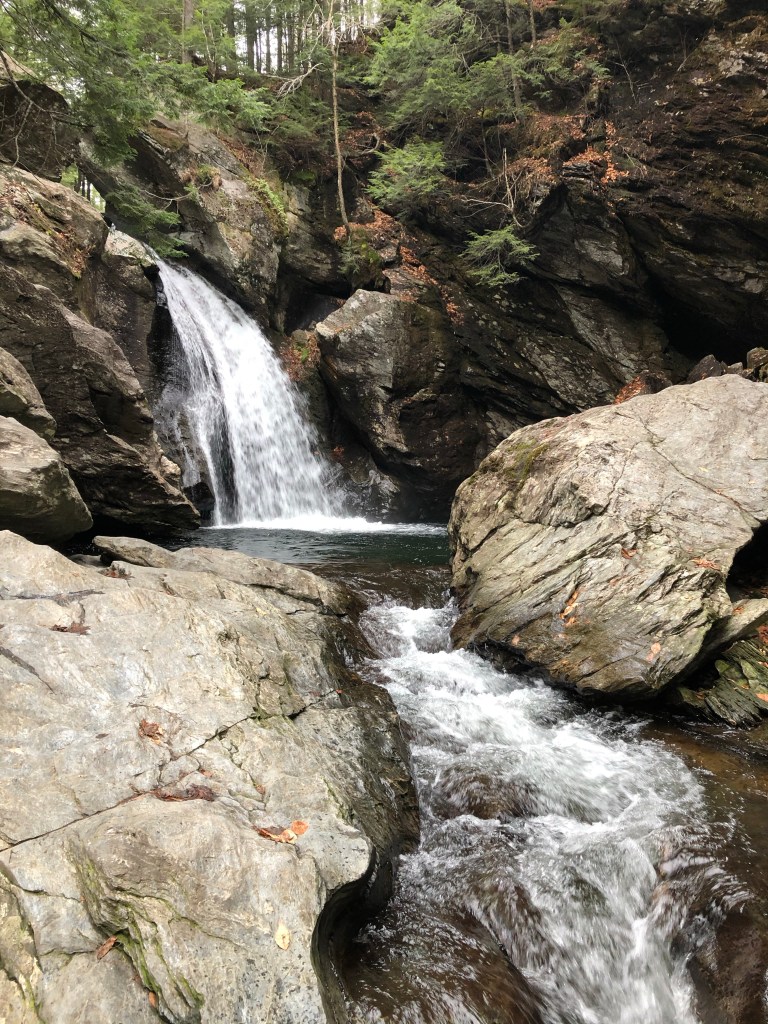
    Hiking options are everywhere here, but we wanted waterfalls on this trip. Stowe has a couple of waterfalls nearby that are well worth the quick hike to see. Moss Glen Falls are a tumbling cascade framed by hemlocks. It’s an easy ten minute hike from the car to the best viewing point, and I smiled at how over-prepared we were for a much longer trek. The falls are postcard perfect, and worth a visit on quiet days when the tourists are elsewhere.

    Bingham Falls are near Smugglers Notch with a beautiful waterfall falling into a pristine pool worth the descent. What goes down must go up, and the walk up isn’t as bad as you think it will be after descending a couple of steep, muddy stretches. A few people have died falling into the gorge here, and it’s easy to see how. Nothing separates you from a plunge into the gorge but your own awareness. Not a place for little kids to run unattended.

    Mountains and waterfalls pair well together, and I greedily seek out each. I often wonder why there aren’t more visitors when I come across beautiful places, but usually it’s because I go when the crush of visitors ebbs. Like the mountains at sunrise, waterfalls whisper to you when there’s nobody else around. But only if you’re there to listen.

    Moss Glen Falls
    Bingham Falls
  • Lost in an Autumn Playlist

    Autumn. Smell the pumpkin and ripe apples and decaying leaves and wood smoke. Late September through Thanksgiving in New England offer vibrancy with the fourth sense fully engaged in the game of being alive. I could live in many places in the world, but these crisp nine weeks are when I appreciate living in New Hampshire most.

    Autumn. Blue jeans and long sleeves, the heat radiating through a mug warming your hands, wiping dew off the chair before sitting down in the backyard writing chair. Blankets pressing you down into the mattress like you’re a panini. Socks. The days grow shorter and cooler, and the wardrobe changes with the tilt of the earth. We’ve been here before, and we grow reacquainted once again with fabric on our extremities. The dance with Autumn inevitably means literally feeling her on your skin.

    Autumn. Yellow and red waves sweep first over the highlands and wetlands, moving southward and finally capturing the strongest holdouts in between. Northern vistas so stunning you can’t help but stare, and apologize profusely for being so rude. I confess my productivity decreases when I travel to Vermont or northern New Hampshire. Like stained glass in a church, the leaves demand your attention.

    Autumn. Sweetness of apples and the omnipresent pumpkin spice. Last of the harvest turned to cider and preserves. Lighter summer fare giving way to richer dishes that warm you inside out. If you haven’t lost those few extra pounds by now you face an uphill battle as caloric intake holds the advantage. Baked goods take the place of salads, rum gives way to scotch, soups and stews and casseroles tempt and delight. The scale be damned.

    Autumn. The fading crickets song grows sadder while the crows caw grows bolder. Soon the red-winged blackbirds and other transients fill the trees with a cacophony of excited conversation. The hiss and pop of an outdoor fire. And always, a playlist of standards for Autumn. There’s a soundtrack for every season, and Autumn is when my playlists grow reflective.  In the spirit of the senses, I’ll limit myself to five standards that set the tone for Autumn in New Hampshire:

    Philosophers Stone by Van Morrison (King of Autumn music)

    The Long Day is Over by Nora Jones

    I Was Brought to My Senses by Sting

    You Don’t Have to Say You Love Me by Shelby Lynne (sorry Dusty)

    Deacon Blues by Steely Dan

  • The Yin and Yang of New Hampshire and Vermont

    “She’s one of the two best states in the Union.
    Vermont’s the other. And the two have been
    Yokefellows in the sap yoke from of old
    In many Marches. And they lie like wedges,
    Thick end to thin end and thin end to thick end,
    And are a figure of the way the strong
    Of mind and strong of arm should fit together,
    One thick where one is thin and vice versa.”

    – Robert Frost, New Hampshire

    New Hampshire and Vermont are Yin and Yang.  Almost flipped mirror images of one another, as Frost describes.  The people are similar in so many ways, and different in so many other ways.  Generally, Vermont is a “blue state” while New Hampshire is a “red state”, traditionally voting Republican (much to the chagrin of Vermont and Massachusetts).  New Hampshire has a certain active principle, Live Free or Die vibe going, while Vermont embraces a more receptive, Freedom and Unity vibe.

    The Connecticut River defines the border between the two, as determined by King George III in 1763. Vermont didn’t exist back then, the land was deemed New York’s. But that didn’t last very long; about the time it took for New York to try to collect taxes from the people there. Ethan Allen and the Green Mountain Boys chased the tax collectors right out and Vermont seceded as the American Revolution was ramping up. That’s a very New Hampshire thing to do! And ever since, these two states have been locked in an eternal embrace; interconnected yet independent. White Mountains and Green Mountains, conservative and liberal, two of the smallest states in size and population; wonder twins holding up the northern border and hugging each other for eternity.

  • Hubbardton

    There was only one battle inside the borders of Vermont during the Revolutionary War.  Many people would point to Bennington as the location, but that battle actually took place in New York.  The Battle of Hubbardton erupted on the morning of July 7, 1777 when the British forces (mostly Hessians) and their Native American allies pursuing Colonial Army forces retreating from Fort Ticonderoga caught up to them on this site.

    The 11th Massachusetts Regiment was the rear guard and were late to join the larger forces commanded by St. Clair, who were marching to Castleton.  Colonel Seth Warner commanded the Green Mountain Boys and Nathan Hale (not the spy) commanded the 2nd New Hampshire Regiment that waited for the 11th to catch up.  Warner decided to spend the night instead of marching on, and the British caught up with them at dawn.  The combined forces of the Massachusetts, New Hampshire Regiments and Green Mountain Boys stood their ground along the top of a ridge and laid fire on the pursuing British forces, retreated further and engaged again.

    Casualties were high on both sides. On the Colonial Army side a combined 370 men were killed, wounded or captured, and New Hampshire’s Nathan Hale was captured in the battle and eventually died in captivity.  On the British side, almost 200 were killed or wounded.  The battle was technically won by the British, but it was a costly battle that, along with battles in Fort Anne and Bennington, were critical delays that helped lead the way to the American victory at Saratoga.  General Burgoyne’s critical mistake was losing focus on the ultimate goal of controlling the British along the water routes from the St. Lawrence to the Hudson River, which would have cut off New England from the rest of the colonies.  Saratoga proved a critical win as it prompted the French to join the Americans against the British.

    I walked around the site of the Battle of Hubbardton on April 18th when I took a quick detour from my business meetings.  Driving out to the battle site is an exercise in faith, as the signage is limited, cellular service ended for both my AT & T and Verizon phones, and you’re driving for what feels like a long time from the highway to the site.  But I’m not easily intimidated by such things.

    The actual battle site looks a lot like it did that day.  If anything, it’s even less developed now than it was then, as the fields once planted with corn, beans or hay have been taken back by the forest.  The battle site remains fields, with mown paths that carry you to signs that tell you where you are and what happened at that location.  This was the moment when I recognized that my old dress shoes were no longer waterproof, as the soggy grass transported water to my dress socks with ease.  I normally keep boots in my car but this side trip wasn’t anticipated and, well, it’s only water.

    The Battle of Hubbardton site is an active museum, but it doesn’t open until May and there’s a sign that let me know it’s okay to walk around the grounds.  There’s a small building that likely offers much more information on the battle and the related action at Lake Champlain, Fort Ticonderoga, Fort Independence and Saratoga.  But that will have to wait for another day.  A white marble monument surrounded by an iron fence offers a stoic tribute to the events of that day, and I spent a few minutes walking around it reading the engravings on each side.  I was alone that day, and that solitude made the experience all the more moving as I reflected on the quiet ground that once roared with violent conflict.

  • New Hampshire Grant

    New Hampshire Grant

    The land that is today Vermont was once claimed by Massachusetts, New York and New Hampshire.  The Massachusetts claim originated from a fort established in the Connecticut River Valley in present-day Brattleboro.  New York based their claim on original Dutch territorial claims that all the lands west of the Connecticut River to Delaware River were theirs.  When the Dutch were ousted from North America New York followed the same general borders, which were validated by King George II.

    New Hampshire Governor Benning Wentworth chose to follow his own guidelines, choosing the western border of Massachusetts and going north to Canada and east to the Connecticut River as land he had jurisdiction over, which he then granted to middle class farmers who settled the land.  New York was granting the very same land to wealthy landowners and wasn’t particularly pleased by Wentworth’s interpretation of the borders.  These wealthy landowners then tried to tax the middle class farmers on “their” land, which led to even more tensions.

    The most famous of these middle class farmers was Ethan Allen, who was a natural self-promoter.  Allen and other farmers formed the Green Mountain Boys, who organized armed resistance to New York.  The escalating confrontations between the New Hampshire Grantees and the New York grantees continued until the beginning of the Revolutionary War forced all parties to focus on a larger problem.  Eventually New York gave up and Vermont would become a state.  There’s still an independent streak in Vermont and New Hampshire to this day.  Perhaps there’s still some lingering annoyance on the part of some wealthy New York family who’s ancestors gave up the fight for lands they were granted.

  • Silent Night

    Silent Night

    This year marks the anniversary of Silent Night, written and then composed to music two hundred years ago.  The history of Silent Night is making the rounds on various media this holiday season, so I won’t re-write it here, save for this brief Wikipedia intro: “Silent Night” (German: “Stille Nacht, heilige Nacht”) is a popular Christmas carol, composed in 1818 by Franz Xaver Gruber to lyrics by Joseph Mohr in the small town of Oberndorf bei Salzburg, Austria.

    It’s Christmas Eve in New Hampshire.  The nest if full, if only for the briefest of times, the presents are under the tree, the plans are made.  2018 was a tough year in so many ways, and many people who were with us at Christmas last year aren’t here this Christmas Eve.  Best to make peace with yourself and your neighbors on this holiest of days.

    Austria is calling me.  Vienna and Salzburg keep popping up in my life.  I work for a company based out of Salzburg and the whole Sound of Music connection to Stowe, Vermont (Trapp Family Lodge) has lingered in my imagination for some time.  Vienna is the title of a Billy Joel song that keeps reminding me that Vienna waits for you.  The Geography of Genius and Cultural Amnesia have both informed me of Vienna’s place in our cultural history and the fragility of Humanism and Intellectualism in the face of the rise of Nazi Germany.

    A popular bumper sticker this year seems to be the “Resist” slogan.  It’s a reaction to Trump and white supremacist groups feeling the courage to crawl out of the rock they live under in the last two years.  Trump is testing our democracy and the Rule of Law like no other President in American history.  So resist, but know your history and what happens when you don’t resist.  Blindly following a religious, political or military leader has consequences often not seen until it’s too late.  The best defense is strength and knowledge.

    On Christmas Eve, most of us want peace of Earth and goodwill toward men.  Looking back one hundred years to the meat grinder that was World War One, it’s easy to see what can happen when we let “leaders” power go unchecked.  When I think of Silent Night I think of the story of the two sides in opposite trenches stopping the fighting on Christmas Eve and singing Silent Night.  The war would grind on and many more would die, but for that brief moment reason and goodwill took over.

    Silent Night, Holy Night
    Mindful of mankind’s plight
    The Lord in Heav’n on high decreed
    From earthly woes we would be freed
    Jesus, God’s promise for peace.
    Jesus, God’s promise for peace.