Tag: Wildlife

  • Playing Possum

    Last night I got to experience something for the very first time. The pup, now eight months old and keenly observant of all that moves in her kingdom, spotted an opossum nibbling on fallen birdseed a second before me. It seems opossums don’t run nearly as fast as an excited mutt. The gap was closed in an instant and the pup was on top of the opossum before I could reach her. Sure enough, the opossum looked like road kill with its tongue halfway out the mouth and twisted oddly out of wack. It looked like a crime scene minus the blood. The dog thankfully lost interest right away and began sniffing around for something else nearly as exciting. Suspecting our newfound neighbor was faking it, I got the dog inside the house and took her for a walk on the street instead. After the walk I took the flashlight out to investigate and sure enough, the opossum had awoken from its tonic immobility and moved on to safer places.

    Tonic immobility is an automatic reflex to high stress situations. It’s playing dead, but without the playing. The opossum wasn’t just lying there with its eyes closed and mouth open, it was unconscious for a period of time to allow the danger to disappear. Puppies like squeaky toys. When the toy didn’t squeak the pup looked for something more fun to chase. The Wikipedia link above is informative, and points to all sorts of creatures who go into a state of tonic immobility when they’re stressed.

    Humans can also reach a similar state when fainting. I once watched a bridesmaid faint in the middle of a ceremony on the beach just as the happy couple were about to say “I do”. I watched a groom faint in the middle of his own vows at a different wedding ceremony. It seems weddings are high-stress environments for some humans. I’ve never seen anyone playing dead at a wedding, but I’ve witnessed some marriages that were dead on arrival.

    Fainting may make the problem go away, but usually not. When we are in extremely stressful situations we ought to stay conscious. We ought to keep our wits about us, as the saying goes. Slow, deep breaths help greatly to calm us down, but it’s a hard state to achieve when you’re being chased by a bear or are experiencing something equally catastrophic. Being more resilient through practiced breathing may help, and thinking through what we might do in the worst case scenarios is likely our best option. When it feels like it’s not our first rodeo, we’re less likely to be frozen immobile when things are turned upside down.

    This morning I turned on the outdoor spotlights, looked around and then waited a beat before opening the door. If dogs could roll their eyes at their humans I’m sure that’s what the pup would have done to me in the moment. I smiled at her and let her out to chase her own dreams with a bit of assurance that the scene would be a little better than last night. One crime scene per week is my limit.
  • Sunrise and Mosquitoes

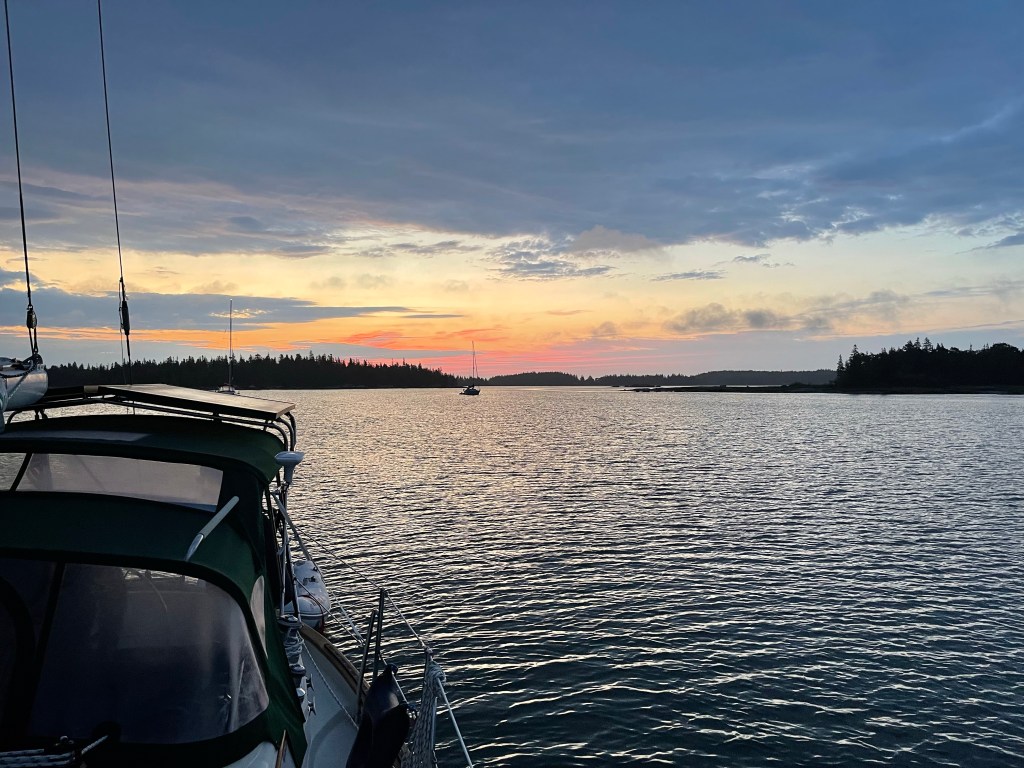
    Seal Bay, Maine. 04:30 and a brightening sky. There’s a strong probability of magic in the air. To get up or to linger awhile in the finally-comfortable position I’d found? The answer is obvious by now—up and at ‘em.

    Moving slowly as not to awaken the crew (who inevitably were awakening anyway), I slid open the hatch with an unwelcome bang that turned my intentions upside down. “Sorry,” I mumbled quietly. There’s just no sneaking around on a sailboat.

    Outside, the sky began to glow, as a light breeze carried wispy clouds of fog across the cove. Sitting a few beats, I heard the familiar song of a mosquito buzzing nearby. Damn. Soon another. We take the good with the bad in this world, and reconcile it as best we can. I celebrated a pristine, quiet cove distracted by a hungry swarm of fast flyers. “Such is the way,” whispered an understated sunrise rising above it all. And so it was.

  • How Much Alive

    “It matters not where or how far you travel—the farther commonly the worse—but how much alive you are.” — Henry David Thoreau

    Sitting outside, listening to birdsong in the magic hour before the world shook the cobwebs off, I watched a couple of large birds fluttering tree-to-tree. I wondered at them, thinking perhaps pileated woodpeckers who tend to behave this way, or maybe a couple of young turkeys waking up from their roost. Definitely not hawks on the hunt. Black and white with a bit of duck-like appearance to them, I quickly exhausted my list of possibilities and remained mystified. The binoculars and camera remained safely in the house where they offered the least amount of help in the moment. So I quietly thanked them for their visit and released them from my attention as they worked their way away from my own perch. I may find out yet who my visitors were, but it wasn’t our moment for a proper introduction.

    We aren’t meant to know everything, but we ought to be curious. We all seek answers in this world. We climb to high summits, fly to faraway places, seek solace in the new. Shouldn’t we celebrate the world as it comes to us? Why do we feel compelled to fly across the globe? Because we know it’s out there, and like those birds, once we’re aware of that fact we want to know a bit more about it.

    Thoreau traveled too, he just wasn’t collecting frequent flyer miles or navigating security lines. He sought faraway places relative to his time and place, traveling to Cape Cod and Maine and paddling down the Concord and then up the Merrimack Rivers. He sought what was just out of reach just as we do. Credit the pace of travel if you will, but he didn’t postpone his aliveness for when he arrived at his destination, he encountered it in each moment along the way. Shouldn’t we do the same?

  • Disturbing the Roost

    Mid-March brought the turkeys back. They roost high in the white pine trees at the edge of the forest, protected from the coyotes, bobcats and other predators who long for a turkey dinner. They’re silent during the early morning hours until something disturbs them. This morning that something was me.

    Coffee in hand, I walked out into the songbird chorus of pre-dawn, stood silently to let the world sink in, and caught a glimpse of motion out of the corner of my eye. Turning to greet it, I watched a single turkey glide away in the early light. Soon another one began it’s own glide from the high trees to some place further away. A few beats later another dozen flew off silently, and then the squawking began. Grumpy morning conversation about the guy with his coffee disturbing the sleep-in.

    I ought to write about St. Patrick’s Day or the luck of the Irish. I ought to write about war and pandemics and the collective pain we all feel at the disruption of our lives by things out of our control. But the sight of turkey’s gliding silently through a dim, foggy morning in New Hampshire reminded me that we each leave our small ripple on the universe in our own way. Today I disturbed the roost, but they don’t seem worse for the wear.

    It made me wonder, what else lies dormant, waiting to be stirred in the foggy morning?

  • Hiking the Trails of Mount Wachusett

    On every side, the eye ranged over successive circles of towns, rising one above another, like the terraces of a vineyard, till they were lost in the horizon. Wachusett is, in fact, the observatory of the State. There lay Massachusetts, spread out before us in its length and breadth, like a map. There was the level horizon, which told of the sea on the east and south, the well-known hills of New Hampshire on the north, and the misty summits of the Hoosac and Green Mountains, first made visible to us the evening before, blue and unsubstantial, like some bank of clouds which the morning wind would dissipate, on the northwest and west. These last distant ranges, on which the eye rests unwearied, commence with an abrupt boulder in the north, beyond the Connecticut, and travel southward, with three or four peaks dimly seen. But Monadnock, rearing its masculine front in the northwest, is the grandest feature.

    As we beheld it, we knew that it was the height of land between the two rivers, on this side the valley of the Merrimack, or that of the Connecticut, fluctuating with their blue seas of air,—these rival vales, already teeming with Yankee men along their respective streams, born to what destiny who shall tell? Watatic, and the neighboring hills in this State and in New Hampshire, are a continuation of the same elevated range on which we were standing. But that New Hampshire bluff,–that promontory of a State,—lowering day and night on this our State of Massachusetts, will longest haunt our dreams.
    ” — Henry David Thoreau, A Walk to Wachusett

    Mount Wachusett is a glaciated monadnock, standing 2006 feet tall. Like her neighbor to the northwest, Mount Monadnock in New Hampshire, Mount Wachusett stands watch over the landscape that bows before her. You can’t talk about one mountain without mentioning the other, for they are forever kindred spirits in the landscape. Both mountains are uniquely positioned so that their waters flow to the Merrimack River from one side and to the Connecticut River from the other. The waters from each river run in my blood, which made a hike to the summit a sort of homecoming for me. And yet, for all the hikes I’ve done on Monadnock, I’d never hiked Wachusett.

    This was a month where the weather continued to disappoint those who dream of deep snow drifts, while thrilling those who pine for a mild winter. Count me in the camp of the former: I wanted nothing more than to fly across snow plains this winter. A heavy snowfall the day before offered one last chance for the month. But it was quickly apparent that this was a micro spike hike, and the snow shoes were left behind yet again.

    From the Visitor’s Center, you can easily summit Mount Wachusett in under 30 minutes. But that wasn’t our goal. Instead we took the Bicentennial Trail around the eastern slope to High Meadow Trail, up through a stand of Hemlocks to the Pine Hill Trail. Fluffy snow over ice creates uncertain footing, and we slowed our pace to mitigate the risk of injury. For a time, the only break in the trail ahead was from a porcupine, who’s distinct tail marked the trail in footprints and swirly plows. It seems most people cut to the chase and scramble up the mountain. We were more inclined to linger with it, to get to know it better. To feel what Thoreau felt when he and Richard Fuller hiked here from Concord, set up their tent atop the lonely summit, and had the place to themselves for a night.

    Wachusett’s summit has changed since Thoreau’s time. There’s a ski slope on one side, there’s a mountain road you can drive up in the warmer months to see the view without earning it, and there’s ample parking for those cars. A few towers, including an observation tower, complete the scene. I wonder, reading Thoreau’s account, where did they pitch their tent and read Virgil by the light of a summer full moon?

    Winter snow obscures much of the impact of man, but you’re still clearly in a manmade world when you’re on the summit of Mount Wachusett. To return to nature you must seek the trails that criss-cross around the reservation. But the views are largely the same as they were for Thoreau’s 180 years ago. Just as it was for him, Monadnock stands prominently as the grandest feature of the 360 degree view.

    Inevitably we left with more to see, trails and old growth forest to explore another day. For this day I found what I was looking for. Time with an old friend hiking trails I’d always meant to get to one day. And a glimpse into a world Thoreau would find both foreign yet comfortably familiar. Wachusett is timelessly accessible, but somehow always felt apart from the mountains I sought out. We finally got acquainted with one another.

    Summit tower, Mount Wachusett
    Distinctive porcupine tracks mark the trail
    Plenty of exposed granite despite the snow
    Which way do we go? Plenty of choices.
  • Fat Squirrel Haiku and Much Work to Do

    I watched a squirrel, fat for winter, dig in the garden for who knows what. The squirrel wasn’t welcome, but invited itself to this place I’ve called my own. Its ancestors might say the same of me, for one day generations ago there was a stand of trees, the next day someone laid a foundation and a house rose where the maples and oaks once stood and squirrels foraged in the wood. Who encroached on who?

    December cold and the bird feeders are filled once again. We’re told to hold off on filling them until the bears hibernate, lest they’re drawn to the neighborhood seeking food. The bears are always here, friend, but why invite trouble? I let the feeders run out and kept them empty until the 5th of December. But trouble arrived anyway–not as bears, mind you, but squirrels. They quickly got the memo that the buffet was open once again.

    The air is cold, reminding me of things left undone in the yard while I was busy doing other things. The list is longer than I’d like it to be, but I dream of escaping to faraway places anyway. Best to turn my attention back towards the nest. The squirrels are boldly circling back, ever closer, thinking, “If he’s not going to use it, we’ll grab it back for ourselves.”

    Fat squirrel digs for food
    Is the garden his or mine?
    Today, the rodent

  • Scarcity and Abundance

    We live in a world of scarcity and abundance. I see it in nature, where wildlife adjusts to a world of dwindling food, scrapping together something to eat in the dormant forest. A newly-filled birdfeeder sets off an alarm in the woods, and no sooner do I walk away from it that it’s filled with the boldest of foragers — black-capped chickadees and such. Soon the turkey, squirrels and blue jays will appear. In a world of scarcity this gift of food quickly garners attention.

    A pair of deer walked slowly through the mud and runoff from the recent rains. They know they’re relatively safe in these woods, for hunters can’t reach them so close to houses. I inch closer to try to get a decent picture and eventually spook them. They splash away a hundred yards or so and reassess the danger I present to them. Armed with an iPhone, the most dangerous thing I can do to them is spook them into the deeper forests in town, where the hunters are. I walk slowly back towards the house and leave them be.

    The only thing that’s abundant now are the millions of brown leaves blanketing the ground, mocking me for my excuses. I chose to pay someone to remove the leaves this year, a nod to the extensive time away but a bit frivolous for an otherwise active adult. I could have done it, the leaves taunt, and I silently agree. Yardwork is a favorite workout, and I’ve deprived myself of it this year. I find myself hoping the landscaper comes soon so I don’t have to hear the leafy voices anymore.

    In New Hampshire, we look towards Thanksgiving as a time to celebrate the abundance of the harvest and the time to share it with others. All this extra downtime waiting for someone else to pick up the leaves offers too much time to think. It’s not the same anymore, Thanksgiving, and yet we have so much to be thankful for. I can’t help but think of what’s missing this year, but remind myself to focus on what you do have. Life is a balancing act between scarcity and abundance. We must plan for the former and not overindulge in the latter. And in those moments when things seem a little out of balance it helps to pause and catch your breath.

    The world dances all around us in a blur of motion and stillness. Wildlife scrapping life together one day at a time and the leaves returning to the earth after their season in the sun. Who are we to refuse this gift of the present dwelling on what’s missing? Focus on what’s here, friend. And be thankful.

  • After the Owls

    If there’s a joy in shorter days, it’s greeting the dawn at a more civilized time. We all have an idea of what that word civilized means to us. I celebrate the late evenings when I’m able to stay awake long enough to enjoy them, but generally call it a night well before last call so that I might have the early morning solitude. Life is full of trade-offs, and we must choose which edge of the day to hug closely. The alternative is to sacrifice sleep. But sleep should be non-negotiable.

    In the darkness of early morning October, I sat in the dark with a family of Barred Owls overhead, gossiping in their most hauntingly unique language, an eavesdropper whom they were no doubt aware of but with whom they could easily talk circles around. All the while the sky brightened and the waning crescent moon cut in and out of the inky black clouds. Eventually they tired of toying with me and took their conversation elsewhere. And there I was, in the sudden stillness at the edge of the woods, alone with my thoughts.

    What do you do with the waning darkness after the owls have moved on? You might think about the game of life and sort out how to play it better. You might conspire with hot coffee and the slow appearance of the world. You might replay the highlights of the previous day; what went well and the what might-have-beens. Or you might just listen to the world around you as if waiting for more instruction.

    When you wake up to the loud conversation of owls the rest of your day has a tough time measuring up. But isn’t it fun to give it a go to see if you can? In that time, after the owls, I decided to leap. And, having decided, the real work begins.

  • The Duck With the Broken Beak

    If there’s a perk to travel, it’s the opportunity to encounter things you would never see in your daily existence. When you pause from your frenzied attempt at getting things done long enough to observe what’s hiding in plain sight around you. On this particular trip, it began with a glimpse of a duck swimming in the pool at the Rosen Plaza Hotel in Orlando.

    It seems this duck that was hit by a car at some point, resulting in a broken beak and an inclination to live a more comfortable life. The story goes that she had a family with some scoundrel mallard and returned with her ducklings in tow. When she became an empty nester she dropped the old mallard for another mate and now spends her days swimming in the hotel pool and walking amongst the guests looking for handouts.

    At some point in her evening she flies away to spend the night elsewhere, but returns in the warmth of the day to take up her role as ducky ambassador for another day. The hotel employees are familiar with her routine and don’t blink an eye when she walks around looking for stray bits to eat. The novelty is still with the guests, as we encounter this unusual pool duck in our own time. She seems to relish every encounter, and poses for pictures as she’s no doubt done a thousand times before.

    The broken beak is her unique feature, and no doubt caused her great discomfort when she had her accident. But she wears her scars proudly, showing the world that this duck is a survivor. Humans could learn a thing or two from her. Wear your scars proudly, treat everyone with respect and don’t put up with characters who don’t measure up to your standards.

    These encounters are where the joy of travel resides. We move through our time and this world, chancing on these moments with a life force here and there that makes us stop in wonder. I’ll continue my journey, likely never back in this place again. But I’ll remember this scarred, friendly ambassador, poolside with her court.

  • Blueberry Thieves

    It’s easy to see motion in the garden when the motion is coming from a six foot tall mess of stakes, chicken wire and plastic netting. The chicken wire was a 2021 addition after the plastic netting proved insufficient to keep the birds and chipmunks off of the blueberry bushes. Know what my blueberry harvest was in 2020? Take a look at that last number in the year.

    So this year brought new resolve and a commitment to reaching the finish line with at least one bowlful of blueberries. And then I saw motion inside the cage. Sure enough a gray catbird had somehow gotten inside but couldn’t figure out how to get out. I offered some advice, filtered here for the protection of the innocent. And the catbird found a way out with my encouragement.

    An hour later, more motion from the cage. Looking over, a chipmunk was inside, stretched to its limits in the act of attempting to steal a ripening blueberry. I threw the head of a hoe at the cage, terrifying the chipster and emptying the cage once again. Clearly this cage isn’t working out as planned.

    A quick online search for how to scare away critters brought the usual assortment of scarecrows, pinwheels and shiny tape. But it also brought up one I hadn’t considered – plastic snakes. It seems the forest creatures find plastic snakes unnerving enough that they stay away from the blueberries.

    Which makes me wonder, what am I doing growing blueberries anyway? Wouldn’t it be a lot easier to just buy some at the market? When I’ve reached a point where I’m buying toy snakes as garden accessories, has the very act robbed me of the joie de jardiner? Am I adding whimsy or tackiness? I crossed that threshold when I put up a chicken wire cage in my garden.

    I pride myself on coexisting with most of the critters in the neighborhood. Until they start messing with my garden anyway. Last year featured epic battles with the groundhog. This year it’s been rabbits, birds and chipmunks. Am I willing to concede the blueberries to fate, or is a small crop of fruit worth an investment in a scary-looking toy? Will there even be fruit to protect by the time I obtain a snake?

    The things I do for a garden…. While there are blueberries to fight for this battle isn’t over, and neither is the story. Stay tuned.