Tag: Wildlife

  • The Great Bunny Escape

    I’m not one to think a lot about bunnies. And I can assure you this post will be a rarity in the relentlessly eclectic world of Alexandersmap. But there’s a story that must be told.

    It seems there are people in this world who buy bunnies as pets around Easter. They seem to believe this is a good thing, sharing cuteness and such with children or lovers or maybe just a self-indulgence – who knows, really? Personally, I’m more inclined to dark chocolate, but some people choose to acquire living creatures as pets. And they love them for all their cuteness. Until they grow bigger and become adult bunnies. And then what?

    Well, they drive through some wooded street far from their own home and abandon that bunny on the side of the road like an old mattress or refrigerator they don’t want to pay to have removed. Classy. And a winning strategy for teaching the next generation how to be responsible adults. I bet these bastards don’t even recycle.

    I don’t believe in fairy tales, but I hope if there’s an afterlife there’s a special place in hell reserved for bunny and mattress dumpers. I imagine, in my darkest moments, it involves lying forever on that dirty old mattress surrounded by millions of abandoned bunnies, each with that wrinkly nose munching vibe that bunnies have, staring with those crazy genetically-engineered pink eyes, while the dumpers slowly spirals into insanity.

    What? Won’t concede me this version of Dante’s Inferno? Could they at least have nightmares about abandoned bunnies scratching at the walls trying to get back in?

    Flight of fancy aside, my work day was interrupted by an animal control officer ringing my door bell to inform me that there was a white bunny in my backyard. I’d heard about this bunny, for it’s been roaming the neighborhood since some A-hole dumped it on the side of the road. Apparently the longer bunnies are alive out in the wild the more they like their newfound freedom. Honestly, I don’t blame the bunny – I’d rather deal with wild predators in unfamiliar woods than that crappy family that bought me like some edible arrangement that could be tossed aside when the only thing left was melon slices.

    Apparently the bunny was spotted in the neighbor’s backyard. For those keeping track, this is the same neighbor’s backyard that featured a goat hiding from a killer bear last fall, so the word was out amongst the domesticated animal crowd that this was the halfway house in town. So the neighbors have animal control on speed dial and they had a reunion in the driveway, spooking the bunny into my own backyard, which brings us back to the doorbell ringing.

    Walking outside, I’m confronted with four animal control professionals with a distinct smell of skunk in the air (they’ve been busy elsewhere on this day). Each had a large net on poles, like a fishing net on steroids. They had the bunny surrounded in the shrubbery and were discussing how to get it out of there when I showed up. The bunny answered for them and shot out of the holly and sprinted towards the deck.

    What I noticed in this moment, if we were to put it in slow motion like a Hollywood movie, is four capable adults with nets watching the bunny makes its move. The nets never descended on the bunny. Which makes me wonder – why carry a net at all? Returning to normal speed, the white bunny was moving at a high rate of speed, impossibly fast for the reaction time of an animal control officer bent over to peer under a holly bush. It seems it’s not as simple as bending sideways to dodge a flying bullet like a superhero.

    The bunny went under the deck and the animal control officers each shrugged their shoulders and packed up to leave. Leaving me wondering what they hell I was going to do with a rogue domesticated bunny in my yard. Come on folks, what ever happened to “Try, try again”?! And sure enough, just as I was thinking this the bunny sprinted out from the deck and around to the front of the yard. I shouted to the animal control officers and the chase was on once again!

    You might be thinking this is where they catch the bunny. No, the bunny ran away again, and the animal control officers once again took their big nets, got in their cars and drove away saying they’d be back when the bunny was back. Back? The bunny is still here, just fifty feet from where it left you! But I knew the truth in this statement, the bunny was here as long as it felt like being here or became a bobcat dinner. They just weren’t going to invest any more time chasing it.

    Sure enough, later in the afternoon I walked out to tend the garden and there was the white bunny, quietly munching on my lawn. Next to it was a wild rabbit doing the same. Each assessed me while chewing the flora, knowing there wasn’t much I could do to stop them. I’m not a bunny killer, they could see it in my eyes. And just maybe, they saw a future together, wild and domestic, living together in bliss. I suppose it’s better than the house of horrors the bunny came from.

  • The Magical Hours

    Water patterns reflect on the tree trunks, illuminating the bark and lichen in a dance of morning light. The wave patterns slowly fade as my bathing suit air dries in the early warmth. Birds and chipmunks fill the air with a soundtrack of their greatest hits. It’s going to be a scorcher today, they seemed to agree.

    The house wren that moved into the bluebird house dominates the conversation, but the chipmunks have a lot to say too. Until I stand up and abruptly reset the agenda from banter to assessing the new guy. In the sudden hush I catch the sound of a woodpecker, unseen, seeking a meal in a tree somewhere in the woods. The bass tone indicates deep work.

    It’s such a short time, these magical hours spent in outdoor spaces when everything in the world just seems perfect. No bugs, no pollen, no shoes, no problems. That these days exist at all is a blessing. I imagine this is why people live in Southern California, where every day is this kind of perfect. Here we take what we can get while it’s here, and boy do we love it when it’s here.

    Early mornings are reserved for the knowing few. I catch a glimpse of a neighbor out watering potted plants as I do the same with my own. We nod a greeting to each other and return to the work at hand.

    The garden isn’t the same as Mother Nature. Magic doesn’t just happen in a garden, you’ve got to put the work in. These are the days when you’re rewarded (or punished) for the work invested in a yard and garden. Harvest is still weeks or months away for the vegetables, but we’re entering peak season for the flowers.

    How do you know when you’ve reached a peak? When the world aligns in moments of wonder? When everything just seems to click for you? Or do you have to wait until you’ve declined from your peak, when things aren’t going as well and you see, maybe for the first time, just how good that moment was?

    I’m past peak when it comes to athletic performance, but haven’t yet peaked in my learning. If fitness is the flowers in your garden, learning and mental development is the fruits and vegetables, often taking until the very end of the season to fully develop. Like flowers your fitness level doesn’t have to stop midway through your season, and like vegetables you can find enlightenment well before the end of your season.

    There are no hard and fast rules in life or gardening, but there are seasons to honor and work to do in each. In each day there are moments available to appreciate the blessings that have come your way. Those magical hours that seem to fly by so quickly when life seems just about perfect in every way.

  • A Moment of Wonder

    Yesterday morning I chanced upon an Oriole in the garden. He looked at me and I at him and we both had our moment of interspecies connection before he decided to fly off to join his mate (who was no doubt pissed at him for his boldness). The bright orange and dark black are still locked in my mind a day later.

    That night in the very same spot I stood while the fireflies made their debut in the yard. More likely, it was the first performance I could attend. They lit up the darkness at the edge of the woods, just as the brilliant moon was rising through the trees. I expect fireflies know more about illumination than I do, but I was beaming just the same at their shared performance. That big, bold moon and the small, sparkling fireflies dancing quietly in the dark to an audience of one.

    What do we make of the moon this week? Called the Super Flower Blood Moon because it’s a combination of the May full moon and a timely lunar eclipse. This kind of thing stirs the collective imagination of the press, the talking heads who eagerly point out the big event. As a sky geek I’m aware of it, and appreciate the need of a news celebrity to talk about something besides a mass shooting or some other tragedy happening somewhere, right now, that may impact me next. Those masters of string pulling and I can agree that this moon is something special, and special things should be seen.

    But just because something should be seen doesn’t mean that it can be. As is usually the case when there’s something of note happening in the sky, it was overcast in my part of New Hampshire in the early morning hours. The lunar eclipse, like so much in this universe, wasn’t meant to be shared with me today.

    But the universe giveth even as it taketh away. Yesterday it offered those encounters with a bold Oriole and dancing fireflies, and each changed me in our moment together. I should think a moment of wonder is all we can really ask for from the universe. Just remember to say thank you.

  • From Fenway Park to Barred Owls in the Night

    Yesterday afternoon I changed up the routine and watched the Boston Red Sox play the Detroit Tigers at Fenway Park. Day games are a different vibe than night games, and all games are a different vibe during a pandemic. But we’re slowly coming out of it, and going to a baseball game on a beautiful day felt pretty cool.

    It’s been decades since I’d seen that many empty seats at Fenway Park. Social distancing requirements demand low capacity, and we were among the lucky few to get in to see the game. Honestly the game was a mess of bad pitching and horrific defense for both teams, with 21 total runs scored. But being back inside the park after a couple of years, and especially the last year, made it special.

    The entire experience, like everything else nowadays, occurs with appropriate precautions. They zip tie the seats you’re not supposed to sit in, and have some ushers walking around asking you to put your mask on if you aren’t eating or drinking. I saw plenty of people breaking this rule, but people are spaced so far apart that it didn’t matter much. The group I was part of is fully vaccinated and more comfortable than we might have been otherwise. No food vendors walking up and down the stairs pitching hot dogs and popcorn, and there were limited options below. But we were still at Fenway Park and loving the afternoon vibe.

    Back at home in New Hampshire and ready to call it an early night, I heard the calls of Barred Owls in the woods behind the house. Loud. Close. And what sounded like three or four owls. We don’t generally have Barred Owls in the neighborhood, mostly because we have Great Horned Owls and they stay clear of each other. But here they were, and the night was filled with the apocalyptic sounds of Barred Owls in the night.

    You can’t just slip away to dreamland when there’s a cacophony of owl calls outside. So I walked outside on the deck and stood listening to them in the dark. High up in the tree canopy, making baby Barred Owls or at least deep in negotiation. I thought about the contrast between Fenway Park and the woods of New Hampshire on this beautiful day in May. I’m not sure what this “new normal” will be, but if this was it, I felt lucky to have been a part of it.

  • Awaiting Discovery

    “It is remarkable that men do not sail the sea with more expectation. Nothing remarkable was ever accomplished in a prosaic mood. The heroes and discoverers have found true more than was previously believed, only when they were expecting and dreaming of something more than their contemporaries dreamed of, or even themselves discovered, that is, when they were in a frame of mind fitted to behold the truth. Referred to the world’s standard, they are always insane.” – Henry David Thoreau, Cape Cod

    This is a year of the commonplace and unromantic if you let it be.  Lockdowns and border closings and mandatory quarantines tend to temper the passions of the high agency traveler.  But then again, if you keep your expectations and dreams focused on regional adventuring until things open up again you might just find the world under your nose.

    Yesterday I watched a bobcat, set against the snow, on the hunt.  It was slinking along the edge of the forest where the fence announces wilderness begins.  I expect it was attracted to the bird feeder activity, for there were squirrels and juicy birds for the taking for the ambitious hunter.  Unlike my snowshoe hare encounter I wasn’t prepared for a picture, and I settled for locking her image in my brain.

    Leaving Cape Cod the other day I stopped to fill up the tank and, glancing up, noticed 9-10 osprey hovering in the wind, all clustered together.  I’ve never seen so many osprey flying together, and there they were right above me gliding gracefully about.  By the time I finished fueling the car the osprey had drifted away to awe others elsewhere, but damn if they didn’t capture my imagination first.

    For all his fame as a transcendentalist and beholder of truths, Thoreau didn’t travel very much in his lifetime.  He spent most of his lifetime in Concord, Massachusetts, with notable trips to Cape Cod, up the Concord and Merrimack Rivers to the White Mountains, to the Maine woods, and one solitary trip across an international border when he visited Quebec.  And yet he saw more than most people who travel far beyond the northeast corner of North America.

    There’s light at the end of the pandemic, though we remain in a dark and treacherous tunnel.  This isn’t the time to cross borders, but the world outside our Twitter feed remains vibrant and alive, awaiting discovery.  The bobcat,  osprey and Thoreau have each inspired me to shake off the creeping prosaic mood that shorter, darker days cloak you in and dive back into adventuring.

    Et toi?  Are you ready to re-join the hunt?  Nothing remarkable was ever accomplished in a prosaic mood.

  • Encounter with a Snowshoe Hare

    The snowy and windy summit of Mount Moosilauke wasn’t a place to linger long. We’d summited and were about to head down below tree line to have lunch when I saw some rime ice building on a cairn and took my iPhone out to snap a couple of pictures of it. Just then I heard a shout from a couple of hikers nearby and a flash of motion. One of my hiking buddies shouted “It’s a Snowshoe Hare!” and a quick glance confirmed it was indeed. With the camera already on I was able to snap a few photos as the hare bounded around me and towards the cover of trees.

    Snowshoe Hare

    The Snowshoe Hare, with the excellent Latin name Lepus Americanus, is native to New Hampshire and loves throughout North America’s colder regions. Its hair turns from brown to white in the fall, triggered by the change in light just as leaves are. The hare I saw looked huge, but it was probably about 5 pounds, which is on the heavier side of their weight range. The distinctively huge rear paws act like snowshoes to launch the hare forward. It was literally born to run in snow.

    As we descended from the summit we wondered what the heck the Snowshoe Hare ate in winter. Looking around there just wasn’t much edible stuff around. According to a State of New Hampshire survey on the animals, they eat up to 2/3 of a pound of “woody browse” per day, and also re-ingest their soft droppings…. yum. May have been better to leave it a mystery.

    Seeing a Snowshoe Hare running through snow in the wild is absolutely thrilling. The only thing more thrilling would have been seeing a lynx or fox chasing after it in a high stakes race. Nothing like that today, just a bunch of appreciative hikers buzzing about the blur of white fur that graced us with a speedy show. And it proved that when you get out there you may just see something amazing.

  • Scenes from a Wildlife Camera

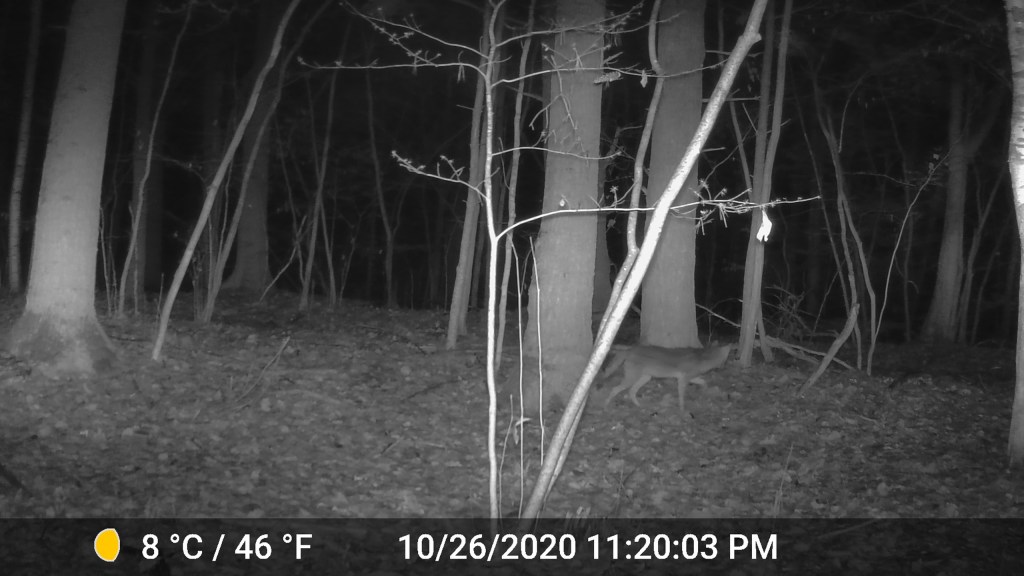
    The young buck appears on the screen for a total of five sequenced pictures. He’s making his way through the woods. I count the points and it appears that’s he’s legal for hunters. I think about him when I hear the guns fire in the distance in the next few days. November is no time to be straying into open woods with a rack. I hope this guy makes it through to see another season, for I’d like to see what he looks like in a year.

    Nearly in the same spot a coyote nested a week before. I wondered if the buck smells the coyote when he walks by. But this time of year scent changes quickly as leaves stack up and the rain washes everything down. Strangely, there’s only the one coyote on the camera. I thought they were social animals, yet here he was alone in the woods. He took a quick nap under this tree on at least two occasions.

    Of course, not everything happens in the night. The wild turkey roam through the scene in large numbers during the day. This is so commonplace now that it hardly warrants a mention, but even now there’s something interesting about watching these large birds. There’s clearly a pecking order in this rafter, coordinating movement through the woods and spooking would-be predators like that coyote.

    I put up the wildlife camera after years of wondering what walked unseen through the woods behind us. I’ve seen plenty over the years from the yard or from an upstairs window, but hearing that bear crunch through the woods last month finally inspired me to get the camera up and running. To find what defies the eyes peering into the darkness. And it hasn’t disappointed. It’s a bit like Christmas morning walking out to see what it picked up every week or two. Isn’t it always interesting to see what the neighbors are up to?

    We had a fire again on Friday night. I could hear something crunching in the woods. Not as loud as the bear, not as stealthy as the deer. I wondered what it might be? This morning I may take a walk out to the camera to see who our visitor was. I’ve come to enjoy solving a good mystery.

  • Beaver Paint and Population Growth

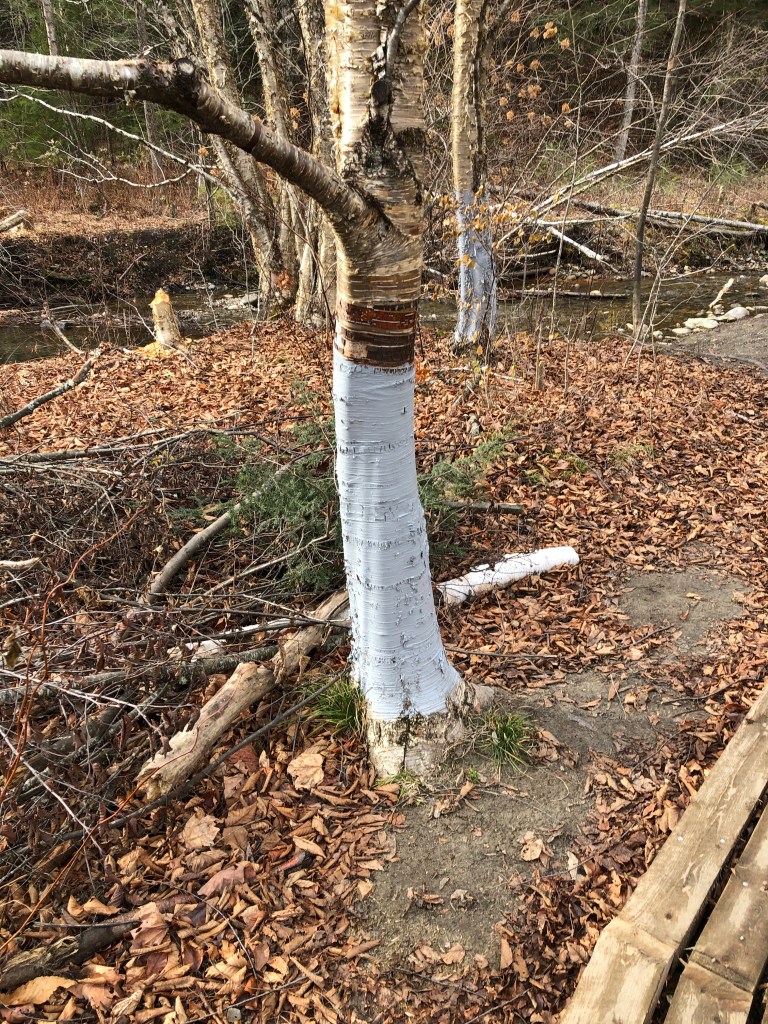
    You know right away when you see it. The trunk of a beech tree painted gray for the first four feet from the ground. But not every tree, just certain designated survivors. The rest are up to the whims of fancy. This is beaver country.

    The paint itself is latex paint, the color doesn’t matter to the beaver, but it does to us. Something that somewhat matches the tree is a nice touch, with enough contrast to recognize from afar that that’s the painted one. But paint alone doesn’t do enough to turn off the beaver, according to the Beaver Institute (!) you’ve got to mix in 20 ounces of mason sand per gallon of latex paint. That makes the bark an unpleasant sandpaper texture that even the hungriest beaver is going to turn their nose at. And in theory that saves the tree.

    Humans and beavers don’t always get along well. They were relentlessly hunted by Native Americans for trade with Europeans in the early 1600’s, and those Daniel Boone hats made a fashion statement even as they kept your head warm and dry. Beaver trappers and hunters wiped out the population in New England and New York over the next couple of centuries.

    According to an interview I read with Ben Goldfarb posted on NENC, there was a time in the early 1900’s when they tried to reintroduce the beaver to New England but simply couldn’t find any active colonies to build off of. They tried New York and they didn’t have enough either. So they acquired some Canadian beavers and some beaver from Yellowstone and relocated twenty of them to New York. Eleven years later they had 15,000 beaver and the population has skyrocketed since. Beavers can have 3-5 kits during the winter months, so that’s some serious beaver mating to achieve that kind of exponential growth.

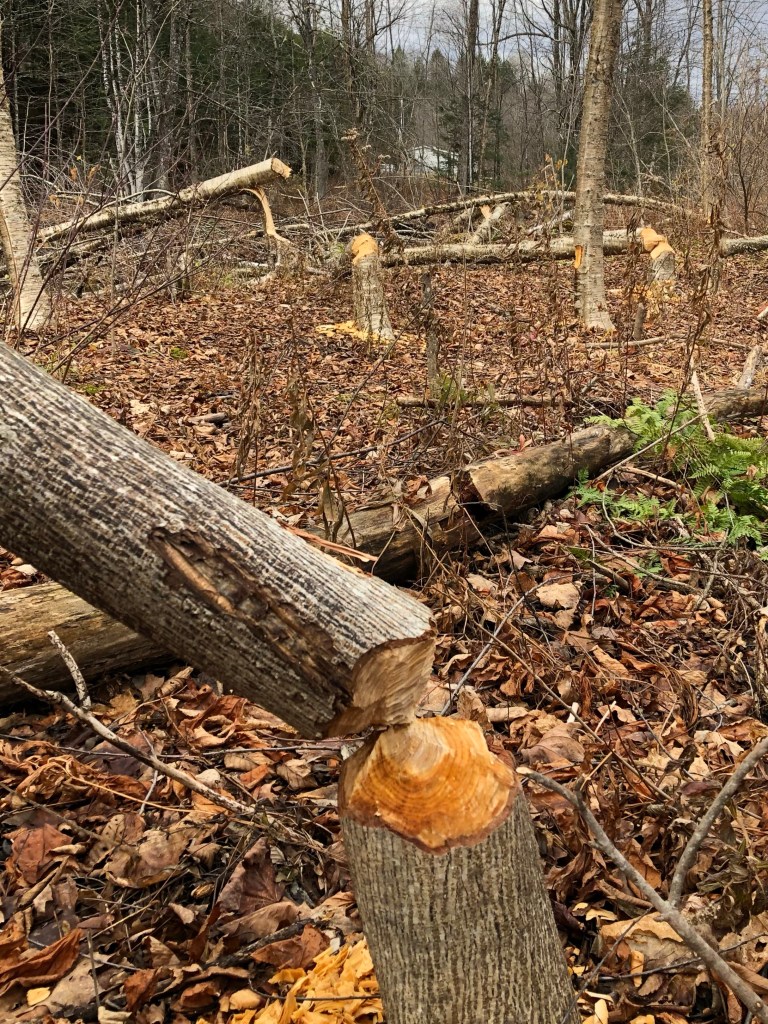
    They don’t just gnaw them down to make nests; this is their food source. Beaver range in size from 30-100 pounds, and they need to eat to keep that beach body. The average beaver eats about 200 trees per year, from saplings to the bigger trees. They prefer aspen, alder, willow and other soft wood deciduous trees. That’s a whole lotta trees. So proactively painting a few with that paint/sand mix is a good way to preserve a few of them while offering up the rest as sacrificial lambs.

    I wondered at this as I walked amongst the trees along the Moss Glen Brook in Vermont over the weekend. The beaver were clearly busy stocking up their food supply for winter, with several downed trees scattered about near the brook. And here amongst them were the designated survivors with gray paint and sand mix. A wonderful curiosity that demonstrated the health of the beaver population in this area. Welcome back.

    Designated Survivor
    Beaver Food
  • A Weekend at The Trapp Family Lodge

    The cow outweighed me by more than 1200 pounds and had long horns protruding menacingly to her right and left, but I edged closer anyway. Bob, the Activities Director at The Trapp Family Lodge, insisted that it was safe to walk out amongst the Highland Cows. He gave us instructions on what to do if they approached us looking for apples (fold your hands into your body and turn slowly away to show you don’t have food). And he told us when one of the cows was annoyed with us. Otherwise, we were turned out to explore the field. Turning around, I realized I was one of the few who took him up on the offer. But risk has its rewards, and being close to the cattle was thrilling.

    Highland Cow

    I’ve been to Stowe, Vermont many times over the years. Mostly I’d drive up for Heady Topper beer, look around a bit and dream of lingering awhile. I’d even stopped to visit the Trapp Family Lodge, walking into the lobby to see what all the fuss was about. Like most Americans I’ve seen The Sound of Music a few dozen times. This wasn’t the Austrian Alps, but you can definitely see why they sank their roots here. The hills are alive in Stowe too.

    The Trapp Family Lodge is a lovely place, with fires roaring and pilsner flowing freely from taps and a quiet elegance without pretense. Pictures of the family decorate the walls throughout the lodge along with art derived from the story of the family’s escape from Nazi Austria. The mountains surround the property in all directions, and the von Trapp family owns much of the land and has donated many more acres to a land trust, ensuring this view would remain largely as it’s always been.

    We’d explored some of that land on our first day at the Lodge, walking the trails to find the Chapel at the top of the hill, and circling back to check out the Kaffeehouse for a snack. There are hiking and snowshoe trails criss-crossing the woods at the resort, and we had plenty of options for getting to know the lay of the land. Mountain bikers had their own single track trails that offered challenging terrain to explore. And wide cross-country skiing trails waited patiently for the snow to arrive. This was an outdoor enthusiast’s paradise. The outdoor hot tub and spa is a great reward for having done the work.

    After meeting the Highland Cows we walked back up the hill to the Lodge, with massive ravens flying about us speaking a sophisticated language of their own. I wondered at the banter, and wished we had more time to get to know them better. But we had other places to explore, and a long hill to walk back up. It seemed the cows were on the furthest pasture from the Lodge, and we had to earn our visit. It worked out to be about a mile each way, and a good way to work off breakfast with a different vantage point.

    We made a quick trip to downtown Stowe to explore the shops and made a stop at The Alchemist to pick up our Heady Topper beer order curbside before returning to the Bierhouse for lunch and a pint. We made a point of saving room in the cooler for some von Trapp beer as well. The Alchemist helped make Stowe the heart of New England IPA country, but the von Trapp’s make a great case for pilsners with their brews. This wasn’t some mass-produced American lager, this was beer with substance.

    Brewing at von Trapp is serious business

    As luck would have it, the woman who seated us was Kristina von Trapp, the granddaughter of Maria and a Director of the resort. She was a gracious host, with a striking presence about her borne of her family celebrity but honed on an active life outdoors and running a successful business. She wasn’t quietly sitting in the corner office looking at spreadsheets, she was hands-on and engaged with the public. And that made the von Trapp experience all the more impressive.

    We resolved to come back here again in the other seasons. Stowe is beautiful year-round, even on a cold November morning when the trees are bare and the snow is just hinting that it might return again. Staying here in all four seasons seems a worthy goal. And it will help keep the refrigerator well-stocked too.

  • Hawks and Squirrels, Bears and Goats

    As the leaves fall the big reveal begins. What exactly have the neighbors across the way been doing all summer with all that building and landscaping? We’ll know soon enough. The golden leaves of fall are quickly conceding to fate and weather, dropping in abundance to coat the ground in a blanket of yellows and reds. And suddenly we see what was screened for months.

    I watched a red-tailed hawk flying rapid spirals up and down a white pine tree, wondering for a moment if it was injured, then recognizing the reality of what was happening. The hawk chased a gray squirrel that was scrambling up, down and around the trunk trying to reach the relative safety of the branches above, but found itself stuck in the long exposed trunk. Its only chance was this spiraling scramble. And this is where the hawk proved to be an expert flyer, keeping pace with the squirrel for what seemed like forever. But suddenly it was over, the hawk flying to a nearby branch, exhausted perhaps, but having the food that would keep it alive to fight another day. I picked my jaw up off the ground and left the hawk to its meal.

    The big reveal brought another surprise. I knew the neighbor’s didn’t have a dog, but caught a glimpse of an animal walking back and forth on their patio. A look over the fence confirmed it was a goat pacing back and forth near the patio door. A text to the neighbor to inform them of the visitor and a visit from Animal Control and the goat’s owner revealed the truth of the matter: this goat was a survivor, having run away from a black bear that’s been breaking into animal pens for a week now killing chickens and goats. Dangerous, unusual behavior for the bear. And the State of New Hampshire has taken notice, setting traps to try to move this dangerous character out of the area.

    And so it is that I finally put a wildlife camera out in the woods, beyond the old stone fence that separates land that I pay taxes on from land that is preserved and funded by all taxpayers. After close encounters with deer, coyotes, fox, opossum, skunks, raccoons, groundhogs, bobcats, fisher cats, snapping turtles, assorted rodents, bear and now a domesticated animal I’ve finally taken the hint. That preservation land is an animal highway between the brook on one side and the larger forest on the other. The land that I pay taxes on was once part of that highway, until I put up a fence to keep the dog from meeting this parade of characters marching by. Having shifted the corridor over to the other side of the wall the least I could do is capture images of the travelers. And I wonder what will we find stored on the memory card? There’s still some time left in 2020, what haven’t we seen yet? Unicorn? Centaurs? Griffons? In this year of years nothing surprises me anymore.