Tag: Windham Rail Trail

  • Return to the Rail Trail

    For the first time since early in the pandemic I decided to take a walk on the Windham Rail Trail after work. I figured at dusk most people would be wrapping up their time on the trail and heading home. I figured wrong. I nodded a greeting to those who made eye contact, ignored those who didn’t, and held my breath many times for the unmasked swarm of humanity that passed by in close proximity unmasked and unconcerned. I’m not a germaphobe, but at this point in the pandemic I’m informed enough to limit such risks whenever possible.

    You notice a lot of things when you walk a trail often: The change of seasons and how that impacts the trail, the increase in traffic, encroaching development, the casual disregard for others by the relative few who dispose of bagged pet waste on the side of the trail, and the ebb and flow of wildlife. My six mile walk was informative. Comparing it to the fall of 2019 at a similar time of day it was much busier, with many more bicyclists than you’d see a year ago. More walkers too, but not exponentially more. No, it was the swarms of bicycles that were noticeable… and notable. Headlines like “Bicycle sales skyrocket during COVID” come to mind. Here is the proof, relentlessly zipping past me one after the other. While I prefer quiet walks, I can’t complain about the benefits of a healthier society overall. Still, I make a mental note to walk the trail in the rain next time.

    Exactly two months ago I did some damage to my right ankle on the descent of the Old Bridle Path from Mount Lafayette. I’ve largely pretended it wasn’t injured and would cinch up my hiking boots tighter during hikes, but I have tried to nurse it back to health. During this walk I was generally pleased with the progress of the ankle and pushed on past Mitchell Pond in hopes of getting a photo or two of the foliage reflecting on water in the late day sun. But with the drought the water has receded far from the rail trail, with muddy pockets and rotting logs replacing the shimmer of water that used to greet me on this stretch of trail. The heavy rain earlier in the week was a welcome relief for the wildlife that relies on this water. A lot more would be welcome. Like many of us, I expect they’re longing for a return to normal.

    My walk was six miles out and back. I was running out of daylight and didn’t want to deal with bicycles speeding along on dark trails. It was nice to get reacquainted with the trail, but it felt a bit less special than at other times. Instead of an intimate conversation with the trail and the wild spaces that it dissects it was more of a shouted exchange in a busy venue:
    “Hey, good to see you again!”
    “Good to see you too!”
    “Can you believe all this?”
    “I know! What a crazy year!”
    “How have you been?”
    “What?!”
    “How have you been?!”
    “What?!”

    Anyway, stay well, we’ll catch up again when its a little less busy.”

    And so I left the trail thinking about how parched it looked and how many people were using it. But I was grateful for having it there for them and for me when we needed it most. We all need to get outside and get more exercise, and rail trails serve as an entry into a safer world away from automobile traffic. Even if I like the trails more when they’re quiet, I still value having a place to go close to home. More utilization means there will be more investment in similar trails in the future. And that’s a win for all of us.
  • Miles of Crunch

    The math adds up, mostly. When you walk 4.25 miles in one direction on a rail trail, you should get the same number coming back in the other direction. Except that I took a couple of detours on the walk north, exploring side paths that I’ve previously marched right by. This wasn’t a timed walk, it was all about being outside, alone with the ice. Well, mostly alone; there were the seven other people I saw, shufflers every one. The iciness of the rail trail made it unsafe for walking without micro spikes strapped into your hiking shoes, but crunchy ease with them.

    That crunchiness. The quiet solitude made the crunch, crunch, crunch of my every step echo off the frozen landscape, and I paused now and then to listen to the stillness I was disrupting with my walk. The crunch was caused by my micro spikes biting into the two inches of frozen carpet atop the rail trail, sprinkled on top with bits of broken ice accretion fallen off the branches above as the trees shrugged off last week’s icy embrace. Snowflakes drifted silently to the ground, not in an accumulating way but in a complete the scene way. I welcomed them and noted their progress along with my own.

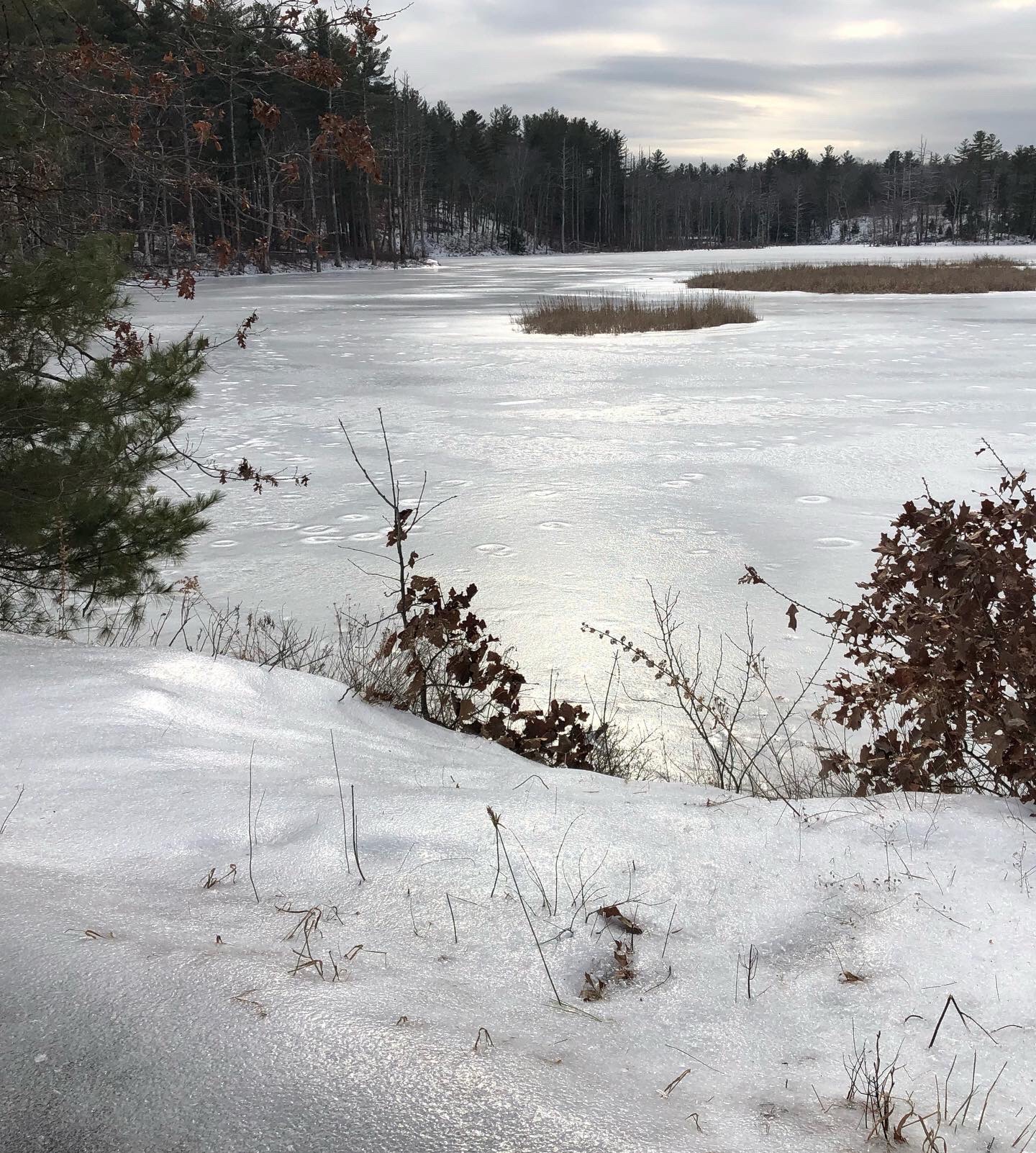
    The ice crunch was my companion the entire afternoon, the chatty hiking partner with a lot to say, but not the only ice talking to me. The ponds on either side of me also spoke, in sustained, low rumbles and pops as the ice sheet on the ponds came alive in the relative warmth of the sun. For those in places where ponds don’t freeze, it’s a fascinating rumble, almost like a serpent is brushing against the icy ceiling, looking for a place to break free. It’s particularly exhilarating when you’re standing out in the middle of that frozen pond, with your body weight adding to the groaning of the ice. These are days when you forget the rest of the madness in the world, and it’s just you and the ice.

    I reached the depot on the north end of my walk, looked around a bit, seeing only two cars in the parking lot and knowing the three people who they belonged to whom I’d see on my return south. And I began the four mile walk back, walking with purpose, focused on getting back in a little more than an hour. That’s a good clip marching on ice, but my meandering was for the northward leg of my walk; it was time to accelerate on the return. Frozen footprints in the ice make fast walking challenging and a bit dangerous in the middle of the rail trail, and getting injured alone two miles from help wouldn’t do at all, but the sides of the trail were generally footprint-free and I made the desired progress. Walking for speed offers a different reward than meandering, this was more workout, less pondering the world. But I made it back to the southern parking lot pleasantly surprised by my speedy pace, finding my car alone in the icy parking lot, patiently waiting for its own chance to move.

    Ice offers its own rewards, if you’ll only look for it. This winter has been uncommonly warm, and the ice was a welcome return to winter for me. A well-prepared walk on a frozen carpet of wonder, surrounded by ice sculptures and rumbling ponds. That’s the February Sunday afternoon I’d been hoping for, an exclamation mark on the weekend and a chance to pivot into the week with a clear head.

    Frozen pond with a lot to say

    Ice sculptures change daily on the trail

    Broken bits of ice accretion sprinkle the landscape. These still show the curve from the branches they hugged

  • Fading Tracks Across Time

    Yesterday morning I stood outside, barefoot, on the deck scanning the woods.  A dozen deer were moving silently through, silhouetted by the sun reflecting off the rapidly melting snow.  Unusually warm weather has created this opportunity to stand barefoot for me, and given the deer access to acorns and other edibles that should be locked into a frozen vault for a couple more months.  The deer don’t worry about climate change, only food and safety, and they graze uninterrupted as I walked back inside.

    Late morning we met friends for a walk on the Windham Rail Trail.  The trail changes every day, and today brought slush mixed with large bare spots.  We discussed using micro-spikes, but they would’ve been overkill on most of the trail, with just one section of about 100 meters testing our decision to leave them in the car.  No, this was a day for water-resistant footwear, good socks and focus on where you stepped next.    The week ahead brings more mild temperatures, and it’s likely this trail will be all pavement by next weekend.

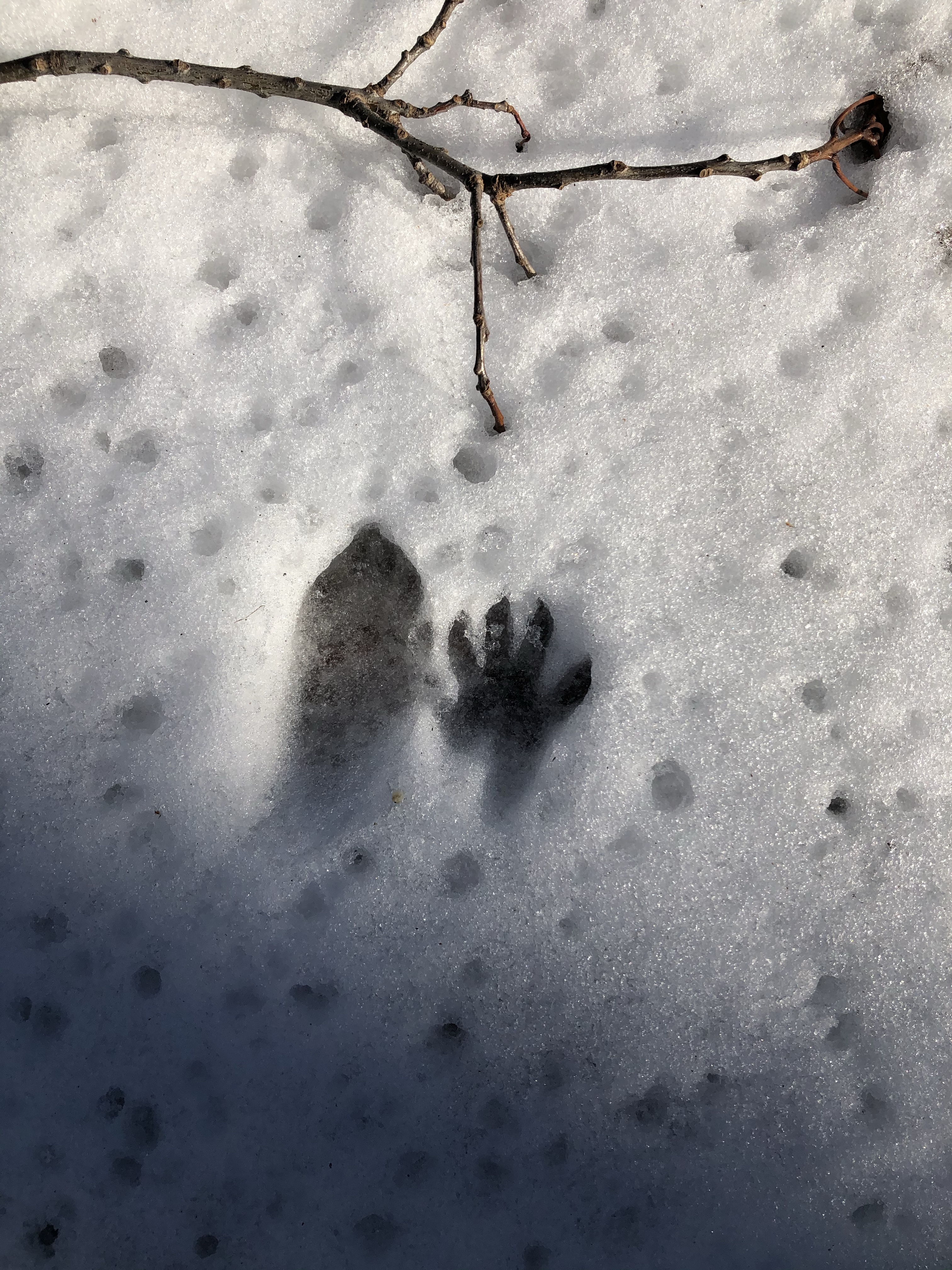
    As usual on this trail, there were many animal tracks crossing this way and that.  Wildlife has their own trail system, but crossing paths with human roads and trails is inevitable.  Deer tracks mixed with turkey, squirrels and the other regulars.  But one set of tracks stood out from the rest; like a small child doing handstands across the snow, beaver tracks punctuated the softening snow.  Their front paws are very defined and human-life.  The back paws are more like a ducks.  The combination convinced me it wasn’t a racoon’s tracks we were looking at.  Beaver don’t hibernate, but they usually aren’t moving about that much this time of year.  Looking around there was no apparent evidence of tree damage from beaver, but we were right next to a pond.  Beaver store their winter food underwater near their nest.  Nest building isn’t a winter activity.  So I wondered what the beaver was traveling through here for.  Visiting friends?  Booty call? Or like me earlier just stepping outside to see what was new in the world?

    Yesterday was a big news day with the death of Kobe Bryant.  Social media and traditional media alike erupted in a flurry of reaction.  It’s a jolt when someone so young and vibrant is killed so abruptly.  Stoicism points out that it could happen to any of us at any moment, so live this moment fully.  So many forget that until a famous person or a loved one shocks the system with a reminder.  Living this moment starts with awareness of everything around you, feeling the changes in the air, seeing the deer moving through the woods, seeing the tracks in the snow, and having an extended conversation with people you care about while you navigate a slushy trail.  Life is now, today, whether it’s a Monday morning or a Friday night.  Bryant, and the other people on that helicopter were taken unexpectedly, tragically, but they were living a full life.  If you aren’t fully alive in this moment, fully aware of the magic around you, are you really living?

    As we left the trail yesterday, our own tracks marched along for 3 1/2 miles in one direction  and back again, covering seven full miles of conversation, observation, exercise and being alive.  Many of those tracks were turning to slushy mush even as we took them, and disappeared with the thousands of other tracks that have walked this path over the years.  Our time here is limited, the memories are made now, so what shall we do with this day before it too disappears?


  • Crunchy Meditation

    There’s nothing like a long walk to sort things out and help you forget about the madness in the world.  Last week New Hampshire received a few inches of heavy, wet snow. Once walked upon, slushy snow becomes a clutter of footprints.  Let it freeze and that snow becomes a crunchy, treacherous mine field.  And such was the state of the Windham Rail Trail on my Sunday walk.  Micro spikes over hiking boots answered most of the challenge, and a little care on where you stepped solved the rest.  A long walk alone became crunchy meditation, with a good workout as a bonus.

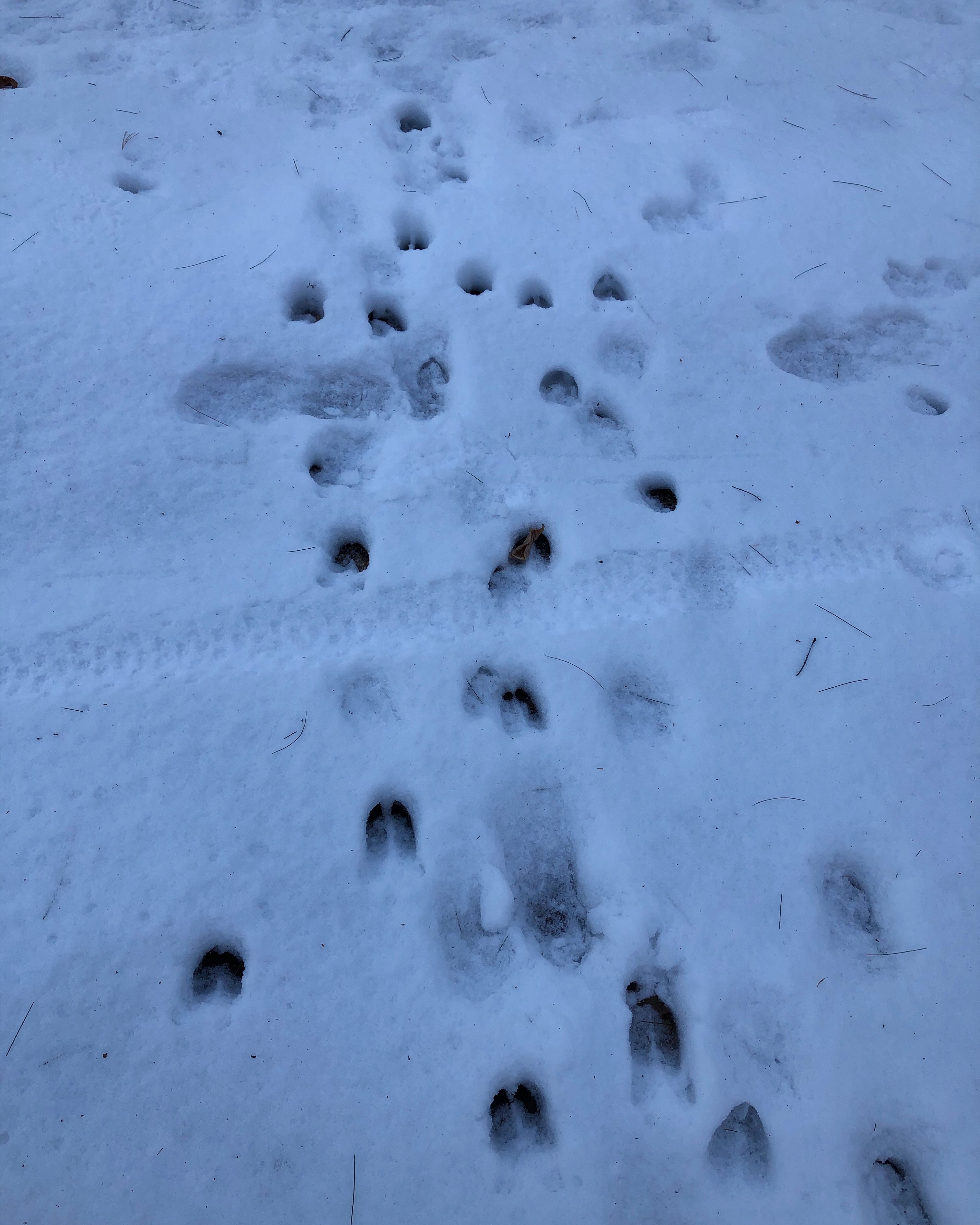
    About three miles into the walk I came across a column of deer tracks crossing perpendicular to the rail trail.  Nothing surprising in that; this is deer country here in Southern New Hampshire after all.  But I found the tracks fascinating anyway.  The deer walked in a line like Native American warriors or Roger’s Rangers would have done when this area was contested frontier.  In the case of warriors and rangers it masks the numbers from the adversary.  I wondered if the deer instinctively mask their numbers or just follow the leader to minimize the calorie burn of moving through snow.  The latter makes sense, doesn’t it? In winter where calories equal survival efficiency in movement means everything.

    For me the goal was just the opposite of the deer: burn as many calories as possible in two hours of walking and be outdoors as an active participant in winter. Mix in a visually interesting trek on rough terrain and this afternoon’s 10,000 (+!) steps scored a high bliss rating. And who doesn’t need more bliss in the short, dark days of January?

  • The Magic Snow Carpet

    Sunday offered the perfect combination of bright sunshine and cold temperatures to be outside. A walk around the block is nice, a walk in the woods is better, but I opted to meet in the middle and picked a rail trail walk. Rail trails are usually paved, and as the name implies they run straight for miles following old railroad beds. The advantage is good footing with much of what a walk in the woods offers. With early snow last week the rail trail was a highway of packed powder extending for miles, a snowmobiler’s dream for sure, and I’m grateful that they groomed the trail for the rest of us.

    The Windham Rail Trail changes with every season. We’re deep into a New Hampshire winter now, even if “winter” doesn’t officially begin until December 21st. Snow came early and lingers with sustained freezing temperatures. Perfect conditions for cross-country skiers and snowshoeing, and I saw a few of each out on the trail. With the packed powder I opted for micro spikes on my boots and never regretted the choice. Walking for miles on packed powder snow is a similar workout to walking on beach sand, with just enough give to increase the workload but not so much that your progress is stalled; 10,000 steps with a little extra effort.

    Today it all changes, with warm temperatures and rain washing away the magic snow carpet I traveled on. By tomorrow night it will be a slushy mess with bare spots. And then Wednesday brings colder temperatures and new snow and a completely different trail will emerge. The old expression about New England weather saying to wait five minutes and it will be completely different applies especially well to the rail trail. I’m happy to have caught it when conditions were perfect, but I suspect I’d have enjoyed it no matter the conditions. To be outside is to accept the world as it comes to you, a perfectly stoic outlook.

  • Time Travel on the Rail Trail

    I took a walk on a local rail trail during a lunch break.  The trail brought solitude occasionally interrupted by fellow walkers, joggers and cyclists. But not really solitude.  There were glimpses of frogs warily looking back at me, chirps of chipmunks announcing “here’s another one.” as I walked by, and a distant hum of traffic in the distance.  But I was alone with my thoughts.  After cutting way back on listening to podcasts and music on most walks and rows, I’ve realized a net benefit in improved creativity.  Everyone has their thing, mine is quiet.

    An acorn stood in the middle of the path, shed of its cap and firmly on its fat end seeking perhaps a bare foot.  But likely hoping for a kick to the grass where it might take root. Asphalt is no place for an acorn with aspirations.  The remains of hundreds of its kin lay massacred on the trail, victims of bicycle tires and shoes alike.  Looking back, I regret not kicking that acorn into the grass.  It might have stood a fighting chance.

    I paused at a wall, built of granite by hand. Dimpled from the stone cutter, lichen and moss-covered from a long watch under a canopy of oak and maple trees.  The wall has stood here for at least 170 years, and aside from a crack or two looks like it could stand for three times that.  If a generation is 30 years, the man that built this wall could well have been my great-great-great-great-great-great grandfather.  I wonder if he thought of that when placing these stones?  Turning back the way I came, I thought the wall could easily stand for another ten generations if left to itself.  Perhaps they’ll stand where I stood today, thinking as I do of those who came before and those who belong to the future.  My moment with the wall was just a glimpse of a time machine passing from then to there, with a brief visit with me along the way.

    That acorn is a time machine as well, waiting to find the right landing place to take root and grow.  It too could outlive all of us.  And a part of me hopes that it does.

  • Ice Sculptures

    Winter in New England brings an endless cycle of freezing and thawing.  This morning we got heavy wet snow.  Today it has warmed up and much of the snow is melting.  Tonight brings bitter cold and water will re-freeze.  This constant cycle brings frustration to those who are ready for spring, but it also brings ice sculptures to the landscape.

    This is most apparent wherever water flows over a surface and down.  The blasted ledge along the side of the highways is a great spot to see ice sculptures as you drive by.  Quarries, rail trails and nature rock outcroppings are other options for seeing ice sculptures.  And of course waterfalls offer a daily transformation as water flows and freezes.  Icicles hanging off rooftops are another source of ice sculpture inspiration.

    Sunday we walked the Windham Rail Trail again.  It was transformed by ice and snow from the previous time we’d walked it a couple of months ago.  Part of that transformation is the ice flows coming off the blasted ledge on the north side of the trail, which formed spectacular ice sculptures.  It’s one of the joys of winter, if you only look for it.

  • Rail Trails

    Rail Trails

    Today I took an eight mile walk on the Windham Rail Trail with my wife.  The trail segment is four miles long and cuts through ledge and over low areas that were built up to level the rail bed.  This section of railroad was originally opened in 1849 and stopped running in the 1970’s.  At the time the technology was by far the most efficient mode of travel, and in some cases it still is.  That efficiency made it worthwhile to undertake the massive manpower project that was the laying of this rail bed.  Just the blasting and moving of ledge must have been a massive project.  Add in miles of building up low areas to that and it must have been backbreaking work.

    Today the trains are gone, replaced by power walkers, joggers, families on bicycles and dog walkers. The occasional house peaks through the trees, but for the most part you’re out in the woods, and it feels like a world away from the strip malls of Route 28.  The highlights of this trail are the long cuts through granite ledge, the water views of Flatrock Brook and Mitchell Pond, and the ghosts of the working railroad that still exist in the quiet forest.  Railroad ties stacked on the side of the trail are slowly returning to the earth as moss and wood rot eat away at the timber.  Walls made from the ledge kept a hill from creeping onto the railroad bed for decades, and now serve that purpose for the trail.

    The segment of rail trail that we walked on was once part of the Manchester and Lawrence Branch.  Eventually Boston & Maine picked up this segment in 1887, but eventually the entire branch was abandoned.  Nonprofit corporations were formed to raise funds for paving and maintaining the segments.  Today there’s a great stretch of paved rail bed from Methuen, Massachusetts all the way up into Derry, New Hampshire.

    Rail trails are popping up everywhere.  Candidly I rarely think to use them, and wish I’d done so years before.  I remember walking along old railroad beds long abandoned in other parts of New Hampshire and Massachusetts.  Re-purposing those beds into rail trails is a great way to make open space accessible for everyone.  The stretch in Windham is a beautiful example of that and that’s opened my eyes to the opportunity to explore more of these trails.